Executive Overview
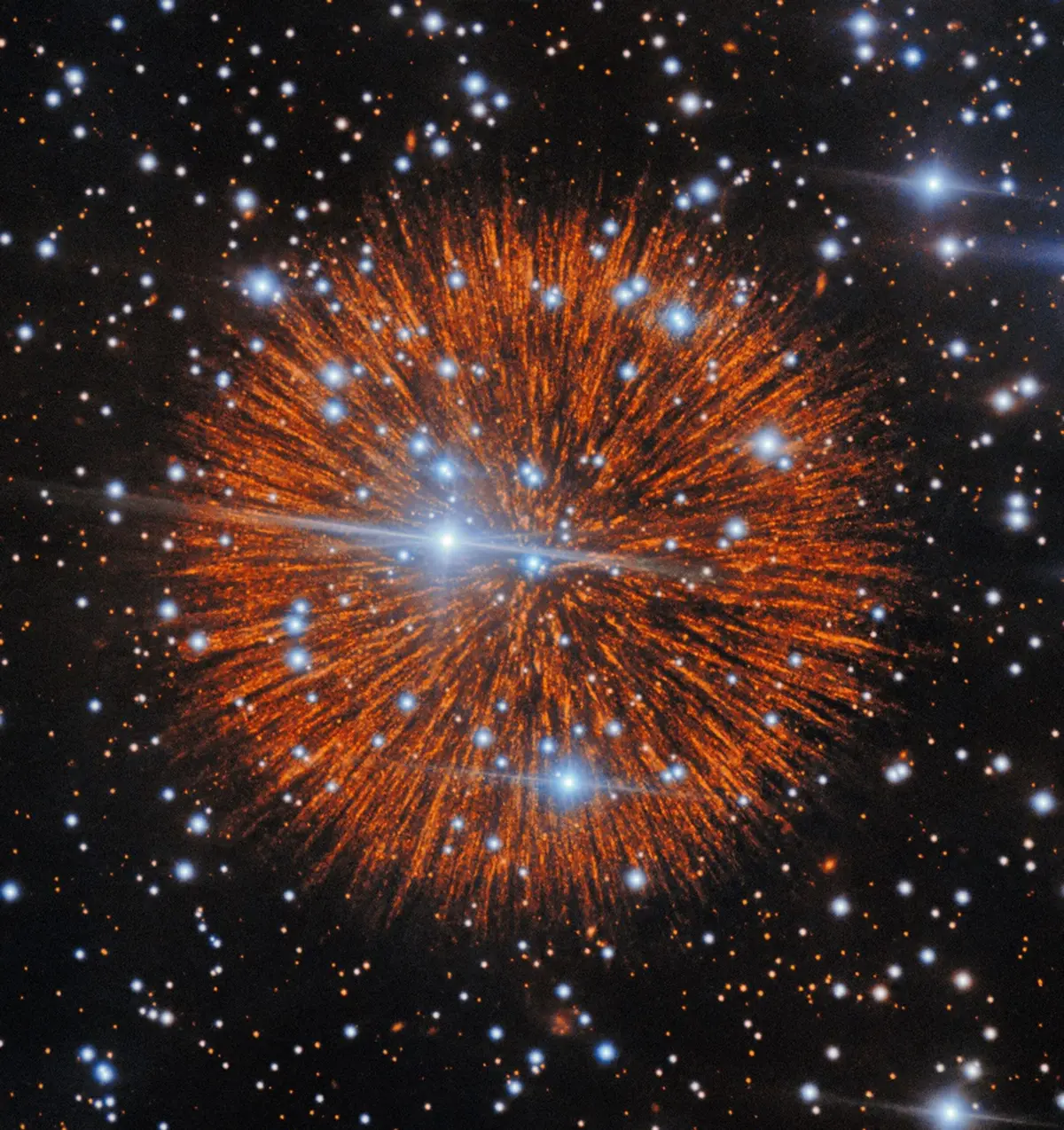
In a milestone achievement for observational astronomy, an international team of researchers has captured the most detailed, high-resolution image to date of the Pa 30 nebula. This celestial structure is the long-sought remnant of a historic supernova—an immense stellar explosion famously documented by stargazers on Earth during the Middle Ages. Leveraging the formidable capabilities of the Gemini North telescope in Hawaii, astronomers have unveiled a breathtaking, intricate architecture hidden within the debris field.
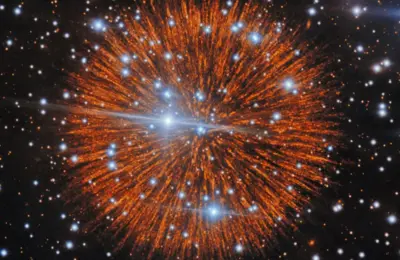
For years, standard imagery of Pa 30 revealed a hazy, spherical expansion of long, filament-like strands of matter, which collectively evoke the striking visual of a frozen firework or a glowing dandelion floating in the vacuum of space. However, the latest observations deliver a tenfold increase in structural clarity. This massive leap in resolution has shattered previous assumptions about the nature of the nebula’s debris. The filaments are no longer understood as continuous, unbroken streams of plasma; instead, they resolve into a precise, repeating pattern akin to beads on a string—composed of pearl-like knots of gas of remarkably uniform dimensions.
These newly dubbed "cosmic pearls" present a compelling cosmic paradox. While astronomers anticipated that the chaotic, high-energy aftermath of a supernova would yield irregular, jagged, and unpredictable distributions of ejected matter, Pa 30 exhibits an astonishing degree of geometric order. Each individual knot spans roughly four light-days in diameter, a scale so immense that the entire planetary region of our solar system could fit comfortably inside a single knot nearly ten times over, with ample room to spare.
Published recently in The Astrophysical Journal, these findings offer a profound new dataset for astrophysicists attempting to decode the complex physics of stellar death. The unexpected regularity of these colossal gas pearls challenges existing theoretical models of supernova remnants, prompting a wholesale reevaluation of how matter behaves, condenses, and organizes itself in the immediate wake of a cosmic cataclysm.
Detailed Chronology: From Medieval Stargazers to Modern Telescopes
To fully appreciate the significance of the Gemini North observations, one must retrace a timeline that spans nearly a millennium, bridging the gap between ancient observational records and cutting-edge optical engineering.
The Medieval Transient (1181 CE)
The story of Pa 30 begins in the late 12th century. Historical chronicles from China and Japan meticulously recorded the sudden appearance of a "guest star" in the night sky. For approximately six months in the year 1181 CE, this mysterious stellar candle shone brightly, visible to the naked eye without the aid of modern instruments. For centuries, this transient event remained a footnote in ancient archives—an intriguing historical anomaly cataloged alongside comets and eclipses.
The Modern Quest for the Remnant
For generations, modern astronomers searched the night sky for the physical ghost of the 1181 event. Pinpointing the exact remnant proved exceptionally difficult because historical coordinates were imprecise, and the remnants of ancient supernovae fade dramatically over centuries. It was not until relatively recently that astronomers definitively linked the historical supernova of 1181 to the faint, peculiar nebula designated as Pa 30. Unlike typical supernova remnants that expand uniformly into wide, diffuse clouds, Pa 30 presented a remarkably compact, high-speed outflow centered around a rare, ultra-hot zombie star—specifically, a surviving white dwarf born from the merger of two carbon-oxygen white dwarfs (a rare Type Iax supernova event).
The Evolution of Imaging Technology
Initial modern observations of Pa 30 confirmed its unique morphology: a central white dwarf powering an expanding sphere of stellar debris resembling a firework display. Yet, these earlier images, captured by space-based observatories and smaller ground-based telescopes, were limited by atmospheric distortion and resolution thresholds. The filaments appeared as smooth, continuous streaks of gas radiating outward from the central engine.
The Gemini North Breakthrough
The turning point arrived when researchers turned the Gemini North telescope—situated near the summit of Mauna Kea in Hawaii and operated by the International Gemini Observatory, a program of NSF’s NOIRLab—toward the nebula. Utilizing the Gemini Multi-Object Spectrograph, the research team pushed the boundaries of ground-based imaging. By capturing the faint emissions of the expanding ejecta with unprecedented fidelity, the telescope cut through cosmic dust and distance to resolve the true substructure of the nebula. What once appeared as solid lines of light instantly dissolved into the mesmerizing, bead-like chain of cosmic pearls that now commands the attention of the global astrophysical community.
Supporting Context & Metrics: Unpacking the Scale of Pa 30
The sheer physical scale of the Pa 30 nebula and its newly discovered components borders on the incomprehensible. To contextualize these findings, it is helpful to examine the precise metrics and environmental conditions governing this stellar graveyard.
Dimensions of the "Cosmic Pearls"
According to the published study, each individual knot within the filamentary network measures approximately four light-days in diameter. To put this into perspective:
- One light-day is roughly 17.3 billion miles (27.8 billion kilometers).
- A four-light-day diameter equates to roughly 69.2 billion miles across for a single knot.
- Dr. Ilaria Caiazzo, a coauthor of the study, noted that the entire planetary system of our sun—stretching from the inner rocky planets, past the gas giants, and out through the Kuiper Belt—could fit inside a single one of these gas pearls roughly 10 times over with room to spare.
Structural Uniformity and Order
In astrophysics, supernovae are generally characterized by extreme violence and asymmetry. When a star explodes, shockwaves ripple through space at thousands of kilometers per second, shredding the stellar envelope and hurling plasma outward in chaotic plumes. Standard hydrodynamic models predict that the resulting debris field should feature clumpy, jagged, and highly irregular distributions of matter driven by Rayleigh-Taylor instabilities and turbulence.

Pa 30 defies these expectations. The pearls are:
- Remarkably Uniform in Size: Unlike typical clumps of supernova debris, which vary wildly based on local density fluctuations during the explosion, these knots maintain a strikingly consistent scale across different filaments.
- Geometrically Aligned: The pearls do not float randomly; they are meticulously strung along the radial filaments like beads on a necklace, extending outward from the central remnant star.
The Central Engine
The engine driving this magnificent structure is equally fascinating. Situated at the exact heart of the Pa 30 nebula is a rare star classified as a progenitor of a Type Iax supernova. Scientists believe this explosion occurred when two white dwarf stars spiraled inward and merged, rather than undergoing the complete, catastrophic detonation seen in standard thermonuclear (Type Ia) supernovae. This "failed" or sub-luminous supernova left behind a zombie white dwarf star that continues to emit powerful stellar winds, interacting with the expanding shell of gas and shaping the intricate morphology observed today.
Official Statements and Expert Analysis
The unexpected revelation of the bead-like structures has sparked intense discussion and excitement across the astronomical community. Researchers involved in the study have shared their perspectives on what these findings mean for the broader field of stellar evolution.
Dr. Ilaria Caiazzo, coauthor of the research paper published in The Astrophysical Journal, emphasized both the scale and the theoretical puzzle presented by the new imagery:
"The planetary region of our solar system could fit in each knot about 10 times with room to spare. The knots are quite strikingly uniform. We are excited to try to model them."
The regularity of the knots has forced theorists to reconsider the physical mechanisms at play during the dying moments of binary star systems. Traditional hydrodynamic modeling will need to be updated to account for how continuous or pulsed ejections from a merged white dwarf can freeze-frame into such precise, bead-like configurations.
Representatives from the International Gemini Observatory and NOIRLab highlighted the instrumental prowess required to achieve such a breakthrough. By combining advanced adaptive optics techniques with the raw light-gathering power of the 8.1-meter Gemini North mirror, astronomers were able to resolve features that remained hidden from view for decades. This achievement underscores the enduring value of ground-based observatories equipped with modern spectrographic instrumentation in advancing our understanding of the cosmos.
Future Outlook: The Road Ahead for Stellar Remnant Research
The publication of the Gemini North imagery marks the beginning of a new chapter in the study of Pa 30, rather than its conclusion. Armed with this high-resolution baseline, astronomers have outlined several key pathways for future research.
Advanced Hydrodynamic Modeling
The immediate priority for the research team is the development of sophisticated computer simulations. Theorists must now construct three-dimensional models that can replicate the formation of four-light-day gas knots along expanding radial filaments. These models will test various hypotheses regarding magnetic fields, thermal instabilities, and the periodic pulses of stellar wind emitted by the central white dwarf. By tweaking variables in the simulation until they match the observed "pearls on a string" morphology, scientists hope to isolate the exact physical trigger that enforces such strict geometric order.
Multi-Wavelength and Spectroscopic Follow-Ups
To gain a comprehensive view of the nebula’s dynamics, researchers plan to complement the optical data gathered by Gemini North with observations across other wavelengths. X-ray telescopes, such as NASA’s Chandra X-ray Observatory, will be deployed to probe the hot gas and high-energy particle interactions occurring near the core. Meanwhile, radio telescopes can map the distribution of cooler molecular gas and dust, providing a multi-layered profile of the supernova’s aftermath.
Expanding the Search to Other Nebulae
Pa 30 is a rare specimen, but it may not be entirely unique. With the techniques and spatial resolutions proven effective on this historic remnant, astronomers are now turning their attention toward other unusual planetary nebulae and supernova remnants suspected of harboring similar hidden structures. Discovering comparable bead-like formations in other systems would indicate that Pa 30 is an example of a broader, previously unrecognized class of stellar death mechanics.
Ultimately, the ghostly remnants of the 1181 supernova continue to rewrite our textbooks nearly a thousand years after medieval skywatchers first caught sight of its initial flash. As technology advances and human ingenuity reaches further into the dark, even the ancient ashes of dead stars reveal new layers of astonishing beauty and mathematical precision.