Executive Overview
In a monumental stride for open science and interplanetary exploration, NASA has officially released approximately 800 gigabytes of pristine scientific data gathered during the historic Artemis II mission. This unprecedented public archive represents a watershed moment: it is the first set of planetary science data obtained outside of Earth, and directly by human hands, in over half a century. Not since the final voyages of the Apollo program has humanity possessed such a rich, human-curated trove of information originating directly from the lunar environment.
The newly unleashed digital compendium—hovering near the one-terabyte threshold—includes 11,000 full-resolution images and videos, 8.5 hours of real-time spoken observations, meticulous handwritten notes, verified transcripts, and high-definition photographs captured directly from the onboard cameras of the Orion spacecraft. While meticulously engineered for the global scientific community, the raw materials and user-friendly summaries are entirely open to the public, inviting space enthusiasts, amateur astronomers, and academic researchers alike to peer over the shoulders of NASA’s astronauts.
Alongside this massive data dump, NASA has published three definitive foundational documents: the Artemis II Preliminary Lunar Science Report, the Artemis II Lunar Science Operations Report, and the Artemis II Lunar Science Data User Guide. Together, these assets provide both the raw telemetry and the contextual scaffolding necessary to decode humanity’s return to the lunar frontier. Early analyses of this information are already bearing fruit, yielding breakthrough insights into meteoroid impact rates and offering vital navigational data for the upcoming establishment of a permanent human base at the lunar South Pole.
Detailed Chronology: From the Far Side and Back
To fully grasp the magnitude of this data release, one must look back at the trajectory of the Artemis II mission itself. As the first crewed spacecraft to journey into the vicinity of the moon in five decades, Artemis II served as the ultimate stress test for NASA’s Space Launch System (SLS) and the Orion capsule. While the mission did not land humans on the lunar surface—saving that historic milestone for Artemis III—it brought a crew of elite astronauts deep into cislunar space, looping around the far side of the moon and offering a human perspective on our celestial neighbor that modern generations have only ever witnessed through automated probes.
The Flight and the Capture
During their passage, the Artemis II crew acted as active planetary scientists. They were not merely passengers enduring the crushing g-forces of deep-space transit; they were keen observers tasked with documenting the nuances of the lunar landscape. Armed with specialized handheld optics and automated payload systems, the astronauts recorded 8.5 hours of continuous spoken observations. They captured high-resolution imagery of the lunar terminator—the dynamic, razor-thin boundary dividing lunar day and night—where long, dramatic shadows obscure craters and elevate ridges into stark relief.
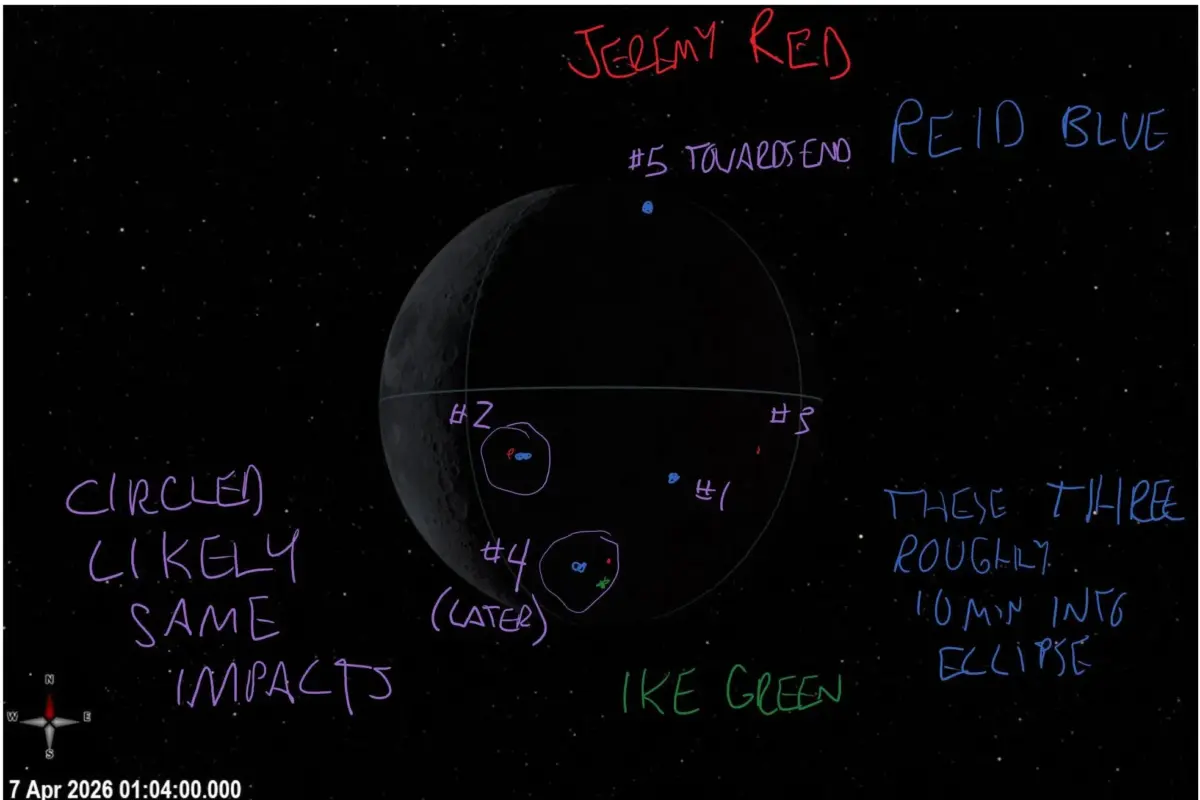
Furthermore, the mission coincided with a rare 54-minute lunar eclipse experienced from the spacecraft’s vantage point. During this darkened window, the astronauts maintained a vigil, documenting transient phenomena that would otherwise go unnoticed by automated orbiters.
Processing and Curating the Cosmos
Upon the crew’s triumphant return to Earth, NASA’s planetary scientists inherited an overwhelming deluge of telemetry, imagery, and audio files. Rather than restricting this archive behind institutional paywalls or delaying release until academic papers could be peer-reviewed, the space agency opted for radical transparency. Over the months following the flight, teams meticulously scrubbed, calibrated, and cataloged the 800 gigabytes of data, matching raw sensor outputs with human audio transcripts, time codes, and annotated notes.
The result is a meticulously structured digital ecosystem hosted primarily within NASA’s Planetary Data System (PDS), ensuring that historians, geologists, and engineers can trace every single data point back to the exact second it was recorded by human eyes and machine sensors alike.
Supporting Context & Metrics: Breaking Down the 800-Gigabyte Archive
Understanding the sheer scale of the Artemis II data release requires a granular look at the metrics and the diverse scientific disciplines poised to leverage this windfall. The archive is not a monolith; it is a meticulously organized matrix of human experience and hard telemetry designed to fuel decades of academic research.
Archive Metrics at a Glance
- Total Storage Volume: ~800 Gigabytes (approaching 1 Terabyte of raw and processed files).
- Visual Assets: 11,000+ full-resolution images and high-definition video files captured from Orion capsule cameras.
- Audio Documentation: 8.5 hours of spoken crew observations, operational chatter, and environmental notes.
- Core Documentation: Three comprehensive mission and science operations reports, paired with an exhaustive Data User Guide.
- Primary Repository: NASA’s Planetary Data System (Geosciences Node at Washington University in St. Louis, alongside JPL’s imaging toolsets).
Multidisciplinary Applications
The data has been structured to feed several distinct branches of space science and engineering:
- Planetary Geology: Geologists are utilizing the high-resolution imagery of the lunar regolith to analyze surface weathering, mineralogical shifts, and structural variances across different lunar terranes. By comparing these human-captured images with legacy composition maps from older orbiters, researchers can construct far more accurate 3D models of the lunar crust.
- Heliophysics & Space Weather: The timing of the mission—including observations taken during the solar eclipse phase—provides heliophysicists with unique data regarding how unfiltered solar radiation and cosmic rays interact with the lunar exosphere in the absence of a substantial magnetic field.
- Meteoroid Impact Science: Perhaps the most immediately actionable data set involves the detection of transient kinetic events. Initial reviews of the mission logs confirmed the observation of five distinct meteoroid impacts on the lunar surface during the 54-minute eclipse window.
- Telecommunications & Remote Sensing Engineers: The telemetry logs detailing communication degradation, signal bounce off the lunar far side, and optical sensor performance under extreme thermal gradients provide invaluable benchmarks for designing next-generation deep space communication relays.
Official Statements and Academic Insights
The release of the Artemis II data package was accompanied by extensive documentation and briefings from NASA leadership and principal investigators, emphasizing both the historical weight and the practical utility of the mission.
"We are looking at a paradigm shift in how planetary science is conducted," noted a senior NASA science directorate spokesperson during the release briefing. "For over fifty years, our understanding of the deep lunar environment has been mediated almost exclusively by robotic proxies—orbiters, impactors, and uncrewed landers. While those instruments are invaluable, they lack human intuition. By putting trained astronauts back into the cislunar environment and capturing their real-time observations alongside petabytes of sensor data, we have bridged the gap between raw telemetry and human context."
The published reports—specifically the Artemis II Preliminary Lunar Science Report—elaborate on the unexpected richness of the data collected near the lunar terminator. According to the mission’s lead operational scientists, the visual data captured when the sun sat low on the lunar horizon revealed micro-topographical features that previously vanished in the washed-out glare of high-noon lighting conditions.
Furthermore, academic researchers across international institutions have praised the accessibility of the PDS archive. Dr. Elena Vance, a planetary geologist specializing in impact mechanics, remarked on the significance of the meteoroid detection data:
"Recording five localized impacts in real time during a single eclipse window gives us a statistical anchor we haven’t had before. When we calculate the flux of centimeter-sized debris hitting the moon, we aren’t just doing abstract astrophysics—we are calculating the exact armor plating required to keep future astronauts alive on the surface."
For the public and space enthusiasts, NASA has deliberately lowered the barrier to entry. While the raw files demand specialized software and rigorous technical know-how, the agency has curated an accessible subset of annotated photographs and audio transcripts. Users can listen to the raw, unedited awe in the astronauts’ voices as they pass over the rugged, crater-scarred terrain of the lunar far side, grounding the high-tech mission in a deeply human experience.
Future Outlook: Paving the Way for Artemis III and Lunar South Pole Bases
The true value of the Artemis II data archive lies not in looking backward at what was achieved, but in constructing a safe, viable pathway for what comes next. As NASA and its international partners pivot toward the impending Artemis III mission—which aims to return humans to the lunar surface—the insights extracted from these 800 gigabytes will serve as mission-critical parameters.
Conquering the Challenges of the Lunar South Pole
NASA’s long-term objective is no longer merely visiting the moon, but establishing a sustainable, semi-permanent human presence. The chosen site for this endeavor is the lunar South Pole, a region characterized by permanent shadows, extreme thermal differentials, and unique geological formations.
The high-resolution imagery of the lunar terminator captured during Artemis II is already proving indispensable for this phase. Navigating the South Pole requires operating in conditions where the sun never rises high above the horizon, casting elongated, pitch-black shadows that conceal treacherous boulders, steep crater walls, and unstable slopes. By studying how visibility and terrain textures shift under low-angle sunlight in the Artemis II imagery, mission planners can better train astronauts to identify visual landmarks, judge distances, and avoid navigational hazards.
Mitigating Impact Risks
Moreover, the precise quantification of meteoroid impacts recorded during the mission’s eclipse phase directly informs habitat architecture and spacesuit design. Centimeter-sized space debris and micrometeoroids travel at hypervelocities; without an atmosphere to burn them up, they strike the lunar surface with devastating kinetic energy. The empirical data on impact frequency gathered by the Artemis II crew allows engineers to refine risk models, ensuring that habitats, rovers, and extravehicular activity (EVA) suits deployed during future missions possess adequate shielding.
A Blueprint for Open Science
Finally, the release of this massive dataset sets a powerful precedent for future crewed deep-space missions. As humanity casts its gaze beyond the moon toward Mars and the outer solar system, the demand for open, collaborative, and rapidly deployed scientific data will only intensify. By democratizing access to the Artemis II archive, NASA has ensured that the burden—and the glory—of interpreting the cosmos does not rest solely within government laboratories, but is shared by a global community of thinkers, dreamers, and scientists.
As researchers worldwide begin unpacking the terabytes of audio, imagery, and telemetry, one thing is certain: the second space age has officially begun, and its foundation has been laid wide open for all to see.