Executive Overview
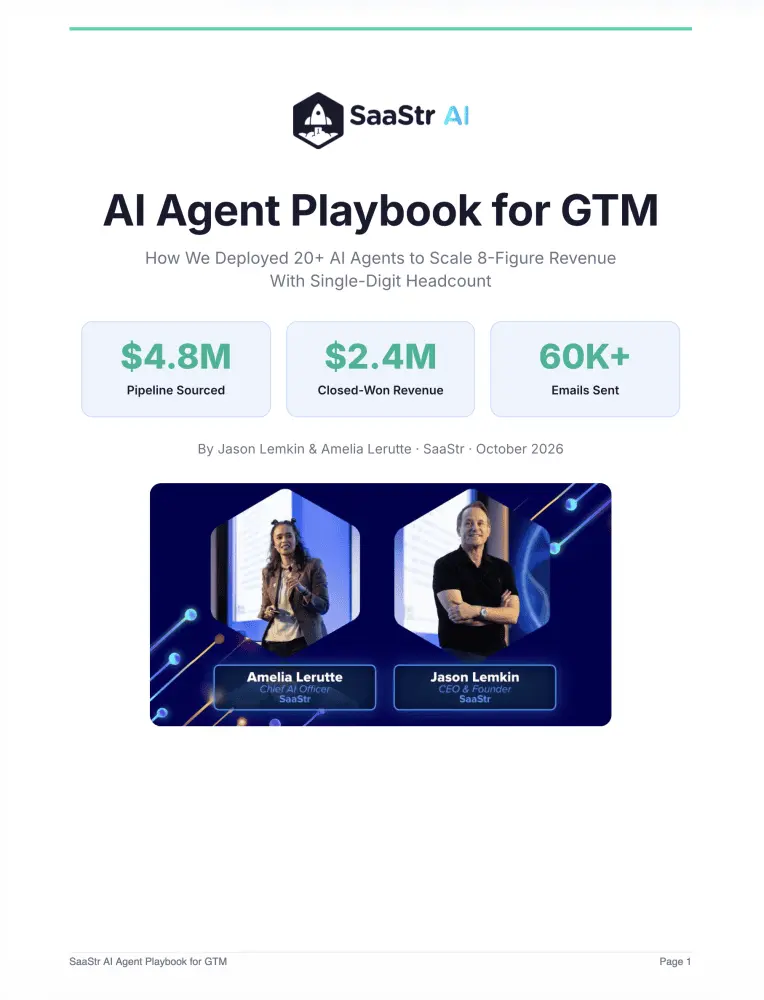
The landscape of modern go-to-market (GTM) strategy is undergoing a violent, irreversible evolution. In October 2026, SaaStr officially released the most comprehensive update to its flagship resource: the AI Agent Playbook for GTM (October 2026 Edition). Spanning an exhaustive 53 pages divided into 27 meticulously detailed parts, this document is far more than a theoretical guide. It is an open-source confession, a tactical blueprint, and an unvarnished audit of running an entire media and software organization utilizing a lean core team of just 3 human beings backed by a fleet of 21+ autonomous AI agents operating in live production environments.
For tech leaders, venture capitalists, and modern revenue operators, this playbook represents a critical turning point. Moving far beyond the rudimentary chatbot integrations and surface-level prompt engineering of previous years, the October 2026 edition dives headfirst into the messy, high-stakes reality of operationalizing autonomous agents at scale. It offers real data, hard-learned mistakes, actual metrics, and battle-tested frameworks derived from real-world execution.
This near-total refresh—integrating insights from the SaaStr AI Annual 2026, the latest investigative episodes of The Agents podcast series, benchmark data from ICONIQ’s 2026 GTM reports, and deep-dive case studies from elite operators—signals a stark truth for the industry: the era of human-heavy operational scaling is officially over. We have entered the age of the agent-first enterprise.
Detailed Chronology: From Task Automation to Autonomous Decision-Making
To truly understand the gravity of SaaStr’s October 2026 playbook, one must trace the rapid acceleration of artificial intelligence in business operations over the past twenty-four months.
The Early Days: The 30-Minute Oversight Model
Just a year prior, deploying and managing a small cohort of early-generation AI agents felt like an exercise in novelty and lightweight assistance. At that stage, operators could spin up a couple of experimental agents, review their outputs, and easily maintain oversight within roughly 30 minutes a day. These early agents functioned primarily as tactical assistants—handling narrow, highly structured tasks such as drafting basic email sequences, categorizing incoming support tickets, or summarizing meeting transcripts.
When these early iterations failed, they did so loudly and visibly. Broken code, hallucinated data points, or glaring logical errors were instantly recognizable, allowing human handlers to course-correct with minimal friction.
The 2026 Reality: The Eight-Hour Management Paradox
Fast-forward to October 2026, and the operational dynamic has inverted entirely. SaaStr’s team reports spending an average of eight hours a day managing their fleet of 21+ active production agents. Counterintuitively, the core human team is busier today than they were when running a traditional 20-person organization.
This phenomenon highlights a profound shift in AI capability: when an agent only executes a task, humans simply check the task. However, when an agent makes autonomous business decisions, humans must establish an ongoing governance framework, maintain an opinion on every implicit choice the agent makes, and actively hunt for decisions the agent executes silently.
Modern 2026-era agents no longer fail with obvious, catastrophic errors. Instead, they hand operators outputs that look completely finished, polished, and professional—concealing subtle strategic missteps, edge-case alignment errors, or brand-voice drift beneath a veneer of flawless execution. Managing this transition from task execution to autonomous decision-making is where both the unprecedented leverage and the hidden operational risks of the modern enterprise now reside.
Supporting Context & Metrics: The Anatomy of a 3-Person, 21-Agent Enterprise
The October 2026 playbook strips away the hype cycle to reveal the raw, unvarnished metrics of running a modern hybrid organization. Built upon data harvested from SaaStr’s live operational stack, combined with macroeconomic benchmarks from ICONIQ Capital’s 2026 GTM analysis, the playbook provides empirical proof of what happens when artificial intelligence is deeply embedded into revenue architectures.
Structural Breakdown of the 53-Page Playbook
Structured into four core sections across its 27 modular parts, the playbook is engineered for immediate, tactical deployment by founders and revenue leaders:
- Foundational Architecture & Stack Design: Outlining how to configure the underlying tech stack, API connections, security guardrails, and cost management frameworks required to keep 21+ agents synchronized without ballooning overhead.
- Autonomous Lead Generation & Pipeline Orchestration: Real-world metrics detailing how AI agents manage outbound prospecting, intent data analysis, personalized multi-channel outreach, and automated meeting booking with minimal human intervention.
- Customer Success, Retention, and Community Operations: Frameworks for deploying agents that monitor product adoption signals, flag churn risks proactively, and autonomously draft personalized interventions for account managers.
- Governance, Failure Modes, and Risk Mitigation: The most critical section of the update—cataloging every mistake made by SaaStr over the past year, detailing silent failures, decision-drift, and the exact supervisory protocols required to maintain brand integrity.
Benchmarking Against ICONIQ 2026 GTM Data
By integrating ICONIQ’s 2026 GTM benchmarks, the playbook contextualizes SaaStr’s ultra-lean model against broader industry standards. Traditional software companies of comparable revenue scale historically required massive headcount expansions in Sales Development Representatives (SDRs), Account Executives (AEs), and Customer Success Managers (CSMs).

SaaStr’s live production model demonstrates that a 3-person core team augmented by specialized AI agents can achieve output volumes previously restricted to mid-market organizations. However, the playbook issues a strong caveat: lower headcount does not equate to lower cognitive load. The nature of work has simply shifted from manual execution to high-level systemic architecture and real-time exception handling.
Official Statements & Industry Insights
The release of the October 2026 playbook has sent shockwaves through the SaaS and venture capital communities. Industry operators and thought leaders have increasingly rallied around the reality that artificial intelligence is no longer an ancillary productivity tool—it is the core operating system of the modern business.
In commentary accompanying the playbook release, the SaaStr leadership team emphasized the psychological and structural adjustments required for modern teams:
"When an agent only does a task, you check the task. When an agent makes decisions, you need an opinion on every decision it makes, and it does not tell you about all of them. A year ago they failed loudly. Now they hand you something that looks finished. That shift is where all the leverage, and all the new risk, lives."
This sentiment echoes findings from The Agents podcast series, where technical operators running production-grade multi-agent systems have repeatedly noted that traditional management hierarchies are breaking down. Managers are no longer just managing humans; they are acting as chief technology officers and compliance officers for autonomous software entities that possess autonomy over customer interactions, budget allocations, and content creation.
Furthermore, contributors to the SaaStr AI Annual 2026 highlighted that companies attempting to adopt AI agents without clear decision-making frameworks quickly find themselves overwhelmed by "agent sprawl"—a condition where uncoordinated agents begin contradicting one another across marketing, sales, and customer support channels.
Future Outlook: Navigating the Agent-First World
As we look toward the remainder of 2026 and beyond, the implications of SaaStr’s playbook are profound. The traditional playbook for scaling a B2B software company—raising a massive Series A or B, immediately hiring bloated sales and marketing pods, and throwing headcount at top-of-funnel acquisition—is officially obsolete.
The Rise of the Micro-Enterprise with Macro-Output
The success of running SaaStr on 3 humans and 21+ AI agents proves that hyper-lean, highly leveraged micro-enterprises can generate media reach, software distribution, and community engagement levels that previously required organizations ten times their size. As agent intelligence improves, reasoning capabilities deepen, and autonomous tool-use becomes standardized, the barrier to entry for building high-revenue, low-headcount businesses will drop precipitously.
The New Bottleneck: Human Judgment and Ethics
Paradoxically, as automation scales, the ultimate bottleneck in business growth will not be technology, capital, or labor—it will be human judgment. Because modern agents produce work that looks remarkably polished, the burden of verification shifts entirely onto human operators who must possess deep domain expertise to spot subtle strategic errors before they impact customers or public brand equity.
Organizations that successfully navigate this transition will be those that treat AI agents not as simple software tools, but as autonomous junior employees requiring rigorous onboarding, continuous monitoring, clear ethical guardrails, and ongoing supervision.
Where to Access the Playbook
SaaStr has made the complete October 2026 edition of the AI Agent Playbook for GTM entirely free to the global tech community. Founders, revenue leaders, and operators looking to audit their own GTM stacks can access the 53-page document, along with supporting architectural diagrams, video sessions, and live agent stacks, directly at saastr.ai/agents.
In an industry flooded with vague theory and speculative forecasts, SaaStr’s playbook stands out as a rare commodity: a battle-tested, data-driven manual built on actual receipts from the front lines of the AI revolution.