Executive Overview
In the high-stakes theater of modern B2B SaaS and enterprise sales, millions of dollars are funneled into sophisticated competitive intelligence strategies, meticulously designed battlecards, G2 grid rankings, and hyper-targeted LinkedIn outreach. Yet, according to industry observations, an astonishing 99% of sales representatives, 95% of Chief Revenue Officers (CROs), and 99% of Chief Executive Officers (CEOs) consistently overlook the single most effective weapon in competitive customer acquisition.
That weapon is not a better feature set, a flashier product demo, or a slicker cold-email sequence. It is a deceptively simple, pitch-free question directed straight at the prospect: "What would it take for you to move over to us? What problem could we completely, 100% solve for you, so you’d switch?"
The prevailing status quo in enterprise sales relies heavily on comparative marketing—highlighting minor feature advantages, touting superior Net Promoter Scores (NPS), or pointing out green checkmarks on review platforms. However, these strategies fail to address the fundamental friction of enterprise software: switching costs. Ripping out an established system involves migration complexities, extensive retraining, new integration pathways, and immense political risk for the internal champion who originally advocated for the incumbent vendor.
Consequently, marginal improvements rarely clear the barrier for a migration. Enterprises do not switch vendors simply because a competitor is 20% better; they switch when a critical process is actively broken, and their current provider refuses to fix it. By shifting the conversation away from self-glorifying pitches and toward deep-rooted client pain points, organizations can unlock hidden pipelines, qualify leads instantly, and fundamentally transform their competitive win rates.
Detailed Chronology: The Evolution of B2B Competitive Strategy
To understand why this direct inquiry is so revolutionary, one must examine how enterprise sales strategies have evolved over the past two decades.
Phase One: The Feature War (Early 2000s – 2010s)
In the earlier days of enterprise software, sales strategies were largely feature-driven. Companies competed on the sheer volume of capabilities they offered. Sales teams deployed competitive battlecards that itemized software capabilities feature-by-feature, aiming to prove technical superiority across every conceivable metric.
Phase Two: The Social Proof and G2 Era (2010s – 2020)
As software markets became increasingly crowded, buyers grew skeptical of self-reported feature lists. The industry shifted toward third-party validation. G2 grids, Capterra reviews, case studies, and NPS scores became the currency of trust. Companies spent heavily on marketing campaigns designed to plaster green checkmarks across their comparison pages, hoping that market consensus would convince buyers to jump ship.
Phase Three: The Algorithmic and Sequence Overload (Present Day)
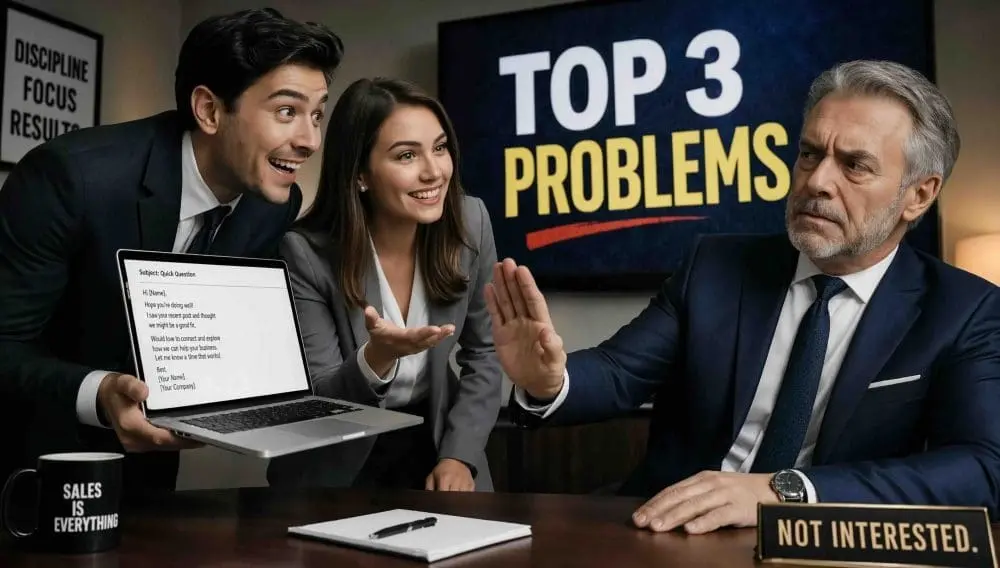
Today, sales development automation allows organizations to blast thousands of templated cold emails daily. Standard sequences open with variations of: "I noticed you’re using [Competitor] and thought you’d want to see how we compare."
This historical trajectory reveals a glaring blind spot: every phase of this evolution has been inherently self-referential. Whether showcasing a feature list or a G2 badge, the messaging is entirely about the vendor, offering zero insight into why a specific buyer would willingly endure the operational pain of migrating off an incumbent system.
The modern sales playbook requires an urgent pivot away from broadcasting vendor features toward diagnosing the exact, localized friction points that make a customer vulnerable to switching.
Supporting Context & Metrics: The Anatomy of a Switch
Switching enterprise software is deceptively expensive. While pricing pages display subscription costs, they fail to account for hidden expenditures that never make it to initial procurement conversations.
The Hidden Costs of Migration
- Data Migration & Architecture: Moving historical data safely from one database schema to another without losing integrity or corrupting workflows requires specialized engineering hours.
- Retraining Workforces: Entire departments must unlearn muscle memory associated with legacy systems and adapt to new user interfaces, leading to temporary dips in productivity.
- Re-integrating Tech Stacks: Re-establishing API connections, webhooks, and security clearances across an organization’s existing software ecosystem introduces operational vulnerability.
- Contractual Overlap: Organizations frequently find themselves locked into multi-year commitments, creating a financial penalty for early termination.
- Political Capital Risk: When an internal champion pushes to replace an incumbent system and the migration hits turbulence, their professional reputation within the enterprise is severely compromised.
Because of these hurdles, incremental improvements are insufficient. A prospective client will not disrupt their operations simply because a competitor claims a 15% faster query speed or a marginally better user interface. They move only when a core workflow is blocked, and their current vendor demonstrates apathy toward resolving it.
The Four Outcomes of the Direct Question
When an organization deploys a direct, pitch-free inquiry regarding what it would take to win their business, responses generally fall into one of four distinct categories. Three generate revenue; the fourth saves months of wasted effort.
- An Existing Capability: The prospect highlights a problem that your platform already solves effortlessly today. The gap narrows instantly to a single targeted demo and a clear migration plan. Most sales teams never discover that they were already the ideal solution because they led with a pitch rather than an inquiry.
- A Roadmap Feature: The requirement aligns with a feature currently under development. This transforms the prospect into an invaluable design partner—complete with a verified logo, clear enterprise use-cases, and a firm ship date attached to a guaranteed revenue opportunity.
- An Impossible Demand: The request involves custom development that falls entirely outside your product vision and architectural scope. Walking away immediately is a massive win, saving quarters of pipeline theater on an account that was never viable.
- A Pricing Play: The response is a demand for a steep discount or a match against a cheaper competitor. This indicates a lack of genuine product pain; the prospect is simply leveraging your quote to negotiate a discount with their incumbent vendor. Deprioritize and move on.
Official Perspectives & Expert Insights
Industry leaders and revenue architects increasingly emphasize that founder-led and executive-level outreach yields disproportionately higher response rates than automated sales development representative (SDR) sequences.
"A founder-to-VP email gets read at a rate no SDR sequence will ever hit, and it gets a more honest answer, because the person reading it knows you can actually do something about what they say. A rep asking ‘what would it take?’ sounds like a discovery question. A founder asking it sounds like an offer."
Furthermore, experts argue that once a target prospect reveals their core pain point, executing the win requires dismantling every operational excuse they might have to delay the transition. This framework rests on five execution pillars:
- Hyper-Tailored Account-Based Marketing (ABM): Presenting customized workflows demonstrating exactly how your platform solves their specific operational bottleneck within their unique business environment.
- White-Glove Migration Services: Explicitly offering to absorb the heavy lifting—migration, implementation, data mapping, integrations, and onboarding—entirely off their plate.
- Switch-Centric Collateral: Creating dedicated marketing assets that address the psychology of changing vendors, rather than generic product tear sheets.
- Contract Buy-Outs: Providing financial bridges (such as months of free service to offset remaining legacy contracts) to neutralize the barrier of double-billed software costs.
- Asymmetric Commission Structures: Incentivizing sales teams to pursue complex competitive takeaways by offering premium compensation for stolen accounts, ensuring reps do not default to easier greenfield opportunities.
Future Outlook: The Next Generation of Competitive Acquisition
As enterprise software markets saturate further and AI-driven outreach tools flood inboxes with hyper-personalized yet ultimately shallow messaging, buyers are becoming increasingly adept at filtering out manufactured noise. The future of competitive sales will not belong to those who shout the loudest about their feature parity or automated workflows. It will belong to those who listen with surgical precision.
Organizations that institutionalize the practice of asking high-leverage, diagnostic questions will build superior product roadmaps, forge deeper customer alignment, and systematically capture market share from complacent incumbents. By replacing pitching with problem-solving, modern revenue teams can turn competitive acquisition from an expensive numbers game into a disciplined, high-conversion science.