SAN MATEO, Calif. — As B2B and artificial intelligence companies finalize their event budgets for the upcoming fiscal year, a silent crisis is brewing in corporate marketing departments. Between now and January, hundreds of venture-backed startups and established tech enterprises will lock in booth sponsorships based on little more than organizer press releases, glossy slide decks, and optimistic foot-traffic projections.
By the third quarter, a sobering reality will set in: roughly half of those booths will have produced zero attributable revenue. The traditional trade show model—built on opaque metrics, vanity attendance figures, and spray-and-pray networking—is failing modern software companies that demand rigorous unit economics from every line item.
Yet, a notable counter-narrative is taking shape in the heart of the Silicon Valley tech scene. The organizers behind SaaStr AI Annual 2027 (colloquially known as "Agentfest") are breaking convention by releasing hard, verifiable lead data from their previous event. Rather than hiding behind inflated attendance estimates, the team has published comprehensive lead counts by sponsor, named the top-performing companies, and openly invited prospective sponsors to call them for references.
Scheduled for May 11-12, 2027, at the San Mateo County Event Center, SaaStr AI Annual 2027 is already pacing significantly ahead of its 2026 footprint. For B2B software leaders wrestling with pipeline math, the event’s radical transparency offers a rare glimpse into what happens when an industry conference actually ties floor traffic to closed-won revenue.
Executive Overview: The Shift Toward Accountable Event Marketing
The economics of B2B tech events have long been accepted as a necessary evil. Marketing leaders routinely allocate six-figure budgets to major conferences, writing off the lack of attribution as "brand awareness." But in a macroeconomic climate where every dollar of burn is scrutinized by boards and CFOs, the era of unaccountable event spending is coming to a close.
The fundamental disconnect with most tech conferences is that they operate as lead-generation black boxes. Organizers promise tens of thousands of attendees, but sponsors rarely know whether those badges belong to enterprise decision-makers, curious students, or job seekers.
SaaStr AI Annual is attempting to flip this dynamic on its head. By publishing audited lead numbers, the event forces a direct correlation between sponsor investment and pipeline generation. According to data released from the 2026 event, top-tier sponsors are walking away with hundreds—sometimes thousands—of qualified leads that translate directly into closed ARR within weeks of the conference floor closing.
Detailed Chronology: The Evolution of "Agentfest" and the 2026 Benchmark
To understand the momentum behind the 2027 conference, one must examine the empirical footprint left by the 2026 gathering. The numbers challenge conventional wisdom about what kinds of software solutions succeed on a physical exhibition floor.
The 2026 Leaderboard Breakdown
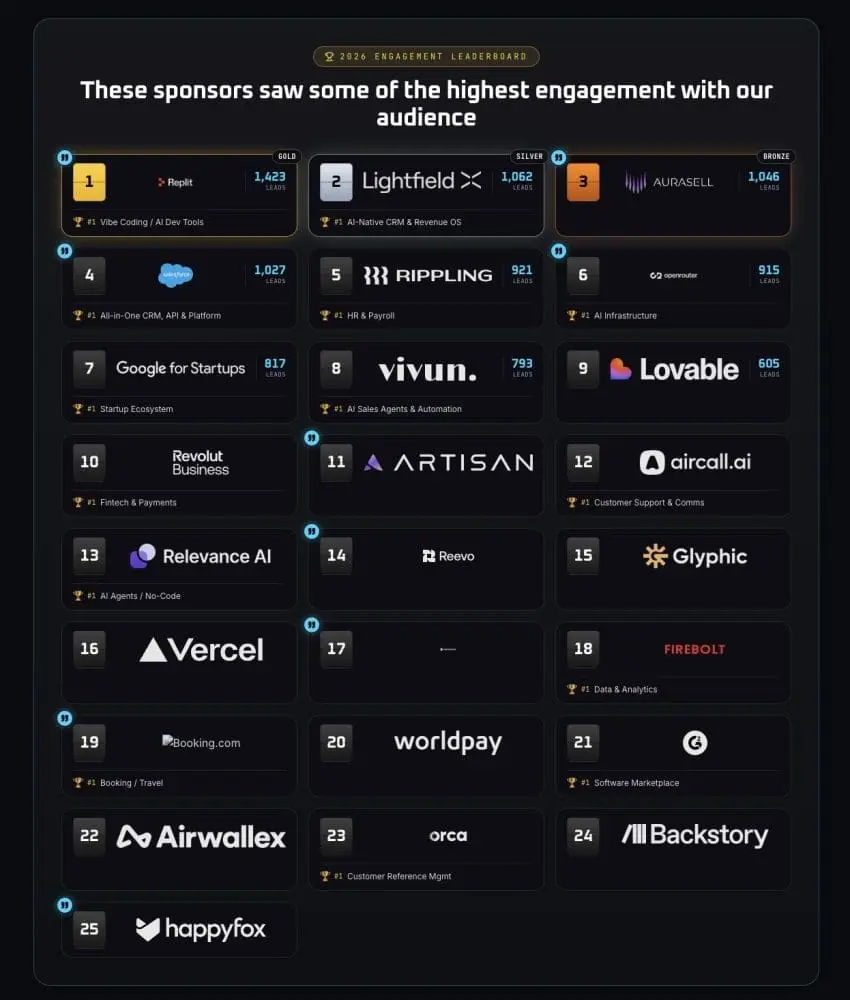
At the 2026 event, the top nine sponsors alone captured a staggering 8,609 leads, averaging an impressive 957 leads per company. Six of those nine sponsors cleared the 900-lead threshold, and even the #9 sponsor secured more than 600 verified interactions.
Leading the pack was Replit, which captured 1,423 leads, outpacing the nearest competitor by a wide margin. The broader top 25 read like a cross-section of modern software infrastructure and fintech, featuring heavyweights such as:
- Revolut Business
- Artisan
- Aircall
- Relevance AI
- Reevo
- Glyphic
- Vercel
- Firebolt
- Booking.com
- Worldpay
- G2
- Airwallex
- Orca
- Backstory
- HappyFox
Beyond Sales Tools: The Non-GTM Category Winners
A common misconception about B2B AI events is that they are exclusively fertile ground for go-to-market (GTM) and sales enablement software. While sales tools certainly performed well—with platforms like Lightfield, Aurasell, Salesforce, and Vivun landing in the upper tier, and an AI-native CRM edging out Salesforce by 35 leads—the broader category winners tell a more surprising story.

Out of all participating sponsors, 14 finished #1 in their respective categories, and fully half of them do not sell software to sales teams.
- Rippling captured 921 leads selling human resources and payroll infrastructure.
- Booking.com and Revolut dominated their categories by offering corporate travel and banking solutions.
The driving force behind this phenomenon is the attendee profile. The foot traffic at SaaStr AI Annual is heavily weighted toward founders, CEOs, and executive leadership teams at companies ranging from $5 million to $100 million in ARR. These buyers are not siloed departmental managers; they are the ultimate decision-makers who purchase the CRM, the payroll system, the corporate card, the developer toolkit, and the travel platform all at once. While traditional conferences grant access to a single functional silo, this environment reaches the executive who signs for every layer of the tech stack.
Supporting Context & Metrics: From Lead Input to Closed Revenue
Lead counts are merely the input metric; the true test of any event lies in what happens after the exhibition hall clears. Organizers tracked the trajectory of leads post-event, revealing substantial pipeline velocity and closed revenue.
- Monaco: Sam Blond, former CRO of Brex and current executive at Monaco, reported that the company closed four five-figure deals sourced directly from SaaStr AI Annual in under three weeks. Blond noted it was the highest-ROI event the company had ever measured, prompting them to return as a Diamond sponsor for the following year.
- Artisan: According to Artisan’s internal attribution, their presence yielded 634 qualified leads, $249,000 in ARR closed directly on-site, $2 million in active pipeline, and over $1 million in closed deals in the immediate months following the event. Much of this momentum was fueled by a live main-stage demonstration of their AI BDR by the company’s CEO.
- Aurasell: Described by their head of event marketing as the busiest booth on the entire show floor, Aurasell capitalized on rapid conversion cycles. Notably, one enterprise customer fully migrated to Aurasell just five days after an initial booth conversation.
- Replit: Securing the #1 spot on the leaderboard, Replit’s booth transformed into a bustling hub for founders and engineering executives building internal tools and autonomous agents. The high concentration of technical builders made it a natural focal point for the developer platform.
Official Statements & The Strategic Advantage of a May Timeline
Beyond lead volume, event timing plays a critical role in corporate financial planning. Holding a major B2B event in May offers a distinct structural advantage over late-autumn or early-winter conferences.
A lead captured on May 11–12 enters the corporate pipeline with two full quarters remaining in the standard fiscal year. For typical B2B enterprise deals ranging from $20,000 to $100,000—which usually carry a 60- to 120-day sales cycle—this timeline allows deals to mature, close, and recognize revenue well before the fiscal year closes in December. Larger enterprise contracts naturally land in Q4, ensuring that the event pays for itself within the exact budget cycle in which it was booked.
Industry analysts also point to the broader health of the events landscape as a barometer for organizer reliability. While giants like Gartner have reported steady event revenue growth (e.g., 15.5% year-over-year growth in mid-2026), other research firms have experienced double-digit declines. A shrinking events profit-and-loss statement is often a leading indicator of a hollowed-out room and diminishing buyer intent.
Future Outlook: What to Expect at SaaStr AI Annual 2027 ("Agentfest")
Looking ahead to the upcoming gathering at the San Mateo County Event Center, organizers are scaling capacity to accommodate surging demand. The projected metrics for 2027 include:
- Over 10,000 verified attendees, bringing together a dense concentration of AI practitioners, buyers, and founders.
- More than 3,000 pre-scheduled meetings facilitated through the event’s matchmaking application.
Event organizers emphasize that pre-booked meetings are the single greatest differentiator for sponsor success. A structured 30-minute conversation with a Vice President of Sales who actively selected your company via the matchmaking app converts at a fundamentally higher rate than a passive badge scan late on the second day of the conference.
Anatomy of a Top-Tier Sponsor
An analysis of the top performers versus the bottom quartile reveals three common denominators that separate successful exhibitors from those who leave empty-handed:
- Radical Clarity: The top performers—such as Replit, Rippling, and OpenRouter—possess a one-line value proposition that can be understood in under five seconds. In a room where buyers walk past dozens of competing booths, brevity wins.
- Multi-Channel Engagement: Successful sponsors do not rely solely on static booth real estate. Companies like Artisan combined physical floor presence with high-visibility speaking slots, live main-stage demonstrations, or workshop hosting to multiply their inbound traffic.
- Pre-Event Outreach: The highest-converting exhibitors utilize event networking applications weeks in advance, ensuring their calendars are fully booked before they ever set foot in the venue.
Due Diligence: Questions to Ask Every Event Organizer
Before signing any sponsorship agreement for the upcoming budget cycle, software executives are advised to pose four critical questions to event organizers:
- Can you provide verifiable, audited lead counts from the previous year broken down by individual sponsor?
- Will you share direct customer references from past sponsors whom we can call to discuss closed-won revenue?
- What percentage of your registered attendees hold verified decision-making authority (Director level and above) within their organizations?
- How many pre-scheduled matchmaking meetings does your platform guarantee or historically facilitate per booth?
As B2B tech companies race to lock in their 2027 marketing allocations, the demand for accountability will only intensify. Events that cannot stand up to rigorous scrutiny of their pipeline math risk being phased out of corporate budgets entirely. Conversely, those willing to open their books—and prove their return on investment—are establishing a new standard for the modern tech conference.