Executive Overview
In the high-stakes arena of enterprise software, mega-acquisitions are frequently viewed as desperate growth-padding exercises doomed to destroy shareholder value. Yet, Palo Alto Networks has fundamentally defied this consensus. Boasting a staggering market capitalization of approximately $265 billion, the cybersecurity behemoth has watched its stock surge roughly 100% over the trailing twelve months, touching an all-time high of $368.80.
This historic ascent, however, was far from a frictionless linear climb. To achieve this milestone, leadership executed a high-wire financial strategy: deploying roughly $29 billion in aggressive M&A over a single twelve-month window, absorbing a GAAP net loss, diluting existing shareholders by approximately 14%, and purposefully slashing earnings-per-share (EPS) guidance. This audacious maneuver triggered a violent market reaction, plunging the stock to a multi-month low of $139 in February.
Rather than backing down, CEO Nikesh Arora and his executive team doubled down. As the company’s core business accelerated and newly integrated acquisitions rapidly compounded, the entire enterprise re-rated. Today, Palo Alto Networks stands as a definitive case study in how an incumbent platform can navigate the structural shifts of the artificial intelligence era, converting market panic into an unmatched operational and strategic triumph.
Detailed Chronology: From Market Panic to Historic Re-Rating
To fully grasp Palo Alto Networks’ current market dominance, one must analyze the precise sequence of events that defined its volatile journey through fiscal 2025 and 2026. The outcome is impressive, but the timeline reveals the nerves of steel required by executive leadership to weather intense short-term market skepticism.
July 2025: The Blockbuster CyberArk Announcement
Palo Alto Networks detonated a bombshell across the enterprise software landscape by announcing its intent to acquire identity security leader CyberArk for a staggering $25 billion—marking the largest transaction in the history of the cybersecurity industry. Wall Street reacted with immediate apprehension. Convinced that the price tag was exorbitant and the integration hurdles insurmountable, the market shaved 12.5% off Palo Alto’s valuation within a single month.
November 2025: Doubling Down on Observability
Refusing to pause for breath after the CyberArk shockwave, management moved to acquire Chronosphere for $3.35 billion—a valuation multiple of roughly 21x Annual Recurring Revenue (ARR). To casual observers, the company appeared to be over-leveraging its balance sheet and aggressively diluting equity to chase unproven adjacencies.
February 2026: The Guidance Cut and the Absolute Bottom
The culmination of this aggressive M&A spree came to a head in February 2026 as the CyberArk deal officially closed. During the concurrent earnings call, management slashed its fiscal 2026 adjusted EPS guidance from $3.80–$3.90 down to $3.65–$3.70 to absorb immediate operational and integration costs.
Wall Street panicked. The stock suffered an additional 7% drop, ultimately bottoming out at $139.57 on February 24.
However, it was precisely at this moment of maximum capitulation that management displayed extraordinary conviction. During this quarter, Palo Alto Networks aggressively deployed $1 billion to repurchase 6.8 million of its own shares at an average price of $147.69. Those exact shares command a value more than double today, validating management’s thesis that the market was myopically pricing short-term dilution while entirely ignoring long-term structural execution.
June 2026 to Present: The Re-Rating and Blowout Results
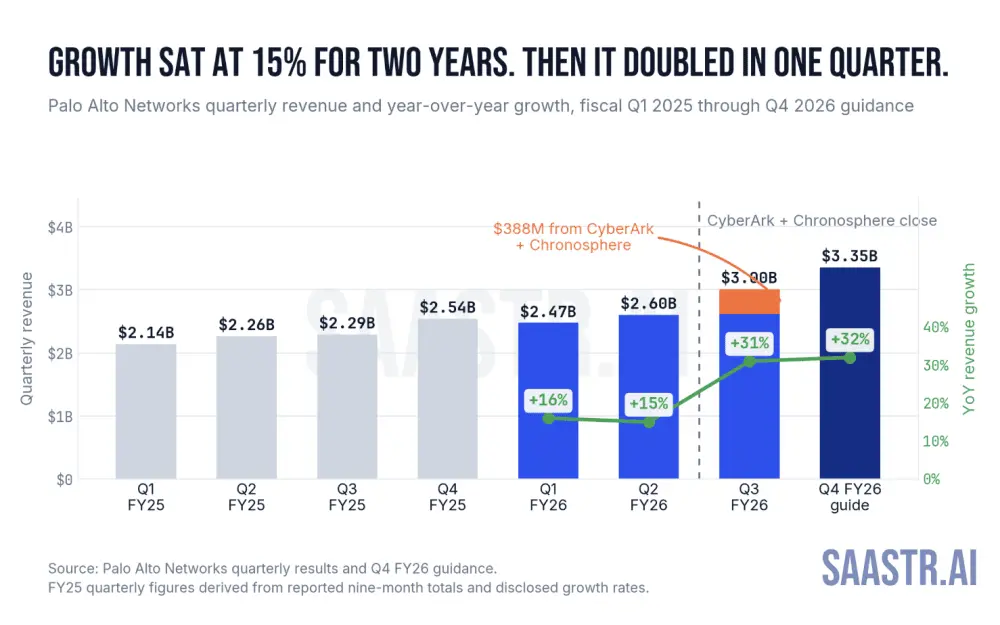
By the time Q3 FY26 results were reported in June, the narrative had completely inverted. Organic bookings accelerated dramatically, Next-Generation Security (NGS) ARR outperformed elevated expectations, and the newly acquired assets began posting explosive growth. By mid-July, the stock shattered previous records to reach $368.80, proving that the gap between announcement-day dilution and execution-driven re-rating can be bridged through relentless operational delivery.
Supporting Context & Metrics: The Anatomy of a Five-Pillar Platform
Founded in 2005 by Nir Zuk and publicly listed in 2012, Palo Alto Networks initially built its empire on next-generation firewalls—physical appliances sitting securely between enterprise networks and the open internet to inspect every packet of data. While network security still anchors roughly 70% of total revenue, the past eight years under Nikesh Arora have transformed the company from a hardware-centric firewall vendor into an integrated, five-pillar security platform driven by more than 20 strategic acquisitions.
Today, the enterprise serves approximately 70,000 customers globally, supported by a workforce of 16,000 employees and an annualized revenue run rate of $11.4 billion. Crucially, hardware has receded to roughly 10% of total revenue, with the vast majority generated by high-margin software subscriptions and recurring support.
The Power of Platformization and the NRR Delta
A critical differentiator in Palo Alto’s financial architecture is its "platformization" cohort. Out of its 70,000+ customers, approximately 2,280 have consolidated multiple security functions onto Palo Alto’s unified architecture rather than utilizing disjointed point products.
This elite cohort generates a staggering 120% Net Revenue Retention (NRR) accompanied by single-digit churn. In Q3 alone, the company secured 110 net new platformizations. Management’s long-term roadmap targets 4,000 platformized customers by fiscal 2030, a milestone projected to single-handedly propel NGS ARR from $8.1 billion to $20 billion.
Why AI is a Foundational Tailwind, Not a Threat
While many software categories face existential threats regarding AI compressing their addressable value, cybersecurity is experiencing the exact opposite phenomenon. Arora articulated a powerful thesis during the Q3 earnings call: artificial intelligence has fundamentally raised the terminal value of the entire cybersecurity industry. Four distinct mechanics drive this expansion:
- Explosive East-West Traffic: Early conversational AI relied on a simple single-prompt, single-response model. Modern autonomous agents completing complex enterprise workflows trigger hundreds of secondary, machine-to-machine calls across internal tools and datasets. This surge in internal "east-west" traffic demands inline inspection, driving hardware and software next-generation firewall bookings up nearly 40% year-over-year—marking the strongest hardware quarter in a decade.
- The Compression of Breach Timelines: Unit 42 researchers demonstrated that an end-to-end ransomware campaign can be executed by automated systems in a mere 25 minutes. Because human-led response teams cannot bridge a days-to-minutes gap, enterprises are forced to adopt automated platforms like XSIAM.
- Multiplied Enterprise Identities: Autonomous agents acting on production systems multiply traditional human administrator credentials by orders of magnitude, validating the strategic rationale behind the $25 billion CyberArk acquisition.
- Telemetry as a Byproduct of Compute: AI workloads generate vast quantities of logs, metrics, and traces. Consequently, observability bills scale directly with a customer’s GPU footprint rather than their headcount, allowing acquisitions like Chronosphere to nearly double ARR in just two quarters.
Official Statements and Strategic Insights
Examining the mechanics behind Palo Alto’s stellar performance reveals five vital operational lessons for modern technology executives:
- The Multiple Paid is Relative to Growth: When Palo Alto acquired Chronosphere for $3.35 billion at roughly 21x ARR ($160M ARR), critics balked. Just two quarters later, observability ARR surpassed $300M, driven heavily by frontier AI labs—including a single frontier lab generating over $200M in ARR alone. The multiple effectively halved because consumption-based AI workloads scaled exponentially.
- Velocity of Incumbent Product Adoption: New products are scaling inside Palo Alto’s footprint at unprecedented speeds. Prisma AIRS surged from 100 to over 300 customers in a single quarter, tracking toward $100M in ARR from a standing start less than 18 months ago. XSIAM reached over $600M ARR across 740 customers in 42 months. Incumbent distribution advantages allow established platforms to capture emerging market demand faster than greenfield startups.
- Outcome-Led Metrics Trump Feature Pitches: XSIAM does not win market share on ARR pitches; it wins because it reduces threat response times from days to under 10 minutes.
- Relentless Post-Merger Integration: Synergy targets were pulled forward by 3 to 6 months not through high-level strategy decks, but via unglamorous execution: consolidating 300+ IT vendors down by 20%, integrating over 40 new facilities, and leveraging combined scale for cloud hosting economies.
- The Ultimate Moat is Proprietary Data: As frontier models become commoditized, software defensibility shifts from the model layer to the data layer. Palo Alto leverages 125 million sensors ingesting 17 petabytes of daily telemetry, creating a self-reinforcing flywheel where every sensor makes the overarching platform smarter.
Future Outlook
Palo Alto Networks enters the final stretch of its fiscal year from a position of profound structural strength. With fiscal Q4 and full-year results slated for release on September 1, management has guided top-line revenue between $3.345 billion and $3.355 billion, with NGS ARR projected to land between $8.9 billion and $8.95 billion.
By proving that large-scale, audacious M&A can successfully integrate into a high-growth core when aligned with an accelerating secular demand curve, Palo Alto Networks has rewritten the playbook for enterprise software maturation in the age of artificial intelligence.