Executive Overview
On the evening of August 12, 2026, a rare and deeply anticipated astronomical event swept across Europe: a total solar eclipse that plunged regions of the continent into eerie, midday-midnight twilight. While millions watched the celestial alignment from city rooftops, beaches, and scientific outposts, Iceland’s most iconic cultural ambassador chose a different path entirely. True to her reputation as Earth’s premier extraterrestrial messenger, Björk orchestrated an underground, experimental gathering on the volcanic outskirts of Reykjavík. Titled “Echolalia,” the one-night-only pop-up rave fused avant-garde electronic soundscapes, high-concept fashion, and an eclectic crowd that had converged on the sub-Arctic island from as far away as Hawaii and Japan.
More than just a musical happening, Echolalia functioned as a momentary tear in the fabric of ordinary time. For seven breathless minutes, as the moon completely occluded the sun, the music ceased, transforming a high-energy rave into a collective, silent vigil interrupted only by spontaneous political solidarity and a surprise romantic engagement. When the light finally returned, Björk herself ascended to the decks in a sculptural masterpiece by Robert Wun, delivering a performance that cemented her status as a singular force in contemporary performance art. This report explores the architecture of that unforgettable evening—tracing its logistical triumphs, cultural resonances, and the breathtaking intersection of cosmic mechanics and underground club culture.
Detailed Chronology: From Twilight to Totality
The Gathering on the Volcanic Fringe
Weeks of clandestine whispers across global electronic music forums had preceded the event, but exact coordinates for Echolalia were only dispatched to ticket holders twenty-four hours before launch. The destination: a desolate, rugged lava field just outside Reykjavík, framed by jagged black basalt and an expansive, moody Icelandic sky.
By late afternoon on August 12, an intergenerational cross-section of attendees—ranging from seasoned local club kids to international devotees who had flown thousands of miles—descended upon the site. The atmosphere was charged with a palpable, electric anticipation. As the afternoon sun hung low in the northern sky, casting long shadows across the moss-covered rocks, the sound system came alive.
CHRONOLOGICAL TIMELINE OF ECHOLALIA
│
├─ 16:00 GMT: Gates open; international crowds flood the Reykjavík lava fields.
├─ 18:30 GMT: Ronja and Sideproject initiate the sonic journey with ambient-industrial sets.
├─ 19:45 GMT: Arca steps up to the decks, driving the BPM higher as ambient light dips.
├─ 20:12 GMT: Totality hits. Music stops; 7 minutes of total darkness and collective chanting.
├─ 20:19 GMT: The corona breaks; Björk emerges in Robert Wun's white balloon ensemble.
├─ 22:30 GMT: Set closes with the Rosalía "Berghain" remix; crowd disperses into twilight.
The Sonic Build-Up: Ronja, Sideproject, and Arca
The evening’s sonic journey was carefully curated to mirror the impending cosmic shift. Early sets by local acts Ronja and Sideproject established an otherworldly, ambient-industrial foundation, allowing the natural acoustic properties of the open-air landscape to meld with sub-bass frequencies.
As the sky began to take on a strange, bruised metallic hue—the unmistakable harbinger of the approaching lunar shadow—Venezuelan experimental electronic pioneer Arca took control of the booth. Arca’s blistering, deconstructed club tracks fractured the air, heightening the tension as daylight rapidly bled out of the environment. The crowd surged forward, locked in a collective trance against the backdrop of Iceland’s primordial topography.
The Seven-Minute Silence and Totality
At precisely the moment of maximum totality, the temperature plummeted, the horizon ringed in a 360-degree sunset glow, and the ambient music abruptly cut out. Total silence descended upon the thousands-strong crowd, save for the howling wind sweeping across the volcanic plain.
Rather than lapsing into awed quietude, however, the gathered collective converted the cosmic stillness into a canvas for human expression. Spontaneous chanting broke out across the field, with the audience raising their voices in unison to cry out: "Free, free Palestine!" Amidst the socio-political solidarity and the surreal celestial canopy, the emotional weight of the moment culminated in a deeply personal milestone: an attendee dropped to one knee amidst the lava rocks to propose to their partner, eliciting cheers that echoed across the dark landscape.
The Return of the Light and Björk’s Grand Entrance
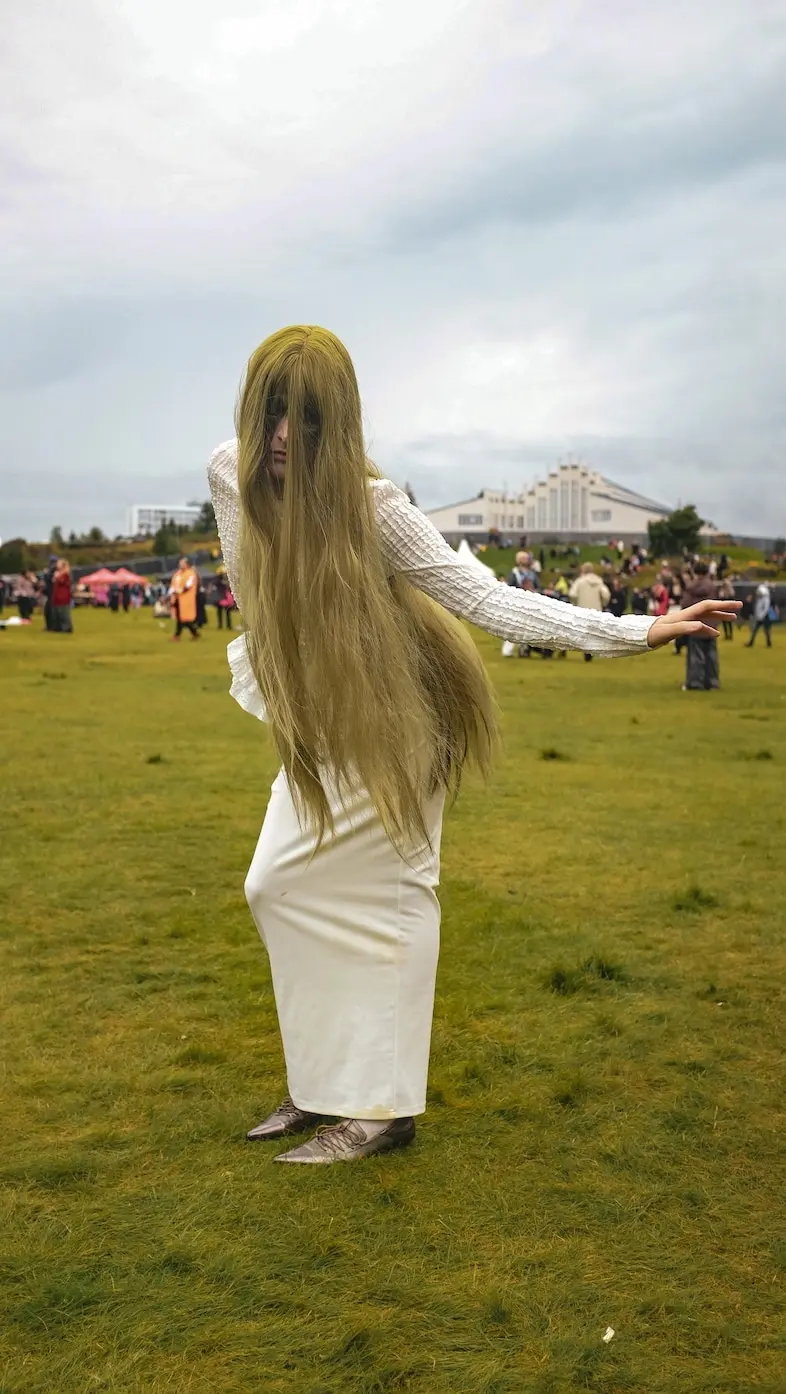
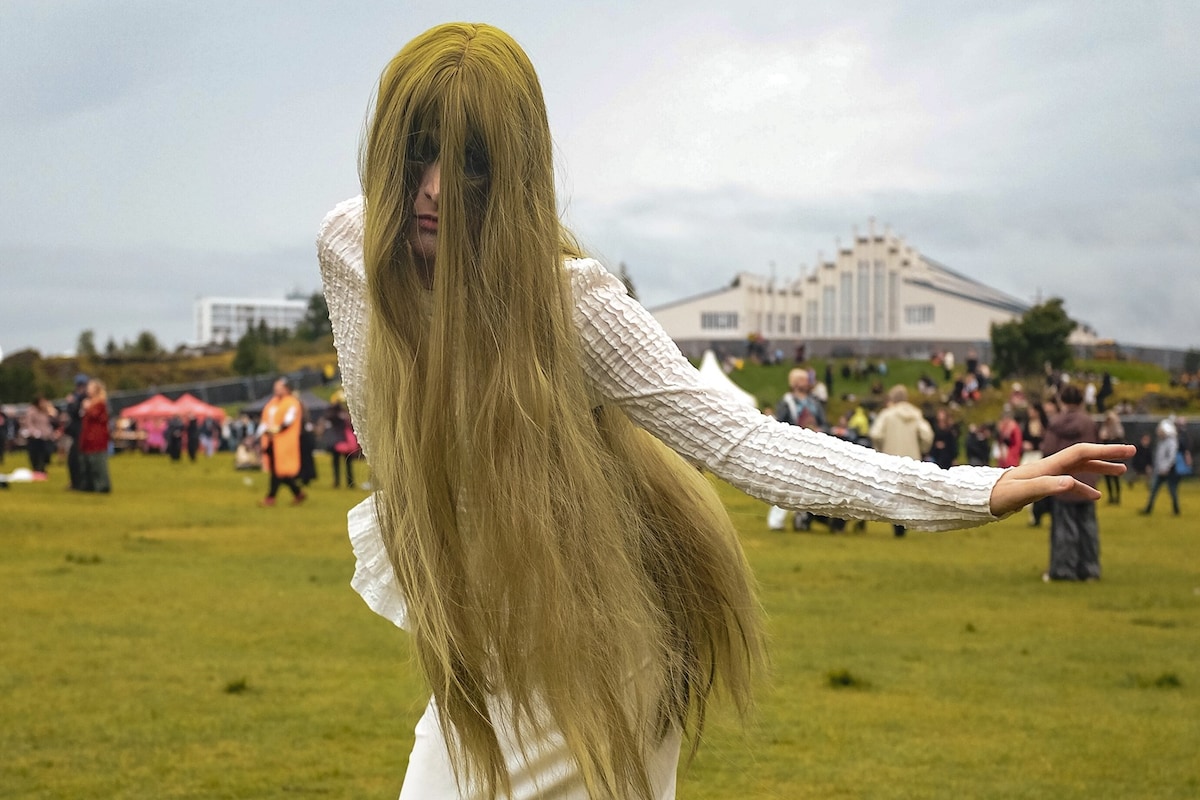
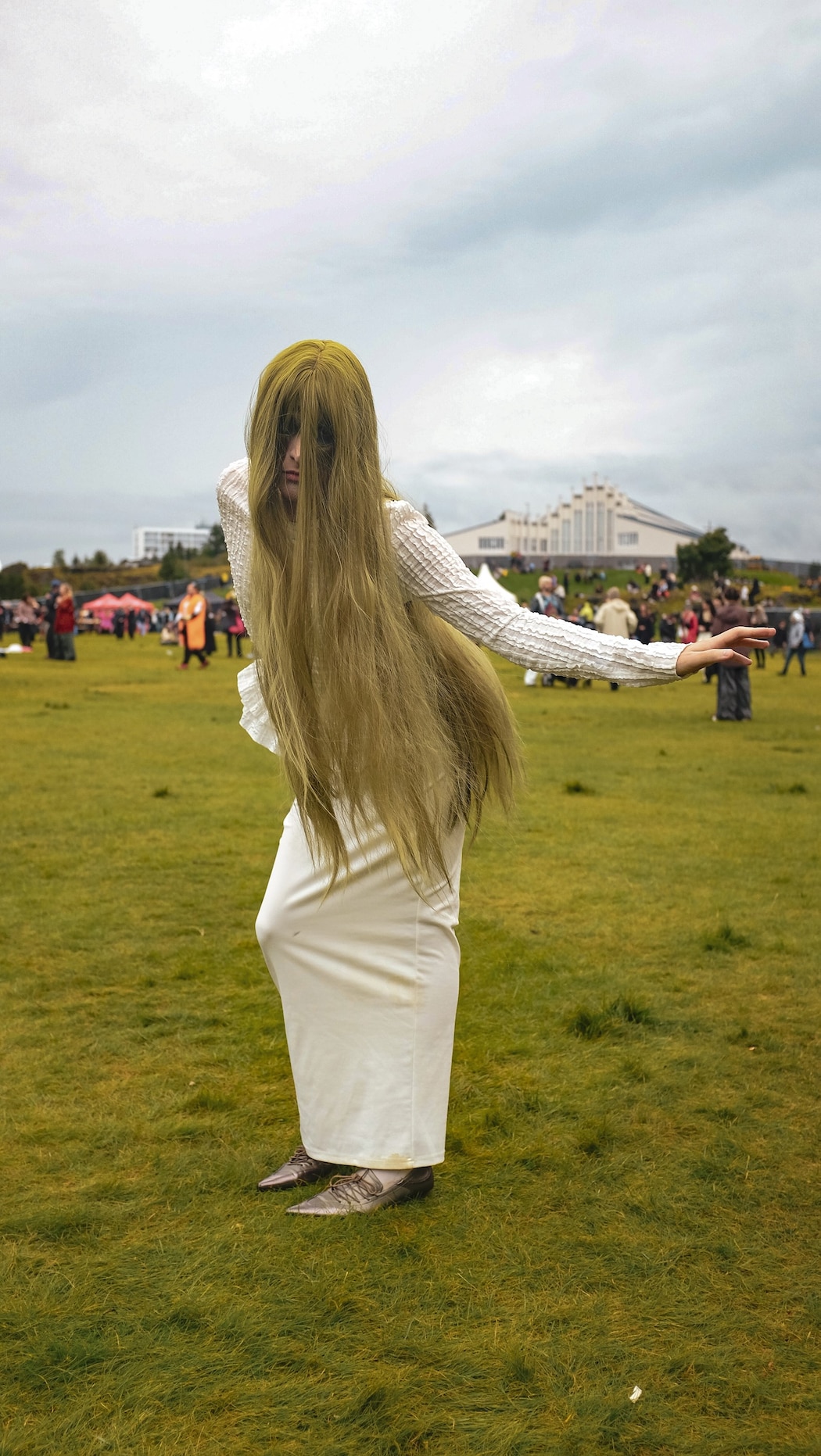
As the diamond ring of the sun broke past the edge of the moon, bathing the landscape in a sudden, surreal re-illumination, Björk made her triumphant entrance. Emerging from the shadows like a mythical Arctic spirit, she was clad in a breathtaking, sculptural white balloon ensemble custom-designed by Hong Kong-born visionary Robert Wun.
True to her theatrical instincts, Björk opened her set with the majestic, ominous strains of the Also Sprach Zarathustra theme from Stanley Kubrick’s sci-fi masterwork 2001: A Space Odyssey. Clutching a glass of rosé wine throughout the performance—a signature touch of nonchalant elegance—she alternated between dancing erratically and engaging in chaotic, visceral drumming on the DJ hardware. Her communication with the crowd was entirely vibrational; she spoke not through a microphone, but through raw physical movement and heavy rhythmic frequencies.
The set traversed dizzying sonic landscapes before culminating in a thunderous remix of Rosalía’s “Berghain,” on which Björk features. As the final notes reverberated across the cooling lava fields, the crowd dissolved back into the lingering, perpetual twilight of the Icelandic summer night.
Supporting Context & Metrics
To fully appreciate the magnitude of Echolalia, one must examine the logistical and cultural framework that made it possible. Total solar eclipses visible from accessible landmasses are exceedingly rare phenomena, often occurring in remote oceanic zones or politically volatile regions. Europe’s visibility path for the August 2026 eclipse represented a once-in-a-generation window for cultural tourism in the Nordic region.
Demographic Breakdown of Attendees
- International Travel: Approximately 45% of attendees arrived from outside Iceland, with significant delegations traveling from Japan, the United States, the United Kingdom, and continental Europe. Long-haul travelers from Hawaii and Australia underscored the borderless pull of Björk’s artistic brand.
- Age Distribution: Contrary to expectations of a purely Gen-Z rave demographic, the crowd was remarkably diverse. Veterans of the 1990s rave and IDM (Intelligent Dance Music) scenes stood shoulder-to-shoulder with twenty-something TikTok-era subculture enthusiasts.
- Environmental Footprint: Given the fragile nature of Iceland’s moss-covered lava fields, organizers worked in tandem with environmental consultants to implement strict "leave no trace" policies, utilizing temporary wooden boardwalk staging and zero-plastic waste mandates.
Comparative Scale of Eclipse Events
| Metric | Echolalia (Reykjavík, 2026) | Traditional Music Festivals | Standard Club Nights |
|---|---|---|---|
| Duration | ~6 Hours (Intense Focus on 7-min Totality) | 3 to 5 Days | 6 to 8 Hours |
| Acoustic Environment | Open-Air Volcanic Basin (Natural Reverb) | Enclosed Tents / Amp Stages | Indoor Sound-Isolated Clubs |
| Visual Production | Natural Celestial Eclipse + Minimalist Avant-Garde Lighting | Heavy LED Screens / Laser Shows | Standard Club Lighting |
| Headliner Involvement | Direct Curatorial Control by Björk | Commissioned Booking Rosters | Resident or Touring DJs |
Official Statements and On-the-Ground Perspectives
The singularity of the event generated immediate acclaim from cultural critics, photographers, and participants alike. Speaking exclusively about the atmospheric shift during the eclipse, official on-the-ground photographer Alex Atherton captured the essence of the experience:
"Of course, the eclipse plunging the area into total darkness was an undeniable highlight," Atherton noted from the site shortly after the dust settled. "The setting—deep within the rocky, picturesque Icelandic fields—combined with the experimental music and the rave descending into complete, star-lit darkness, created an environment that was thoroughly and totally unique. You felt entirely disconnected from modern urban reality."
While Björk herself issued no formal press release or post-event statement—preferring, true to form, to let the art and the experience speak entirely for themselves—representatives from her creative collective hinted that Echolalia might serve as a blueprint for future site-specific, nature-integrated happenings. The ethos of the gathering was clear: rather than treating nature as a backdrop against which human entertainment occurs, the event positioned human celebration as an active, reactive participant in planetary mechanics.
Future Outlook: The Legacy of Echolalia
As the temporary stages are dismantled and the volcanic ash settles back into quiet isolation, the cultural ripples of Echolalia are bound to be felt across the global electronic music and fashion communities for months to come.
- The Intersection of Haute Couture and Extreme Environments: Robert Wun’s structural, voluminous white balloon creation worn by Björk has already been hailed by fashion historians as a watershed moment for wearable art in outdoor, non-traditional settings. It challenges designers to think beyond the sterile white cube of the runway and consider how garments interact with wind, low light, and raw elements.
- Politically Conscious Club Culture: The spontaneous outbreak of chanting for Palestine during the most quiet, vulnerable moment of the eclipse highlights a growing reality in modern rave culture: the dancefloor is no longer viewed as an escape from geopolitical reality, but as an amplifier for global conscience.
- The Blueprint for Experiential Tourism: Iceland’s tourism board, while cautious about ecological preservation, recognizes the immense economic and cultural value of high-art, low-impact events like Echolalia. By tying major cultural happenings to natural astronomical events, artists can bypass traditional stadium tours in favor of hyper-memorable, once-in-a-lifetime pilgrimages.
Ultimately, Björk’s solar eclipse rave will be remembered not merely as a concert or a party, but as a ritualistic alignment of sound, space, and celestial body. In an era dominated by algorithmic feeds and hyper-digitized entertainment, Echolalia offered a visceral reminder of the power of physical presence, collective awe, and the raw, unscripted magic of the natural world.