Executive Overview
In the fast-evolving landscape of enterprise data architecture, the friction of modernization has long been a primary roadblock for organizations scaling petabyte-level analytics. For years, companies relying on the Apache Hive ecosystem—once the bedrock of Hadoop-based data lakes—have faced an intricate dilemma. Migrating legacy data structures to modern, high-performance open table formats like Apache Iceberg historically demanded weeks, if not months, of rigorous engineering work. Teams had to architect custom data pipelines, provision and manage ephemeral compute clusters, handle complex data type conversions, and engineer robust rollback mechanisms—all while keeping mission-critical production workloads running without interruption.
Today, Amazon Web Services (AWS) is fundamentally altering that calculus. In a major enhancement to its analytics ecosystem, AWS has announced native support for managed migrations of Apache Hive tables to Apache Iceberg within Amazon S3 Tables. Designed to be simple, cost-effective, and operationally frictionless, this new capability requires zero custom pipelines to build and no dedicated compute resources to provision.
By offloading the entire heavy lifting of the migration workflow—including data validation, compatibility reporting, type conversions, file recompression, and compaction—to fully managed S3 Tables infrastructure, organizations can now seamlessly upgrade their data lakes. Crucially, this transition occurs while production workloads remain live and queryable. This release marks a watershed moment for data engineers, architects, and enterprise decision-makers looking to harness the petabyte-scale benefits of Apache Iceberg—such as schema evolution, hidden partitioning, and time travel queries—without the traditional operational overhead.
Detailed Chronology: The Evolution to Managed Iceberg Migrations
To understand the magnitude of this release, one must trace the architectural trajectory of cloud-based data storage and query optimization.
The Legacy Challenge of Apache Hive
Apache Hive was foundational to the big data revolution, establishing a SQL-like abstraction layer over distributed file systems. However, as data lakes scaled into petabyte and exabyte territories, Hive’s table format limitations became apparent. Managing atomic transactions, handling concurrent writes, and executing high-performance analytical queries required complex file-listing operations that strained compute engines.

The Rise of Apache Iceberg as the Open Standard
In recent years, Apache Iceberg emerged as the undisputed open standard for large-scale analytics datasets. By introducing table formats that decouple the physical layout of data files from the logical schema, Iceberg unlocked advanced capabilities:
- Time Travel Queries: Allowing analysts to query historical states of data at specific timestamps or snapshots.
- Schema Evolution: Safely modifying columns (adding, dropping, renaming, or reordering) without rewriting underlying data files.
- Hidden Partitioning: Eliminating user-error pitfalls associated with traditional partition management by automatically maintaining partition values behind the scenes.
Despite these clear performance and architectural advantages, migrating legacy Parquet-formatted Hive tables registered in the AWS Glue Data Catalog to Iceberg remained a persistent bottleneck. Engineering teams were forced to write bespoke Spark or Hive jobs, carefully monitor memory overhead, manage edge cases in type mapping, and execute cutovers manually during tight maintenance windows.
The Launch of Amazon S3 Tables and Managed Migrations
Recognizing these operational hurdles, AWS introduced Amazon S3 Tables—fully managed storage purpose-built to maintain high performance and cost-efficiency for Iceberg tables as they scale. S3 Tables introduced automatic maintenance, optimization, replication, and built-in S3 Intelligent-Tiering.
Building upon this foundation, AWS has now bridged the gap between legacy and modern architectures entirely. The newly released managed migration feature transforms what was once an ad-hoc, error-prone engineering project into a standardized, API-driven operation. By handling everything from the initial compatibility check to final table promotion, AWS has compressed a multi-week engineering milestone into a streamlined administrative workflow.
Supporting Context & Metrics: How the Managed Migration Works
The technical architecture behind S3 Tables managed migrations is engineered for transparency, safety, and economic efficiency. Rather than demanding a blind leap of faith from data architects, the migration lifecycle is governed by rigorous automated validation and incremental synchronization.

[ AWS Glue Hive Table (Parquet) ]
               │
               ▼
    S3 Tables Validation
               │
               ├──────► Compatibility Report Generated
               │
               ▼
    Incremental Syncs (`sync-table-migration`)
   (Runs continuously; source writes remain active)
               │
               ▼
    Brief Cutover Window
               │
               ▼
[ Destination Apache Iceberg Table (Read-Write) ]
The Migration Lifecycle Step-by-Step
-
Initiation and Destination Setup:
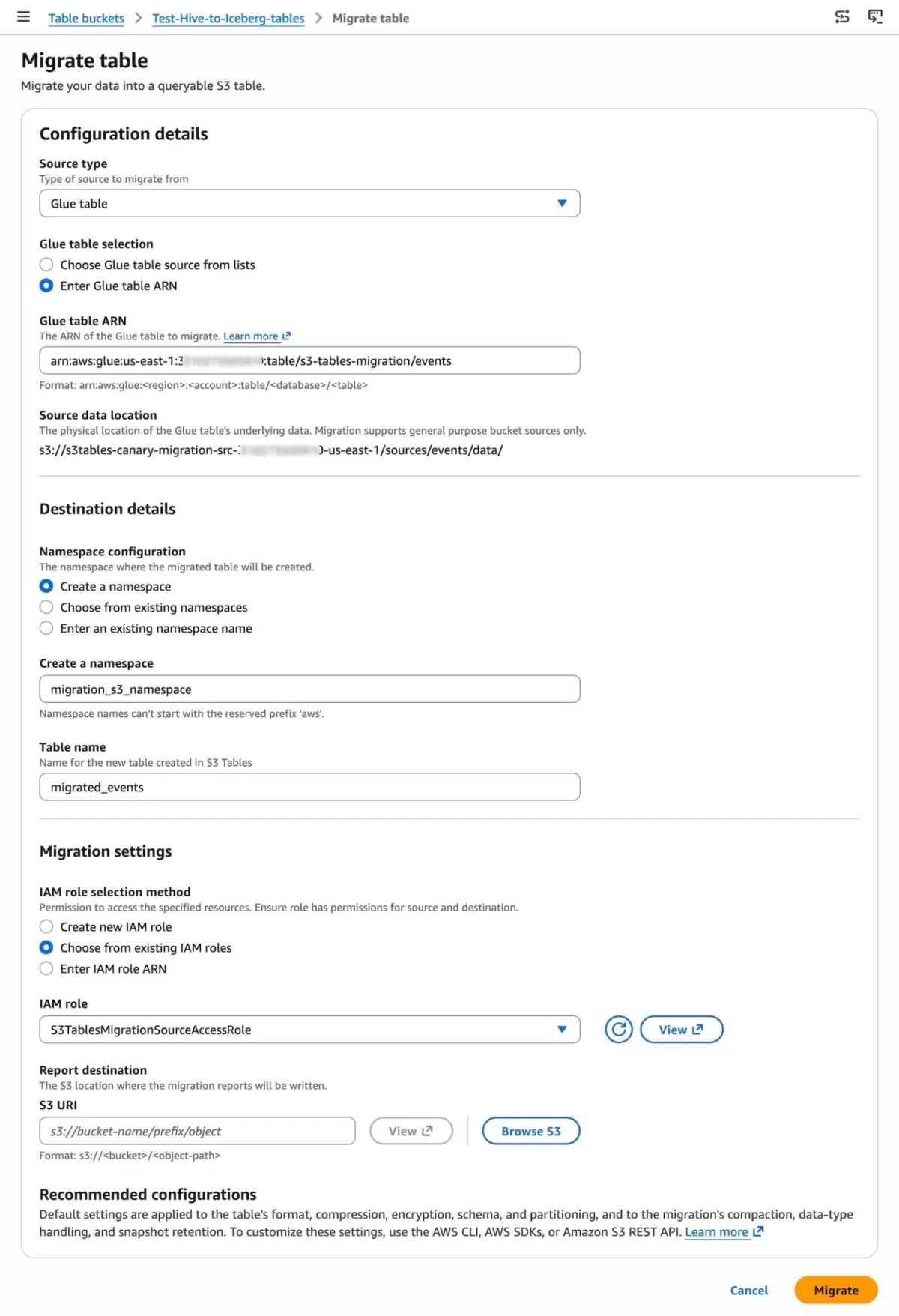
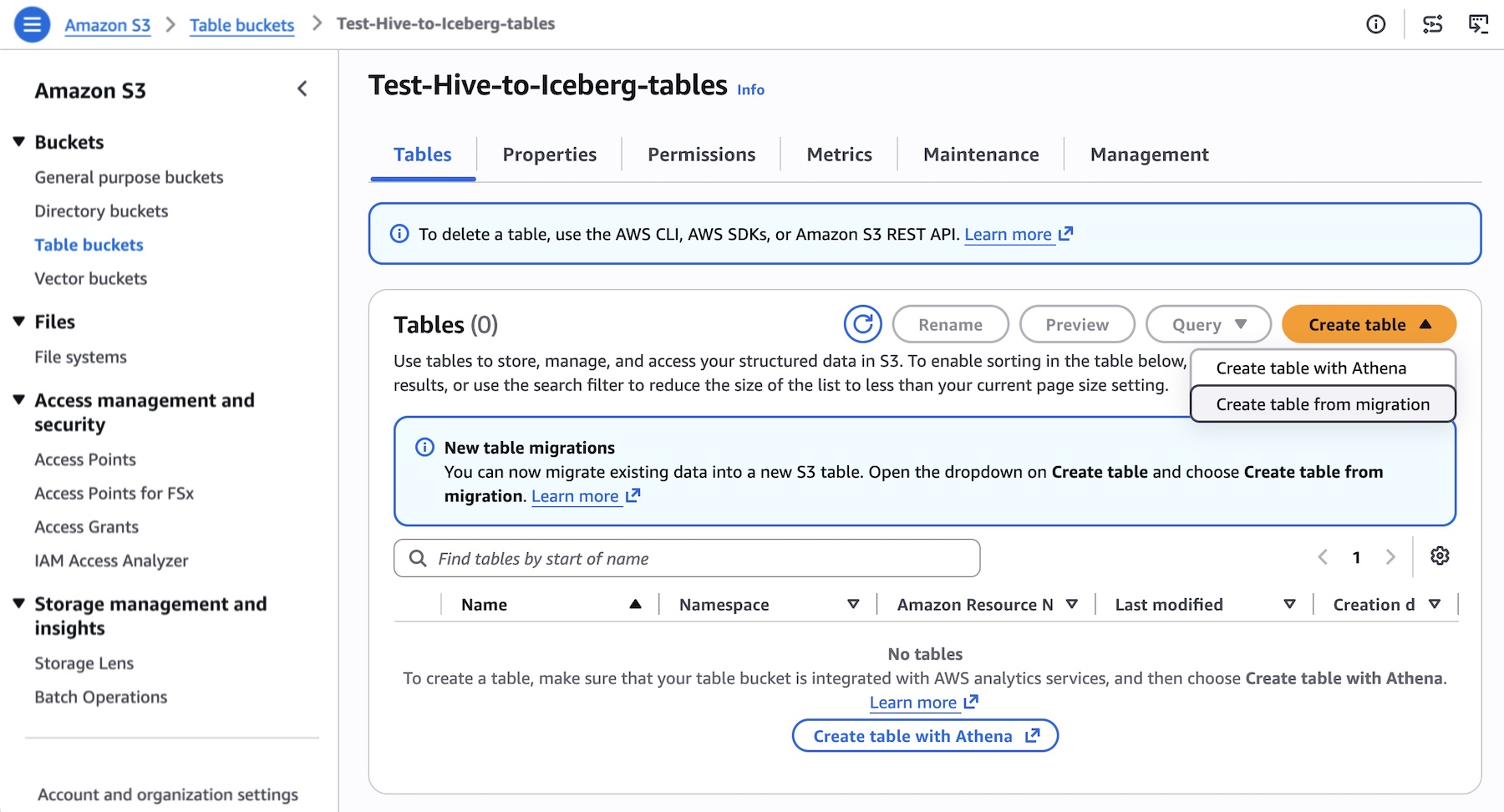
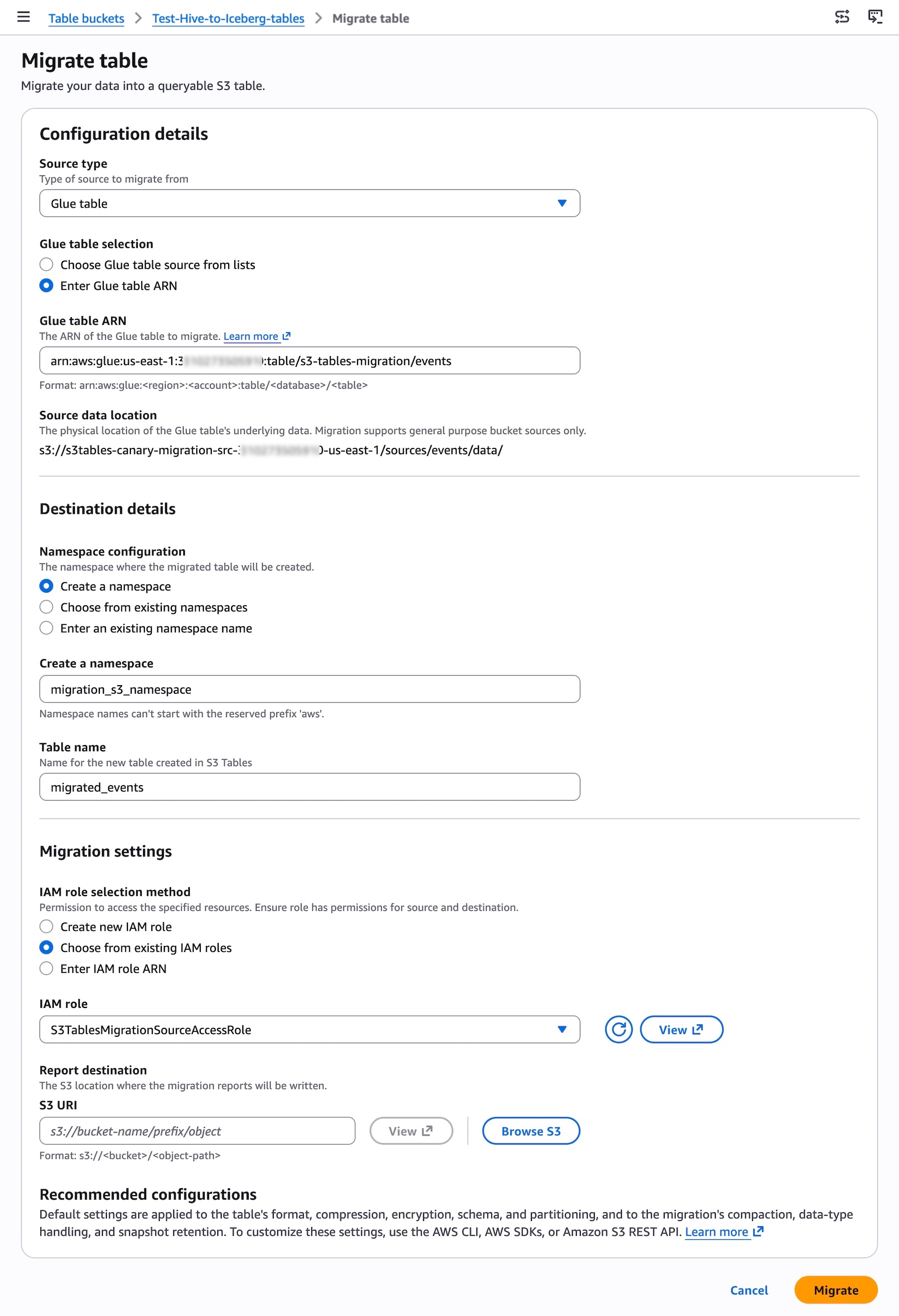
Through the Amazon S3 console, AWS CLI, AWS SDKs, or the Agent Toolkit for AWS, an administrator selects a destination S3 Tables bucket and designates a namespace and table name. S3 Tables automatically apply recommended default settings tuned specifically for query performance and storage efficiency. -
Automated Validation and Compatibility Reporting:
Before copying a single byte of data, S3 Tables scan every source object within scope. They generate comprehensive compatibility reports that flag potential data type discrepancies, schema mismatches, or unsupported configurations. Users can route these reports directly to dedicated S3 reporting buckets, ensuring total visibility before execution. -
Incremental Synchronization (
sync-table-migration):
One of the most powerful architectural features of this release is the ability to keep the source table fully online and actively receiving writes during the migration process. Administrators can execute thesync-table-migrationcommand as many times as necessary. Each subsequent sync operation intelligently copies only the data that has changed since the last synchronization. -
Minimal-Downtime Cutover:
While the migration is actively processing, the destination Iceberg table remains in a read-only state. Once data parity is achieved and the administrator is ready to finalize the upgrade, a brief cutover window—lasting mere minutes—promotes the destination table to full read-write status.
Cost Efficiency and Resource Management
From a financial perspective, self-managed migrations traditionally incurred significant compute costs (such as running continuous Apache Spark clusters on Amazon EMR) alongside the storage transfer overhead. S3 Tables redefine this economic model:
- Zero Conversion Fees: Users pay strictly for the underlying data copied. There are no hidden or proprietary charges levied for the Hive-to-Iceberg structural conversion.
- Preservation of Storage Tiers: Source objects stored within S3 Intelligent-Tiering remain safely in their current access tiers, preventing unintended cost spikes or forced data retrievals during the migration phase.
Technical Implementation: CLI & Agent-Driven Workflows
For platform engineers and DevOps teams embedding data lake modernization into CI/CD pipelines or automated orchestration tools, AWS provides deep programmatic access via the AWS CLI and SDKs.
Example Configuration JSON
Below is a production-grade configuration template utilized by the start-table-migration command, demonstrating fine-grained control over encryption, storage classes, compaction parameters, and migration policies:
  "roleARN": "arn:aws:iam::123456789012:role/S3TablesMigrationRole",
  "destinationTable":
    "tableBucketARN": "arn:aws:s3tables:us-east-1:123456789012:bucket/my-destination-bucket",
    "namespace": "mynamespace",
    "name": "my_destination_table",
    "encryptionConfiguration":
      "sseAlgorithm": "aws:kms",
      "kmsKeyArn": "arn:aws:kms:us-east-1:123456789012:key/1234abcd-12ab-34cd-56ef-1234567890ab"
    ,
    "storageClassConfiguration":  "storageClass": "INTELLIGENT_TIERING" ,
    "tags":  "team": "s3tables", "purpose": "migration" ,
    "properties":
      "writeFormat": "parquet",
      "icebergFormatVersion": 2,
      "compressionCodec": "zstd",
      "dictionaryEncoding": true
    ,
    "schema":
      "type": "struct",
      "schemaId": 0,
      "identifierFieldIds": [1],
      "fields": [
         "id": 1, "name": "id",      "type": "long",   "required": true, "doc": "primary key" ,
         "id": 2, "name": "payload", "type": "string", "required": false
      ]
    ,
    "icebergSortOrder":
      "orderId": 1,
      "fields": [  "sourceId": 1, "transform": "identity", "direction": "asc", "nullOrder": "nulls-first"  ]

  ,
  "sourceType": "glueTable",
  "source":
    "glueTable":
      "catalogId": "123456789012",
      "databaseName": "my_glue_database",
      "tableName": "my_source_table"

  ,
  "dataMigration":
    "maintenanceSettings":
      "icebergCompaction":  "targetFileSizeMB": 512, "strategy": "binpack" ,
      "icebergSnapshotManagement":  "minSnapshotsToKeep": 3, "maxSnapshotAgeHours": 168
    ,
    "migrationPolicies":
      "unmatchedSourceFieldsPolicy": "fail",
      "incompatibleValuesPolicy": "fail"

  ,
  "reviewMigrationPlan": false,
  "migrationOutput":
    "bucket": "arn:aws:s3:::my-report-bucket",
    "prefixes":
      "tableCompatibilityReport": "reports/table-compatibility/",
      "objectCompatibilityReport": "reports/object-compatibility/",
      "objectMigrationReport": "reports/object-migration/"
Executing the migration job via the AWS CLI is as straightforward as invoking:
aws s3tables start-table-migration
  --cli-input-json file:///tmp/start-migration.json
Integration with Modern AI Coding Assistants and MCP Servers
In step with modern cloud engineering paradigms, AWS has also ensured that this feature is immediately accessible via autonomous coding agents and developer toolkits. Utilizing coding agents such as Kiro, engineers can leverage the specialized migrating-hive-tables-to-s3-tables skill within the Agent Toolkit for AWS. This skill supplies step-by-step guidance, built-in safety guardrails, and context-aware execution strategies.
Furthermore, developers can harness the AWS Model Context Protocol (MCP Server) and associated plugins with their preferred AI tooling to search documentation, verify regional availability, inspect API payloads, and troubleshoot migration errors in real time.
Future Outlook & Regional Availability
Immediate Availability
At launch, Amazon S3 Tables managed migrations are globally deployed across a robust footprint of core AWS Regions:
- Americas: US East (N. Virginia, Ohio), US West (Oregon)
- Asia Pacific: Mumbai, Singapore, Sydney, Tokyo
- Europe: Frankfurt, Ireland, Stockholm
The initial release fully supports AWS Glue-registered Hive tables stored in Parquet format residing within the same AWS account and AWS Region.
The Horizon of Open Table Architectures
By lowering the barrier to entry for Apache Iceberg adoption, AWS is signaling a broader industry shift toward fully managed, open-standard data lakes. As organizations continuously ingest exponential volumes of structured and unstructured data, the ability to transition legacy formats into high-performance table architectures without incurring operational downtime or massive infrastructure overhead will become a competitive differentiator.
Looking ahead, we can anticipate further automation in data lake lifecycle management, deeper native integrations across analytics engines like Amazon Athena, Amazon EMR, and Amazon SageMaker Unified Studio, and expanded cross-account or cross-region migration capabilities. For data leaders and platform engineers alike, the message is clear: the path from legacy technical debt to modern, open analytics has never been smoother or more cost-effective.