Date: November 19, 2026
Reading Time: 7 minutes
Industry Categories: Artificial Intelligence, Digital Infrastructure, Energy, Cloud Computing, Modular Data Centres
Executive Overview
As the global artificial intelligence boom strains traditional construction methodologies and power grids, Japan is taking a decisive step toward securing its technological future. In a landmark strategic partnership announced on November 18, 2026, Mitsubishi Heavy Industries (MHI) and SAKURA internet have signed a Memorandum of Understanding (MoU) to jointly explore and develop modular AI data centres across Japan.
This alliance seeks to radically compress facility construction timelines, optimize energy and thermal efficiencies, and fortify Japan’s national digital sovereignty. By marrying MHI’s world-class heavy engineering, power systems, and advanced cooling technologies with SAKURA internet’s premier cloud services and data centre operational experience, the collaboration addresses the acute infrastructure bottlenecks currently stifling Japan’s digital economy.
However, while modular architecture promises rapid deployment and predictable, scalable quality, the initiative faces stark macroeconomic and structural headwinds—most notably, protracted grid connection queues and stringent new energy efficiency regulations mandated by the Japanese government.
Detailed Chronology: The Road to the MHI-SAKURA Partnership
To understand the strategic gravity of the MHI and SAKURA internet alliance, it is essential to trace the rapid escalation of Japan’s computing demands and regulatory interventions over recent years.
The Spark of Sovereign AI (2024)
The foundation for Japan’s modern domestic cloud ecosystem was heavily catalyzed in 2024. Under the Economic Security Promotion Act, Japan’s Ministry of Economy, Trade and Industry (METI) rolled out a massive GPU cloud subsidy program valued at approximately ¥72.5 billion ($453.4 million). The initiative aimed to reduce reliance on foreign hyperscalers and establish sovereign AI capabilities.
SAKURA internet emerged as the primary beneficiary of this national mandate, capturing roughly 69% of the total allocation—about ¥50.1 billion ($313.3 million). This capital injection positioned SAKURA internet as a critical pillar of Japan’s digital independence.
Government Validation and the Search for Scale (March 2026)
Building on its state-backed momentum, SAKURA internet achieved a major milestone in March 2026 by becoming the first domestic cloud provider formally approved for Japan’s Government Cloud program—a centralized national initiative designed to modernize public sector digital systems.
Yet, as SAKURA’s workloads expanded exponentially alongside broader enterprise AI adoption, the limitations of traditional, site-built data centre construction became glaringly apparent. Scaling up required vast amounts of power and specialized cooling infrastructure that conventional builds simply could not deliver fast enough.
The Strategic MoU (November 18, 2026)
Recognizing that workload demand was rapidly outstripping infrastructure supply, MHI and SAKURA internet formalized their ambitions. Announced on November 18, 2026, the MoU establishes a framework to research, design, and deploy standardized, modular AI data centres.

While both companies confirmed that specific development locations and strict timelines remain under evaluation, the partnership immediately positions itself as a blueprint for overcoming Japan’s unique capacity constraints.
Supporting Context & Metrics: The Anatomy of Japan’s Infrastructure Crisis
Japan’s data centre market is experiencing robust, undeniable growth, yet it is simultaneously colliding with severe physical limits.
Market Projections and Constraints
According to JLL’s February 2026 report, Japan Data Centre Market Opportunities, the country’s data centre market generated $23.4 billion in revenue in 2024. Projections indicate this figure will surge to $33.4 billion by 2030, expanding at a compound annual growth rate (CAGR) of 6.7% beginning in 2025.
Despite this lucrative trajectory, expansion is severely bottlenecked by power availability. JLL data reveals that securing sufficient electrical capacity for new data centre developments can take an astonishing eight to 10 years in Tokyo, compared to a comparatively brisk three to five years in Osaka.
"For AI data centres, the current scaling constraint is energy (power and cooling)," noted representatives from MHI, emphasizing that infrastructure supply is perpetually chasing runaway workload demand.
The Geographic Over-Concentration Dilemma
Geographic centralization compounds these energy grid pressures. JLL’s analysis highlights that roughly 90% of Japan’s existing data centre infrastructure is hyper-concentrated within Greater Tokyo and Greater Osaka.
To mitigate systemic risks associated with this concentration—ranging from seismic vulnerabilities to localized grid overloads—the Japanese government has ramped up regional diversification incentives. Initiatives like the Digital Infrastructure Development Plan 2030 and the Watt-Bit Collaboration program are actively working to align telecommunications network expansion with renewable and regional power availability.
Regulatory Pressures: The PUE Mandate
Compounding the power crunch are rigorous new environmental standards. Under regulations introduced by METI via the Energy Conservation and Non-Fossil Energy Conversion Act, qualifying data centres must achieve a Power Usage Effectiveness (PUE) of 1.3 or better after two years of operation, effective from fiscal 2029.
PUE—the metric determining total facility energy consumption relative to the power delivered strictly to IT equipment—presents a formidable technical hurdle for legacy facilities housing dense, heat-generating AI graphics processing units (GPUs). Meeting or exceeding this standard requires radical redesigns in thermal management, liquid cooling integration, and electrical sub-station configurations.
Official Statements and Industry Insights
The partnership between MHI and SAKURA internet represents a convergence of heavy industrial prowess and digital agility.

Bridging Engineering and Cloud Operations
Rather than developing power generation, cooling loops, and IT white space in isolated silos—the traditional approach that often results in coordination delays—MHI intends to integrate power, cooling, and control systems from the earliest design phases.
"Modular construction helps to deliver predictable quality and reduce timelines," MHI explained.
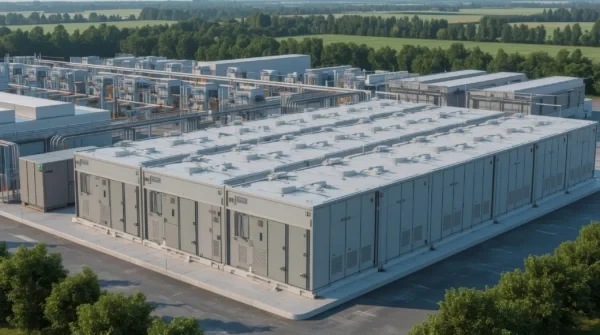
Under the proposed modular methodology, critical infrastructure components—such as modular power distribution units and advanced liquid-to-air cooling systems—can be fully manufactured, assembled, and rigorously tested off-site. This drastically limits on-site civil engineering work and streamlines final commissioning. As enterprise demand scales, operators can simply drop in incremental modules.
However, industry realists note a critical caveat: while modularization cuts construction phases down from years to months, it cannot bypass bureaucratic and technical delays tied to primary electrical grid connections. Power availability remains the ultimate master clock for deployment schedules.
Complementing, Not Competing with Hyperscalers
Addressing market positioning, SAKURA internet confirmed to Capacity that its joint venture with MHI is not designed to wage a direct war against global hyperscalers (such as AWS, Microsoft Azure, or Google Cloud).
Instead, the initiative is laser-focused on fortifying Japan’s domestic cloud and AI ecosystem. By providing Japanese enterprises, research institutions, and government bodies with localized infrastructure, the partnership guarantees absolute data residency, security, and institutional control over sensitive AI workloads.
International Replicability across APAC
The hurdles facing Japan are by no means unique. MHI highlighted that numerous markets across the broader Asia-Pacific (APAC) region are grappling with an identical triad of pressures: skyrocketing AI compute demand, constrained electrical grids, urgent demands for compressed deployment timelines, and a surging regional interest in digital sovereignty. Consequently, the modular infrastructure templates engineered by MHI and SAKURA internet could eventually serve as exportable benchmarks for the wider APAC landscape.
Future Outlook: Can Modular Infrastructure Deliver?
As Japan looks toward its 2030 digital and economic milestones, the success of the MHI-SAKURA partnership will serve as a bellwether for sovereign tech infrastructure.
If standardized, modular data centres can successfully navigate Japan’s rigorous seismic safety codes, integrate seamlessly with regional power grids, and hit METI’s strict 1.3 PUE threshold by 2029, the model could radically transform how digital capacity is brought online. It offers a viable escape hatch from the eight-to-ten-year grid connection purgatory plaguing metropolitan hubs like Tokyo.
Ultimately, the alliance between a heavy industrial titan and a sovereign cloud pioneer underscores a vital modern truth: the future of artificial intelligence is inextricably bound to the physical world. Without innovative engineering in power distribution and thermal management, the digital promises of the AI era will remain unfulfilled. Through modular innovation, MHI and SAKURA internet are building the scaffolding to ensure Japan remains at the forefront of the global intelligence economy.