Executive Overview
In the fast-paced world of modern cloud-native software development, containerization has transformed how organizations build, deploy, and scale applications. At the center of this architectural shift is Amazon Elastic Container Service (Amazon ECS), a fully managed container orchestration service that powers mission-critical workloads for thousands of enterprises worldwide. However, as organizations scale their microservices architectures from a handful of experimental containers to thousands of production-grade services, a persistent, operational bottleneck has emerged: ingress networking configuration.
For years, platform engineering teams managing applications at scale have grappled with the exhausting, repetitive complexity of configuring ingress routing for every individual service. Every single time a new microservice is born, engineers must manually provision, configure, and wire together an intricate web of infrastructure primitives. This includes Application Load Balancers (ALBs), AWS Certificate Manager (ACM) TLS certificates, AWS WAF web ACLs, target groups, and underlying security groups. Furthermore, keeping these disparate resources synchronized as services scale, undergo rolling updates, or sunset has introduced significant administrative overhead. This per-service friction directly impedes deployment velocity, dampens engineering agility, and dramatically increases the risk of configuration drift—a silent killer of enterprise cloud stability.
To permanently solve this systemic enterprise pain point, AWS has announced the general availability of Amazon ECS Gateway.
Amazon ECS Gateway is a groundbreaking, account-level resource designed to fundamentally abstract and simplify ingress networking for containerized workloads. By operating as an intelligent intermediary, ECS Gateway dynamically provisions, manages, and scales the necessary underlying infrastructure on behalf of platform teams, while retaining total transparency by building all resources directly inside the customer’s AWS account.
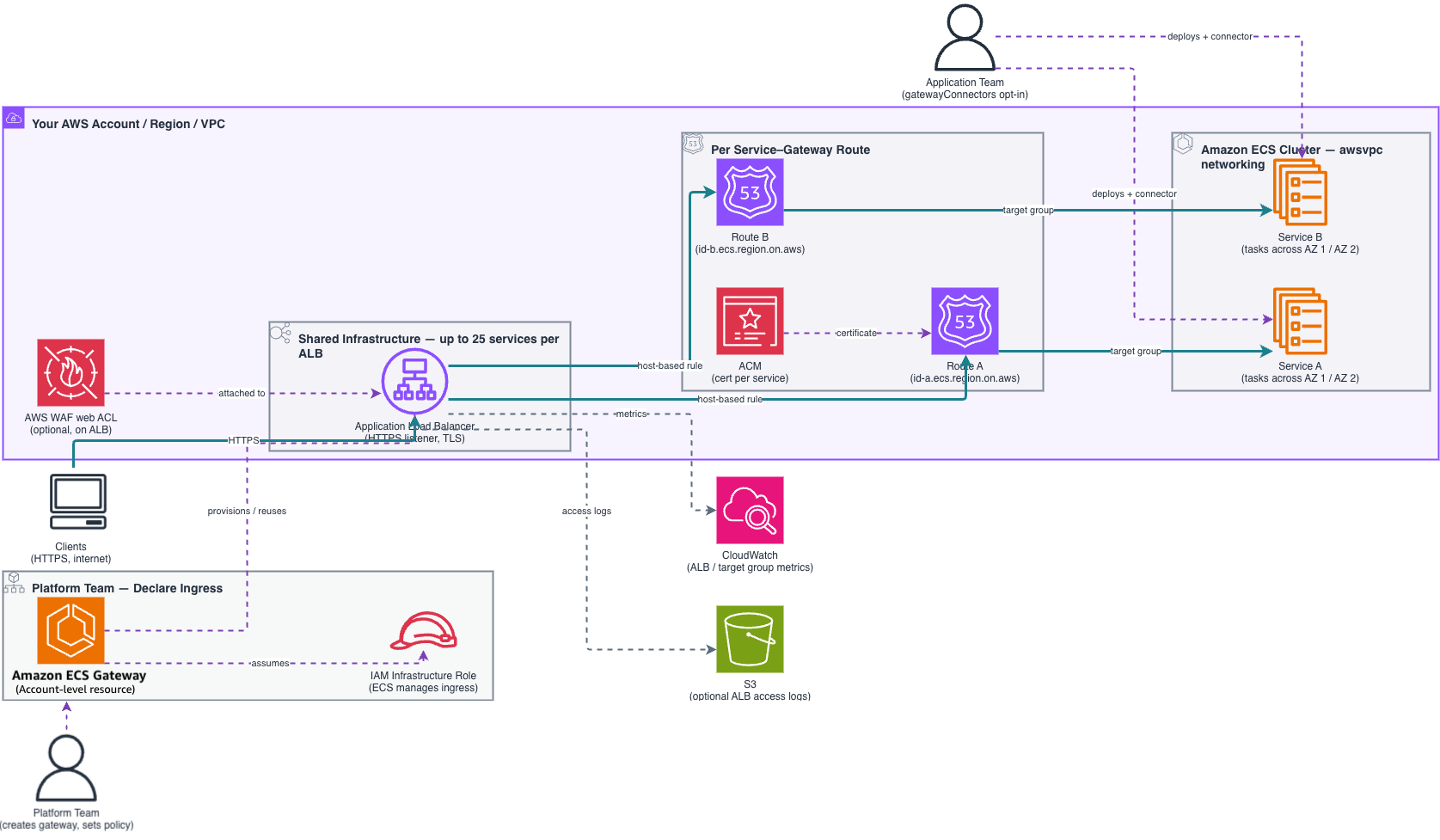
By introducing a clean separation of responsibilities between centralized platform teams and distributed application developers, ECS Gateway enables up to 25 container services to safely share a single Application Load Balancer through intelligent host-based routing. This optimizes infrastructure costs, slashes operational overhead, automates certificate and DNS lifecycle management, and ushers in a new era of frictionless, scalable microservices operations.

Detailed Chronology & Mechanics: How Amazon ECS Gateway Works
To understand the transformative impact of Amazon ECS Gateway, one must examine its technical architecture, lifecycle management, and day-two operational workflows. The feature was engineered from the ground up to bridge the gap between rigorous enterprise security governance and developer self-service enablement.
The Architectural Paradigm: Separation of Responsibilities
Before ECS Gateway, platform teams were trapped in a structural dilemma: either tightly couple networking provisioning to application pipelines—leading to fragile CI/CD scripts and exposed security boundaries—or act as a centralized bottleneck, manually reviewing and provisioning every load balancer and security group request.
ECS Gateway solves this by formalizing a clear operational boundary:
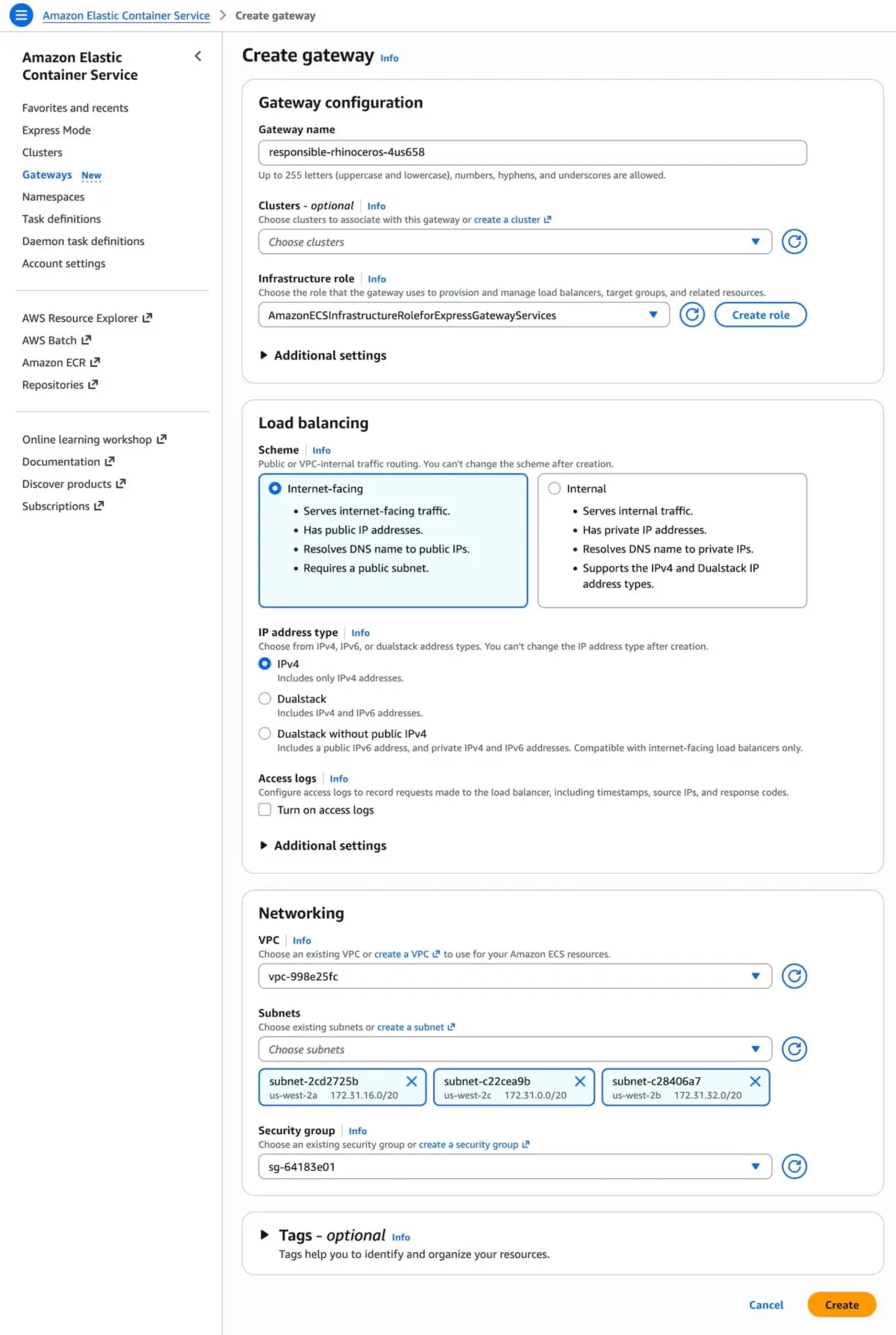
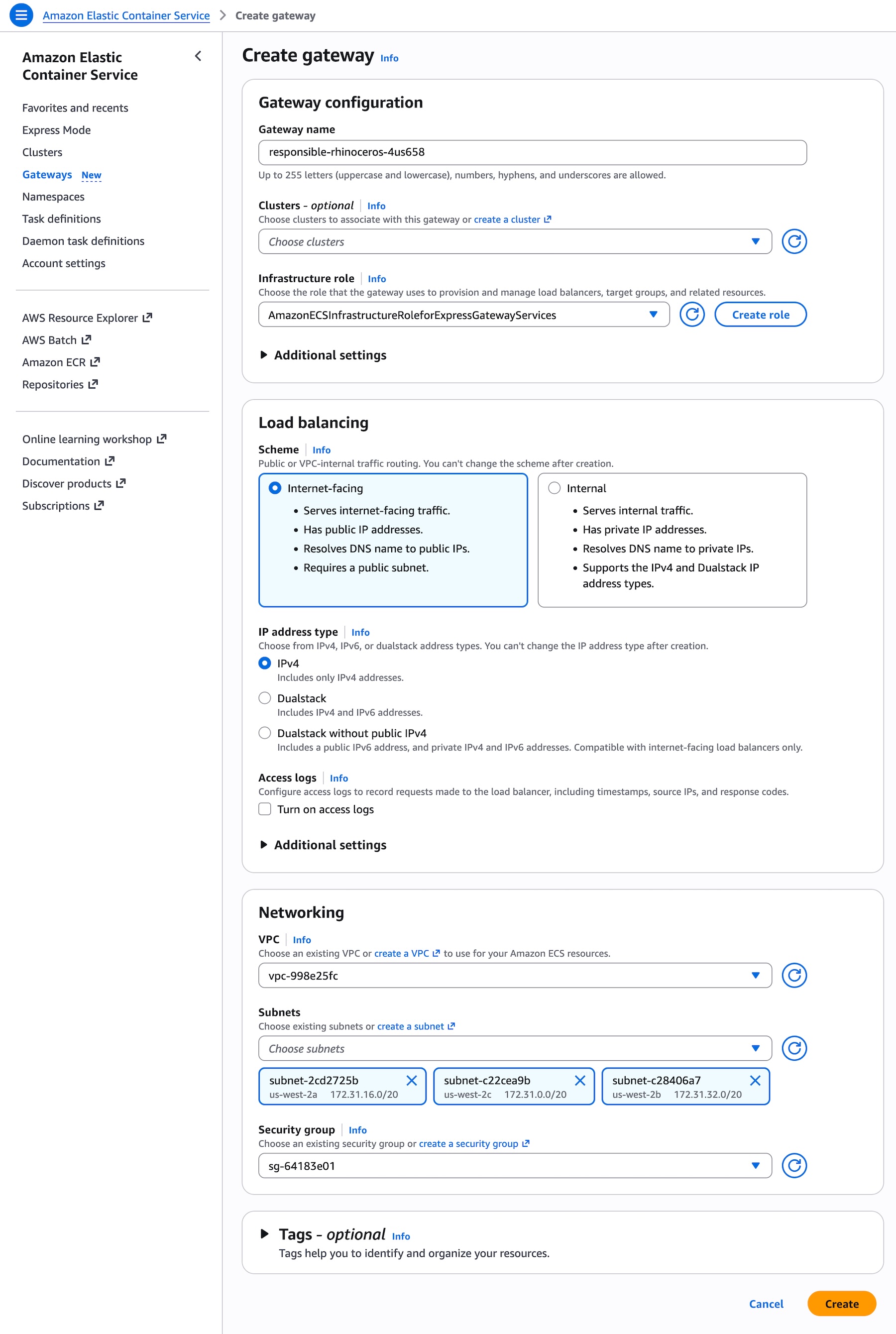
- Platform Teams establish the global security and networking posture. They define the gateways, assign appropriate IAM infrastructure roles, specify Virtual Private Clouds (VPCs) and subnets, and associate gateways with relevant ECS clusters.
- Application Teams simply attach a lightweight "gateway connector" to their service definitions. They do not need to interact with load balancer target groups, listener rules, or certificate chains; the system handles the heavy lifting automatically.
Provisioning and Lifecycle Management
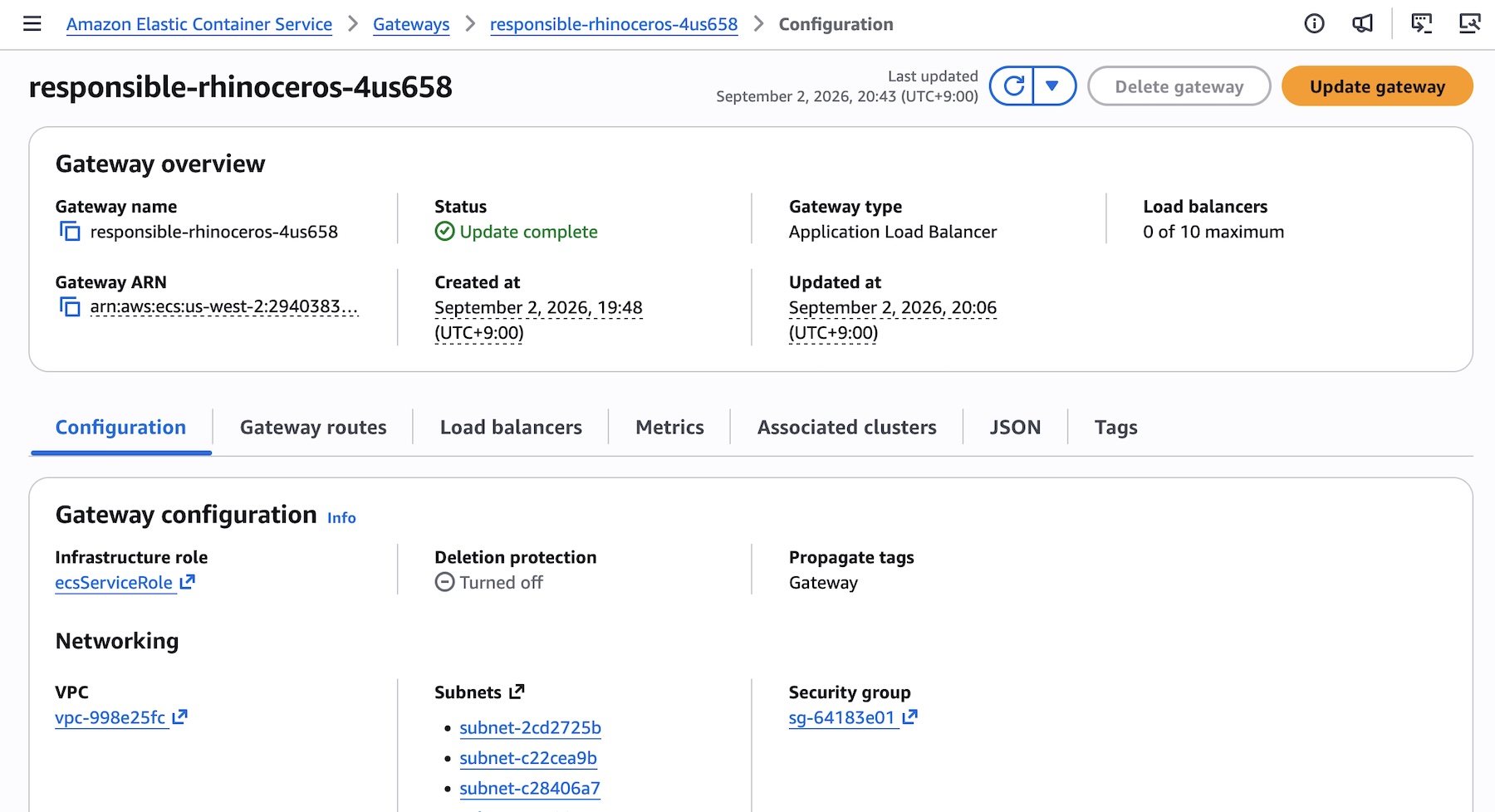
The journey of an ECS Gateway begins within the AWS Management Console or programmatically via the AWS Command Line Interface (AWS CLI). A platform administrator initiates the creation of a gateway by executing the CreateGateway API call, passing a unique account-level name, an IAM infrastructure role (which ECS assumes to manage underlying networking resources securely), and a comprehensive configuration object.
aws ecs create-gateway
  --name my-team-gateway
  --infrastructure-role-arn arn:aws:iam::123456789012:role/ECSGatewayRole
  --configuration '
    "HostSharedAlb":
      "networkConfiguration":
        "subnets": [
          "subnet-080779f9bd887757a",
          "subnet-03d5b2fead6bc6258",
          "subnet-0861210a397d31252",
          "subnet-06539e194023cb77a"
        ],
        "ipAddressType": "ipv4"
      ,
      "scheme": "internet-facing"

  '
Crucially, no underlying infrastructure is provisioned at the moment the gateway is created. This lazy-provisioning model ensures that cloud resources are only consumed when actual application workloads demand them, eliminating idle infrastructure costs.

Once the gateway exists, administrators establish a many-to-many relationship by associating the gateway with one or more ECS clusters (up to 10,000 clusters per gateway, and up to 5 gateway associations per cluster). This provides immense flexibility, allowing organizations to share a common ingress gateway across staging environments or assign distinct public and private gateways to specialized workloads.
aws ecs associate-gateway-with-cluster
--gateway my-team-gateway
--cluster arn:aws:ecs:us-east-1:123456789012:cluster/my-cluster
The Ingress Pipeline in Action
When an application team deploys or updates a service using the CreateService or UpdateService APIs, they include a gateway connector configuration:
aws ecs create-service
  --cluster my-cluster
  --service my-api-service
  --task-definition my-api-service:1
  --gateway-connectors '[ "portName": "api", "filters": "accessTypes": ["PUBLIC"], "healthCheck": ... ]'
At deployment time, Amazon ECS performs an automated compatibility check, evaluating the gateways associated with the cluster. A gateway is deemed compatible if:
- Its access type (public internet-facing vs. VPC-internal) matches the service’s connector filter.
- It resides within the same VPC as the container service.
- It encompasses all Availability Zones utilized by the service’s configured subnets.
Upon validating compatibility, Amazon ECS orchestrates a sophisticated provisioning sequence behind the scenes:
- ALB Assignment & Auto-Scaling: ECS evaluates existing Application Load Balancers associated with the gateway. If an active ALB has remaining host-routing capacity (supporting up to 25 services per ALB), the service is assigned to it. If capacity is exhausted, ECS automatically provisions a brand-new ALB, scaling infrastructure seamlessly up to the user-defined
maxAlbCountquota limit. - Per-Service Resource Creation: For the specific service, ECS dynamically provisions an ACM SSL/TLS certificate, generates a unique, ready-to-use DNS hostname, configures listener routing rules that direct incoming traffic for that hostname to the correct target group, and establishes a dedicated security group allowing inbound traffic exclusively from the ALB security group.
- Activation: Once health checks pass and provisioning completes, the gateway route transitions to an
ACTIVEstate, and the application’s unique URL is instantly live to accept production traffic.
Furthermore, teams utilizing existing ECS services with traditional, standalone load balancers can adopt ECS Gateway incrementally. By executing an UpdateService call to add a gateway connector, both ingress paths remain operational concurrently. This dual-path capability allows engineering teams to thoroughly validate their new gateway connections before deprecating and removing legacy load balancer configurations.
Supporting Context & Metrics: Solving the Configuration Drift Crisis
To appreciate the economic and architectural weight of Amazon ECS Gateway, one must examine the hidden costs of traditional container networking at scale.
In enterprise environments operating hundreds or thousands of microservices, infrastructure provisioning has historically been governed by Infrastructure-as-Code (IaC) pipelines using tools like Terraform, AWS CloudFormation, or Pulumi. While IaC provides reproducibility, it introduces a severe latency penalty when applied to micro-changes in ingress routing. Every time a development team spins up a new ephemeral preview environment or deploys a new service branch, IaC scripts must execute API calls across dozens of AWS services, often resulting in provisioning delays ranging from 5 to 15 minutes per service.
Multiply this delay across an organization launching 50 new microservices a month, and the lost engineering hours scale into the thousands. More insidiously, manual or semi-automated provisioning frequently leads to configuration drift. Over time, orphaned load balancer rules, unattached security groups, and expired SSL/TLS certificates accumulate in AWS accounts. These stray assets not only incur unnecessary financial waste—often totaling thousands of dollars per month in idle ALB hourly charges and fixed capacity fees—but they also create critical security blind spots and audit vulnerabilities.
Amazon ECS Gateway directly attacks these inefficiencies through three core pillars:
- Cost Optimization via Density: By intelligently multiplexing up to 25 containerized services behind a single Application Load Balancer using host-based routing, ECS Gateway drastically reduces the financial footprint of microservices architectures. Organizations no longer pay the fixed hourly baseline cost for an individual ALB per microservice.
- Elimination of Operational Toil: Automating the end-to-end lifecycle of ACM certificates, DNS mapping, target groups, and listener rules removes human error from the critical path of software delivery.
- Enhanced Security Posture: By enforcing strict, automated security group linkages between ALBs and container tasks, ECS Gateway ensures that perimeter controls remain airtight, preventing unauthorized lateral movement within the cluster VPC.
Official Statements & Industry Reception
The release of Amazon ECS Gateway has generated substantial excitement across the cloud architecture community, hailed as one of the most impactful operational enhancements to Amazon ECS in recent years.
Speaking on the launch, principal engineering leaders at AWS emphasized the philosophy of developer autonomy balanced with enterprise governance:
"Platform teams have long faced an impossible trade-off: either build complex, bespoke internal developer platforms to wrap infrastructure provisioning, or burden developers with low-level networking complexities that slow down feature delivery," noted senior product leadership during the rollout.
"With Amazon ECS Gateway, we are shifting the burden of infrastructure choreography away from humans and into the managed service layer. Platform teams define the guardrails once, and developers get instant, secure, production-grade ingress networking the exact second their containers spin up. It is the missing link in enterprise container self-service."
Early enterprise adopters participating in the private preview echoed these sentiments, highlighting dramatic reductions in deployment lead times. Financial technology firms and healthcare providers managing strict compliance boundaries noted that the ability to delegate secure cluster association while retaining strict IAM and VPC boundaries has streamlined their internal audit processes. By ensuring that all networking artifacts are created natively within the account under strict role governance, security teams maintain 100% visibility without sacrificing developer velocity.
Furthermore, AWS has ensured that modern developer workflows are fully integrated from day one. By supporting the AWS MCP (Model Context Protocol) Server and associated plugins, developers can query documentation, inspect gateway configurations, and manage ECS Gateway resources directly from their preferred AI-assisted coding tools and IDEs, cementing the feature’s place in the modern AI-augmented engineering stack.
Future Outlook: The Evolution of Cloud-Native Ingress
As we look toward the future of enterprise software architecture, the boundary between application code and underlying cloud infrastructure continues to dissolve. The introduction of Amazon ECS Gateway marks a definitive industry transition away from static, imperative infrastructure configuration toward intent-driven, dynamic orchestration.
In the coming months, industry analysts anticipate that the patterns pioneered by ECS Gateway—such as account-level multi-tenant resource pooling, automated DNS and certificate lifecycle management, and strict operational separation between platform administrators and application developers—will become the baseline expectation for all major container orchestration platforms.
For organizations running workloads on Amazon ECS, the immediate call to action is clear. Platform engineering leaders should audit their existing per-service load balancing architectures, identify sprawling fleets of underutilized Application Load Balancers, and begin planning the incremental migration of services toward ECS Gateway.
Amazon ECS Gateway is available today at no additional charge in all commercial AWS Regions where Amazon ECS is supported. Customers pay solely for the underlying AWS infrastructure provisioned in their accounts as services connect to gateways—including standard Application Load Balancer hourly charges and data transfer fees, CloudWatch logs and metrics, and ACM certificates.
By embracing this new architectural paradigm, enterprises can finally eliminate the networking bottleneck, drastically reduce their cloud infrastructure overhead, and empower their engineering teams to focus on what matters most: writing exceptional application code that delivers business value.