Executive Overview
With consecutive Academy Award wins for Best Director for Birdman (2014) and The Revenant (2015)—a feat matched among living filmmakers by very few—Alejandro G. Iñárritu occupies a singular tier within contemporary global cinema. He possesses both the rare industry clout and the fearless artistic audacity required to greenlight Digger.
An aggressively strange, financially heavy, star-studded enterprise, Digger defies easy categorization. Even after multiple viewings, the film remains an elusive cinematic beast: ostensibly a political satire featuring Tom Cruise buried under heavy prosthetics as a cartoonish, bombastic oil tycoon named Digger Rockwell, yet simultaneously something far darker, more tragic, and profoundly destabilizing.
In this exclusive deep dive, we examine the anatomy of Iñárritu’s most confounding project to date. Blending meticulous production design, high-stakes environmental warning, and theatrical metacommentary, Digger is designed to pull the rug out from under its audience. Below is an exhaustive breakdown of the film’s genesis, its tonal shifts, its heavy socio-political underpinnings, and what the auteur himself has to say about the terrifyingly prescient world that inspired it.
Detailed Chronology: From 2017 Drafts to London World Premiere
The genesis of Digger traces back nearly a decade. Iñárritu co-wrote the initial draft of the script alongside playwright and author Sabina Berman in 2017, long before global supply chains, extreme weather anomalies, and digital censorship reached their current boiling points.
[2017: Initial Draft] ──> [2024-2025: Production] ──> [Late Sept 2026: London Premiere] ──> [Oct 2: UK Release]
  Iñárritu & Berman         Shot on VistaVision;      World premiere met with          Cinematic rollout
  pen the screenplay        heavy artistic/tech       critical intrigue and            amid fierce public
  envisioning "Firewall"    collaboration             director reflection              debate
The Long Road to the Screen
When Iñárritu and Berman first conceived the narrative elements—specifically the concept of the "Firewall," an AI-driven mechanism designed to scrub terms like "global warming" and "Al Gore" from public consciousness—they worried it bordered on speculative absurdity.
"At that time, Sabina and I thought the Firewall was a crazy idea, and now it exists," Iñárritu reflects, speaking in a sunlit London hotel room in late September, just hours after the film’s high-profile world premiere.
Subsequent script revisions saw contributions from Alexander Dinelaris and Nicolás Giacobone, who helped refine the razor-sharp, overlapping dialogue rhythms. The production utilized rare VistaVision cameras to capture every inch of the frame with uncompromising fidelity, loading the background scenery with visual motifs, artistic homages, and historical Easter eggs.
The World Premiere and the Director’s Reflection
Sitting down with the 63-year-old Mexican director the morning after his premiere offers rare insight into his creative process. Having experienced the unpredictable audience reactions to his semi-autobiographical Netflix release Bardo, where he ultimately trimmed 15 minutes post-Venice, Iñárritu viewed Digger with a mixture of anxiety and liberation.
"I will never watch Digger the way you did," Iñárritu confesses, referring to the narrative blindsiding that defines the viewing experience. "I would have loved to have discovered the film as you did. Seeing a film with a real audience, it reveals itself to you. Sometimes I have doubts. But yesterday I felt serene. I wasn’t struggling, thinking, ‘This is too slow,’ or, ‘I should have kept that scene.’ It was a pleasant experience, strangely for me."
Supporting Context & Metrics: The Science, The Style, and The Satire
To understand Digger, one must abandon linear expectations of narrative delivery. The film operates on a pendulum, swinging wildly between screwball comedy and apocalyptic dread.

The Tonal Inversion
In his 2000 feature debut, Amores Perros, Iñárritu crafted a dark, unrelenting drama that abruptly pivots forty minutes in to feature a buoyant, life-affirming montage set to the hip-hop track "Si Señor." With Digger, a tragedy dressed up as a broad comedy, he reverses the trick.
- Act I: For the first half-hour, Tom Cruise’s line delivery is startlingly snappy, the production design is meticulously artificial, and the film introduces surreal comedic beats—including a meowing puppet cat designed explicitly for deadpan comic relief.
- Act II: The rug is violently pulled. The tone darkens into a bitter, existential nightmare. It is a transformation so radical that Iñárritu explicitly requested reviewers and press outlets withhold the narrative twist from public write-ups.
The Plot and the Players
At the center of the storm is Tom Cruise, delivering a performance that outstrips the manic intensity of his motivational speaker in Magnolia (and arguably outpaces even his off-screen tirades captured during pandemic-era Mission: Impossible shoots). Cruise’s Digger Rockwell spits venomous, rhythmic dialogue concerning his family’s Texan oil heritage, his manifest destiny, and his irreplaceable value to the American empire.
Crucial supporting performances match Cruise’s manic energy:
- Sandra Hüller plays Digger’s equally unstable, razor-sharp sister.
- John Goodman portrays a overtly misogynistic, out-of-touch US President.
- Riz Ahmed steps in as Ganesh, a methodical, truth-seeking scientist who brings devastating news.
+--------------------+---------------------------------------------------+
| Character          | Narrative Role & Symbolic Function                |
+--------------------+---------------------------------------------------+
| Digger Rockwell    | The avatar of unchecked capitalist greed & ego    |
| Ganesh (Riz Ahmed) | The voice of objective climate science & reality  |
| The US President   | A satirical representation of institutional denial  |
| Digger's Sister    | The chaotic manifestation of systemic corruption   |
+--------------------+---------------------------------------------------+
Climate Reality vs. Cinematic Fiction
Ganesh’s scientific discovery forms the ticking clock of the film: Digger’s relentless extraction of oil has accelerated the destabilization of a massive ice shelf—affectionately and chillingly nicknamed "Judy" by government officials—which threatens to trigger catastrophic flooding that could claim millions of lives across Europe and beyond.
When the President balks at the multi-trillion-dollar price tag of neutralizing Judy, Digger proposes a cheaper alternative: the "Firewall."
"Everything Ganesh says is the truth and science-based," Iñárritu emphasizes. "I worked with two different scientists, and travelled twice to the Arctic. They told me in 30 years we have a window to react. At that time, there had never been a detached ice shelf. Greenland wasn’t on the map of the United States. And now it is. We were ahead by ten years, and unfortunately that’s where we’re heading."
Official Statements & Artistic Inspirations
Digger is packed with visual and thematic homages, drawing inspiration from classical European art, theatrical absurdism, and self-aware Spanish-speaking literature.
Visual Architecture: Painting with Light and Whiteness
Working alongside legendary cinematographer Emmanuel "Chivo" Lubezki, Iñárritu sought a specific visual palette that would reflect the ideological vacuum at the heart of modern Western power structures.
"The faces don’t always have that shadowy thing. It’s mainly painters who use light like that. I used that because this is a film about white men taking power, and controlling the world, and operating on this level almost like ghosts. Chivo and I decided that if Digger is ruling the narrative, the colour is vanishing, and there’s the whiteness of the world we’re living in."
To ground this, the director drew heavy inspiration from master painters:
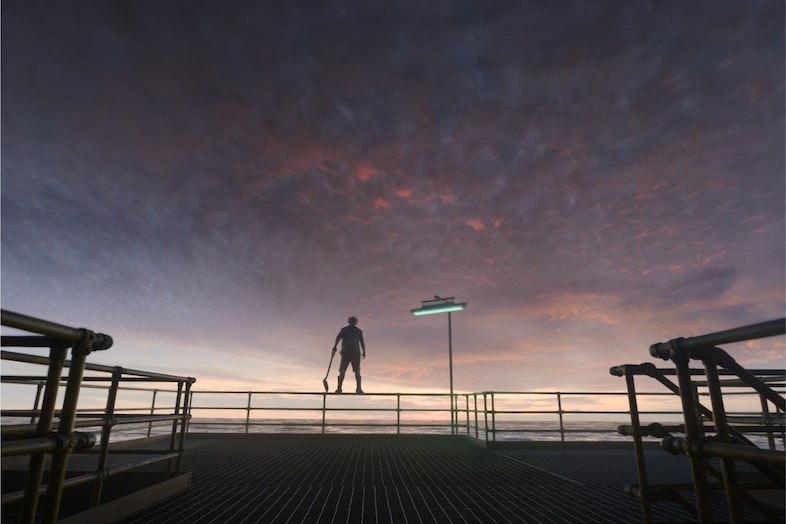
- Vilhelm Hammershøi and Johannes Vermeer for their muted, atmospheric use of color.
- Edward Hopper and Rembrandt for their stark, psychological approaches to light and contrast.
Cinematic and Literary Lineage
During pre-production, Iñárritu screened a curated masterclass list of films for his cast and crew to establish tone and rhythm:
- His Girl Friday (for rapid-fire dialogue timing)
- The Firemen’s Ball (Hoří, má panenko, for its chaotic, systemic absurdity)
- Network (for the sheer, blistering force of its central monologues)
Background set design also features subtle nods to cinematic history, including framed posters for John Cassavetes’ Opening Night and Ernst Lubitsch’s 1942 anti-Nazi wartime comedy To Be or Not to Be.
The literary DNA of the project runs equally deep, drawing on the self-aware, fragmented structures of Spanish-language masters like Ernesto Sabato, Julio Cortázar, Miguel de Unamuno, and Miguel de Cervantes.
Future Outlook: The Message to a Generation
As Digger prepares for its UK theatrical rollout on October 2, its ultimate impact is designed to transcend traditional box office metrics. It serves as a philosophical and political mirror held up to an increasingly fractured digital society.
[The Media Landscape] ──> [Constant Noise & Spin] ──> [The Audience's Choice]
  Powerful elites           "Compliance is freedom"    Decide which narrative
  control narratives        graffiti on concrete       to believe and fight for
Throughout the film, background details underscore the systemic coercion of the modern populace. A piece of ironic concrete graffiti spray-painted on a drab street corner reads simply: "COMPLIANCE IS FREEDOM." It is a reminder that the crisis explored in the film is not merely the fault of cartoonish billionaires like Digger Rockwell, but of a society that has grown comfortable participating in its own surveillance and pacification.
When asked about the tonal whiplash between screwball comedy and harrowing existential drama, Iñárritu ties the entire enterprise back to the fundamental utility of art in the 21st century.
"The film’s about storytelling," he concludes. "It’s about the stories we tell ourselves, the futility of art, and the importance of art as a way to explain ourselves when we’re dealing with so much reality. Theatre is a way to represent reality, and that representation is sometimes more real than reality because it allows us to see ourselves—and laugh about ourselves."
Addressing the younger generation sitting in multiplexes across the globe, the director issues a direct call to arms:
"This film is about your generation. You’re dealing with people taking the narrative and telling you that everything is fine, when you guys know that everything is not fine. You are being bombarded with narratives all day. Powerful people are controlling the narrative for their own interests. You have to decide which story you want to tell yourself."
Digger arrives in UK cinemas on October 2.