Executive Overview
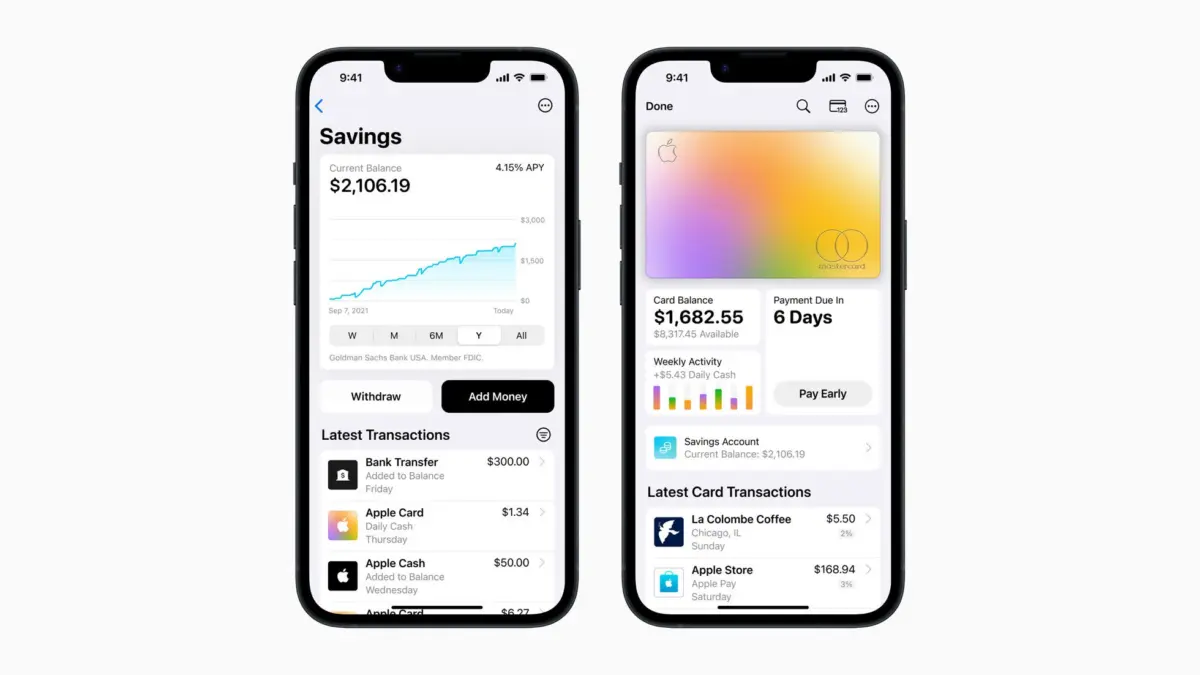
In a strategic maneuver that further blurs the traditional boundaries between Silicon Valley technology conglomerates and legacy financial institutions, Apple Inc. formally launched a high-yield savings account for Apple Card users on Monday. Developed in close partnership with Wall Street titan Goldman Sachs, the new financial product offers users an annual percentage yield (APY) of 4.15%.
This launch represents a significant escalation in Apple’s aggressive multi-year push into consumer finance. By integrating a competitive savings vehicle directly into the iOS Wallet app, the Cupertino-based tech giant is no longer merely facilitating transactions; it is actively intercepting and retaining consumer capital that would otherwise flow into traditional brick-and-mortar banking systems.
The mechanics of the account are designed for maximum user acquisition and seamless integration. Apple Card holders can now elect to automatically route their "Daily Cash"—the fractional cash-back rewards earned through everyday card usage—directly into the high-yield savings vehicle. Beyond automated rewards sweeping, users are permitted to deposit external funds directly from linked traditional bank accounts, up to a maximum balance threshold of $250,000, insured by the Federal Deposit Insurance Corporation (FDIC) through Goldman Sachs Bank USA.
While a 4.15% APY is not the absolute highest rate available in the fiercely competitive digital banking landscape, it represents a staggering multiple over the yields offered by traditional national banks. For context, legacy institutions such as Bank of America currently offer standard savings account yields as low as 0.01% APY. By pairing this financial incentive with the frictionless user experience native to Apple’s hardware and software ecosystem, the company is positioning itself as a formidable alternative to conventional retail banking.
This release follows closely on the heels of another major fintech rollout: Apple Pay Later, a "buy now, pay later" (BNPL) service introduced just weeks prior. Together, these offerings illustrate a cohesive, calculated blueprint. Apple is systematically constructing a closed-loop financial ecosystem designed to capture value at every stage of the consumer lifecycle—from point-of-sale financing to long-term wealth preservation.
Detailed Chronology: From Apple Pay to the High-Yield Savings Account
To fully understand the gravity of Apple’s latest financial foray, one must examine the methodical, patient chronology of the company’s expansion into the financial services sector. Apple has rarely rushed into regulated industries; instead, it lays foundational digital infrastructure years before introducing proprietary financial products.
1. The Foundation: Apple Pay (2014)
The genesis of Apple’s financial ecosystem dates back to October 2014 with the rollout of Apple Pay. Initially met with skepticism from a retail banking sector wary of ceding control over point-of-sale data, Apple Pay established the secure hardware and software tokens necessary to facilitate mobile payments. By leveraging the Secure Enclave on iPhone hardware, Apple proved it could handle sensitive financial transactions with bank-grade security without compromising user privacy. Over the subsequent decade, Apple Pay evolved from a novel convenience into the ubiquitous standard for contactless payments globally.
2. The Hardware-Software Synergy: Apple Card (2019)
If Apple Pay was the software bridge, the Apple Card—announced in March 2019 and launched that August—was the physical and digital anchor. Partnering with Goldman Sachs as the issuing bank and Mastercard as the payment network, Apple introduced a titanium credit card deeply integrated into the iOS Wallet app. Crucially, the card eliminated traditional fees, introduced real-time spending categorizations, and pioneered "Daily Cash"—instant cash-back rewards paid out daily rather than monthly. This feature laid the psychological and technical groundwork for the recent savings account integration.
3. Expanding the Credit Matrix: Apple Pay Later (March 2023)
In March 2023, Apple accelerated its fintech timeline by introducing Apple Pay Later, allowing users to split purchases into four installments spread over six weeks with zero interest and no hidden fees. Managed entirely through a wholly-owned subsidiary called Apple Financing LLC, this move signaled a shift. While Goldman Sachs continued to back the revolving credit of the Apple Card, Apple began taking on direct credit risk for installment loans, putting it in direct competition with established fintech giants such as Klarna, Affirm, and Block’s Afterpay.
4. The Capstone: High-Yield Savings Account (April 2023)
The launch of the high-yield savings account on April 17, 2023, serves as the logical capstone to this sequence. Having given users a way to spend (Apple Pay), a way to earn rewards (Apple Card Daily Cash), and a way to defer payments (Apple Pay Later), Apple completed the financial loop by giving users a place to save. By enabling customers to deposit external funds alongside their Daily Cash rewards, Apple transitioned from a transactional middleman into a repository for generational household wealth.
Supporting Context & Metrics: The War for Deposits
Apple’s entry into high-yield savings is occurring against a turbulent macroeconomic backdrop. The timing of the launch is neither accidental nor merely opportunistic; it is a calculated strike against a vulnerable traditional banking sector.
The Macroeconomic Environment
Throughout 2022 and early 2023, the U.S. Federal Reserve engaged in an aggressive monetary tightening cycle, rapidly raising the federal funds rate to combat persistent inflation. While this environment forced banks to increase borrowing costs for consumers and businesses, many traditional high-street banks were remarkably slow to pass those higher yields along to everyday savers.
Legacy institutions like Chase, Wells Fargo, and Bank of America have continued to trap billions of dollars in low-yield savings accounts paying a fraction of a percent (often between 0.01% and 0.04% APY), relying on customer inertia and branch convenience to retain deposits. Meanwhile, digital-first neo-banks and fintech platforms have aggressively courted yield-conscious consumers with rates hovering between 3.5% and 5.0%.
How Apple Stacks Up
By offering a 4.15% APY, Apple and Goldman Sachs immediately positioned themselves in the upper echelon of consumer deposit rates.
| Financial Institution / Product | Annual Percentage Yield (APY) | Account Minimums | Monthly Fees |
|---|---|---|---|
| Bank of America Savings | 0.01% | $25 (to open) | $8 (w/ waived conditions) |
| Chase Savings | 0.01% | $0 | $5 (w/ waived conditions) |
| Ally Bank Online Savings | 3.85% – 4.25% | $0 | $0 |
| Apple Card Savings (Goldman) | 4.15% | $0 | $0 |
While specialized high-yield competitors occasionally offer marginally higher rates (some crossing the 5.0% threshold depending on Federal Reserve adjustments), none possess Apple’s unique distribution advantage. An Apple Card holder can set up the savings account within seconds directly inside the iOS Wallet app, bypassing the cumbersome identity verification (KYC) bottlenecks and auxiliary paperwork typically associated with opening an account at a traditional online bank.
The Mechanics of Goldman Sachs’ Deposit Strategy
It is critical to analyze the role of Goldman Sachs in this partnership. For Goldman, the Apple Card and savings account represent the cornerstone of its consumer banking pivot, known internally as Marcus. After spending billions trying to build an independent consumer brand with Marcus, Goldman realized it lacked the low-cost customer acquisition engine possessed by big tech.
By partnering with Apple, Goldman outsourced user acquisition to the most valuable brand on earth. Goldman holds the deposits, provides the regulatory compliance, and manages the FDIC insurance backing, while Apple provides the frictionless digital interface. However, this partnership has not been without friction; industry reports have noted that Goldman’s consumer division has faced internal structural challenges and heavy financial overheads, making the low-cost deposit influx from Apple users a vital lifeline for Goldman’s funding model.
Official Statements and Corporate Vision
The strategic rationale behind the rollout was articulated clearly by Apple’s executive leadership during the launch. Rather than framing the product as an aggressive assault on Wall Street, Apple framed the initiative through its classic lens of user empowerment, ecosystem cohesion, and digital health.
Jennifer Bailey, Apple’s vice president of Apple Pay and Apple Wallet, underscored this philosophy in an official company statement:
"Our goal is to build tools that help users lead healthier financial lives, and building Savings into Apple Card in Wallet enables them to spend, send, and save Daily Cash directly and seamlessly — all from one place."
This framing is deliberate. By categorizing financial management under the umbrella of "health" (akin to Apple Watch fitness tracking and the iOS Health app), Apple normalizes the integration of personal finance into daily consumer habits. The messaging subtly implies that traditional banking—with its fragmented apps, hidden fees, and cumbersome interfaces—is inherently "unhealthy" and obsolete.
Furthermore, Apple emphasized that the account is built with absolute simplicity in mind: no hidden fees, no minimum deposit requirements, and no minimum balance constraints. Users can manage their entire financial lifecycle—checking rewards balances, transferring outside capital, monitoring interest accrued, and initiating withdrawals—without ever visiting a physical bank branch or speaking to a customer service representative.
Future Outlook: What’s Next for Apple Financial Services?
The launch of a 4.15% high-yield savings account is not a standalone experiment; it is a foundational building block for a much larger financial services architecture. As we look toward the future of fintech and consumer technology, several critical trajectories emerge.
1. International Expansion
Currently, the Apple Card savings account is restricted exclusively to U.S. consumers who hold an Apple Card. However, the underlying infrastructure is entirely scalable. Regulatory hurdles, differing central bank interest rates, and compliance frameworks across the European Union, United Kingdom, and Asia-Pacific regions remain complex. Nevertheless, industry analysts widely anticipate that Apple will seek to export its financial products internationally, leveraging existing partnerships with regional banking institutions to replicate the U.S. model abroad.
2. The Evolution into a "Super App"
In international markets—particularly across Asia with platforms like WeChat Pay and Alipay—the concept of the "super app" is a daily reality. These platforms combine messaging, social media, shopping, ride-hailing, and comprehensive banking into a single digital application.
While Western tech companies have historically struggled to replicate this model due to fragmented regulatory landscapes and user privacy concerns, Apple is uniquely positioned to achieve it. With the iOS Wallet app, Apple already controls the default mobile wallet for over a billion active iPhone users. By layering checking capabilities, peer-to-peer payments (Apple Cash), BNPL (Apple Pay Later), credit (Apple Card), and high-yield savings (Apple Savings) into a unified interface, Apple is quietly constructing the Western world’s most successful de facto financial super app.
3. Direct Lending and Beyond Goldman Sachs
As Apple’s financial footprint expands, questions inevitably arise regarding its long-term reliance on external banking partners like Goldman Sachs. While regulatory constraints prevent Apple from legally operating as a chartered bank in the United States without assuming immense systemic oversight, the company’s massive cash reserves and proprietary technological infrastructure give it immense leverage. Should Goldman Sachs or future partners falter in their appetite for consumer debt or deposit liabilities, Apple’s wholly-owned subsidiaries (such as Apple Financing LLC) signal a gradual, controlled willingness to bring more of the financial stack in-house.
4. The Threat to Legacy Retail Banking
The immediate victims of Apple’s financial expansion are not necessarily high-flying neo-banks like Chime or Wealthfront, but rather legacy national banks. Traditional institutions have long relied on "sticky" consumer deposits that earn near-zero interest, utilizing that cheap capital to fund highly profitable lending operations.
If millions of affluent, tech-savvy iPhone users begin sweeping their extra liquidity into an Apple-branded, Goldman-backed account yielding 4.15% (or higher, depending on macroeconomic shifts), legacy banks will face an uncomfortable choice: raise their own retail deposit rates across the board, thereby compressing their net interest margins, or watch capital steadily bleed out to Silicon Valley.
Conclusion
Apple’s introduction of a 4.15% high-yield savings account marks a pivotal watershed moment in the convergence of technology and finance. What began nearly a decade ago as a secure method for tapping a smartphone against a credit card terminal has evolved into a comprehensive, high-yield digital banking ecosystem.
By marrying Goldman Sachs’ regulatory and balance-sheet capabilities with Apple’s peerless hardware integration and user-experience design, the two giants have created a financial product that is both aggressively competitive and frictionless to adopt. While traditional banks sleepwalk through a high-interest-rate environment, offering negligible yields to complacent customers, Apple has provided its vast user base with a compelling, intelligent alternative.
As this ecosystem continues to mature, expand internationally, and incorporate new financial primitives, the question facing traditional financial institutions is no longer whether tech companies will disrupt banking. The disruption is already well underway, and Apple is holding the keys to the vault.