Executive Overview
In the heart of London’s Southbank, a monumental dialogue between contemporary painting and stark Brutalist architecture has taken root. Unveiled on 23 September, September—a striking two-panel installation by acclaimed artist Renée Levi—now flanks the iconic, deep-set rectangular window known locally as the "eye" of the Hayward Gallery. Co-commissioned by the Hayward Gallery and Audemars Piguet Contemporary, this site-specific work represents a historic milestone: it is Levi’s first large-scale public art commission in the United Kingdom and the inaugural painting ever commissioned by Audemars Piguet Contemporary in the fifteen-year history of its nomadic art programme.
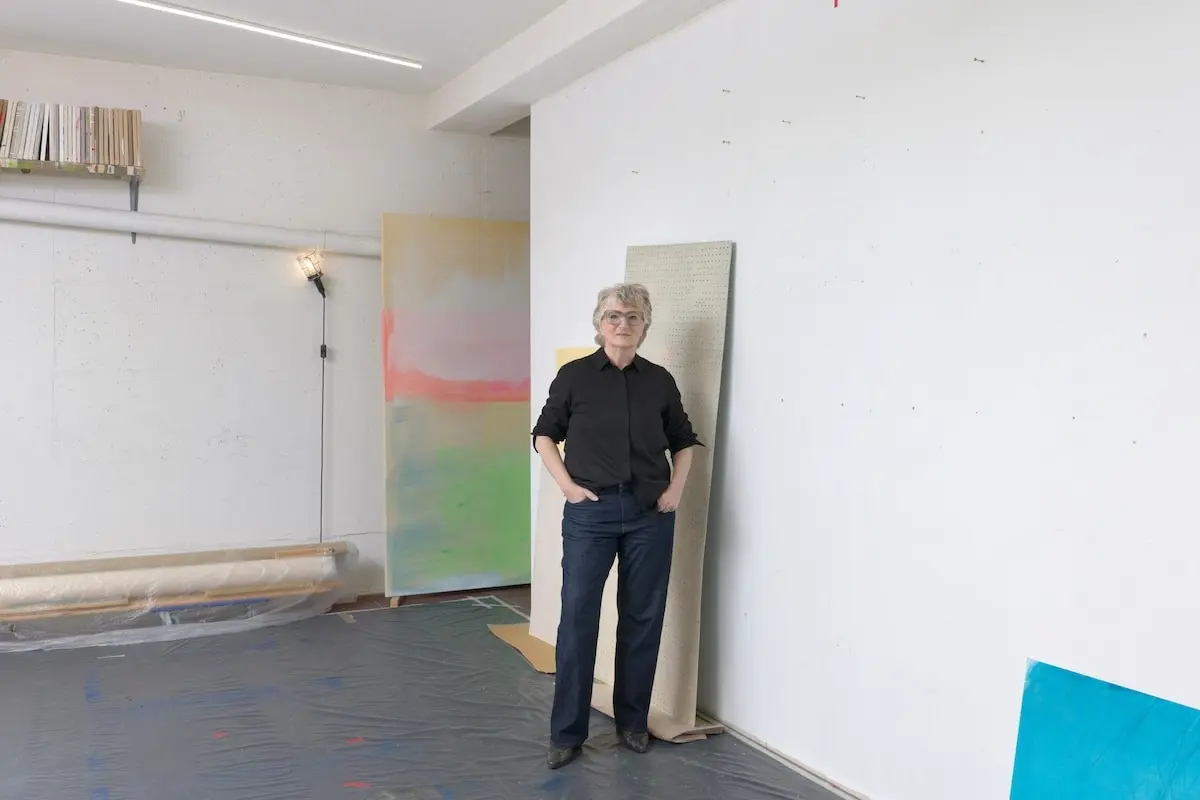
Before establishing herself as a pioneering figure in contemporary painting, Levi studied architecture, absorbing the foundational principles of how heavy structures bear loads, deflect weather systems, and channel natural light. For more than three decades, however, her artistic trajectory has done the precise inverse of traditional construction. Rather than erecting walls, she uses paint to conceal, reveal, and fundamentally reshape them. September marks the grandest physical manifestation of this philosophy to date.
Hanging in the open air, the installation is subject to the mercurial shifts of London’s autumn climate—transforming continuously under changing daylight, cast shadows, and intermittent rain. By applying chemical-infused fluorescent pigments onto an industrial mesh, Levi has created a porous visual barrier that challenges conventional perceptions of scale, surface, and space. On view to the public through 15 November, September invites viewers to reconsider the porous boundaries between fine art and urban infrastructure. In this exclusive feature, we examine the genesis of the project, trace the technical complexities of its execution, and explore the conceptual underpinnings of Levi’s enduring artistic practice through an in-depth interview with the artist herself.
Detailed Chronology: From Architectural Studies to Brutalist Canvas
The intellectual lineage of September stretches back decades, rooted in Renée Levi’s formative years as an architecture student. Training to understand the physics of buildings—how reinforced concrete bears weight, how façades seal out the elements, and how apertures invite light into dark interiors—imbued the young artist with a spatial consciousness that would ultimately dictate her pictorial language.
When Levi transitioned from structural design to painting, she carried these spatial mechanics with her. Over a career spanning more than thirty years, her interventions have consistently engaged with architectural surfaces. Instead of viewing a wall as a neutral backdrop for a framed artwork, Levi treats the architectural envelope as the primary medium itself. She uses color, line, and chemical pigments to perform surgical alterations on spatial volumes—veiling structural imperfections, highlighting brutal geometry, and altering the perceived depth of rooms and facades.
The commission for the Hayward Gallery represents the culmination of this lifelong fascination. Initiated through a collaborative co-commission between the Hayward Gallery and Audemars Piguet Contemporary, the project required an artist capable of engaging with one of London’s most polarizing and distinct pieces of Brutalist architecture. Built in the late 1960s from board-marked, raw cast concrete, the Hayward Gallery presents an imposing, fortress-like facade.
Levi approached this monumental canvas not as an outsider decorating a structure, but as an interventionist interrogating its skin. The centerpiece of her intervention frames the gallery’s iconic "eye"—the dramatic rectangular void that splits the southern elevation of the Brutalist building. By placing her two-panel painting on either side of this aperture, Levi created a dynamic frame within a frame, drawing the public’s eye toward the interplay between solid concrete and open air.
The fabrication process demanded rigorous experimentation. Working without compromise, Levi sought to construct a set of conditions that allowed for equal parts spontaneity and structural precision. She experimented extensively with the chemical signatures of fluorescent paints, testing how luminescent pigments would react when bonded to an industrial-grade mesh substrate. Because the work had to withstand unpredictable outdoor conditions—including high winds and heavy autumn precipitation—September was meticulously fabricated in sections. Each panel was thoroughly tested in the studio for structural integrity and visual resonance before being safely transported and assembled on-site at the Southbank landmark.
Supporting Context & Metrics: Audemars Piguet Contemporary and the Art of Nomadic Commissioning
To understand the scale and ambition of September, one must examine the institutional framework that helped bring it to life. Audemars Piguet Contemporary operates as a unique nomadic art programme, partnering with international artists to create ambitious, large-scale projects that might otherwise be unfeasible within traditional commercial gallery frameworks. Over the past fifteen years, the programme has commissioned more than 57 exhibitions globally, consistently seeking out visionaries who challenge the boundaries of their respective mediums.
The collaboration with Levi marks a significant institutional departure. While Audemars Piguet Contemporary has a rich history of supporting spatial installations, sculptures, and technologically complex media works, September stands as the very first painting commission in the programme’s history. This choice underscores the brand’s evolving commitment to expanding the definition of contemporary painting into the public and architectural sphere.
The metrics surrounding the project highlight its logistical and cultural weight:
- Duration: The installation is accessible to the public for a strictly limited window, running from 23 September through 15 November.
- Geographic Scope: This marks Levi’s debut large-scale public art installation within the United Kingdom.
- Institutional Partnership: A direct co-commission between the Hayward Gallery (a pillar of London’s Southbank Centre) and Audemars Piguet Contemporary.
- Global Footprint: September joins a roster of over 57 international artistic interventions supported by Audemars Piguet’s nomadic programme.
- Substrate Engineering: Custom-engineered industrial mesh paired with chemically reactive fluorescent pigments designed to endure severe environmental conditions.
The exhibition benefits immeasurably from curatorial leadership. The complex process of navigating structural engineering requirements, municipal safety regulations for public walkways, and the preservation guidelines of a listed Brutalist building was overseen by Audrey Teichmann of Audemars Piguet Contemporary and Yung Ma of the Hayward Gallery. Their collaborative support ensured that Levi’s uncompromising artistic vision could safely interface with the public realm.
Official Statements: In Conversation with Renée Levi
Amidst the installation’s run on the Southbank, we sat down with Renée Levi to discuss the intersection of architecture and painting, the mechanics of play, and her advice for the next generation of creators.
You’ve been known to say that every material has its own possibilities. What was the first thing you noticed about the Hayward Gallery facade?
Renée Levi: My comment referred to the surface on which the work was painted—in this case, the mesh. I perceived the Hayward facade primarily as a three-dimensional form.
Audemars Piguet Contemporary has been seeking out artists with strong conceptual visions for 15 years. How were the limits of your practice pushed as their first commissioned painter?
Renée Levi: I have realised several large-scale projects before, so working on this scale was nothing new to me. In this case, the key considerations were the listed building itself, its public presence and, above all, the safety of the public passageway in challenging wind conditions. The main challenge was reconciling the technical constraints with our artistic intentions. This would not have been possible without the understanding and support of both curators, Audrey Teichmann of Audemars Piguet Contemporary and Yung Ma of the Hayward Gallery.
September is in constant dialogue with its surroundings as it changes throughout the day. What do you think audiences will notice?
Renée Levi: There is a focus on the work as a whole, encompassing the upper part of the image, ‘the eye’ and the lower part. The focus then shifts to individual parts of the painting or drawing, and finally to the transparent and opaque areas of the image. The degree of transparency can vary depending on the light, the viewing angle and where you are standing. You can see through to the supporting framework and even the building’s facade beyond. I call this “X-ray vision.”
How do you maintain a state of play in the midst of trial and error and failure?
Renée Levi: For me, play is, above all, about working without expectations and without thinking in terms of success or failure. If something doesn’t work, you try something else. Sometimes, a chance occurrence is much more interesting than the result you originally imagined. In this sense, play means forgetting myself and sharing a laugh with the unknown within me.
“For me, play is, above all, about working without expectations and without thinking in terms of success or failure,” — Renée Levi
Is there anything you want to say to the artists of the next generation?
Renée Levi: Trust yourself! Don’t be overly swayed by feedback, whether positive or negative. Be curious about other people’s work. Don’t let works that seem similar to your own unsettle you. Think of them as a source of support: they should strengthen your confidence, not confuse you. Try to make friends and form a group to exchange ideas. Don’t take on too much. Take your time.
What do you look for when you first enter a space?
Renée Levi: Every place and its context are different, so I cannot establish a general rule. My state of mind also shapes how I perceive things, making it even harder to define one. I can only describe my experience on a case-by-case basis.
Does a painting begin as an action or an image for you?
Renée Levi: For me, painting begins with the conditions in which I work. At home, I make small pieces at a table. The scale of my work can vary depending on the size of the studio. A painting takes shape in circumstances that seem to have nothing to do with the image itself or the act of painting.
What has stayed constant in your practice over the years, and what has changed the most?
Renée Levi: Since I stopped teaching, my impatience has completely disappeared. The knowledge and experience I’ve accumulated over the years have given me a sense of lightness. My collaboration with Marcel has deepened, and the simple act of pencil touching paper has lost none of its fascination.
Future Outlook: The Legacy of September and Public Art Integration
As September remains on display at the Hayward Gallery through 15 November, the project serves as a compelling case study for the future of public art in urban spaces. The integration of high-impact contemporary painting onto heritage Brutalist architecture demonstrates that historic public buildings do not need to remain static monuments; rather, they can serve as active participants in ongoing cultural dialogues.
The success of this collaboration between the Hayward Gallery and Audemars Piguet Contemporary opens new pathways for how corporate patronage can intersect with public institutions. By supporting projects that demand rigorous technical engineering and uncompromising artistic vision, nomadic art programmes can facilitate cultural moments that transcend traditional gallery walls. For Levi, September marks a triumphant expansion of her architectural-pictorial vocabulary—proving that paint can indeed restructure our experience of the built environment.
For those wishing to experience the shifting transparencies, fluorescent chemical resonance, and architectural X-ray vision of September, the installation remains open to the public on the Hayward Gallery’s Brutalist facade through 15 November.