Executive Overview
In the sprawling, glittering constellation of Parisian monuments, the Arc de Triomphe stands as an unyielding testament to architectural mastery and historical endurance. In the parallel universe of contemporary electronic music, Belgian DJ, producer, and powerhouse label owner Charlotte de Witte occupies a remarkably similar tier of preeminence. Renowned for stripping techno down to its raw, pulsating fundamentals and driving the genre forward with uncompromising momentum, de Witte has quietly rewritten the rulebook of modern club culture to become an icon in her own right.
It is hardly a coincidence, therefore, that this formidable intersection of design, legacy, and raw power serves as the backdrop for Own the Arc, the striking new global campaign from Dutch denim innovator G-STAR.
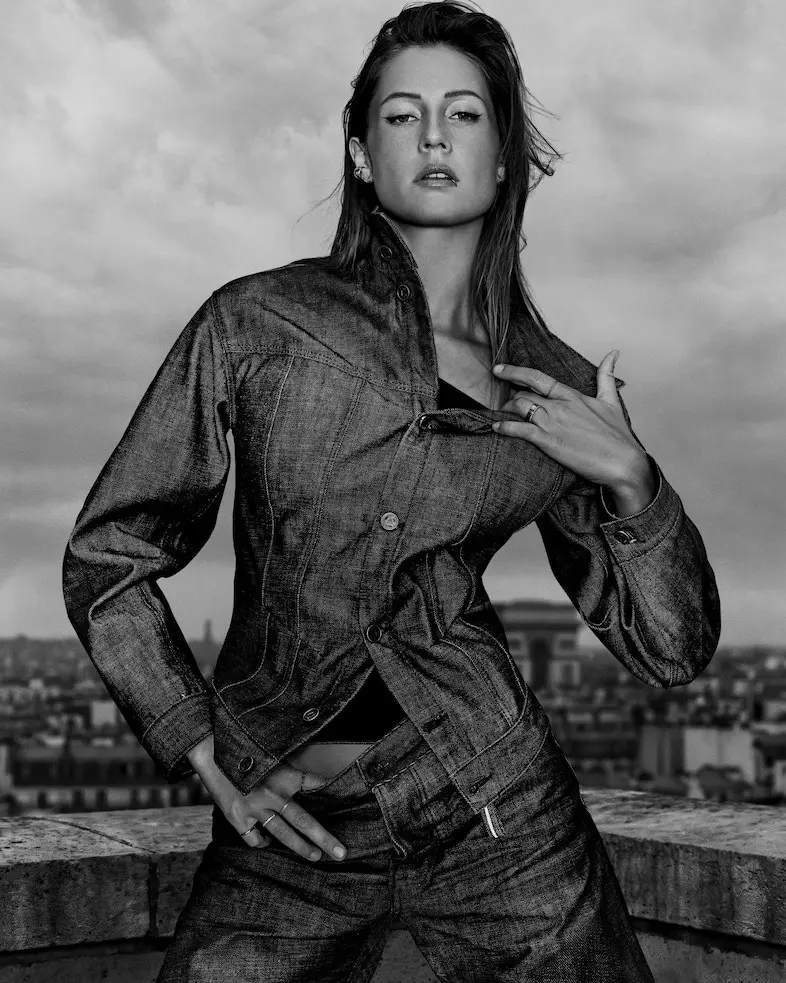
Earlier this month, G-STAR officially announced de Witte as its newest global brand ambassador—a strategic pairing that marries the avant-garde sensibilities of industrial denim design with the uncompromising, nocturnal energy of underground techno. Own the Arc represents the first fully realized creative output of this partnership, placing the techno titan front and center. Captured between grueling club nights and sold-out international tour dates, the campaign features a series of stark, high-contrast black-and-white portraits set against the cinematic expanse of the Paris skyline.
Beyond high fashion and striking visual motifs, the campaign serves as a multifaceted exploration of shared ethos: the engineered silhouettes of the French capital’s most famous arch mirroring the architectural precision of G-STAR’s signature Arc jean, all while echoing the tireless, nocturnal ascent of de Witte herself. This comprehensive report investigates the genesis of this partnership, the deep cultural intersections between denim and electronic music, and what this high-stakes collaboration signals for the future of both brands.
Detailed Chronology: From Underground Soundscapes to Global Campaigns
To fully appreciate the gravity of the Own one’s Arc campaign, one must trace the parallel trajectories of G-STAR and Charlotte de Witte—two entities that have spent decades meticulously constructing their respective reputations through a dedication to form, function, and fearless independence.
The Rise of a Techno Titan
Charlotte de Witte’s journey to global electronic music dominance was neither swift nor accidental. Emerging from the vibrant underground scene of Ghent, Belgium, she spent her formative years cutting her teeth in dimly lit clubs, playing under an alias before reclaiming her birth name and pivoting toward a harder, more hypnotic brand of techno. While many contemporary artists chase fleeting commercial trends, de Witte’s trajectory has been defined by a process of subtraction—stripping away unnecessary sonic fluffs to focus on driving basslines, atmospheric tension, and absolute sonic certainty.
Over the past decade, her resume has transformed into a masterclass in modern music industry dominance:
- 2015–2017: Establishing her signature dark, driving sound through foundational EPs on labels like Turbo Recordings and Novamute, alongside relentless international touring.
- 2019: Launching her imprint, KNTXT, which rapidly evolved from a localized event series in Ghent into a global powerhouse, hosting stage takeovers at the world’s most prestigious festivals, including Tomorrowland and Creamfields.
- 2020–2022: Making history as the first female artist to open the mainstage at Tomorrowland, alongside a string of Beatport chart-topping releases and massive livestream sets viewed by millions during global lockdowns.
- 2023–Present: Cementing her status as a global tastemaker, balancing a punishing global touring schedule with high-profile fashion collaborations, brand curation, and mentoring the next generation of underground producers.
The Evolution of G-STAR’s Design Philosophy
Simultaneously, Dutch denim brand G-STAR—founded in 1989—has carved out a legendary reputation for pushing the boundaries of garment construction. Eschewing traditional denim aesthetics in favor of architectural, 3D-engineered designs, the brand has continually treated denim not merely as a fabric, but as an industrial design medium.
The centerpiece of the current campaign is the return of the G-STAR Arc jean. First introduced over a decade ago, the Arc jean is characterized by its twisted seams, which create a uniquely bowed, architectural silhouette that wraps organically around the leg. Much like the monument from which it draws inspiration, the Arc jean was built to defy conventional flat-pattern cutting, prioritizing ergonomic movement and structural integrity.
When G-STAR’s design team began conceptualizing a global campaign to reintroduce this iconic silhouette to a new generation of fashion-conscious consumers, they needed a figure who embodied the same structural integrity, independence, and architectural power. They found that exact synthesis in Charlotte de Witte.
Supporting Context & Metrics: The Intersection of Music and Fashion
The marriage of electronic music and high fashion is far from a new phenomenon, but the nature of these collaborations has evolved dramatically in recent years. No longer content with simple logo placements or one-off capsule collections, modern luxury and streetwear brands are increasingly seeking out authentic cultural architects whose personal brands align seamlessly with their corporate identity.
The Demographics of Modern Techno and Denim
Industry analysts note that both high-end denim and underground techno share a remarkably similar consumer base: a digital-first, globally minded demographic that prioritizes authenticity, durability, and individuality over fleeting fast-fashion trends.
- Global Reach: Charlotte de Witte commands a digital footprint numbering in the millions across Instagram, Spotify, and YouTube, reaching a fiercely loyal demographic aged 18–35 across Europe, the Americas, and Asia.
- The Longevity Factor: According to recent retail data within the apparel sector, demand for functional, heritage-driven garments—such as heavy-weight denim and industrial-inspired outerwear—has seen a steady year-on-year increase. Consumers are investing in pieces that tell a story, mirroring the timeless appeal of underground vinyl culture and analogue-driven techno production.
The Visual Narrative of Own the Arc
Artistically, the Own the Arc campaign relies heavily on stark minimalism. Shot entirely in black and white, the portraits strip away the colorful distractions of modern advertising. Against the majestic backdrop of the Paris skyline and the geometric perfection of the Arc de Triomphe, de Witte is captured in moments of quiet intensity.
The styling deliberately highlights G-STAR’s signature approach to denim: structured jackets, form-fitting silhouettes, and industrial hardware that complement the DJ’s signature dark, utilitarian wardrobe. The visual parallel is unmistakable: just as the Arc de Triomphe was engineered to stand the test of time against the elements and historical upheaval, both de Witte’s career and G-STAR’s garments are built to withstand the rigors of relentless, high-pressure environments.
Official Statements and Industry Insights
The partnership represents a deeply personal alignment of values for both parties, moving far beyond a standard corporate endorsement deal.
Reflecting on the collaboration, Charlotte de Witte emphasized the natural synergy between her daily life and the brand’s core philosophy:
"I’ve always lived in denim. It’s functional, effortless, and has attitude, which feels very natural to me."
She further noted that the partnership was forged out of shared core values rather than superficial marketing metrics:
"Both G-STAR and I share an independent spirit and a strong point of view—the desire to build our own kinds of monuments. There’s a real connection between our worlds through music, fashion, and a global audience that values individuality."
From the brand’s perspective, the collaboration marks a pivotal evolution in how G-STAR approaches its women’s collections. Company representatives have noted that while the brand has historically drawn heavy inspiration from industrial design and utilitarian menswear, the partnership with de Witte allows them to pivot toward a more fluid, dynamic expression of femininity—one defined by strength, movement, and unyielding confidence.
As the brand noted in campaign briefs, the Arc de Triomphe was originally built to commemorate revolutionaries and those who forged new paths. By aligning with an artist who has relentlessly revolutionized the global techno landscape, G-STAR is signaling that its future collections will continue to honor those who refuse to follow the beaten path.
Future Outlook: What the Partnership Signals for Fashion and Music
As the Own the Arc campaign rolls out globally across digital platforms, billboards, and retail flagships, industry watchers are already looking ahead to what this partnership might foreshadow for the broader cultural landscape.
1. The Deepening Convergence of Subculture and Luxury
We are entering an era where traditional fashion houses and underground music subcultures are no longer adjacent worlds, but deeply intertwined ecosystems. Artists like Charlotte de Witte are functioning as modern creative directors, bridging the gap between high-concept design and raw, visceral nightlife experiences. Future iterations of the G-STAR and de Witte partnership are widely expected to explore limited-edition capsule collections, exclusive festival activations, and immersive multimedia installations that merge sound design with textile engineering.
2. A Redefinition of Women’s Denim and Workwear
For G-STAR, the campaign serves as a powerful opening salvo for a broader reimagining of its womenswear division. By centering the collection around a figure known for commanding massive festival stages in practical, high-impact attire, the brand is championing a form of empowerment rooted in utility and comfort. The message is clear: modern style does not require sacrificing functionality or strength.
3. The Legacy of the "Architects"
Ultimately, Own the Arc is about legacy. Whether it is Pierre Chalgrin’s neoclassical masterpiece anchoring the Place de la Étoile, G-STAR’s pioneering work with 3D denim construction, or Charlotte de Witte’s relentless curation of the global techno underground, all three pillars share a common obsession with structural perfection.
As de Witte continues to tour the globe, commanding sold-out crowds from Los Angeles to Tokyo while draped in G-STAR denim, she carries with her not just a brand, but a shared manifesto of architectural permanence in a disposable world. The campaign may have launched at the Arc de Triomphe, but for Charlotte de Witte and G-STAR, the monument is only the beginning.