Executive Overview
In a major development for the cloud data engineering landscape, Amazon Web Services (AWS) has announced the official general availability of AWS Glue 6.0. This flagship release introduces a fundamental modernization of the platform’s underlying architecture, marrying significant cost optimizations with deep integrations for next-generation open table formats. Most notably, AWS Glue 6.0 delivers a 30% price reduction compared to previous iterations, establishing a new benchmark for cost-efficiency in serverless data integration.
Built from the ground up on a modernized runtime stack—featuring Apache Spark 4.1, Python 3.13, and Scala 2.13—AWS Glue 6.0 aims to address the escalating performance and scalability demands of enterprise data lakes. Alongside these foundational runtime upgrades, the platform introduces complete support for the Apache Iceberg v3 specification (built on Iceberg 1.11.0). This includes the game-changing VARIANT data type with built-in shredding support, designed to dramatically accelerate queries on semi-structured data like JSON logs and real-time event streams without the traditional overhead of schema flattening or custom parsing pipelines.
By combining these performance enhancements with a comprehensive serverless model—retaining pay-as-you-go, second-by-second billing and a generous free tier for the AWS Glue Data Catalog—AWS is positioning Glue 6.0 as the definitive engine for modern extract, transform, and load (ETL) workflows, real-time streaming, and lakehouse architectures.
Detailed Chronology of the Release and Architectural Evolution
The path to AWS Glue 6.0 represents a multi-year engineering effort by AWS to align its fully managed serverless infrastructure with the rapid evolution of the open-source data ecosystem. Over the past several cycles, the data engineering community has shifted decisively toward open table formats, particularly Apache Iceberg, which allows for ACID transactions, time travel, and high-performance querying directly over object storage.
The Evolution Toward Spark 4.1 and Modern Runtimes
Historically, maintaining custom data processing pipelines required massive engineering overhead to manage cluster configurations, runtime dependencies, and version incompatibilities. AWS Glue abstracted much of this operational friction by introducing serverless Spark execution. However, as enterprise data volumes expanded into petabyte-scale territories, the demand for faster execution speeds, reduced memory footprints, and tighter integration with modern programming languages became paramount.
With the release of AWS Glue 6.0, AWS has leaped forward by adopting Apache Spark 4.1, the latest and most advanced iteration of the industry-standard processing engine. Coupled with Python 3.13 and Scala 2.13, this modern runtime engine provides developers and data engineers with access to cutting-edge language features, improved garbage collection, enhanced query optimization, and superior execution speeds for complex PySpark workloads.
Integrating Apache Iceberg v3
A cornerstone of the AWS Glue 6.0 release is its comprehensive support for the Apache Iceberg v3 specification (Iceberg 1.11.0). This integration makes AWS Glue the most complete Iceberg v3 implementation available on any fully serverless managed Spark service.
Semi-structured data—such as web traffic logs, IoT telemetry, application JSON outputs, and microservice event streams—has historically plagued data pipelines. Traditional approaches forced engineers to either flatten schemas into rigid tabular structures (leading to storage bloat and data duplication) or store raw strings that required expensive, custom parsing logic during every query execution.

AWS Glue 6.0 solves this via the introduction of the VARIANT data type with native shredding support. The VARIANT type allows storage engines to dissect semi-structured payloads at the storage layer. When queries are executed, the engine reads only the relevant shredded attributes rather than scanning and parsing entire string columns. This architectural shift yields orders-of-magnitude performance improvements for analytical queries touching complex, nested JSON or event data, while completely eliminating pipeline breakage when upstream schema evolution occurs.
Supporting Context, Economic Impact, and Technical Metrics
The 30% Price Reduction: Driving Down Total Cost of Ownership (TCO)
In enterprise data analytics, infrastructure costs can quickly spiral out of control as data lakes grow. By cutting prices by 30% across the board for AWS Glue 6.0 compared to previous versions, AWS is directly addressing corporate mandates for cost optimization and budget containment.
This price reduction does not come at the expense of performance. On the contrary, the combination of Apache Spark 4.1 optimizers and the efficiency of Iceberg v3 data layouts means that jobs complete faster, consume fewer resource units (DPUs—Data Processing Units), and incur significantly lower compute charges.
Pricing and Billing Model
The economic framework of AWS Glue 6.0 remains transparent, predictable, and developer-friendly:
- Crawlers and ETL Jobs: Users are billed an hourly rate, calculated on a second-by-second basis, for the precise duration required to discover metadata or execute data transformation and loading tasks. There are no idle charges or pre-provisioned cluster costs to manage.
- AWS Glue Data Catalog: Metadata storage and access are governed by a simplified monthly fee structure. To lower the barrier to entry for startups and enterprise development teams alike, the first million objects stored and the first million accesses are completely free.
Operational Simplification: Zero API Changes and Seamless Migration
A common friction point during major engine upgrades is the extensive refactoring required in application codebases and orchestration templates. AWS has mitigated this hurdle for Glue 6.0 by ensuring no API changes are required to adopt the new version.
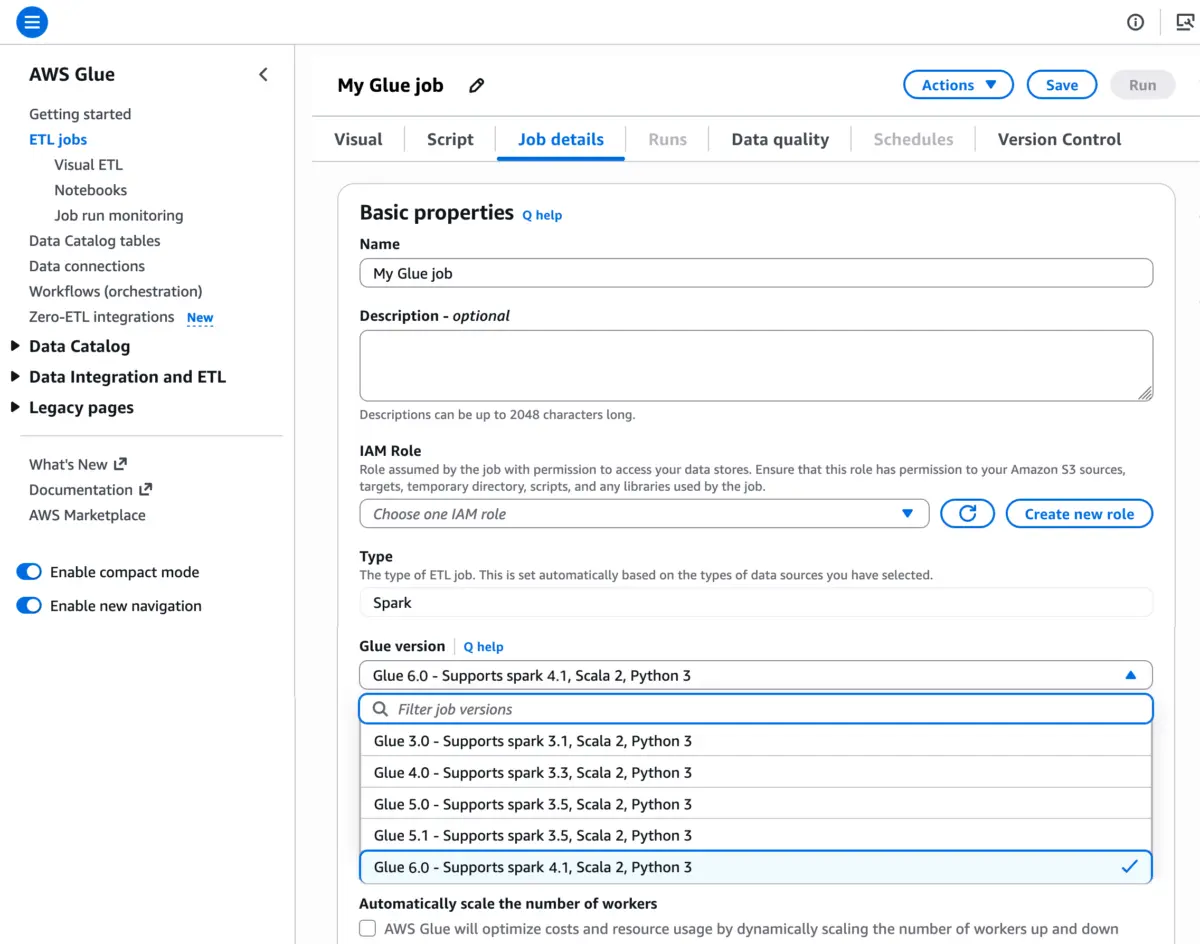
Data teams can seamlessly transition their infrastructure by adjusting the existing --glue-version parameter within their create-job or update-job API calls. This parameter can be modified across multiple deployment mechanisms:
- AWS Command Line Interface (AWS CLI)
- AWS SDKs
- AWS Glue Studio
- Amazon SageMaker Unified Studio
- Local or cloud-based IDEs
For interactive data exploration and notebook-based development, engineers utilizing AWS Glue Studio notebooks or Jupyter notebooks can instantly spin up a Glue 6.0 session by setting 6.0 in the %glue_version magic command.
To ease the migration burden for legacy workloads, AWS has integrated the Spark upgrade agent directly into AWS Glue Studio. Furthermore, an automated upgrade feature allows organizations to transition existing pipelines to Glue 6.0 with minimal manual intervention.

Official Statements and Industry Perspective
While specific executive quotes from the AWS leadership team emphasize the continuous drive toward serverless efficiency and open-source standards, the overarching message from the engineering team is clear: serverless data integration should be fast, cost-effective, and deeply compatible with modern open data formats.
Industry analysts have noted that the timing of AWS Glue 6.0 aligns with a broader industry consolidation around Apache Iceberg as the de facto standard for open data lakehouses. By offering a fully managed, serverless execution environment that natively understands Iceberg v3 and the VARIANT data type, AWS is effectively removing the operational barriers that previously prevented organizations from building enterprise-grade data lakes on open standards.
Furthermore, the introduction of the AWS MCP Server and associated AI plugins enables developers to interact with AWS Glue 6.0 documentation, search regional availability, call APIs, and troubleshoot runtime errors using their preferred AI-powered development tools. This integration underscores AWS’s commitment to developer productivity in the era of generative AI-assisted engineering.
Future Outlook: The Next Generation of Serverless Lakehouses
The general availability of AWS Glue 6.0 marks a pivotal milestone in the evolution of cloud-native data platforms. By aggressively reducing pricing by 30% while simultaneously introducing state-of-the-art runtimes (Spark 4.1, Python 3.13, Scala 2.13) and comprehensive Iceberg v3 support, AWS is setting a high bar for competing cloud data services.
Looking ahead, we can expect to see wider adoption of real-time streaming architectures running with single-digit millisecond latency on AWS Glue, powered by the optimized execution paths of Spark 4.1. As enterprises increasingly migrate away from proprietary data warehouses in favor of disaggregated, open-format lakehouses built on Amazon Simple Storage Service (Amazon S3) and Apache Iceberg, tools like AWS Glue 6.0 will serve as the connective tissue—orchestrating ingestion, transformation, and governance at global scale.
Organizations are encouraged to evaluate AWS Glue 6.0 immediately by navigating to the AWS Glue Studio console, selecting Glue 6.0 – Supports Spark 4.1, Scala 2, Python 3 within the Job Details tab, and leveraging the automated migration assistants to modernize their legacy pipelines. Regional availability spans all commercial AWS regions where AWS Glue currently operates, ensuring that global enterprises can deploy these optimizations without geographical constraints.