Executive Overview
In an era where cloud environments have scaled in both size and complexity, maintaining optimal infrastructure configuration remains one of the most persistent hurdles for engineering teams. Manual architectural reviews, periodic security audits, and reactive cost-cutting measures often fall short in fast-paced software development lifecycles.
To bridge this operational gap, Amazon Web Services (AWS) has announced the public preview of the AWS Well-Architected Agent. Billed as an advanced, AI-powered service, the Agent is designed to analyze an organization’s entire AWS footprint to deliver targeted, highly contextual recommendations aimed at maximizing performance, fortifying security, ensuring resilience, and driving down unnecessary costs.
Moving beyond static checklists and generic best-practice guidelines, the Well-Architected Agent functions much like a seasoned cloud architect embedded within an engineering team. By automatically synthesizing utilization metrics, intricate resource configurations, and application topologies against Well-Architected best practices spanning over 65 AWS services, the system evaluates cloud environments through the precise lens of an organization’s stated business goals.
Crucially, the public preview launch marks a strategic shift from passive reporting to active, context-aware optimization. Rather than simply highlighting misconfigurations or inefficiencies, the AWS Well-Architected Agent surfaces cross-pillar trade-offs and delivers ready-to-implement remediation packages. These range from direct AWS Management Console steps and CLI commands to precise code modifications for Infrastructure as Code (IaC) tools like Terraform, AWS CloudFormation, and the AWS Cloud Development Kit (CDK).
Available initially across select regions for customers holding qualifying AWS Support plans, the Well-Architected Agent introduces an automated, intelligent layer to cloud governance. This detailed report explores the technical architecture, core operational workflows, integration capabilities, and strategic implications of AWS’s latest enterprise offering.
Detailed Chronology: The Evolution of Cloud Architecture Reviews
To understand the magnitude of the AWS Well-Architected Agent, it is necessary to examine how cloud optimization and architectural reviews have evolved over the past decade.
The Era of Static Documentation and Manual Audits
When AWS first introduced the Well-Architected Framework in 2012, its primary objective was to provide architectural best practices for designing and operating reliable, secure, efficient, and cost-effective systems in the cloud. However, applying these principles relied heavily on human intervention. Cloud engineers, solutions architects, and system administrators had to manually parse documentation, cross-reference their architecture diagrams with operational realities, and complete exhaustive questionnaire-based reviews.
These manual audits, while thorough, suffered from systemic limitations:

- Point-in-Time Limitations: A manual review captured the state of an architecture at a single moment in time, rendering it obsolete almost immediately as development teams pushed new code and infrastructure updates.
- Siloed Expertise: Ensuring compliance across all six pillars of the Well-Architected Framework—Operational Excellence, Security, Reliability, Performance Efficiency, Cost Optimization, and Sustainability—often required consulting multiple domain experts within an enterprise.
- Friction in Remediation: Identifying a misconfiguration was only the first step; translating high-level recommendations into specific code adjustments or deployment scripts required significant manual engineering effort.
The Rise of Tooling and Automated Guardrails
Recognizing these challenges, AWS systematically introduced tooling to automate parts of the evaluation process. The launch of the AWS Well-Architected Tool digitized the review questionnaires, allowing teams to track architectural improvements over time. Furthermore, services like AWS Trusted Advisor and AWS Compute Optimizer began offering automated insights into specific operational metrics, cost anomalies, and security vulnerabilities.
Yet, a fundamental fragmentation persisted. While Trusted Advisor might flag an underutilized EC2 instance, and the Well-Architected Tool might identify a lack of multi-region redundancy, engineers were left to piece these disparate findings together. They had to manually weigh the trade-offs—such as whether increasing resilience via cross-region replication would violate budgetary constraints outlined in the cost-optimization pillar.
The Convergence of Generative AI and Cloud Governance
The public preview of the AWS Well-Architected Agent represents the logical convergence of generative AI capabilities with enterprise cloud management. By leveraging advanced language models and automated data correlation engines, AWS has transformed the Well-Architected Framework from a static reference manual into a dynamic, conversational, and prescriptive system.
Instead of forcing engineers to hunt for optimization opportunities across dozens of individual dashboards, the Well-Architected Agent unifies telemetry, resource metadata, and intent-driven business objectives into a single, cohesive interface. This marks the transition from descriptive analytics (what happened) and diagnostic analytics (why it happened) to prescriptive, automated execution (how to fix it, tailored to specific business contexts).
Core Capabilities and Operational Workflows
The AWS Well-Architected Agent is engineered to integrate smoothly into existing cloud operations, providing end-to-end oversight from pre-deployment validation to post-deployment monitoring.
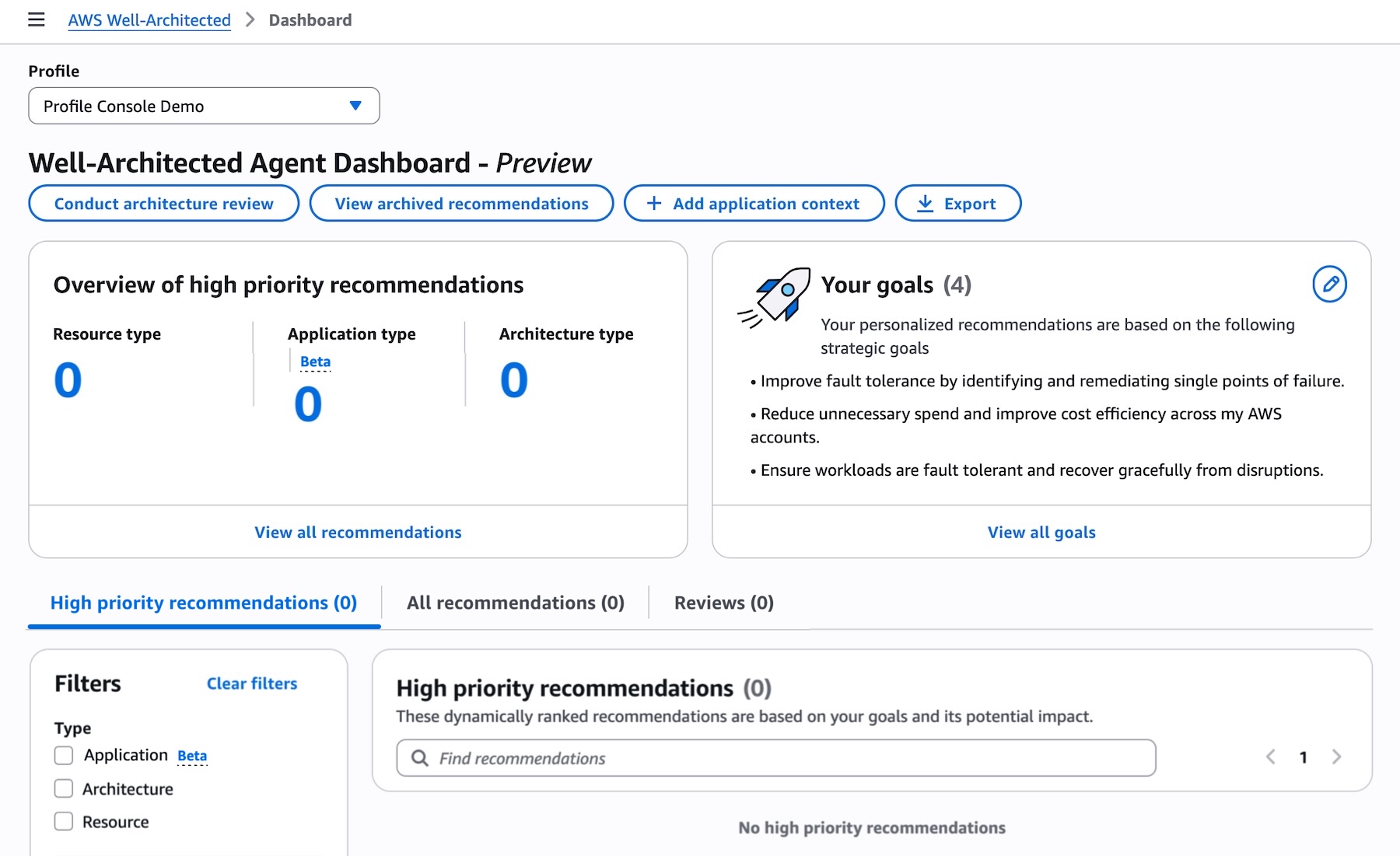
1. Creating an Agent Profile and Defining Scope
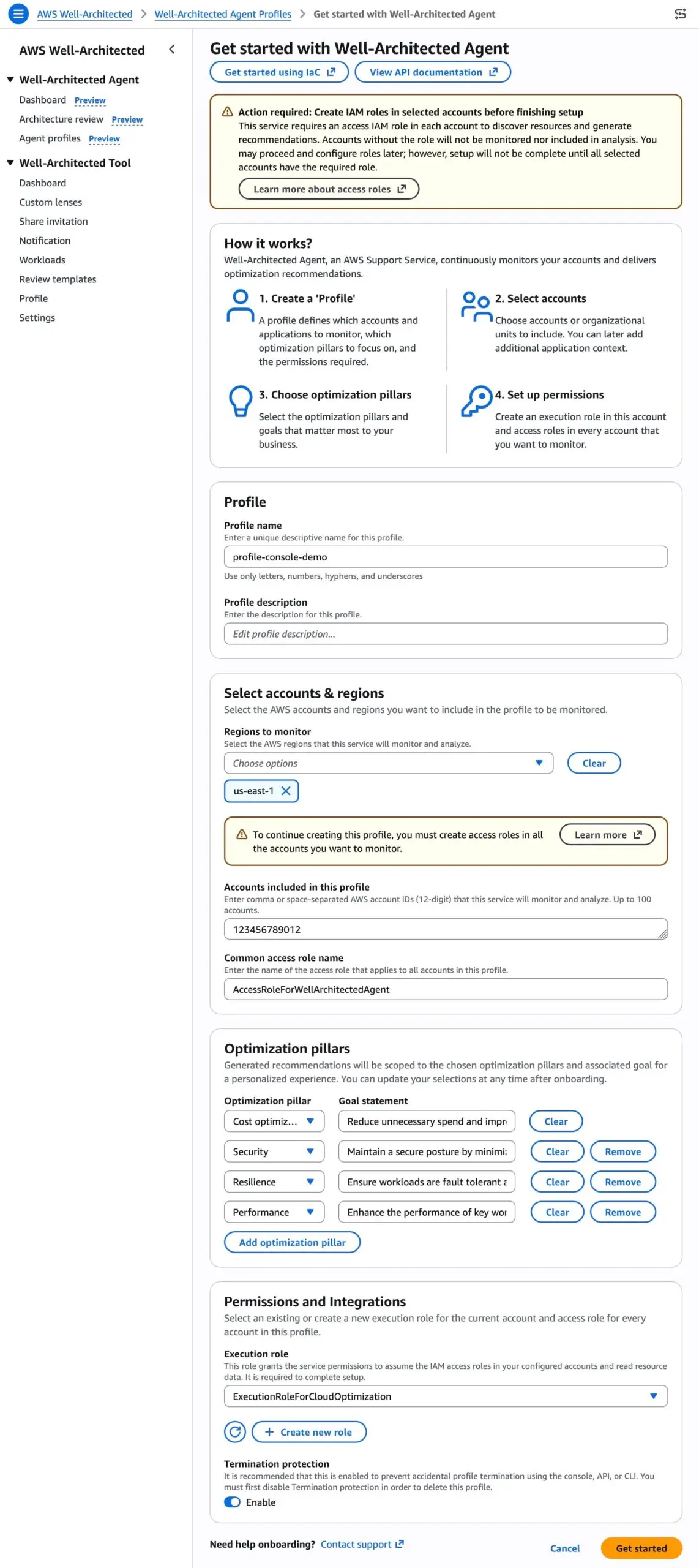
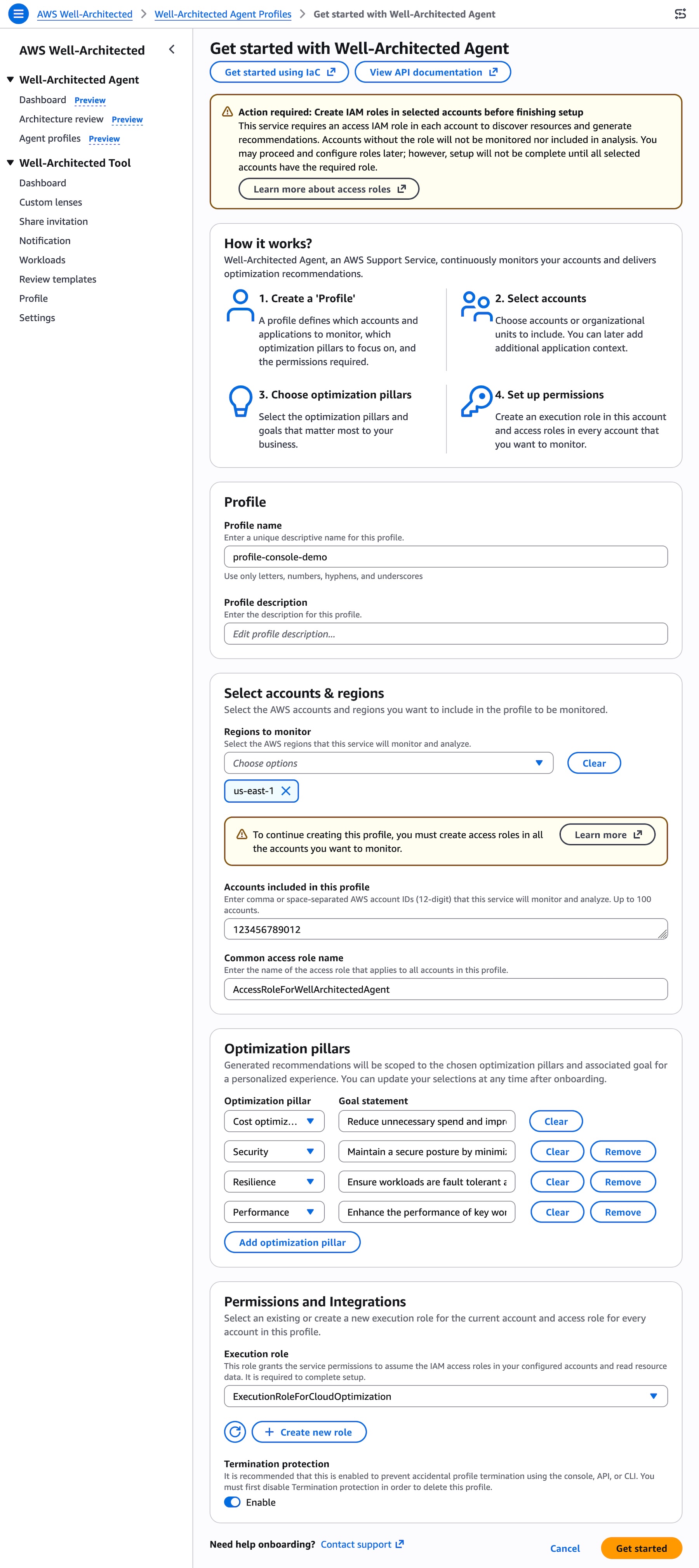
The journey with the Well-Architected Agent begins within the AWS Well-Architected console. Administrators initiate the process by selecting Get started with Well-Architected Agent, which opens the configuration wizard for building an agent profile.
An agent profile acts as the operational boundary and strategic compass for the AI service. Through this profile, platform engineers specify:
- Target Scope: The exact AWS accounts, organizational units, and AWS Regions that the agent is permitted to monitor and analyze.
- Pillar Focus: The specific optimization pillars prioritized by the business. While all pillars are evaluated, organizations can weight their goals toward cost reduction, latency minimization, high availability, or stringent security postures.
- Business Intent: Declared goals that allow the agent to contextualize its findings. For instance, an environment designated for mission-critical financial processing will prompt the agent to prioritize high-availability and security configurations over aggressive cost-saving instance rightsizing.
To securely grant the agent visibility into the cloud environment, administrators provision customer-managed IAM roles. These roles grant the agent read-only access to resource configurations, CloudWatch utilization metrics, and application topology maps without exposing sensitive application payloads. Once established, the agent initializes its baseline analysis, generating its first wave of comprehensive recommendations within 24 hours.
2. Pre-Deployment Architecture Reviews via IaC
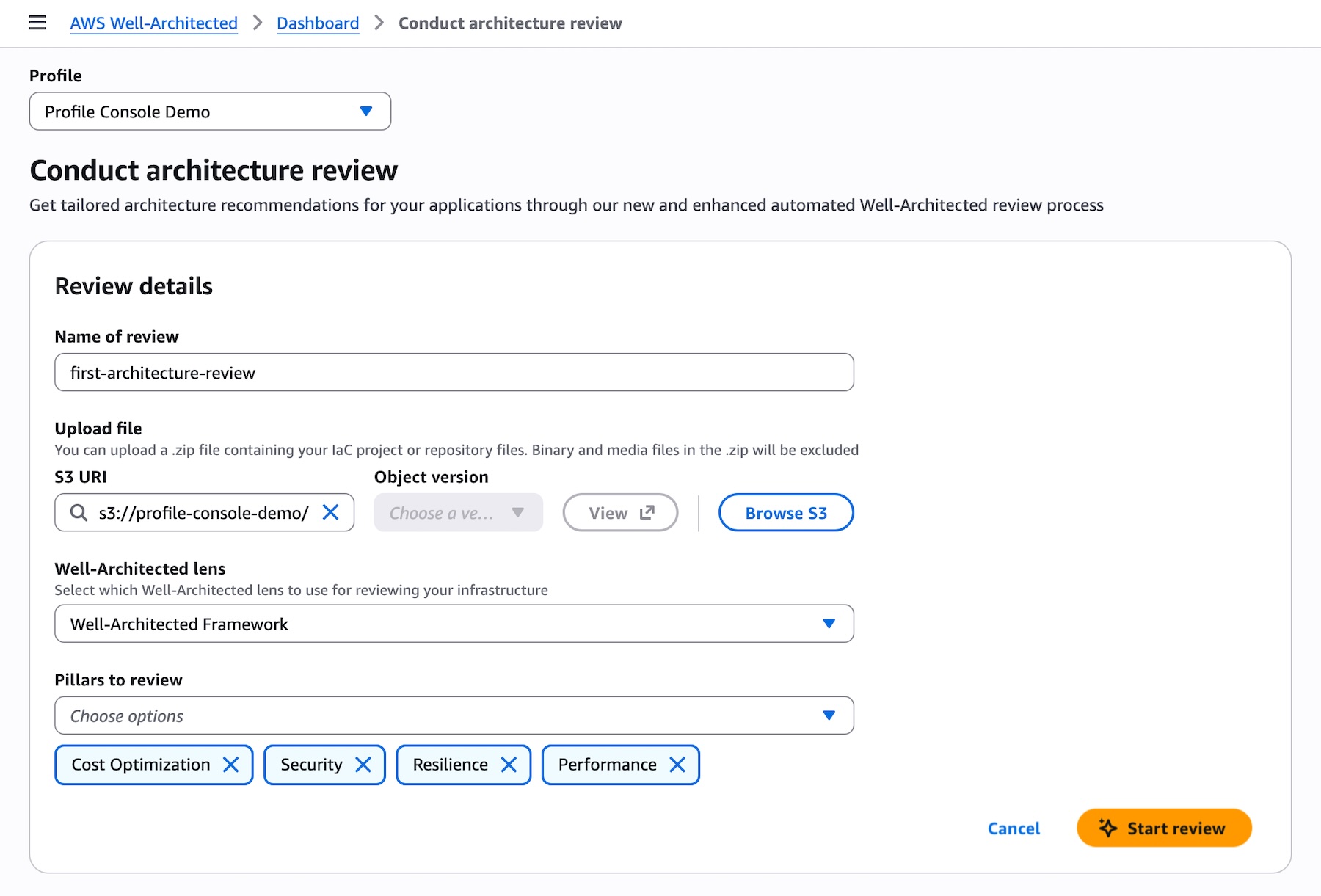
One of the most powerful features of the Well-Architected Agent is its ability to evaluate workloads before they are deployed to production. Modern cloud infrastructure is predominantly defined using Infrastructure as Code (IaC) frameworks. The Well-Architected Agent capitalizes on this paradigm by allowing teams to upload pre-deployment project repositories.
Engineering teams can package their IaC projects—whether written in HashiCorp Terraform, AWS CloudFormation, or the AWS Cloud Development Kit (CDK)—into a .zip file and upload them directly via the dashboard. The agent analyzes the code against the selected Well-Architected lens, identifying structural flaws, security group misconfigurations, scalability bottlenecks, and cost anti-patterns before a single resource is provisioned in the cloud. This shift-left capability ensures that architectural governance occurs at the earliest stages of the software development lifecycle.
3. Application-Centric Contextualization
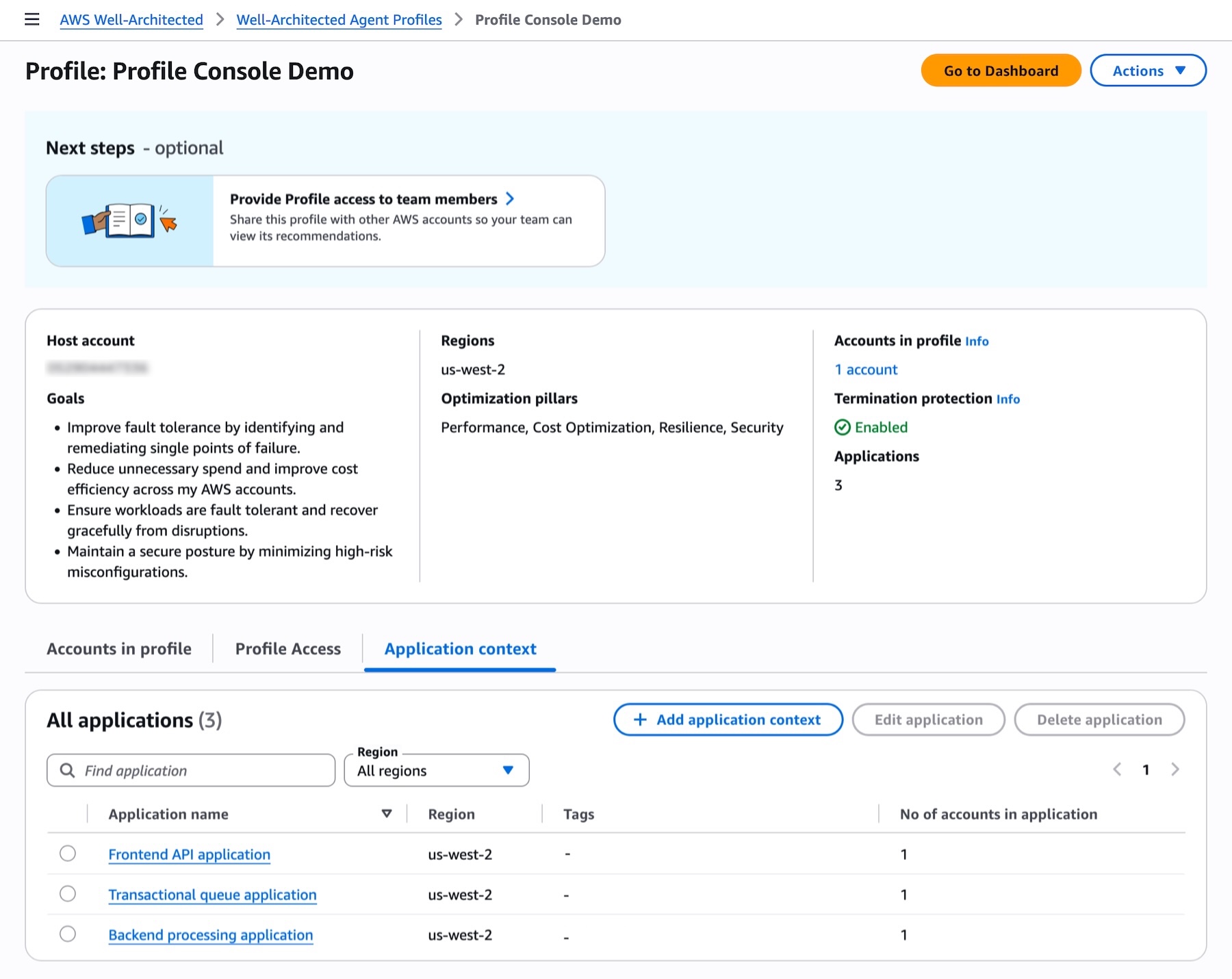
Generic cloud recommendations often fail because automated tools lack domain knowledge about how disparate resources function together to form a business application. The Well-Architected Agent addresses this by allowing developers to define explicit application contexts.
Within the dashboard, users can select Add application context to group resources using metadata tags, specific AWS accounts, regions, and services. By mapping underlying infrastructure to logical applications, the agent gains deep insight into service dependencies. This context drastically reduces false positives and ensures that recommendations reflect the true operational blast radius of any proposed architectural change.
Remediation and Integration Workflows
Identifying architectural drift and inefficiency is only valuable if remediation is frictionless. The Well-Architected Agent streamlines the path from insight to execution by offering prioritized recommendations coupled with multi-channel resolution paths.
Prioritized Findings and Trade-Off Analysis
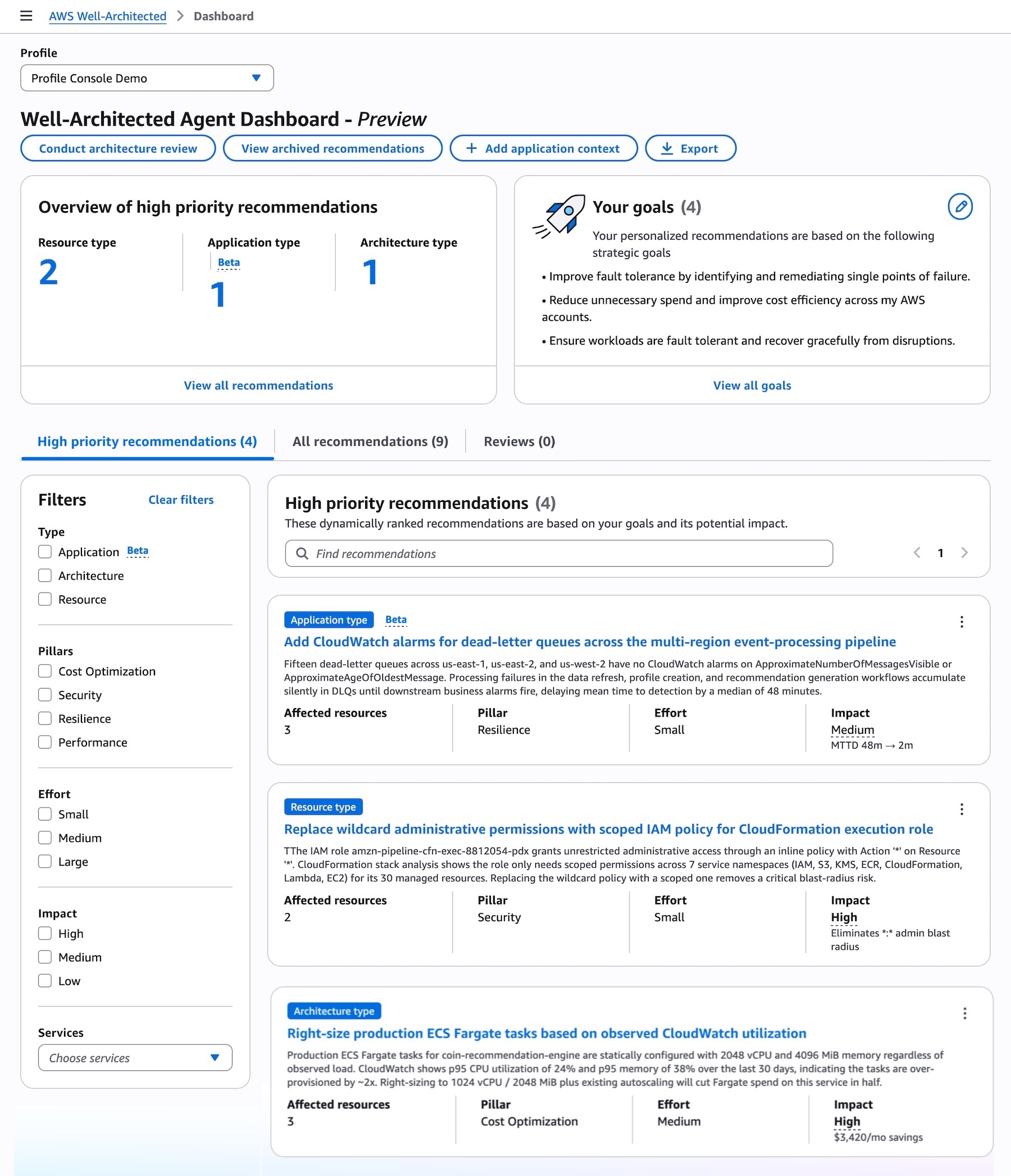
Once the agent analyzes an environment or IaC project, it presents findings on a prioritized dashboard. Each recommendation is ranked based on its potential impact on the organization’s declared business goals.
Crucially, the agent does not evaluate pillars in isolation. It surfaces cross-pillar trade-offs. For example, if a recommendation suggests provisioning a multi-AZ database replica to improve resilience, the agent explicitly highlights the corresponding cost implications and performance trade-offs. This transparency empowers engineering leaders to make informed, risk-adjusted decisions.
Multi-Channel Remediation
When an engineer selects a specific recommendation, the agent provides a detailed root-cause analysis explaining why the suggestion is being made, along with the affected resources. Users can then initiate remediation by clicking Start remediation, which offers three distinct resolution pathways:
- AWS Management Console: Step-by-step navigational guidance directing administrators to the exact console pages and settings required to apply the fix manually.
- CLI Commands: Ready-to-execute AWS Command Line Interface scripts designed for rapid, script-driven execution across environments.
- Updated IaC Templates: For teams utilizing Infrastructure as Code, the agent generates precise code diffs and updated template snippets (such as modified AWS CDK functions or CloudFormation YAML blocks). Engineers can copy these updates directly into their code repositories, maintaining single-source-of-truth version control.
Programmatic Integration via AWS MCP Server and Plugins
Recognizing that enterprise developers live inside integrated development environments (IDEs) and CI/CD pipelines rather than cloud consoles, AWS has built programmatic access into the Well-Architected Agent ecosystem.
By leveraging the AWS MCP (Model Context Protocol) Server and associated plugins, developers can integrate the Well-Architected Agent directly into their preferred AI coding assistants and development tools. This enables engineers to query architectural documentation, search for remediation patterns, and receive agent-driven recommendations without ever leaving their code editor.
Supporting Context & Strategic Metrics
The introduction of the Well-Architected Agent arrives at a critical juncture for enterprise IT spending and operational complexity. Industry data consistently underscores the friction inherent in cloud management:
- Cloud Waste: Independent industry surveys frequently estimate that organizations waste between 25% and 30% of their total cloud spend on idle resources, over-provisioned instances, and unoptimized storage tiers. Traditional manual audits struggle to keep pace with dynamic auto-scaling environments.
- Security Misconfigurations: Human error—specifically improper identity and access management (IAM) permissions, unencrypted data stores, and overly permissive security groups—remains the leading vector for cloud security incidents. Automated, continuous evaluation mitigates the window of exposure.
- Cognitive Load: As the AWS ecosystem expands to encompass over 200 fully featured services, expecting individual cloud architects to maintain expert-level fluency across every service domain is increasingly unrealistic. AI-driven agents act as force multipliers, democratizing deep architectural expertise across broader engineering organizations.
Coexisting alongside the traditional, manual AWS Well-Architected Tool—which continues to support user-defined custom lenses—the Well-Architected Agent represents the automation tier of AWS governance. It transforms cloud oversight from a periodic compliance exercise into an ongoing, intelligent dialogue between cloud infrastructure and business intent.
Future Outlook and Availability
The launch of the AWS Well-Architected Agent signals a broader industry shift toward autonomous, agentic AI systems designed to manage enterprise infrastructure. As these AI agents evolve from advisory roles to autonomous execution engines, the boundary between writing application code and managing underlying cloud infrastructure will continue to blur.
Availability and Onboarding
- Region Availability: During the initial public preview, direct access to the AWS Well-Architected Agent and its recommendation engine is provisioned in three key regions: US East (N. Virginia), US East (Ohio), and US West (Oregon). However, organizations can onboard and analyze workloads originating from any AWS commercial Region.
- Prerequisites: The service is delivered as an extension of AWS Support and is available to customers maintaining an active AWS Support plan.
Roadmap Considerations
Looking ahead, industry analysts anticipate that AWS will expand the agent’s capabilities to include automated, one-click remediation for a broader class of findings, deeper integration with enterprise ticketing and incident management systems (such as Jira and PagerDuty), and expanded support for multi-cloud and hybrid architectures through AWS Outposts and Amazon ECS/EKS hybrid deployments.
For cloud architects, DevOps engineers, and IT executives, the AWS Well-Architected Agent offers a compelling glimpse into the future of cloud operations: an environment where artificial intelligence absorbs the heavy lifting of continuous governance, freeing human engineers to focus on building innovative products that drive business value.
The public preview is open today within the AWS Well-Architected console, with customer feedback channeled directly through standard AWS Support pathways.