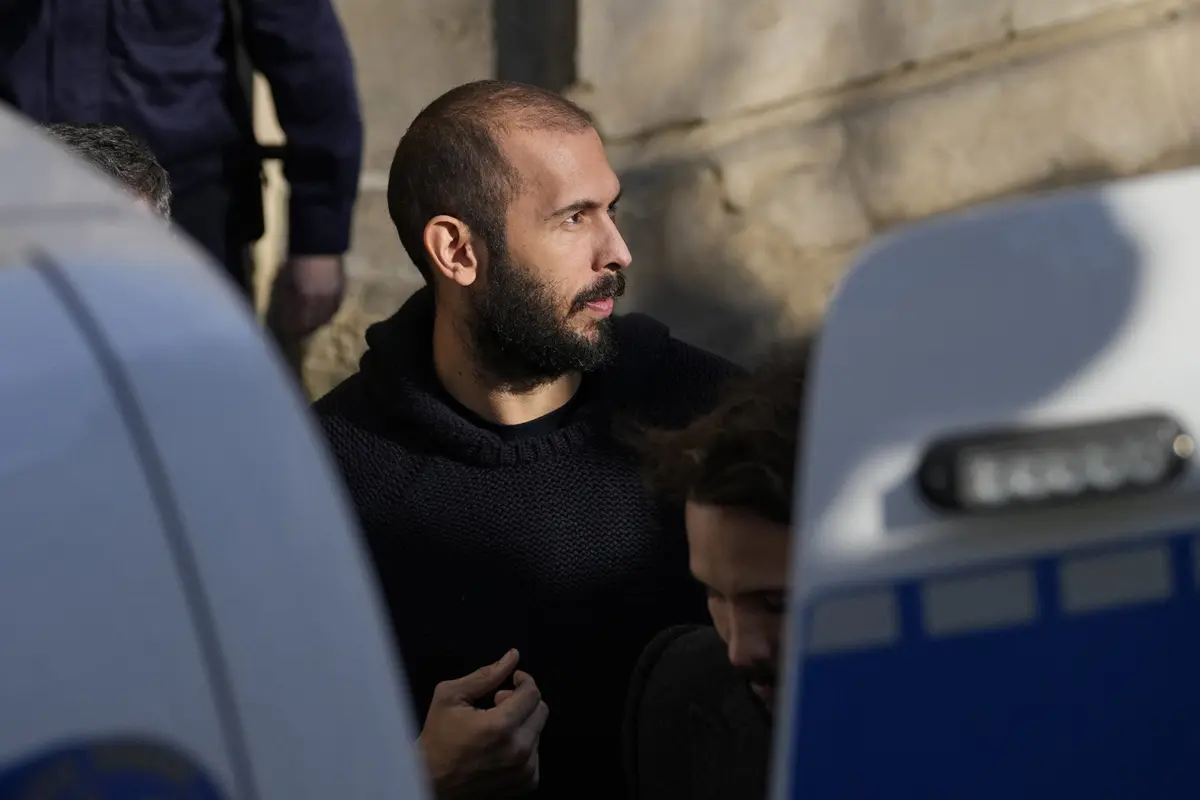
BUCHAREST — In the murky intersection of social media notoriety, organized crime investigations, and geopolitical intrigue, few figures have commanded as much relentless global attention over the past year as the controversial influencer Andrew Tate. Together with his brother, Tristan, and two alleged accomplices, Georgiana Naghel and Luana Radu, the self-described misogynistic media personality found himself at the center of a high-stakes legal tempest in Romania, the country they adopted as a base of operations.
While late March brought a temporary legal reprieve when a Bucharest appeals court granted the quartet a transition from harsh central detention to house arrest, a mountain of investigative records, court filings, and leaked wiretaps reveals a starkly different reality beneath the surface. According to Romanian prosecutors, legal experts, and court documents obtained via freedom of information requests, the Tate brothers’ aggressive attempts to control the narrative, intimidate witnesses, and engineer an escape from behind bars have severely backfired. Far from securing their freedom, their calculated moves inside detention may have laid the groundwork for entirely new criminal investigations, deeply alienating the judiciary and ensuring that their upcoming trial will be fraught with heightened legal peril.
Executive Overview
The journey of Andrew and Tristan Tate from internet infamy to Romanian correctional facilities began in the dramatic predawn hours of December 29, when special forces raided their sprawling compound north of Bucharest. Arrested on suspicion of human trafficking, organized crime, and forming an organized criminal group to sexually exploit women, the brothers faced immediate scrutiny from the Directorate for Investigating Organized Crime and Terrorism (DIICOT).
While their defense teams have continuously maintained their innocence—framing the prosecution as a politically motivated witch hunt orchestrated by shadowy adversaries—internal court documents tell a tale of active obstruction. Prosecutors allege that while incarcerated, Andrew Tate plotted a clandestine escape to Dubai under the guise of urgent medical treatment, orchestrated pressure campaigns against key witnesses through his massive digital army, and attempted to forge alliances with controversial right-wing politicians. Meanwhile, co-defendant Luana Radu, a former police officer, allegedly leveraged unauthorized access to classified law enforcement databases to grant the group an unfair tactical advantage.
This executive summary outlines the cascading legal blunders that have defined the Tates’ period of detention. Legal scholars in Bucharest warn that the profound "irritation" exhibited by judges toward the defendants’ extra-judicial maneuvers will cast a long shadow over their upcoming trial, fundamentally altering how judicial bodies interpret their future testimony and potentially expanding the scope of the indictments against them.
Detailed Chronology of Detention and Legal Escalation
To understand the precarious legal tightrope the Tate brothers are currently walking, it is necessary to examine the timeline of events that transpired between their initial December apprehension and their eventual relocation to house arrest at the end of March.
Phase One: The December Raid and Initial Detention (Late December 2022)
When DIICOT agents swept into the Tates’ Pipera compound, the immediate public reaction was one of shock, followed swiftly by polarization. Supporters rallied online, claiming the brothers were targeted for their conservative and anti-establishment viewpoints. However, within the Romanian judicial system, the initial files presented a grim narrative of alleged human trafficking, coercion, and systematic abuse. The court quickly ordered a 30-day preventive arrest, a period that was subsequently extended multiple times as prosecutors gathered a mountain of digital and testimonial evidence.
Phase Two: The Escalation of Obstruction (January – February 2023)
As the investigation deepened, prosecutors uncovered what they termed a coordinated multi-pronged strategy by the defendants to derail the judicial process. Court documents from a pivotal February 21 court session highlighted "new reasons" for keeping the brothers locked in the central arrest building.
Central to the prosecution’s concerns during this window was an alleged plot to flee the jurisdiction. Wiretaps of jailhouse phone calls captured Andrew Tate discussing plans to travel to Dubai under the pretext of receiving treatment for a dark spot on his lung—a condition initially described by a representative as a probable tumor, but later downgraded by Andrew himself on Twitter to mere scarring "from an old battle." Because the United Arab Emirates does not maintain an extradition treaty with Romania, authorities recognized the travel request for what it allegedly was: an evasion tactic. The request was flatly denied.
Concurrently, a US-based law firm representing the Tates issued a cease-and-desist letter to a key witness and alleged victim residing in Palm Beach, Florida. The letter demanded a retraction of her statements or face immediate defamation litigation. Romanian judges viewed this document not as a legitimate exercise of international legal rights, but as a calculated piece of an intimidation puzzle designed to silence accusers.
Phase Three: Political Outreach and Database Breaches (Late February – March 2023)
Desperate to shift the political and public relations momentum, Andrew Tate allegedly instructed an assistant to approach two prominent Romanian right-wing politicians: George Simion and Diana Șoacăoacă. Known for their provocative stances on gender, sex education, and COVID-19 vaccines, as well as their occasional alignment with anti-Western rhetoric, the politicians were allegedly offered future political backing and rewards in exchange for public support. Wiretaps translated into English recorded instructions such as, "If you take the side of the guys, when they get out of prison they will make sure you are rewarded for telling the truth." Both politicians ultimately declined to publicly defend the brothers.
Simultaneously, prosecutors zeroed in on Luana Radu. Investigators discovered that between April and December 2022, Radu—utilizing her background as a former police officer—had allegedly gained unauthorized electronic access to classified Ministry of Internal Affairs databases. The presiding judge noted that such a breach would have been functionally impossible without external accomplices, adding fuel to the fire that the group operated with systemic inside knowledge.
Phase Four: The Shift to House Arrest (March 31, 2023)
Despite the growing dossier of obstructive behavior, a panel of appeals court judges newly assigned to the case ruled on March 31 that the Tates, Naghel, and Radu could be moved from central detention to house arrest at their suburban compound. While celebrated by the defense as a major legal victory, the ruling triggered quiet alarm within official circles. The compound is now subject to constant surveillance, and prosecutors continue to weigh whether the actions taken during detention warrant standalone criminal charges.
Supporting Context, Metrics, and Expert Analysis
The legal strategy deployed by the Tates and their representatives has been scrutinized by top-tier legal minds across Eastern Europe. The consensus among criminal defense specialists in Bucharest is that the influencers fundamentally misunderstood the nature of the Romanian judicial system, substituting online clout for courtroom pragmatism.
The Psychology of Public Notoriety
An experienced insider within the Romanian justice system, speaking on condition of anonymity, offered a blunt assessment of Andrew Tate’s behavior behind bars: "I think Andrew Tate is not the most intelligent guy, but he probably can’t help himself."
According to this perspective, the very traits that fueled the influencers’ rise to digital stardom—an addiction to controversy, a compulsion for constant public attention, and an aggressive defiance of institutional authority—became their primary liabilities inside a courtroom setting. Every tweet, every leaked phone call, and every theatrical legal maneuver served to confirm to prosecutors that the defendants held zero respect for the rule of law.
Legal Ramifications of Witness Intimidation
Mihai Mareș, a prominent criminal defense lawyer in Bucharest and a lecturer in law at the Alexandru Ioan Cuza University of Iași, pointed out that the judicial irritation documented in court papers is far from harmless.
"Any subsequent statements they may give will be viewed with a certain amount of skepticism by the judicial bodies," Mareș explained to journalists. Furthermore, he noted that the US-issued cease-and-desist letter sent to the Florida witness could directly expand the scope of the criminal case. If investigators can prove the communication was explicitly designed to force a withdrawal of a criminal complaint, it constitutes a distinct, severe offense under Romanian law: the crime of influencing statements.
Official Statements and Defense Counter-Narratives
Throughout the investigative process, the Tate brothers’ legal teams and official spokespersons have pushed back vigorously against the narrative constructed by DIICOT prosecutors.
- Eugen Vidineac (Defense Counsel): Vidineac has consistently attempted to quell speculation regarding flight risks or illicit maneuvers. Speaking to local media outlets, he stated, "They have a home and children in Romania, they are under criminal investigation, there is no reason to run away."
- Mateea Petrescu (Spokesperson for the Tates): Addressing the controversial jailhouse wiretaps regarding the proposed trip to Dubai, Petrescu argued that the prosecution deliberately omitted crucial context. She asserted that Andrew Tate was discussing medical travel only in the event that his legal status and court permissions explicitly allowed for it. Regarding the US cease-and-desist letter, Petrescu defended it as standard legal procedure, noting, "These suspicions are obsolete given that the judges from the appeals court decided to place them in house arrest."
- Tina Glandian (US Legal Counsel): Seeking to distance the defense team from the more aggressive outreach campaigns, Glandian stressed to media representatives that her specific firm had zero involvement in dispatching the controversial cease-and-desist notification to the witness in Florida.
Despite these defensive buffers, prosecutors maintain that the cumulative weight of the evidence—ranging from coordinated social media harassment campaigns by pro-Tate influencers like Sulaiman Ahmed to the alleged database breaches by Radu—paints an unambiguous picture of a criminal enterprise attempting to subvert justice from the inside out.
Future Outlook: The Road to Trial
As the calendar ticks closer to the anticipated start of the formal trial in late April, the legal landscape surrounding the Tate brothers remains deeply volatile.
Moving from the sterile confines of a detention center to the controlled environment of a guarded suburban compound has provided the defendants with physical comfort, but it has done little to repair their standing before the bench. Legal analysts suggest that prosecutors are likely to bide their time, compiling the obstruction, witness intimidation, and database breach allegations into secondary indictments that could be introduced either at the outset of the main trial or as separate, consecutive proceedings.
For Andrew and Tristan Tate, the core challenge of their upcoming legal battle will not merely center on defending against the initial human trafficking and organized crime allegations lodged in December. Rather, they must now contend with the self-inflicted fallout of a detention period defined by overreach, perceived coercion, and an inability to silence the very impulses that catapulted them to global infamy. In the formal courtrooms of Bucharest, social media algorithms hold no sway—and as the trial approaches, the price of their courtroom belligerence is poised to come due.