For a decade spanning more than 3,000 individually crafted newspaper strips, Bill Watterson’s Calvin and Hobbes defined a gold standard for the comics medium. While countless pop-culture retrospectives focus strictly on the anarchic charm of a six-year-old boy and his sardonic stuffed tiger, a deeper examination reveals a more profound truth: Watterson was an artistic chameleon. Operating within the traditionally rigid constraints of the newspaper syndication format, he manipulated layout, genre, philosophy, and tone with unprecedented dexterity.
This analysis explores the multifaceted brilliance of Watterson’s 1990s output, highlighting nine definitive comic strips that capture his staggering range as a draftsman, storyteller, and philosopher. From biting environmental commentary to surrealist visual escapades, Watterson proved that the funny pages could accommodate high art, existential dread, and unbridled wonder.
Detailed Chronology: Defining Moments of Artistic Range in the 1990s
To fully appreciate Watterson’s technical and thematic scope, one must trace the specific strips where he shattered conventional boundaries. Below is a detailed chronology of nine definitive milestones from the 1990s that showcase his expansive artistic repertoire.
9. Watterson on the Environment (April 1992)
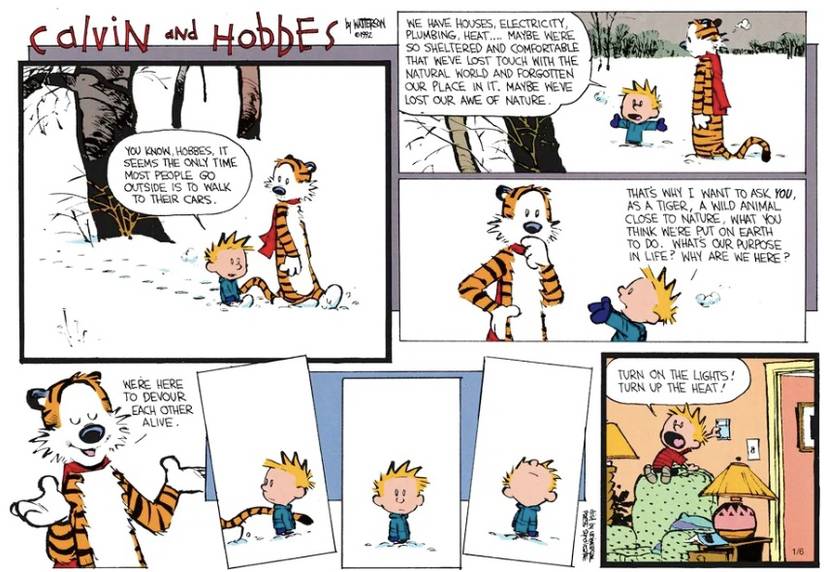
Long before climate fiction (cli-fi) became a dominant cultural genre, Watterson embedded a passionate reverence for the natural world directly into the DNA of Calvin and Hobbes. While characters like Calvin’s father frequently championed the outdoors through grueling camping trips, Watterson often used Calvin himself to articulate a stark, melancholic critique of human industrialization.
Thematic Focus: In an April 1992 strip, Calvin laments humanity’s collective loss of "awe of nature."
Artistic Execution: Rather than resorting to heavy-handed lecturing, Watterson pairs minimalist dialogue with sweeping, tender panels of quiet woods, establishing a visual contrast between human noise and planetary silence.
8. Watterson’s Philosophical Side (Mid-1990s)
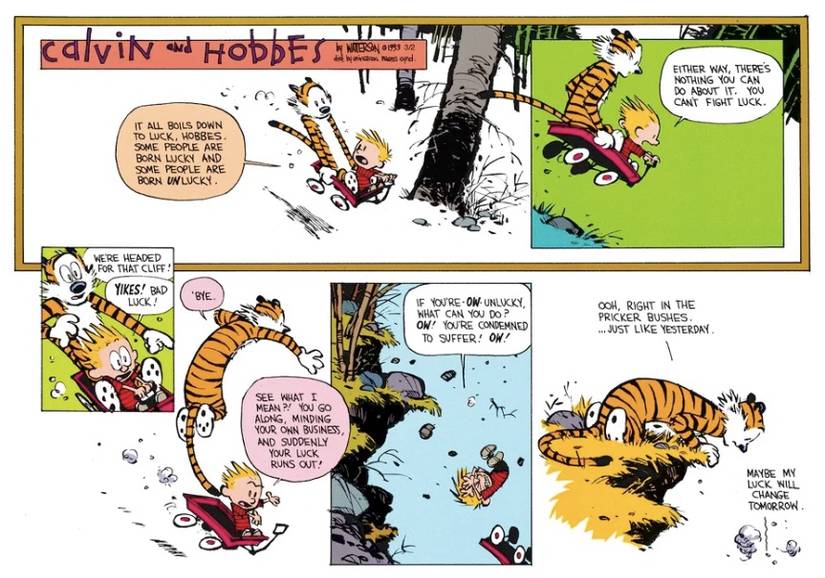
Watterson frequently transformed the daily comic strip into a vehicle for existential inquiry. Rather than shying away from abstract concepts, he weaponized childhood innocence to interrogate complex philosophical dilemmas.
Thematic Focus: A standout strip features Calvin and Hobbes debating the nature of luck while careening down a massive hill inside a red wagon.
Artistic Execution: The juxtaposition of high-minded philosophical discourse—pondering determinism versus random chance—with the violent, kinetic chaos of a wagon crash culminating in a thick patch of sticker bushes encapsulates Watterson’s comedic genius: intellectual weight crashing headfirst into slapstick reality.
7. Capturing the Imagination of a Child (1995)
While Calvin frequently possessed a vocabulary and intellect far exceeding his chronological age, Watterson consistently grounded him in authentic childhood psychology.
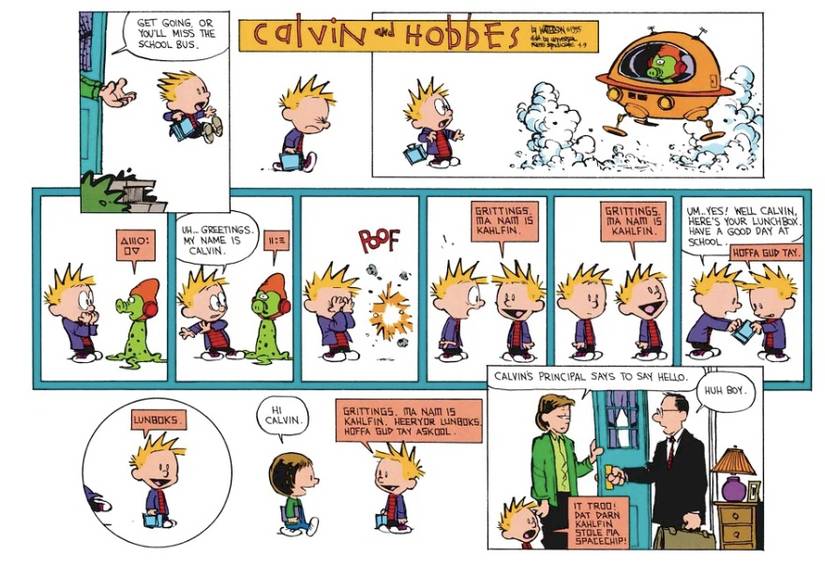
Thematic Focus: A Sunday strip from 1995 features Calvin imagining an elaborate encounter with an extraterrestrial being that camouflages itself to look exactly like him.
Artistic Execution: The domestic fallout—where Calvin attends school disguised as the alien, resulting in an inevitable trip to the principal’s office—highlights Watterson’s uncanny ability to map the exact contours of childhood escapism and the desperate measures kids take to avoid accountability.
6. Watterson as a Master Storyteller (1990)
Most newspaper comics adhered strictly to single-day punchlines or brief three-day gags. Watterson routinely blew past these limitations, crafting multi-week narrative arcs that read like epic mini-novels.
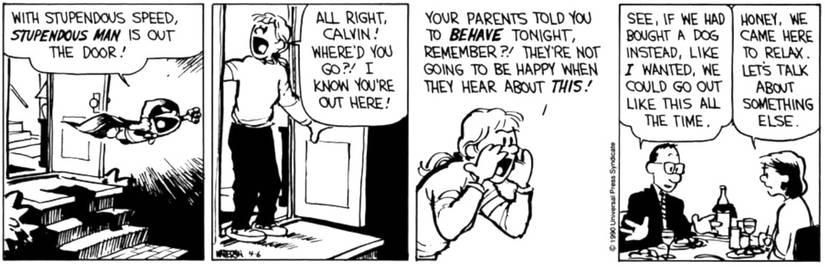
Thematic Focus: The recurring psychological warfare between Calvin and his dreaded babysitter, Rosalyn.
Artistic Execution: In a 1990 sequence, Calvin adopts his alter ego, "Stupendous Man," to wage war against Rosalyn. Watterson paces the narrative over several days, building escalating tension, sharp character reversals, and intricate visual gags that reward daily readership.
5. Tugging at the Heartstrings (1993)
While Watterson’s wit was sharp, his capacity for unadorned emotional resonance set him apart from his contemporaries.
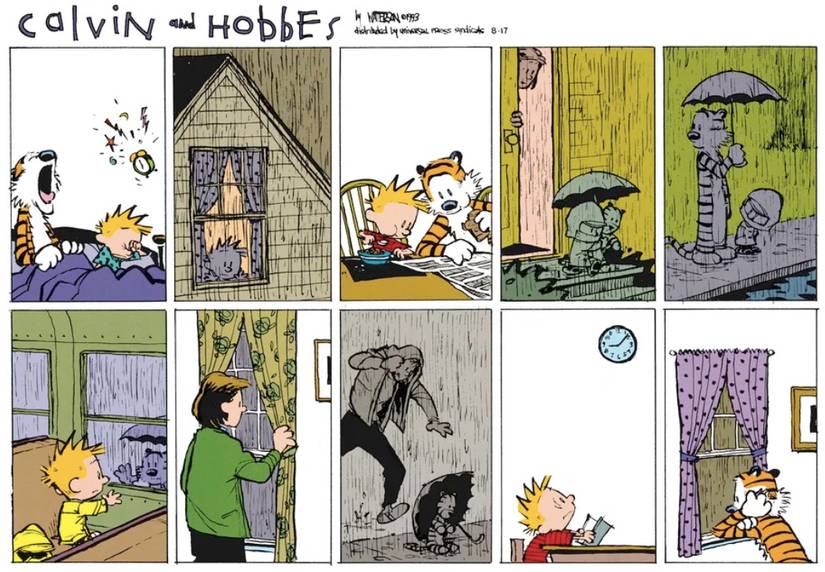
Thematic Focus: A 1993 single-day strip depicting a quiet, agonizing day in the life of Calvin and Hobbes as they yearn to be reunited.
Artistic Execution: Notably devoid of dialogue, the strip relies entirely on pacing, posture, and facial expressions to communicate loneliness and deep-seated affection, proving Watterson’s mastery of visual storytelling.
4. Exploring a Dark Sense of Humor (January 21, 1991)
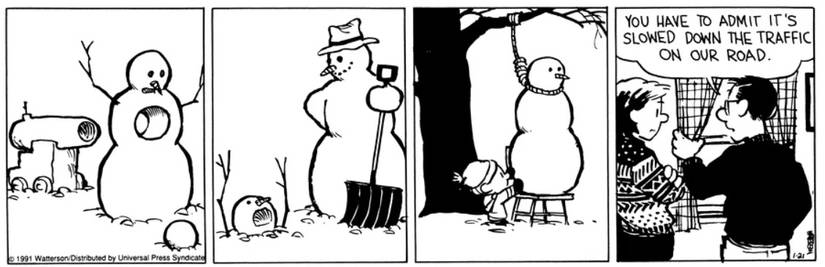
Beneath the heartwarming exterior of a boy and his tiger lay a delightfully macabre, pitch-black sense of humor—most famously displayed through Calvin’s psychotic snowman yard installations.
Thematic Focus: The January 21, 1991 strip features three distinct snowman tableaus in a single composition: one being executed by a cannon, another being buried alive, and a third hanging from a noose.
Artistic Execution: This stark subversion of wholesome newspaper funny-pages tropes (Peanuts, The Family Circus) shocked readers and cemented Watterson’s willingness to court controversy in the name of uncompromising artistic vision.
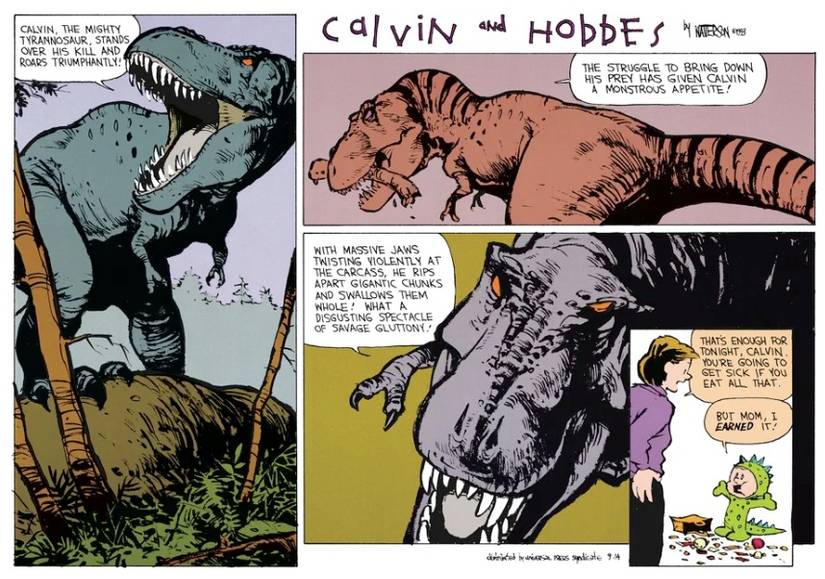
Daily newspaper cartooning historically favored simplicity to accommodate low-resolution printing presses. Watterson, however, routinely fought for and achieved breathtaking illustrative complexity.
Thematic Focus: Halloween-themed strips in 1993 where Calvin transforms into a ferocious Tyrannosaurus rex.
Artistic Execution: Abandoning minimalist backgrounds, Watterson rendered prehistoric jungles, towering ferns, and dinosaur anatomy with meticulous detail and dramatic chiaroscuro lighting.
2. Breaking the Format (August 1995)
Watterson was famously adversarial toward syndication rules, fighting aggressively for larger Sunday panels and the right to experiment with page layouts.
Thematic Focus: An August 1995 strip featuring Calvin undergoing an extended internal monologue suspecting his parents are actually alien invaders.
Artistic Execution: Watterson warps panel borders and utilizes distorted perspectives to mirror Calvin’s mounting paranoia, treating the comic strip page not as a grid, but as a malleable canvas.
1. The Ultimate Farewell (December 31, 1995)
No retrospective of Watterson’s career is complete without his final bow.
Thematic Focus: Running on December 31, 1995, the final strip depicts Calvin and Hobbes looking out over a pristine, snow-covered landscape.
Artistic Execution: Eschewing grand melodrama, Watterson delivered an open-ended, beautifully understated send-off. With the iconic line, "Let’s go exploring," the strip captured the essence of childhood curiosity and closed the book on a monumental era in American art.
Supporting Context & Metrics: The Scale of Watterson’s Achievement
To understand Bill Watterson’s impact, one must evaluate the structural landscape of the comics industry during his active years (1985–1995):
Syndication Reach: At its peak, Calvin and Hobbes was syndicated in over 2,400 newspapers worldwide, reaching tens of millions of daily readers.
Total Output: Watterson produced approximately 3,160 individual comic strips over ten years, maintaining complete writing and artistic control without the aid of ghostwriters or production studios—a rarity in the comic strip industry.
Merchandising Stance: Watterson famously turned down tens of millions of dollars in licensing and merchandising revenue, refusing to allow Calvin and Hobbes to be commercialized on t-shirts, coffee mugs, and plush toys, thereby preserving the artistic integrity of the work.
Official Statements and Industry Impact
Watterson’s fierce protection of his artistic vision and his battles with newspaper syndicates over layout space are legendary within the publishing industry. In various essays and introduction books, such as The Calvin and Hobbes Tenth Anniversary Book, Watterson reflected on the limitations of the medium:
"The comics page is a remarkably restrictive environment. To do anything genuinely unique within three square inches of newsprint requires fighting for every millimeter. I wanted the Sunday strip to breathe, to look less like a commercial billboard and more like a playground for the imagination."
Comics historians and contemporary cartoonists frequently cite Watterson’s 1990s run as a turning point that proved comic strips could achieve the literary and emotional depth of traditional literature and fine art.
Future Outlook: The Enduring Resonance of Calvin and Hobbes
Decades after Bill Watterson laid down his pens on December 31, 1995, the cultural footprint of Calvin and Hobbes remains untouched. In an era dominated by digital media, algorithmic content generation, and hyper-commercialized intellectual property, Watterson’s uncompromising dedication to hand-drawn purity serves as an enduring blueprint for independent creators.
As new generations discover the adventures of a boy and his tiger through collected anthologies, Watterson’s work continues to prove that genuine artistic versatility is timeless. Whether tackling environmental destruction, the mechanics of luck, or the simple joy of hurtling down a snowy hill in a red wagon, Calvin and Hobbes remains an immortal testament to the boundless power of human imagination.