Executive Overview
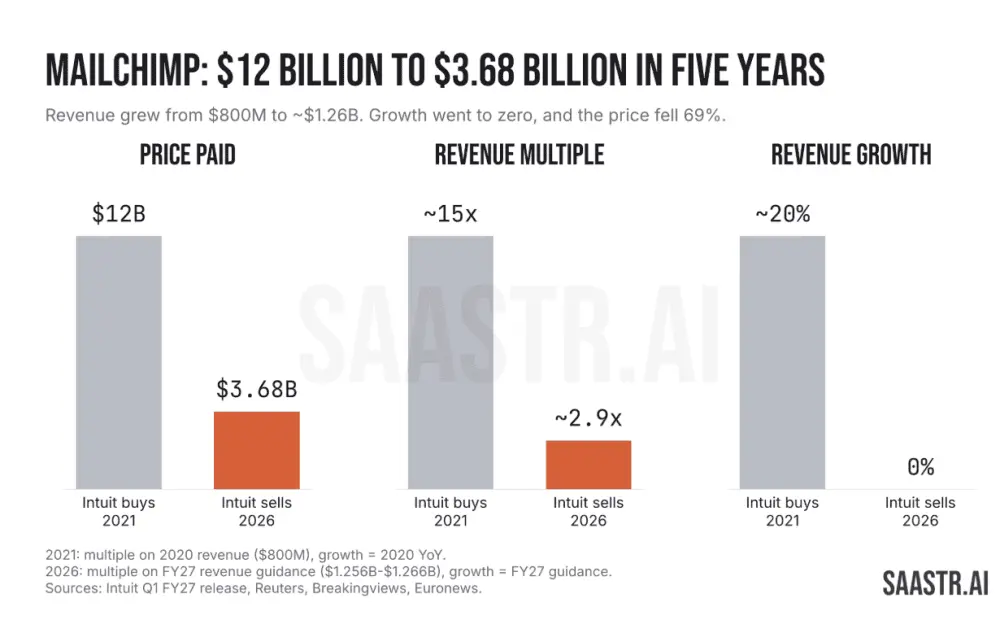
In the volatile theater of enterprise software, few transactions have encapsulated the systemic correction of tech valuations quite like Intuit’s divestiture of Mailchimp. In 2021, financial technology giant Intuit executed a blockbuster acquisition, shelling out a staggering $12 billion for the bootstrapped, highly profitable email marketing pioneer. Today, that narrative has undergone a severe financial reckoning. Intuit has officially agreed to unload Mailchimp to European tech roll-up engine Bending Spoons for a mere $3.68 billion—representing a catastrophic 69% evaporation of value in just over five years.
The transaction, structured as $3.31 billion in cash alongside $368 million in Bending Spoons equity, is slated to officially close in early 2027. For Intuit, the sale marks an unceremonious exit from a strategic misadventure, allowing the company to redirect capital toward its core, AI-driven small-business ecosystems through aggressive share repurchases. For the broader B2B software-as-a-service (SaaS) landscape, the deal serves as an unvarnished reality check. It provides the first transparent, public benchmark for the valuation of a massive, highly profitable, yet growth-stagnant B2B enterprise at scale.
As mature tech companies face a macroeconomic environment that heavily penalizes flat growth, the Mailchimp saga establishes a sobering precedent: once-glorified tech darlings are now routinely being repriced at a humbling 2x to 3x revenue multiple.
Detailed Chronology: From the 2021 Peak to the 2026 Reckoning
The 2021 High-Water Mark
To understand the magnitude of the current write-down, one must revisit the intoxicating market conditions of 2021. Mailchimp was operating at the absolute zenith of its independent existence. Founded as Rocket Science Group by Ben Chestnut and Dan Kurzius, the company famously eschewed venture capital funding, scaling organically into an absolute powerhouse of the bootstrapped SaaS movement.
In the fiscal year preceding the 2021 acquisition, Mailchimp generated roughly $800 million in annual recurring revenue (ARR), marking a robust 20% year-over-year expansion. Intuit, eager to cross-sell marketing automation tools into its sprawling QuickBooks small-business user base, swooped in with a massive $12 billion cash-and-stock offer. This valuation equated to an eye-watering 15x multiple of 2020 revenue—a premium justified at the time by Mailchimp’s pristine margins, sticky recurring revenue, and consistent double-digit growth.
For Chestnut and Kurzius, the timing was nothing short of legendary. By exiting at the absolute peak of the post-pandemic tech boom, the founders successfully cashed out at the most favorable valuation multiple the market has ever seen for an email marketing platform.
The Stagnation Years Within Intuit
Integration within a corporate conglomerate, however, did not inject the hyper-growth Intuit envisioned. While Mailchimp’s top line continued an incremental climb, its velocity ground to a near-complete halt.
By the first quarter of fiscal year 2027, Mailchimp’s revenue contracted slightly to $313 million—down 1% year-over-year. Full-year guidance painted an unmistakable picture of stagnation, projecting revenues between $1.256 billion and $1.266 billion, translating to negative-one to zero percent growth.
Over a span of more than five years under Intuit’s stewardship, Mailchimp’s revenue grew by a modest 57%, moving from $800 million to approximately $1.26 billion. Yet, during this same period, the rest of Intuit’s portfolio surged ahead, posting a 12% growth rate in Q1 alone to hit $4.4 billion. Representing roughly 7% of Intuit’s total revenue, Mailchimp had effectively transformed into an anchor, dragging down the parent company’s consolidated growth metrics quarter after quarter.
The Bending Spoons Takeover
Enter Bending Spoons. Freshly listed on the Nasdaq under the ticker symbol BSP on July 1, 2026, the Milan-founded, Berkshire Hathaway-backed technology consolidator has embarked on one of the most aggressive acquisition sprees in recent corporate history. Since late 2024—beginning with its acquisition of Brightcove—Bending Spoons has deployed an estimated $10.8 billion across a series of high-profile platform buyouts, including Airtable in August 2025, Miro in September 2025, and now Mailchimp.
With 2025 revenues hovering around $1.31 billion, Bending Spoons is absorbing an asset that nearly matches its own corporate scale. The deal values Mailchimp at 2.9x its current revenue—a stark plummet from the 15x multiple Intuit paid just half a decade prior. As part of the transaction terms, Intuit has agreed to a strict two-year non-compete clause, effectively locking the fintech giant out of the marketing automation sector and signaling a definitive end to its diversification experiment.
Supporting Context & Metrics: The Anatomy of a Repricing
The 2021 vs. 2026 Multiples Comparison
The collapse of Mailchimp’s valuation multiple is not an isolated anomaly; it reflects a systemic recalibration across the entire B2B software sector. Assets that commanded 10x to 20x forward revenue multiples during the zero-interest-rate policy (ZIRP) era of 2020–2021 are now routinely clearing the market at 2x to 3x multiples if their organic growth rates dip into single digits.
| Metric / Milestone | 2021 Acquisition (Intuit) | 2026 Divestiture (Bending Spoons) |
|---|---|---|
| Valuation | $12.00 Billion | $3.68 Billion |
| Annual Revenue | ~$800 Million | ~$1.26 Billion |
| Revenue Growth Rate | ~20% Year-over-Year | (1)% to 0% Year-over-Year |
| Revenue Multiple | ~15.0x | ~2.9x |
| Consideration Structure | Cash & Intuit Stock | $3.31B Cash + $368M BSP Stock |
Bending Spoons’ Aggressive Playbook
Bending Spoons operates under a distinct operational philosophy that diverges sharply from traditional strategic buyers like Intuit. Rather than cultivating organic growth or fostering experimental product development, the firm focuses on extracting maximum operational efficiency and margin expansion from mature software properties.
This playbook relies heavily on aggressive restructuring. Following its acquisition of Brightcove, Bending Spoons swiftly reduced headcount by more than 85% across a roughly 200-person organization. Similar operational overhauls have been executed across its broader portfolio—including Airtable, AOL, Tractive, and Vimeo—resulting in immediate, dramatic improvements to profitability. In its Q3 earnings release, the company highlighted substantial operating income growth—climbing $43 million, or 34%—driven almost entirely by these post-acquisition cost-optimization initiatives.
For Mailchimp’s existing workforce, the writing is on the wall. The transition to Bending Spoons signals an imminent wave of organizational restructuring, deep workforce reductions, and a ruthless streamlining of operations to optimize the newly acquired asset for immediate cash flow generation rather than headcount expansion.
Official Statements and Strategic Intent
Intuit’s Strategic Pivot to AI
From Intuit’s perspective, the decision to absorb an $8.3 billion accounting loss on Mailchimp is a calculated maneuver to sharpen its corporate focus. Leadership has made it abundantly clear that capital allocation must prioritize high-growth, high-margin, artificial intelligence-native initiatives tailored specifically for small businesses and self-employed professionals.
In public statements accompanying the divestiture announcement, Intuit confirmed that the $3.31 billion in net cash proceeds will not be reinvested into another sprawling enterprise acquisition. Instead, the company plans to deploy the capital directly into aggressive share repurchase programs. By shrinking its share count, Intuit aims to deliver immediate, tangible value to shareholders—preferring to bet on its own core financial platform rather than subsidizing an email marketing unit experiencing structural growth fatigue.
Bending Spoons’ Public Market Ambitions
For Bending Spoons, the acquisition of Mailchimp serves as the crown jewel of its post-IPO growth strategy. Having established its public market credibility on the Nasdaq under ticker BSP, the company is positioning itself as the ultimate aggregator of legacy digital assets. By consolidating marquee names like Airtable, Miro, and now Mailchimp under a unified operational umbrella, Bending Spoons is attempting to prove to public market investors that mature software cash flows, when managed with extreme cost discipline, can yield formidable compound returns.
Future Outlook: Implications for the B2B SaaS Ecosystem
The Mailchimp-Bending Spoons transaction serves as a watershed moment for the broader enterprise technology ecosystem, carrying profound implications for founders, venture capitalists, and corporate strategists alike.
1. The End of the "Growth at All Costs" Grace Period
For founders and operators running B2B companies with revenue growth decelerating below 10%, the Mailchimp exit provides an unambiguous market signal. Private equity and strategic consolidators are no longer willing to pay premium historical multiples for sluggish assets. If a market leader backed by massive distribution—sitting right alongside QuickBooks and its millions of small-business customers—can stall out at 0% growth and see its valuation cut by nearly 70%, smaller mid-market players face an even harsher valuation floor.
2. The Rise of the Roll-Up Consolidation Era
The aggressive capital deployment by entities like Bending Spoons signals a structural shift in how mature software assets are managed. As organic innovation slows down in certain software verticals, financial engineering, cost rationalization, and portfolio consolidation are replacing hyper-growth as the primary drivers of shareholder value. Expect to see an acceleration of secondary buyouts as large conglomerates seek to offload non-core acquisitions made during the 2021 frenzy.
3. A Vindication for Bootstrap Pioneers
Finally, the enduring legacy of the Mailchimp transaction belongs to Ben Chestnut and Dan Kurzius. By refusing institutional venture capital, retaining 100% equity control, and executing their exit at the absolute apex of the market cycle in 2021, the founders achieved an outcome that institutional investors can only dream of. While the subsequent market correction has battered the asset’s underlying valuation under corporate and consolidator ownership, the founders secured their fortunes at the top—serving as a masterclass in macroeconomic timing that will be studied in business schools for decades to come.