Executive Overview
The traditional software go-to-market (GTM) playbook is undergoing a structural collapse. For decades, scaling a B2B SaaS business meant linearly expanding headcount—hiring armies of entry-level Sales Development Representatives (SDRs), scaling Account Executives (AEs), and bloating RevOps teams. Today, that orthodoxy is being dismantled by artificial intelligence.
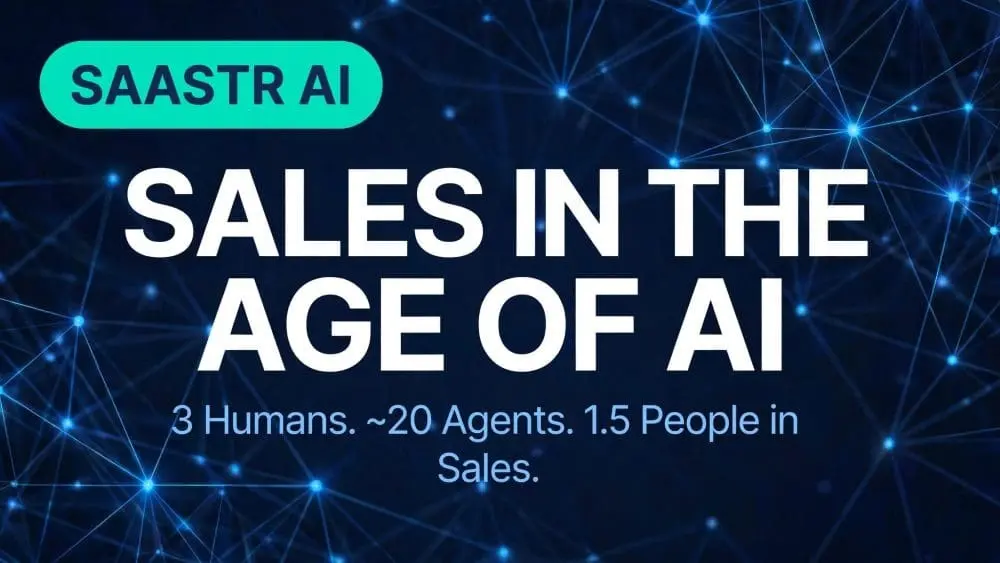
Nowhere is this shift more radically documented than at SaaStr. Projected to hit approximately $20 million in revenue this year, SaaStr operates with a lean core of just three full-time humans and roughly 20 autonomous AI agents in production. Through natural attrition that was intentionally left unbackfilled, the company’s sales organization has shrunk to 1.5 equivalent human heads. Yet, outbound revenue is up 124%, inbound conversions have surged by 60%, and overall revenue has jumped 47% following a prior contraction.
This is not an isolated experiment. Drawing on data from major industry players—including Anthropic, Salesforce, PayPal, Replit, and ICONIQ Capital—the real-world transformation of enterprise sales reveals a stark dichotomy: roughly half of what industry leaders expected to change in sales has radically evolved, while the other half has stubbornly refused to move.
This comprehensive report breaks down the 10 ways GTM has fundamentally changed, the 10 constants that remain untouched, and the emerging operational realities of running a modern, agent-driven enterprise.
Detailed Chronology: The Evolution of Agentic GTM
The transition from human-led manual outreach to agentic workflow execution did not happen overnight. It represents a systematic evolution over the past 13 months, moving from basic automated emailing to fully autonomous, context-aware operational agents.
Phase 1: The Death of the 24-Hour Form Response
Thirteen months ago, inbound pipeline management followed standard corporate protocol: a prospective sponsor filled out a contact form, a human round-robined it, and a representative responded within a day with a boilerplate email. Today, that process is obsolete.
An autonomous inbound agent now greets prospects directly on the landing page. Over the past 12 months, this agent has managed 17,000 conversations, booked approximately 600 meetings, and closed over $1 million in deals via self-serve paths. Rather than instantly firing off a generic calendar link, the agent waits 10 minutes for the session to conclude, scans heatmaps, and queries seven distinct first-party data signals: site visitation history, active sequences, ad exposure, newsletter engagement, event attendance, speaking history, and internal editorial mentions.
For modern buyers who run AI operations within their own organizations, a one-day lag and a generic form letter are no longer acceptable; they are immediate indicators of a lagging, antiquated vendor.
Phase 2: Disintermediating the SDR Role
The Emergence 2026 survey of over 560 companies highlights a sweeping structural trim: 36% of organizations have reduced their SDR headcounts, while only 14% have cut sales engineers, and 28% have actively expanded their AE teams.
At SaaStr, the SDR seat was entirely eliminated. Autonomous agents now execute 100% of outbound and SDR workflows, pushing roughly 3,200 targeted emails per month—dwarfing the 75 to 285 monthly ceilings of human SDRs. Because SDR work fundamentally revolves around rule-based execution (research, sequencing, follow-up, and booking), agents have absorbed the load, leaving high-value human capital to focus on complex judgment calls.
Phase 3: Universal Coverage and Automated Renewals
Historically, sales teams suffered from the Pareto principle—ignoring long-tail leads and waiting until the final 30 days of a contract to address renewals. AI agents have completely closed this coverage gap.
As shared by leaders from Salesforce and PayPal at recent SaaStr events, PayPal injected AI agents into roughly 8,000 unworked monthly leads, driving a 50% increase in meeting conversions within 14 weeks. Similarly, SaaStr’s Agentforce win-back campaign engaged 1,000 ghosted leads and achieved a staggering 72% open rate. Renewal agents now systematically contact every single account at every Annual Contract Value (ACV) tier, analyzing multi-channel data to tailor pitches. For instance, an AI renewal agent preparing a Replit contract automatically surfaced six million yearly impressions for the CEO while flagging minor performance dips and drafting a proactive 2027 remediation plan, successfully securing the account’s renewal.
Supporting Context & Metrics: The Hard Numbers
The operational restructuring observed at SaaStr aligns with macroeconomic shifts captured across the broader software ecosystem. GTM teams are getting leaner, pricing models are shifting away from per-seat subscriptions, and first-party data has become the ultimate competitive moat.
Headcount Compression by ARR Band
According to ICONIQ’s State of GTM report, AI-forward companies operate with significantly smaller GTM teams relative to their ARR when compared to lower-adopting peers:
- $1M–$10M ARR: 43% smaller GTM headcount
- $10M–$50M ARR: 32% smaller GTM headcount
- $50M+ ARR: 21% smaller GTM headcount
The contraction gap narrows at higher ARR bands because enterprise deals demand heavy human relationship management and bespoke engineering support. However, the efficiency gains remain undeniable.
The Shift to Consumption and Consumption-Adjacent Pricing
The SaaS pricing model is fracturing. Vendors are rapidly moving away from rigid per-seat models toward usage-based structures:
- Salesforce offers multi-tiered pricing via Agentforce ($2 per conversation, Flex Credits, and "digital labor" user seats).
- HubSpot charges $0.50 per resolved customer agent conversation.
- CrowdStrike’s Falcon Flex—where customers commit to a single pool of funds drawn down across modules—has surpassed $2.29 billion in ARR, growing 101%.
Concurrently, buyers are feeling the pinch. Redpoint’s CIO survey indicates that 45% of new AI budgets are being cannibalized directly from existing software lines, and Zylo’s index notes that 78% of companies experienced surprise AI or consumption-related overages.
First-Party Data vs. Purchased Data
While third-party enrichment providers like ZoomInfo and Clay remain standard, they are fundamentally commoditized. Any competitor can buy the same database.
The true strategic advantage lies in proprietary, first-party data. By centralizing a decade of historical Salesforce records, event attendance, newsletter metrics, and editorial history into an advanced marketing cloud, SaaStr empowered its AI marketing and RevOps agent (“10K”) to clean lists daily and generate hyper-personalized ABM pitches. Outbound messages that reference a prospect’s specific historical interactions with SaaStr consistently outperform generic automated sequences.
Official Statements & Industry Insights
Throughout the year, GTM leaders from leading technology companies took to the SaaStr stage to dissect what has fundamentally changed and what has stubbornly resisted the AI wave.
The Rise of Self-Serve Enterprise Sales
Eleanor Dorfman restructured Anthropic’s sales organization, achieving a milestone where 54% of new enterprise logos originated entirely through self-serve channels within four months. Similarly, Gamma crossed $100 million in ARR without a traditional sales team.
However, industry leaders advise caution. Grant Lee, CEO of Gamma, noted that relying purely on inbound organic demand is a reactive posture that founders should not blindly replicate. As companies scale, even AI-native disruptors eventually build massive outbound sales engines. Anthropic expanded its startup sales team from under 10 to over 150, and OpenAI scaled its GTM organization from 50 to more than 700 people in just 18 months.
RevOps Automation and Administrative Velocity
Complex administrative tasks that once crippled operations are now executed in fractions of a second:
- Account Tiering: Backstory utilized Claude and simple connectors to tier 141 accounts across four distinct tiers in just 3 to 4 days—a project that historically required five teams an entire quarter.
- Guided Selling: Nue demonstrated that setting up complex sales playbooks can be compressed from months to roughly two minutes.
- Quote-to-Cash: At SaaStr, once a contract is executed in PandaDoc, the AI operations agent (10K) automatically updates Salesforce to Closed Won, populates missing contacts, generates and dispatches Bill.com invoices, and initiates collections workflows with automated escalations.
Future Outlook: The 10 Constants That Haven’t Changed
Despite the unprecedented velocity introduced by autonomous agents, the core tenets of enterprise sales remain deeply human. Ten operational realities have resisted automation:
- The Absence of an AI Account Executive: While agents successfully source, qualify, follow up, invoice, and collect, zero autonomous agents can independently navigate a complex buying committee, defuse high-stakes objections, or negotiate bespoke pricing.
- Productivity Multipliers Have Limits: Despite a plethora of AI call-prep, summarization, and coaching tools, human AEs are not magically twice as fast or knowledgeable. Productivity gains manifest primarily as headcount reductions rather than doubled individual output quotas.
- Sales & Marketing Remains the Largest P&L Line: GAAP sales and marketing spend as a percentage of revenue remains high across public SaaS (ranging from 34% at Salesforce to 48% at CrowdStrike), proving that customer acquisition costs remain a dominant business expense.
- Implementation Cycles Hold Firm: Regardless of how fast an AI agent generates a quote, enterprise security reviews, procurement, legal vetting, and multi-departmental budget approvals still anchor to the customer’s internal timeline—averaging a stubborn 90-day implementation window.
- Product-Market Fit is Non-Negotiable: An AI SDR can flood a calendar with meetings, but if product-market fit is absent, pipeline metrics remain a vanity facade. Mediocre reps and advanced agents alike hit 0% quota attainment without true market demand.
- Continuous Human Oversight is Mandatory: Autonomous agents require strict guardrails. Without active supervision, AI agents can misinterpret custom naming conventions, bypass signed contracts due to strict metadata rules, or exceed operational spend caps during emergency troubleshooting.
- Garbage In, Garbage Out: Agent output is entirely bound by data integrity. Gaps in CRM hygiene, payload tracking errors across integration webhooks, and incomplete enrichment data immediately degrade customer-facing agent interactions.
- The Human Touch Wins the Reply: Fully automated long-sequence outbound yields diminishing returns. When a prospect replies, passing the conversation to a human armed with a custom-tailored executive deck remains the definitive conversion catalyst.
- The Power of Direct Inquiry: Asking the foundational question—"What would it take to make you switch?"—continues to unlock competitive insights that no battlecard or AI-generated brief can replicate.
- The Human Core Remains Irreplaceable: At SaaStr today, automated agents manage inbound triage, sequencing, CRM hygiene, and billing collections. Yet, every single real conversation, non-standard pricing decision, major sponsor relationship, and final system audit is anchored by three human beings.
The future of SaaS is not about replacing human ingenuity with algorithms; it is about leveraging autonomous infrastructure to strip away administrative friction, allowing human talent to focus entirely on high-stakes strategy, deep relationship building, and transformative execution.