Executive Overview
In the high-stakes theater of Silicon Valley public relations, few spectacles rival an Elon Musk product launch. Yet beneath the pyrotechnics, roaring crowds, and gravity-defying stunts in Texas, a much deeper corporate strategy was laid bare. When Musk introduced the long-delayed, SpaceX-engineered Tesla Roadster—a vehicle boasting an electric drivetrain capable of launching from 0 to 60 mph in 0.8 seconds and featuring cold-gas thrusters that enable brief bursts of flight—automotive enthusiasts cheered. However, industry analysts saw past the smoke and mirrors.
The unveiling of a car that "sorta flies" is not a harbinger of a Jetsons-style airborne transit future. Instead, it marks the psychological sunset of Tesla as a traditional automotive manufacturer. As shrinking profit margins, aggressive international competition, and shifting government subsidies squeeze Tesla’s core electric vehicle (EV) business, the company is pivoting rapidly toward artificial intelligence, autonomous robotaxis, and humanoid robotics.
According to financial analysts and industry insiders, this theatrical blending of Tesla and SpaceX technology is the clearest indicator yet that the two corporate titans are hurtling toward a massive, unprecedented megamerger. By subsuming Tesla into a privately backed, high-valuation space and defense conglomerate, Musk is preparing to alter the global corporate landscape forever—paving the way for a $3.5 trillion galactic entity designed to build autonomous fleets, manufacture millions of Optimus robots, and fund data centers that stretch from the Earth to the stars.
Detailed Chronology: From the Roadster’s Genesis to the Texas Spectacle
To understand where Tesla is going, one must examine the rocky timeline of the vehicle that started it all and the one designed to end an era.
The Delayed Promise of a Legend
The original Tesla Roadster concept was first teased in 2017, capturing the imaginations of EV true believers who eagerly shelled out $50,000 standard reservations—and as much as $250,000 for the limited Founder Series. For years, the vehicle’s release date slipped further and further into the future as Tesla prioritized scaling production for the Model 3 and Model Y, while pouring capital into the contentious Cybertruck development.
The Texas Reveal
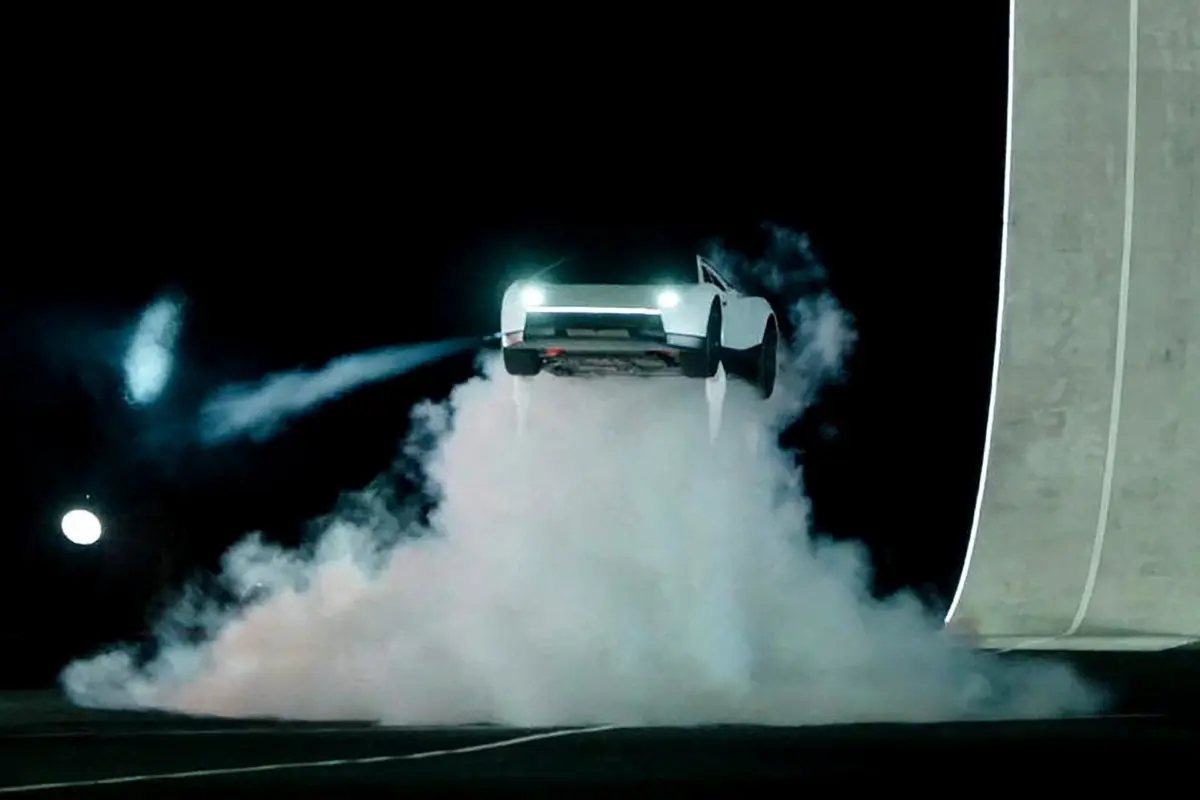
During a dramatic livestreamed event in Texas, Musk pulled back the curtain on the "new-new" Roadster. Set against the backdrop of a massive C-shaped ramp, the vehicle—resembling a stylistic mashup of a 1970s Lotus Esprit and an SR-71 Blackbird spy plane—ascended the curve. Utilizing a downforce-generating fan system, the car stuck upside down before breaking free, executing a controlled roll, and touching down amid a cloud of compressed air.
Musk touted the vehicle’s SpaceX-designed gas thrusters, proclaiming, "What you see with your eyes, you will not believe!"
The Pricing and the Wait
True to form, ordering the vehicle requires immense financial capital and boundless patience. Tesla has structured the new Roadster across three distinct trim levels:
- Performance Trim: Priced at $50,000.
- Thrust Trim: Priced at $250,000.
- Rocket Trim (The "Flying" Version): An exclusive, invite-only sum.
Customers have been told to expect deliveries around 2028. Whether these vehicles will ever see mass production remains a point of intense skepticism among automotive veterans, who note that Musk’s production timelines have historically served as aspirational targets rather than hard guarantees. More importantly, Musk explicitly stated that the Roadster will be the last manually drivable car the company ever builds, officially drawing a line in the sand regarding Tesla’s corporate trajectory.
Supporting Context & Metrics: The Shifting Economics of Tesla
Why would a company that generated roughly $95 billion in revenue and delivered more than 1.6 million manually drivable vehicles in 2025 consciously wind down its identity as a mass-market carmaker? The answer lies in cold, hard numbers.
Margins, Competition, and Market Saturation
Tesla’s profit margins are under historic pressure. The company has not introduced an all-new, non-flying consumer vehicle since the Cybertruck launched in 2019. Furthermore, Tesla has effectively ended production of its high-priced luxury stalwarts—the Model S sedan and Model X SUV—leaving the Model 3 and Model Y to shoulder the entire automotive enterprise.
This narrowing portfolio faces stiff headwinds:
- Global Competition: A massive wave of affordable, high-quality electric vehicles from Chinese automakers has flooded international markets, undercutting Tesla’s pricing power.
- Geopolitical Blowback: In Europe, political polarization and Musk’s vocal support for right-wing political movements have visibly hurt local sales.
- Regulatory Cliff: Government regulatory credits, which historically padded Tesla’s bottom line to the tune of billions of dollars, are vanishing. Simultaneously, the rolling back of federal tax credits in the United States has cooled consumer demand across the domestic EV sector.
The Pivot to Autonomy and Humanoids
Faced with these macroeconomic realities, Musk has determined that selling millions of moderately priced consumer EVs is simply not lucrative enough to satisfy his grand ambitions. Instead, the future of the enterprise relies on two pillars:
- The Cybercab: A completely autonomous vehicle lacking a steering wheel or pedals, designed to operate as an on-demand robotaxi fleet.
- Optimus Humanoid Robots: Bipedal machines that Musk claims will eventually push Tesla’s market capitalization from its current $1.4 trillion to a staggering $25 trillion. Priced at an estimated $30,000 apiece, these robots are envisioned to handle everything from factory assembly line drudgery and lawn care to elder care and off-world colonization.
Official Statements and Industry Analysis
The convergence of Tesla’s automotive struggles and SpaceX’s technological dominance has fueled rampant speculation on Wall Street.
The Barclays Perspective
Financial analysts are increasingly treating a corporate unification as an inevitability rather than a remote possibility. Notably, Barclays analyst Dan Levy suggested in recent investor notes that a merger between Tesla and SpaceX is "almost a done deal."
Under this projected financial maneuver, SpaceX would act as the acquiring entity. Tesla investors would swap their equities for SpaceX stock, creating a combined corporate monolith with an estimated valuation scaling past $3.5 trillion.
The Capital Rationale
Why combine the two companies? The financial mechanics are straightforward. Transforming Tesla’s massive global manufacturing footprint to mass-produce Cybercabs and Optimus robots requires astronomical amounts of capital. Furthermore, keeping pace with artificial intelligence powerhouses like OpenAI and Anthropic demands continuous, multi-billion-dollar investments in data-center construction.
SpaceX possesses an unmatched ability to raise staggering sums of capital from public and private markets. By merging the two operations, Musk can leverage SpaceX’s financial gravity to rescue Tesla’s shifting balance sheet and fund his most radical futuristic blueprints—including plans to launch data centers directly into orbit to harvest unmitigated solar energy.
Future Outlook: The Birth of a Galactic Mega-Entity
As the dust settles on the Texas Roadster spectacle, the true narrative comes into focus. The event was not merely a nostalgic nod to the early days of Tesla marketing; it was a calculated symbolic transition.
For years, skeptics questioned why Tesla was killing off lucrative luxury models and ignoring highly profitable market segments like full-sized SUVs. Musk’s underlying philosophy has always been teleological: the manufacture of millions of traditional electric vehicles was merely a bootstrapping phase—a necessary means to develop global supply chains, advanced manufacturing expertise, and artificial intelligence capabilities.
The goal was never to become the "electric Toyota." The goal was to build the industrial infrastructure required to crank out a Cybercab every ten seconds and march armies of Optimus robots off assembly lines.
By injecting SpaceX aerospace engineering into a Tesla chassis, Elon Musk is setting the stage for the sunsetting of Tesla as an independent automaker. The brand is poised to dissolve into a singular, sprawling galactic mega-entity. For better or worse, the corporate blueprint being forged in Texas makes cinematic empires like the Weyland-Yutani Corporation look tame by comparison—ushering in an era where the boundary between automotive manufacturing, artificial intelligence, and space colonization is permanently erased.