Executive Overview
For nearly two decades, MacPaw has been a household name among macOS power users. Renowned primarily for consumer-grade utilities like CleanMyMac—a go-to solution for freeing up hard drive space, uninstalling rogue applications, and keeping systems running smoothly—the company has built its reputation on sleek, user-friendly software designed to optimize individual consumer experiences. However, the software landscape is shifting rapidly, and MacPaw is making a bold, strategic pivot away from purely consumer-facing utilities. With the launch of Leebry, a brand-new Work AI platform specifically tailored for IT and operational teams, MacPaw is stepping directly into the complex, high-stakes arena of enterprise software.
Leebry is not merely another generic chatbot designed to regurgitate information pulled from the dark corners of the internet. Instead, it is an enterprise-grade AI solution engineered to tackle one of the most persistent and frustrating bottlenecks in modern organizations: repetitive internal support tickets, fragmented documentation, and the perilous trust gap surrounding workplace artificial intelligence.
In an era where C-suite executives are pressured by LinkedIn feeds and tech hype cycles to deploy AI everywhere instantly, IT departments are often left picking up the pieces. According to MacPaw’s 2026 AI at Work report, a staggering 90% of companies deploy internal AI tools without thoroughly auditing their underlying knowledge bases first. The result? AI assistants hallucinating answers based on outdated product documents, archaic company policies, and random internet forums like Reddit.
Leebry aims to bridge this chasm. Born out of an internal hackathon at MacPaw to solve the company’s own scaling pains, the platform automates level 1 IT support, handles complex access provisioning, and maintains strict permission boundaries—all while anchoring its answers to verifiable, source-linked documentation. For organizations—especially those managing diverse ecosystems of Apple devices—Leebry represents a compelling promise: taking repetitive operational weight off the shoulders of IT teams without sacrificing security, governance, or administrative control.
Detailed Chronology: From Internal Hackathon to Enterprise Launch
To understand how a consumer-focused software developer successfully birthed an enterprise AI platform, one must examine the chronological evolution of Leebry. The project did not begin in a corporate boardroom as a calculated play for market share in the B2B SaaS sector. Rather, it started as an organic, grassroots solution to an internal nuisance.
Phase 1: The 2025 MacPaw Hackathon
In 2025, like many fast-growing technology companies, MacPaw faced a familiar internal friction point: employees repeatedly asking the same operational and IT questions across Slack, internal wikis, and email threads, even when accurate answers already existed somewhere within the company’s vast digital footprint.
Recognizing the drain this placed on engineering and IT resources, a team within MacPaw participated in an internal company hackathon to build a rudimentary Slack bot. The goal was simple: index internal documentation, understand conversational queries, and surface accurate answers directly to employees while pointing them to the exact source material.
Phase 2: Internal Deployment and Validation
What started as a weekend hackathon project quickly proved its utility in the wild. Within just a few months of internal deployment, the custom Slack bot was autonomously resolving approximately 30% of MacPaw’s own level 1 IT support tickets.

For an IT department constantly bombarded with repetitive inquiries about password resets, software access, VPN configurations, and company policies, a 30% reduction in ticket volume is transformative. It frees up skilled technicians to focus on high-value infrastructure projects, security hardening, and strategic scaling. Realizing that they had accidentally built something far more powerful than a simple internal toy, MacPaw’s leadership decided to refine, secure, and productize the technology. This internal engine became the foundation for Leebry.
Phase 3: The Public Launch and Enterprise Positioning
Fast forward to today, and MacPaw is officially bringing Leebry to the broader market. Moving away from its historical comfort zone of single-user macOS utilities, the company is positioning Leebry as a comprehensive Work AI platform designed specifically for IT teams operating in modern, hybrid work environments. By leveraging the lessons learned from auditing their own chaotic internal knowledge repositories, MacPaw has transformed an internal productivity hack into a commercial enterprise solution.
Supporting Context & Metrics: The AI Trust Gap in the Modern Enterprise
The launch of Leebry arrives at a critical juncture in the enterprise technology landscape. Artificial intelligence has dominated corporate agendas for years, yet a massive disparity remains between executive expectations and frontline reality. MacPaw’s 2026 AI at Work report sheds empirical light on why so many enterprise AI deployments ultimately disappoint.
The 90% Knowledge Audit Blindspot
The most alarming statistic highlighted in MacPaw’s research is that 90% of companies deploy AI tools without thoroughly auditing their internal knowledge bases first.
In practical terms, this means organizations are feeding unvetted, disorganized, and fragmented repositories of information into large language models and expecting reliable outputs. When an employee asks an AI assistant a question about company compliance, remote work stipends, or software deployment protocols, the tool scours whatever it can find. This frequently includes:
- Old, deprecated product documentation left in abandoned Google Drive folders.
- Outdated HR policies that violate current labor laws or company standards.
- Random third-party forum discussions (such as archived Reddit threads) that resemble company nomenclature but offer incorrect guidance.
When AI tools pull from these polluted pools of data, hallucinations run rampant, employees lose trust in internal tech stacks, and IT departments are forced to spend hours troubleshooting misinformation propagated by the company’s own software.
The C-Suite vs. IT Leadership Disconnect
Compounding the knowledge audit crisis is a profound cultural disconnect within the corporate hierarchy. According to MacPaw’s survey, 6 in 10 IT leaders report a stark disconnect between what their C-Suite executives expect from AI tools and what IT teams can safely and accurately deliver.
Driven by constant exposure to tech evangelism, viral LinkedIn success stories, and competitive pressure, executive leadership often views AI as a plug-and-play silver bullet that can instantly slash overhead and boost productivity overnight. Conversely, IT administrators—who bear the brunt of cybersecurity risks, data compliance mandates, and user support—understand that AI is only as good as the governance frameworks surrounding it.
This friction is where most enterprise AI disappointment takes root. IT teams are asked to deploy powerful autonomous systems without the necessary guardrails, testing frameworks, or clean data foundations. Leebry was engineered explicitly to bridge this chasm, offering IT leaders a way to satisfy executive demands for automation while maintaining rigorous control over data integrity and system permissions.
What Leebry Actually Does: Features, Architecture, and Security
Leebry differentiates itself from standard consumer and enterprise AI wrappers by focusing heavily on operational workflows, verifiable accuracy, and strict security controls. Designed from the ground up to integrate with the tools employees already use—such as Slack and existing corporate document repositories—the platform performs several core functions.
1. Autonomous Level 1 Support Resolution
Taking a cue from its origins as an internal Slack bot, Leebry automates the handling of repetitive level 1 support tickets. By analyzing incoming employee questions across team chats and ticketing systems, the platform provides instant, accurate answers derived strictly from verified company documents. This drastically reduces ticket queues, ensuring that human IT professionals are only pulled in for complex, nuanced troubleshooting.
2. Streamlined Access Provisioning and Lifecycle Management
For small-to-medium-sized businesses (SMBs) and organizations that lack massive, dedicated Identity and Access Management (IAM) teams, managing user lifecycles is a chronic headache. When employees join a company, move across departments, or leave the organization, updating their software access rights is frequently manual, slow, and prone to human error.
All too often, departing employees retain access to sensitive corporate software and internal networks days after their departure. Leebry automates access provisioning and removal throughout an employee’s lifecycle. For IT organizations managing extensive fleets of Apple devices—where rapid, secure onboarding is essential—automating these access changes eliminates a major operational pain point.
3. Source-Linked Verification and Stale Data Flagging
To combat the AI trust deficit, Leebry does not simply spit out answers and demand blind faith. Every single response generated by Leebry links directly back to its source material.
This transparency allows employees and IT administrators to verify the validity of an answer instantly. Furthermore, if an employee notices that an answer is derived from outdated documentation, they can flag the stale information directly within the platform. This feature serves as a direct product response to the 90% knowledge audit problem identified in MacPaw’s research, turning everyday users into active participants in maintaining a clean, accurate corporate knowledge base.
4. Permission-Aware AI and MCP Server Integration
Security-conscious IT directors are rightly skeptical of AI tools that aggregate knowledge into a single shared pool, frequently allowing unauthorized users to surface confidential HR records, financial spreadsheets, or proprietary source code.
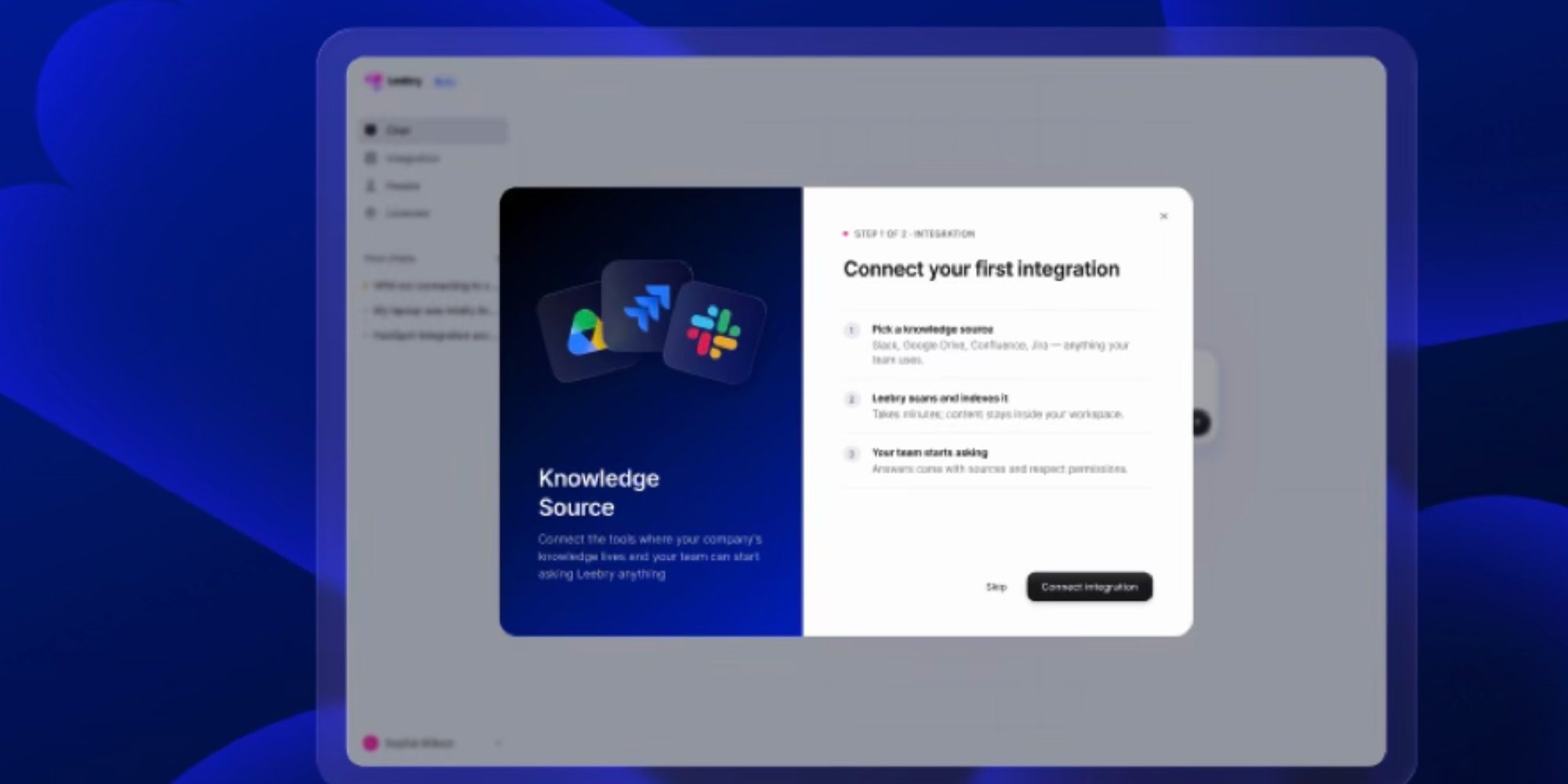
Leebry is built from the ground up to be permission-aware. The platform authenticates each user upon query and dynamically filters the knowledge base, ensuring that employees can only access information they are explicitly permitted to view.
Additionally, Leebry ships with a Model Context Protocol (MCP) server. This advanced feature safely exposes the device management control plane to AI agents, backed by strict, admin-configured guardrails on every single action. IT teams can safely delegate repetitive device management and operational workflows to AI agents without relinquishing granular control over what those agents are authorized to execute.
Official Statements and Industry Perspectives
Evaluating enterprise software requires looking past marketing jargon to understand the core philosophy driving the product team. Dan Jaenicke, Director of B2B Product Development at MacPaw, encapsulated the product ethos succinctly:
"Businesses don’t need another tool to check, they need work taken off their plate, without sacrificing oversight or control."
This philosophy addresses a phenomenon known as "tool fatigue"—the exhaustion experienced by IT administrators and employees alike who are constantly forced to adopt, configure, and monitor yet another software dashboard that demands constant manual intervention. Leebry’s objective is not to add another administrative chore to an IT manager’s daily routine, but to absorb the repetitive friction of internal support and documentation management.
Bradley Chambers, an experienced Apple IT administrator, notes that the platform’s focus on access provisioning and automated onboarding addresses a glaring vulnerability in modern SMB operations:
"For IT orgs that work extensively with Apple, the access provisioning aspect is interesting. Automating access changes as people move within the organization can be a huge pain point for SMBs without a dedicated IAM team. Most of the time, it’s manual, it’s slow, and departing employees end up with access that should have been revoked days earlier. I’ve run into this myself quite a bit."
Future Outlook: Can a Consumer Utility Giant Conquer the Enterprise?
The most frequently asked question regarding MacPaw’s bold venture is simple: Why should enterprise IT teams trust a consumer Mac software company to build mission-critical enterprise tooling?

Historically, consumer software companies attempting to scale upward into enterprise B2B markets often struggle. Their products can lack the security rigor, scalability, and administrative controls demanded by corporate IT departments. However, MacPaw’s trajectory with Leebry suggests a fundamentally different origin story.
Leebry was not conceived in a vacuum by a product marketing team trying to capitalize on the enterprise AI gold rush. It was built out of desperate necessity to solve MacPaw’s own internal IT and operational bottlenecks. It was tested, refined, and proven inside a live tech organization before ever seeing the light of the commercial market. That foundation—solving a genuine, lived operational problem rather than chasing a financial trend—gives Leebry a distinct credibility advantage over many competing enterprise SaaS offerings.
Furthermore, the modern corporate landscape is increasingly decentralized. Documents, chat threads, internal wikis, and cloud file-sharing repositories are hopelessly scattered across disparate applications. Employees everywhere are guilty of asking colleagues to track down information that is already documented somewhere in the digital ether.
As enterprises continue to grapple with the fallout of hasty, unvetted AI deployments, the demand for permission-aware, source-verified, and automation-driven IT platforms will only accelerate. By leveraging its deep roots in the macOS ecosystem and channeling its software engineering expertise into workplace intelligence, MacPaw is positioning Leebry to become an indispensable ally for IT teams striving to bring order to the chaos of modern work.