In a landmark architectural development for enterprise data management, Amazon Web Services (AWS) has announced a powerful new capability for Amazon Aurora PostgreSQL: the ability to directly query operational data alongside historical data lakes formatted in Apache Iceberg and Apache Parquet. By embedding the high-performance analytical engine DuckDB—following the recent integration of the DuckLabs team into Amazon—AWS has eliminated one of the most stubborn and costly engineering bottlenecks in modern cloud architecture: the traditional Extract, Transform, Load (ETL) pipeline.
For decades, application architects and database administrators have faced a rigid dichotomy. Operational databases (OLTP systems) like PostgreSQL excel at handling rapid, transactional workloads—processing real-time customer checkouts, tracking live inventory, and logging immediate system events. Conversely, analytical data stores and data lakes (OLAP systems) hosted on platforms like Amazon S3 are built to crunch petabytes of historical information, training machine learning models and generating long-term business intelligence reports.
Bridging these two worlds historically required complex, resource-intensive reverse-ETL pipelines. Data had to be continuously copied, transformed, synchronized, and duplicated across different storage tiers, driving up infrastructure costs, introducing synchronization latency, and multiplying points of failure. Furthermore, as organizations aggressively deploy artificial intelligence (AI) agents that require immediate, fluid access to both real-time operational state and deep historical context, pre-replicating and predicting every conceivable dataset has become practically impossible.
The newly released capability within Aurora PostgreSQL—supported natively on major versions 17 (starting with 17.11) and 18 (starting with 18.6)—fundamentally shatters this paradigm. Utilizing standard PostgreSQL syntax, tools, and extensions, developers can now execute unified queries that effortlessly join live, uncommitted operational writes inside Aurora with massive, immutable Parquet files and Apache Iceberg tables residing in Amazon S3 and S3 Tables. Leveraging advanced database optimizations such as predicate pushdown, column pruning, and local instance caching, AWS has delivered a seamless, zero-ETL integration that promises to redefine how enterprises build real-time dashboards, contextual transaction processors, and autonomous AI systems.
Detailed Chronology and Technical Architecture
The journey toward native data lake querying within Aurora PostgreSQL represents a deliberate convergence of open-source analytical innovation and enterprise-grade relational database engineering.
The Evolution of the Hybrid Query Engine
Historically, executing a query that combined live transactional data with archival records meant standing up distributed query engines like Amazon Athena or building custom data pipelines using AWS Glue, Apache Spark, or managed Kafka streams to sync S3 data back into PostgreSQL. These architectures inevitably introduced network hops, storage bloat through data duplication, and operational overhead.
The turning point arrived with the strategic integration of DuckDB into the AWS ecosystem. Following the acquisition of the core DuckLabs engineering team—the minds behind the high-speed vectorized analytical database DuckDB—AWS engineers began evaluating how to bring DuckDB’s renowned processing efficiency directly inside the memory and compute space of managed relational databases.
Rather than treating DuckDB as a separate microservice, AWS embedded the analytical engine directly within the Aurora PostgreSQL process space. This allowed the system to perform vectorized, highly optimized analytical scans on external file formats like Parquet and Iceberg locally, while the native PostgreSQL engine manages operational data transactions.
Setting Up and Configuring the Integration
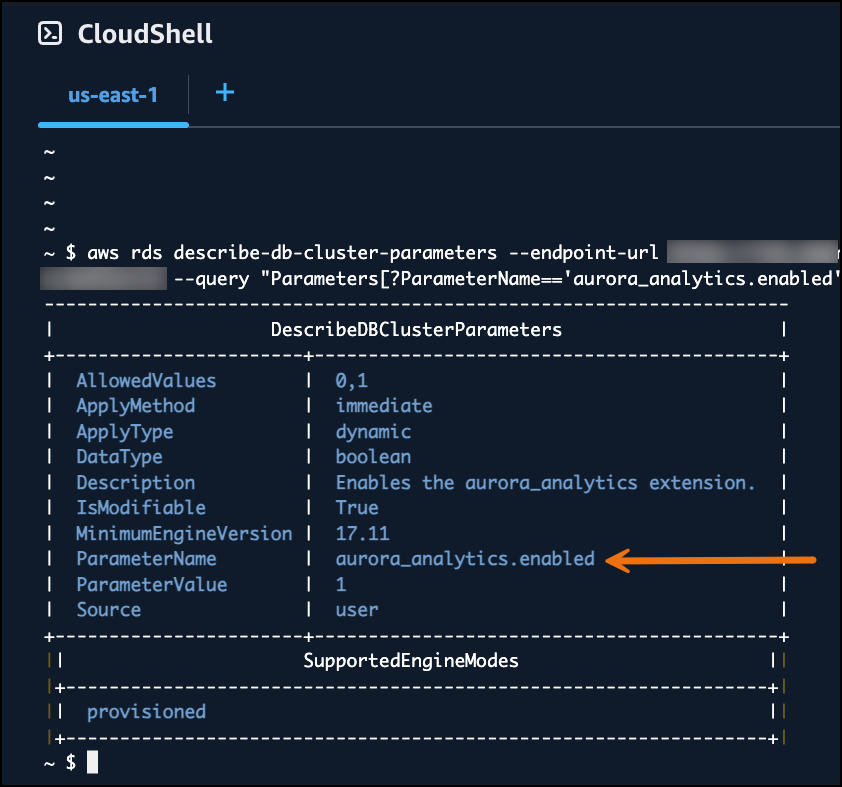
Activating this capability within an Aurora PostgreSQL cluster is streamlined for database administrators. The infrastructure requires a few foundational steps:
Cluster Provisioning: Deploy an Aurora PostgreSQL cluster running version 17.11 (or higher) or version 18.6 (or higher).
IAM Role Assignment: Attach an AWS Identity and Access Management (IAM) role to the cluster equipped with the necessary permissions (AuroraAnalytics feature scope) to read data from Amazon S3 and interact with the AWS Glue Data Catalog.
Extension Activation: Connect to the database via any standard PostgreSQL client (such as psql) or the Amazon RDS console, and enable the core extension:
CREATE EXTENSION aurora_analytics;
Foreign Table Declaration: Map external data lake resources by defining foreign tables. Crucially, Aurora leverages Parquet and Iceberg metadata schemas automatically. By defining a foreign table with empty parentheses, the database automatically inspects the underlying file structure:
CREATE FOREIGN TABLE transaction_history ()
SERVER aurora_analytics_server
OPTIONS (
   location 's3://<my-bucket>/finance/transaction_history.parquet',
   format 'parquet'
);
Bulk Schema Ingestion: For complex analytical environments comprising hundreds or thousands of individual tables, administrators can bypass manual definitions entirely. A single IMPORT FOREIGN SCHEMA statement automatically discovers and registers every Iceberg or Parquet table housed within an AWS Glue Data Catalog database.
Federated Catalogs and Advanced Optimizations
Modern enterprises rarely store all their analytical data in a single bucket or catalog. To address this, Aurora PostgreSQL supports external Iceberg REST Catalog (IRC)-compatible catalogs through AWS Glue Data Catalog federation. By registering an external catalog once with Glue, developers can create foreign tables that point seamlessly to multi-cloud or multi-account data stores. A single SQL query can subsequently join operational Aurora tables with Iceberg datasets distributed across multiple distinct catalogs.
Under the hood, performance is safeguarded by sophisticated query optimization techniques:
Predicate Pushdown: Filters (such as WHERE customer_id = 'C-1001') are pushed down directly to the storage tier, ensuring that unneeded rows are never scanned or transferred.
Column Pruning: Only the columns explicitly referenced in the SELECT clause are read from Amazon S3, drastically reducing I/O consumption.
Intelligent Caching: Frequently accessed data lake blocks are intelligently cached inside the Aurora instance’s memory, ensuring that subsequent queries return faster.
Observability: Database engineers can inspect execution mechanics and analyze caching behavior on a per-query basis using the native diagnostic function aurora_analytics_stat_statements(), which reports precise metrics including rows scanned, bytes read from S3, and cache hit ratios.
Supporting Context & Metrics
To understand the profound economic and operational impact of this release, one must examine the hidden costs of traditional data architectures. Industry benchmarks consistently demonstrate that data duplication—the byproduct of maintaining separate data lakes and operational operational databases—accounts for a significant percentage of cloud storage expenditures. Furthermore, engineering teams historically dedicate up to 30% of their operational bandwidth to building, debugging, and maintaining brittle ETL pipelines.
Consider a common enterprise scenario: a financial institution needs to evaluate a customer’s recent credit behavior alongside their multi-year transaction history to approve a real-time loan.
In the legacy architecture, the last 7 days of data reside in an Aurora table (recent_transactions), while the past 5 years of archival history sit in a compressed Parquet file on Amazon S3 (transaction_history). To query both datasets simultaneously, an engineer would previously have to write a custom synchronization job, stage data into temporary staging tables, or query Athena and stitch the results together in application code.
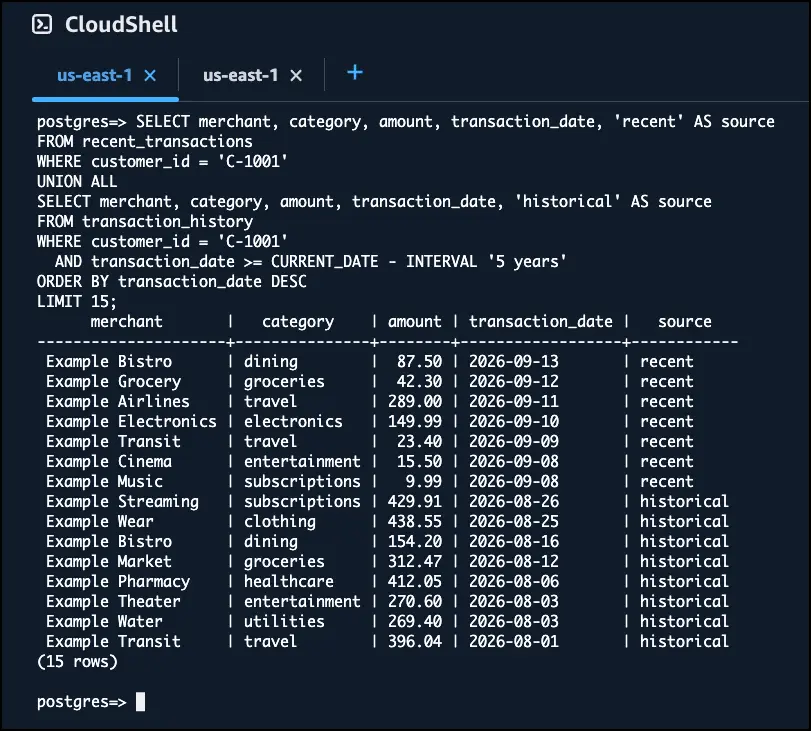
With the new Aurora PostgreSQL capability, the operation is executed natively within a single, elegant SQL statement:
SELECT merchant, category, amount, transaction_date, 'recent' AS source
FROM recent_transactions
WHERE customer_id = 'C-1001'
UNION ALL
SELECT merchant, category, amount, transaction_date, 'historical' AS source
FROM transaction_history
WHERE customer_id = 'C-1001'
  AND transaction_date >= CURRENT_DATE - INTERVAL '5 years'
ORDER BY transaction_date DESC
LIMIT 15;
When this query runs, DuckDB executes the heavy analytical scan of the historical Parquet files on S3 under the hood, while the PostgreSQL engine fetches the live operational rows. The result set is unified instantaneously.
Materialization for Ultra-Low Latency
While direct querying over S3 provides immense flexibility and cost savings, certain workloads demand single-digit-millisecond latency. For hot datasets that require lightning-fast access, developers can easily materialize data from the data lake directly into native Aurora PostgreSQL tables using standard commands:
CREATE TABLE materialized_history AS
SELECT * FROM transaction_history WHERE transaction_date >= CURRENT_DATE - INTERVAL '1 year';
These materialized tables reside natively inside Aurora and can be queried just like any other relational table. Crucially, read queries can be distributed across any read replica in the Aurora cluster, effectively offloading intensive analytical scans from the primary writer instance and protecting core transactional performance.
Official Statements and Industry Perspective
The integration of DuckDB technology into Amazon Aurora reflects AWS’s broader strategy of absorbing best-of-breed open-source innovations and wrapping them in enterprise-grade security, scalability, and managed operational controls.
While AWS product leaders have emphasized the elimination of operational complexity, independent database architects and data engineers have lauded the move as a major step toward ending the artificial wall between operational databases and analytical data warehouses.
"By bringing the speed and simplicity of DuckDB directly into Amazon Aurora PostgreSQL, we are empowering developers and AI agents alike to query and combine operational and Iceberg data using the exact same PostgreSQL tools, applications, and endpoints they already rely on," notes the AWS Aurora engineering team in their technical release notes. "Because this capability is built around DuckDB, future enhancements to the open-source engine will continuously deliver performance and functionality gains across Aurora and the broader AWS ecosystem."
Industry analysts point out that this feature directly addresses the unique demands of modern generative AI applications. When deploying autonomous AI agents capable of multi-step reasoning, developers cannot anticipate what historical archives or live operational metrics an agent might need to reference mid-conversation. Requiring pre-built ETL pipelines for unpredictable AI prompt paths is a recipe for architectural failure. By providing an open, federated query interface directly within the transactional database, AWS has equipped developers with the foundational plumbing required for truly intelligent, context-aware applications.
Future Outlook and Market Implications
The launch of direct Apache Iceberg and Parquet querying in Amazon Aurora PostgreSQL signals a fundamental shift in cloud database design. As data lakes mature into the de facto standard for long-term enterprise storage—bolstered by open table formats like Apache Iceberg that decouple storage from compute—the role of the operational database is evolving.
The Decline of the Isolated Silo
For years, the database market was characterized by extreme specialization: OLTP databases were strictly forbidden from executing analytical queries, and analytical warehouses were incapable of handling transactional concurrency. Platforms like Aurora PostgreSQL are proving that modern hardware, advanced vectorization engines like DuckDB, and intelligent pushdown optimizations can successfully bridge this divide without sacrificing performance.
Looking ahead, we can anticipate several evolutionary leaps in this domain:
Deeper AI Agent Integration: As frameworks like LangChain, Semantic Kernel, and custom agentic architectures integrate directly with Aurora PostgreSQL, agents will autonomously generate complex SQL queries that span live row-level operational state and petabyte-scale historical data lakes in milliseconds.
Open Table Format Dominance: With native support for Iceberg REST Catalogs and AWS Glue Data Catalog federation, organizations will increasingly adopt open table formats as their universal data standard, knowing their primary operational databases can read those files natively.
Cost Optimization Pressures: As enterprises demand greater financial efficiency from their cloud deployments, features that eliminate redundant storage and expensive, multi-hop ETL pipelines will become mandatory procurement criteria.
Availability and Economic Accessibility
Crucially, AWS has chosen to make this transformative capability available at no additional charge in all commercial AWS Regions and AWS GovCloud (US) Regions. Users incur costs only for the incremental Aurora compute consumed during query execution and standard Amazon S3 request and data-transfer pricing.
This pricing model lowers the barrier to entry, allowing startups and Fortune 500 enterprises alike to experiment with unified operational-analytical architectures without upfront software licensing hurdles or complex capacity planning.
In summary, Amazon Aurora PostgreSQL’s native integration of DuckDB marks the beginning of the end for costly, high-latency ETL synchronization between operational databases and data lakes. By unifying live transactions and historical archives under a single, familiar SQL interface, AWS has laid down a new benchmark for enterprise data agility.