Executive Overview
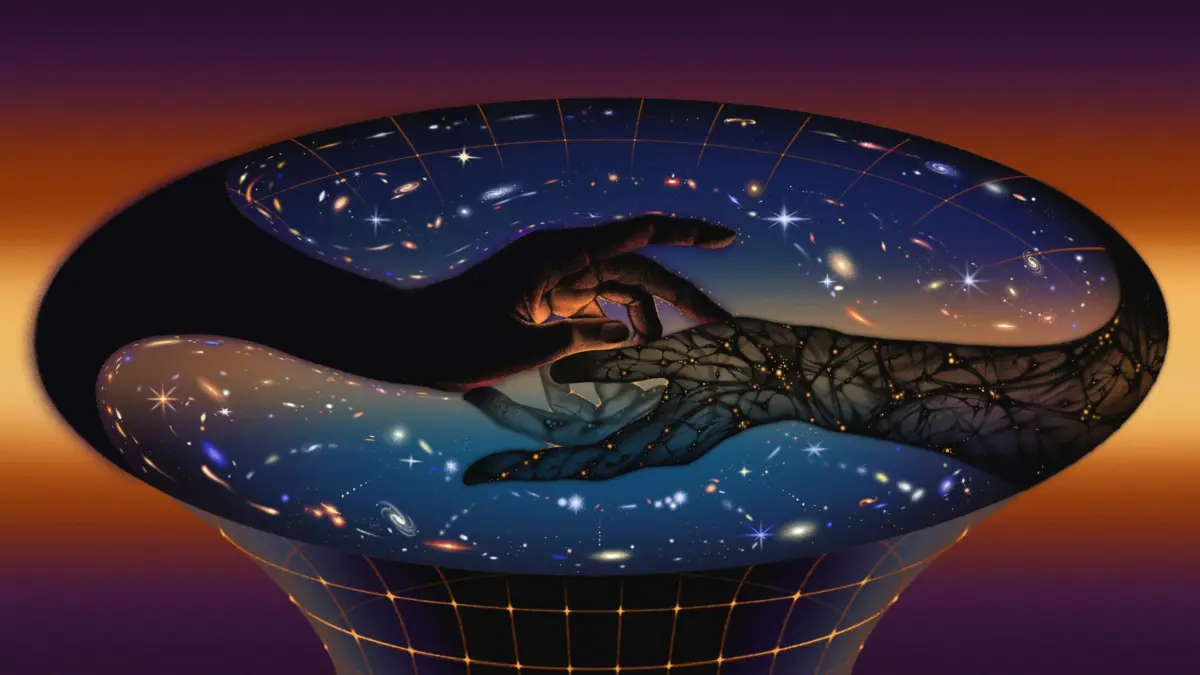
To look out into the cosmos is to gaze upon a profound mystery. Modern astrophysics rests on an uneasy foundation: roughly 70 percent of the universe consists of dark energy—an enigmatic force driving the accelerated expansion of space—while another 25 percent is comprised of dark matter, the invisible scaffolding holding galaxies together. Together, these two invisible phenomena account for 95 percent of reality. Yet, despite sharing the modifier "dark" due to their complete lack of interaction with light, physicists have traditionally treated them as entirely separate entities, linked only by their elusiveness.
That paradigm is now fracturing. Driven by startling astronomical data gathered by the Dark Energy Spectroscopic Instrument (DESI) in 2024 and 2025, which suggests that dark energy is not a constant value but is actively weakening over time, a growing vanguard of theoretical physicists is re-evaluating an old hypothesis: that dark energy and dark matter are physically intertwined.
Far from being isolated cosmic anomalies, these forces may be deeply coupled components of a unified "dark sector." By constructing models rooted in quantum chromodynamics, string theory, and a radical hypothesis known as the "dark dimension," researchers are beginning to solve some of cosmology’s most stubborn puzzles—including the infamous "Hubble tension." If these emerging models prove correct, we may be standing on the precipice of a new era in physics, one that finally bridges the chasm between abstract high-energy theory and observational astronomy.
Detailed Chronology: The Shift from Cosmic Constants to Dynamic Dark Sectors
For decades, the standard model of cosmology—known as the Lambda-CDM model—treated dark energy as Einstein’s cosmological constant ($Lambda$): a static, unchanging background energy density inherent to the vacuum of space itself. In this framework, dark matter acted merely as a passive gravitational anchor, clustering to form the webs of galaxies we see today while dark energy pushed them relentlessly apart.
The first major cracks in this static picture appeared in 2024. The DESI collaboration, utilizing a specialized multi-object spectrograph mounted on the Mayall 4-meter Telescope at Kitt Peak in Arizona, mapped millions of galaxies and quasars across cosmic time. Their initial analysis delivered a seismic shock to the physics community: the strength of dark energy appeared to be varying over time.
By 2025, a follow-up study incorporating more than twice as much DESI data reinforced these conclusions. The data indicated that dark energy had reached a peak energy density roughly 2 billion years ago before beginning to weaken. More peculiarly, the data suggested that in an earlier cosmic epoch, dark energy may have grown stronger—a phenomenon that appeared to violate the foundational law of energy conservation.
[Cosmic Timeline of Dark Energy & Matter Evolution]
-------------------------------------------------------------------------
Early Universe          ~2 Billion Years Ago        Present Day
(Phantom Regime)        (Peak Density)              (Weakening Force)
   |                          |                           |
   v                          v                           v
Dark Matter transfers   Dark Energy reaches         Dark Energy dilutes/
energy to Dark Energy;  maximum strength;           interacts with Dark
apparent "uphill roll"  expansion accelerates       Dimension fluctuations
To explain this seemingly impossible behavior, researchers described dark energy as entering a "phantom regime." In standard physical terms, this is akin to watching a ball roll spontaneously uphill; it is mathematically and physically permissible only if an external force—something other than gravity alone—is pushing it.

The realization that dark energy might be dynamic rather than constant forced theorists to rethink the isolationist view of the dark sector. As particle physicist Tim Tait of the University of California, Irvine, notes, while scientists long assumed the two dark components had nothing to do with each other, it is entirely logical to imagine a universe where one actively influences the other. This cross-influence points directly toward a unified theory of the dark universe.
Supporting Context & Metrics: Interacting Dark Sectors and the Hubble Tension
The idea that dark energy and dark matter might communicate is not entirely unprecedented. In 2005, physicist Justin Khoury of the University of Pennsylvania, alongside collaborators, investigated whether a form of dark energy with a time-varying density could exist. They discovered that if dark energy and dark matter could mutually affect one another, they would naturally produce the illusion of phantom behavior without violating physical laws.
Two decades later, the DESI revelations galvanized Khoury and his Penn colleagues, Meng-Xiang Lin and Mark Trodden. The team constructed a sophisticated new model of "dark interactions" inspired by a dark-sector analogue of quantum chromodynamics (QCD)—the cornerstone theory that describes how quarks and gluons interact via the strong nuclear force. In this new framework, both the energy density of dark energy and the mass of dark matter fluctuate in tandem.
Around the same time, a study published in Physical Review D by a team including University of Montpellier cosmologist Elsa Teixeira proposed a complementary mechanism. Their model suggests that during a previous era of cosmic history, dark matter transferred a minute fraction of its energy over to dark energy.
"Dark matter is the main brake on the universe’s expansion," Teixeira explains. By easing up on that gravitational brake, the transfer of energy would naturally cause the acceleration of the universe’s expansion to shift gears.
David Andriot, a physicist at France’s CNRS, describes this conceptual shift as a matter of rigorous bookkeeping: "Any change or evolution of the mass of dark matter has been put into the box of dark energy."
Alleviating the Hubble Tension
Beyond explaining phantom behavior, coupling dark energy to dark matter offers a potential lifeline for one of modern physics’ most agonizing crises: the Hubble tension.

The Hubble constant—the rate at which the universe is expanding—can be calculated in two fundamentally different ways:
- The Early Universe Method: Utilizing the Cosmic Microwave Background (CMB)—the residual glow of the Big Bang—measured by missions like the Planck satellite.
- The Late Universe Method: Utilizing local phenomena, such as standard candles (Type Ia supernovae) and Cepheid variable stars, observed by instruments like the Hubble and James Webb Space telescopes.
According to the standard cosmological model, these two methods should yield identical results. Yet, in recent years, scientists have found a persistent 9 percent discrepancy between the early-universe expansion rate and the late-universe rate. This mismatch has sparked fierce debates over whether the error stems from instrumental calibration or points toward entirely new physics.
Models featuring interacting dark energy and dark matter sweep away this crisis. By allowing the two dark forces to interact dynamically, what appears to be an unresolvable contradiction in expansion rates naturally emerges as an expected consequence of cosmic evolution.
Official Statements and Theoretical Perspectives
The movement to integrate dark energy and dark matter has attracted heavyweight theorists who argue that the historical separation of the two was an analytical crutch rather than a physical truth.
"The notion that you can compute dark energy independently of dark matter is wrong. That assumption, often made by cosmologists and also followed by the DESI team, led to the physically unacceptable phantom behavior."
— Cumrun Vafa, Physicist, Harvard University
Vafa, alongside former Ph.D. student Georges Obied (now at the University of Chicago), Princeton’s Alek Bedroya, and Harvard’s David Wu, published a landmark paper in July 2025 demonstrating that cutting-edge string theory models align remarkably well with the anomalous DESI data.
According to their framework, the strength of dark energy and the mass of dark matter are destined to decrease over time. Moreover, the rate at which dark energy changes is directly proportional to its extraordinarily small energy density.

"It’s not surprising that we didn’t see it until now," Vafa points out, noting that because the rate of change is so microscopically tiny, "we had to wait the entire age of the universe to detect something that small."
Future Outlook: The "Dark Dimension" and Experimental Verification
If dark energy and dark matter are fundamentally linked, the root of their connection may lie in spatial dimensions beyond our direct perception.
String theory dictates that our universe possesses six or seven extra spatial dimensions curled up at the Planck scale ($10^-35$ meters). However, a revolutionary proposal put forward by Vafa and his collaborators in recent years introduces the concept of a "dark dimension." Unlike the other microscopic dimensions, this specific extra dimension could be significantly larger—on the scale of a micron ($10^-6$ meters).
In this scenario:
- Gravitons (the hypothetical quantum particles mediating gravity) can leak into this enlarged dark dimension.
- Once inside, they acquire mass, transforming into dark gravitons.
- While these massive gravitons reside primarily in the dark dimension, their gravitational footprints leak back into our familiar four-dimensional spacetime, effectively mimicking the observable gravitational behavior of dark matter.
[The Dark Dimension Framework]
   Familiar 4D Space (Us)          The Dark Dimension (~1 Micron)
      |                                       |
      |-------- (Gravitons leak across) ----> |
      |                                       v
      | <------ (Massive Dark Gravitons) ---- |
      v
(Exhibits properties of Dark Matter & couples directly to Dark Energy)
"There is a very natural coupling between dark energy and dark matter," explains Georges Obied. "Changes in the size of the dark dimension would affect both."
Testing the Untestable
Historically, string theory has faced fierce criticism for being untestable—a mathematical framework detached from empirical reality. However, the dark dimension hypothesis opens up tangible avenues for verification.
If dark matter is coupled to dark energy through a dark dimension, dark matter particles must interact with one another via a new, long-range force distinct from gravity. Back in 2006, physicists Marc Kamionkowski and Michael Kesden calculated that if dark matter possessed a stronger self-attraction than ordinary matter, it would distort galactic flybys, leaving behind extended streams of stars, dust, and gas known as "tidal tails."
%2C-and-the-Hubble-Heritage-Team-(STScI-AURA).jpg)
While Kesden and Kamionkowski did not find these extreme tidal tails in their initial observational surveys, their null results successfully established an upper bound on the strength of this extra force. Crucially, that upper bound is roughly 20 times larger than the values predicted by Vafa’s modern dark dimension models—meaning the theoretical predictions sit comfortably within observational limits.
"It is interesting that we are now finding connections between that fairly abstract work and observational and experimental work," Kamionkowski reflects.
Conclusion: The Convergence of Theory and Data
As observational astronomy enters a golden age of precision—bolstered by DESI, the Vera C. Rubin Observatory, and space-based telescopes—the theoretical frameworks of particle physics and cosmology are finally colliding with hard data.
Whether the dark dimension hypothesis ultimately survives the crucible of future observations remains to be seen. But as Georges Obied emphasizes, the scientific method is performing precisely as intended: theoretical physicists are placing every conceivable possibility on the table, allowing empirical data to separate reality from mathematical fiction.
In the quest to understand the 95 percent of the universe that remains shrouded in shadow, the convergence of dark energy and dark matter may soon illuminate the deepest secrets of existence.