Executive Overview
The landscape of business communication is undergoing a quiet, yet profound, transformation. Traditional telemarketing and logistics dispatch operations—historically tethered to rigid interactive voice response (IVR) systems or massive human call centers—are increasingly adopting conversational artificial intelligence.
At the bleeding edge of this shift are developers leveraging modern, high-speed machine learning APIs to build autonomous voice agents that can converse with human beings in real time.
In the logistics and trucking sector, where timely communication can make or break a supply chain, automation is no longer a luxury; it is a competitive necessity. Enter the Google Voice Dispatch Agent, a specialized open-source project engineered by Python automation developer Muhammad Afzal Kalwar.
Designed specifically for trucking dispatch outreach, this architecture bypasses expensive, enterprise-tier telephony infrastructure by marrying consumer-grade tools like Google Voice (driven via browser automation) with high-performance AI models from Groq and Edge TTS.
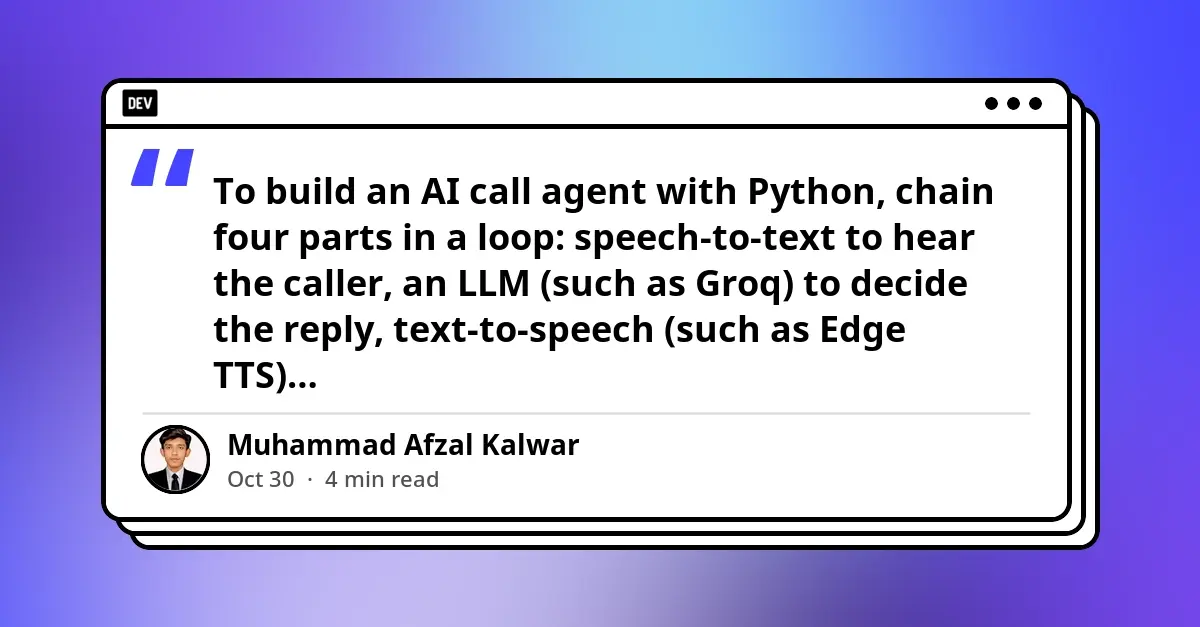
This technical deep-dive explores the core components, runtime architecture, algorithmic safeguards, and broader industry implications of building an AI call agent in Python. By chaining speech-to-text (STT), Large Language Models (LLMs), text-to-speech (TTS), and intelligent call-state detection into a seamless loop, developers can now deploy production-grade voice bots at a fraction of the cost of traditional CPaaS (Communications Platform as a Service) providers.
Detailed Chronology & Technical Architecture
The development of the Google Voice Dispatch Agent highlights the convergence of several previously disparate technologies: browser automation, real-time audio routing, ultra-low-latency inference, and state machine logic.
To understand how a Python script can successfully conduct a two-way phone conversation, one must examine the multi-layered architecture that powers the runtime environment.
The Anatomy of the Dispatch Agent Stack
| Layer | Technology Utilized | Function |
|---|---|---|
| Phone Line | Google Voice via Chrome (Selenium) | Interfaces with the public switched telephone network (PSTN) through a standard web browser interface. |
| Hearing (Input) | Voice Activity Detection (VAD) & Groq Speech-to-Text | Captures incoming audio frames, detects pauses in speech, and transcribes audio into machine-readable text. |
| Thinking (Logic) | Groq LLM (e.g., Llama 3.1) | Analyzes the conversation history, evaluates contextual constraints, and generates concise, context-aware responses. |
| Speaking (Output) | Edge TTS (with pyttsx3 fallback) & VB-CABLE |
Converts text responses into high-fidelity synthesized audio and routes them directly into the browser’s virtual microphone. |
| Control & Management | FastAPI Web Console | Provides human operators with a dashboard to monitor active calls, adjust system configurations, and review system health. |
| Persistence & Audit | Local CRM, SQLite/JSON logs, and Audio Archiving | Stores complete call logs, transcripts, individual audio recordings, and lead states for compliance and human review. |
The Runtime Execution Flow
When a campaign is initiated, the agent executes a rigorously defined sequence:
- Initialization: The script loads contact lists from a local database, verifies configuration parameters, and executes a series of preflight checks to ensure that the browser instance and virtual audio cables are functioning correctly.
- Asset Pre-generation: To eliminate latency during the critical opening moments of a call, the system pre-generates the opening line and standard voicemail drop audio files using Edge TTS before dialing.
- Outbound Dialing & Gating: The Selenium driver navigates the Google Voice interface, inputs the target phone number, and initiates the call. However, unlike crude auto-dialers, the agent does not speak immediately. It enters a sophisticated monitoring loop to verify the call state.
- The Conversation Loop: Once a live human is confirmed on the line, the opening audio file is triggered. The agent then enters a continuous loop: listening for human speech via VAD, transcribing the audio via Groq, processing the intent through the LLM, synthesizing the reply, and playing it back.
- Post-Call Processing: Upon call termination, the system writes comprehensive transcripts and audio recordings to disk, updates the local CRM, and enforces a mandatory cooling-off period before cycling to the next contact.
Step-by-Step Implementation Breakdown
Building a reliable voice agent requires careful attention to edge cases, particularly timing, audio routing, and hallucination management. Below is an examination of the core modules that make up the Dispatch Agent.
Step 1: Intelligent Call-State Detection
One of the most common pitfalls in amateur voice bot development is the "premature greeting" problem—where the agent begins talking while the phone is still ringing or directly into an automated carrier intercept message.
To prevent this, the Dispatch Agent employs a conservative gating algorithm. It reads DOM cues from the Google Voice web interface, enforcing a mandatory minimum ring window before any state transition can be registered.
import time

def wait_for_answer(page, min_ring=2, max_ring=45):
    start = time.time()
    while True:
        elapsed = time.time() - start
        state = page.detect_call_state()      # reads DOM cues for call status
        if elapsed < min_ring:
            continue                          # ignore early noise / stale connection banners
        if state in ("connected", "voicemail", "ended"):
            return state
        if elapsed > max_ring:
            return "no_answer"
        time.sleep(0.25)
This strict state machine ensures that the agent never speaks an opening line to an empty ringtone or a busy signal, drastically increasing the perceived realism of the interaction.
Step 2: High-Speed Audio Capture and Transcription
Once a connection is established, the agent must accurately capture and decode human speech. By chunking audio streams into short frames and utilizing Voice Activity Detection (VAD) to isolate utterance boundaries, the system sends clean audio payloads to cloud-hosted transcription engines.
For real-time applications, low latency is non-negotiable. The integration of Groq’s hosted Whisper models (whisper-large-v3) allows for near-instantaneous speech-to-text conversion.
from groq import Groq
client = Groq()

def transcribe(wav_path: str) -> str:
    with open(wav_path, "rb") as f:
        r = client.audio.transcriptions.create(
            file=f,
            model="whisper-large-v3"
        )
    return r.text
Step 3: Contextual Reasoning via Groq LLMs
When structuring the brain of the call agent, brevity is essential. Human telephone conversations are characterized by quick back-and-forth exchanges; sprawling, paragraph-long robotic monologues instantly break the illusion of an intelligent assistant.
The system prompt must enforce strict token limits and behavioral guidelines, as demonstrated in the following implementation using Groq’s high-speed chat completion models:
SYSTEM = "You are a polite dispatch assistant. Reply in one or two short sentences."

def reply(history: list[dict]) -> str:
    r = client.chat.completions.create(
        model="llama-3.1-8b-instant",
        messages=["role": "system", "content": SYSTEM, *history],
        max_tokens=80,
    )
    return r.choices[0].message.content
By constraining the model to a maximum of 80 tokens and instructing it to focus strictly on logistics parameters—such as truck availability, lanes, and equipment types—the agent remains entirely on-task.
Step 4: Natural Voice Synthesis and Audio Routing
Text-to-speech technology has evolved past the robotic, monotone synthesizers of the past decade. Microsoft’s Edge TTS provides access to remarkably natural-sounding neural voices completely free of charge.
import asyncio, edge_tts

async def speak_to_file(text: str, path: str, voice="en-US-GuyNeural"):
    await edge_tts.Communicate(text, voice).save(path)

# Pre-generate opening line before dialing
asyncio.run(speak_to_file("Hi, this is dispatch calling about your truck.", "opening.mp3"))
To route this generated audio into the active phone call without relying on complex, expensive telephony hardware, the architecture utilizes a virtual audio cable (such as VB-CABLE). By setting the virtual audio device as the system’s microphone input within the Chrome browser running Google Voice, the synthesized MP3 file is played directly into the telephone stream as if a human were speaking into a physical mic.
Step 5: Voicemail Handling and Comprehensive Logging
Not every call results in a live conversation. Intelligent voicemail detection is vital for modern outreach campaigns.
The Dispatch Agent verifies voicemail status post-connection by combining browser DOM indicators with an early-call audio classifier trained to recognize standard greeting tones and beep signals.
If a voicemail machine is positively identified, the agent aborts the conversational flow and executes a fallback routine: playing the pre-recorded voicemail audio file, recording the outcome, and seamlessly transitioning to the next lead in the queue.
Every single interaction—whether completed, missed, or sent to voicemail—generates a detailed audit trail containing full transcripts, audio recordings, and updated CRM metadata.
Supporting Context & Metrics
The economic rationale behind building custom, Python-based AI agents rather than relying on legacy SaaS call center software is staggering. Traditional outbound calling platforms often charge hefty per-minute fees, monthly seat licenses, and steep markup costs on telephony integrations.
By contrast, the Google Voice Dispatch Agent operates on a lean stack:
- Infrastructure Costs: Leveraging consumer Google Voice accounts via browser automation eliminates trunking fees.
- Inference Efficiency: Utilizing Groq’s specialized LPU (Language Processing Unit) architecture drastically reduces inference latency, achieving response times under 500 milliseconds. This eliminates the awkward dead air that typically plagues automated phone calls.
- Scalability: Small-to-medium logistics operations can run multiple parallel instances of browser-driven automation on local hardware or affordable cloud virtual private servers (VPS), managing hundreds of carrier touchpoints daily with zero human intervention required for initial outreach.
Compliance and Disclosure
Deploying autonomous voice agents in the wild requires strict adherence to legal and regulatory frameworks. Telemarketing, automated calling, and data privacy laws vary significantly by jurisdiction.
- Regulatory Compliance: In the United States, operations must comply with the Telephone Consumer Protection Act (TCPA) and Federal Trade Commission (FTC) guidelines regarding auto-dialed calls. In the United Kingdom and European Union, regulations such as the Privacy and Electronic Communications Regulations (PECR) and the General Data Protection Regulation (GDPR) govern automated outreach and data processing.
- Disclosure & Opt-Outs: Best practices dictate that AI agents should explicitly disclose their automated nature when requested or required by local law. Systems must incorporate robust mechanisms to instantly honor "Do Not Call" (DNC) requests and permanent opt-outs, removing numbers from active contact databases immediately.
- Terms of Service: Developers must also review the terms of service of their chosen communication channels—such as Google Voice—to ensure that automated driving via web wrappers aligns with acceptable use policies.
Future Outlook
As large language models become smaller, faster, and more capable of edge deployment, the architecture pioneered by projects like the Google Voice Dispatch Agent represents the future of operational automation.
We are moving away from rigid, menu-driven phone trees toward fluid, conversational agents capable of negotiating freight rates, booking appointments, and resolving customer service inquiries with human-like nuance.
For independent developers and small business owners, the barrier to entry has never been lower. Armed with Python, Selenium, open-source audio models, and high-speed inference engines, engineers can construct sophisticated enterprise-grade communication tools from a standard laptop.
As these systems mature, the expectation of instant, intelligent responsiveness will become standard across every industry that relies on the telephone as a primary point of contact.
About the Author & Project Origin
The Google Voice Dispatch Agent was conceptualized and developed by Muhammad Afzal Kalwar, a Python automation specialist and founder of INDUS Web Agency based in Islamabad, Pakistan. Specializing in auto-dialers, custom web scrapers, AI voice agents, and CRM integrations, Kalwar builds tailored automation solutions for logistics, sales, and call-center enterprises across the United States, the United Kingdom, and Europe.
For developers interested in examining the complete source code, exploring the underlying architecture, or reading a deep dive into call-state detection mechanics, the project repository and technical articles are publicly accessible via GitHub and Dev.to.