At the tender age of 18, photographer Alicia Nieto packed up her life in a quiet town in northern Mexico and crossed an ocean to study in Europe. What began as a personal relocation quickly evolved into a multi-year, transnational odyssey through the pulsing underbelly of the continent’s youth subcultures. Her resulting body of work, See You Sometime, Somewhere, serves as an intensely intimate photographic diary cataloging the transient nature of modern youth: an unstable constellation of friendships, fleeting romantic encounters, cross-country road trips, and sweaty basements echoing with the sounds of punk, goth, and rock.
Far more than a standard collection of coming-of-age snapshots, Nieto’s project is an investigative and philosophical exploration of memory, displacement, and transformation. As she moves fluidly between Berlin, Leipzig, New York, and various European underground enclaves, Nieto captures subjects who, like her, are caught in the liminal space between adolescence and adulthood. Through her lens, the camera acts as both an anchor and an archive—a way to preserve the profound emotional resonance of people who appear in one’s life only to slip away into the ether.
With plans to culminate the project in a comprehensive photo book and exhibition next year, Nieto’s work positions her alongside legendary chroniclers of youth like Nan Goldin, Corinne Day, and Derek Ridgers. This article explores the genesis, thematic undercurrents, and cultural significance of See You Sometime, Somewhere, charting a unique visual language of transience, intimacy, and reinvention.
Detailed Chronology: From Northern Mexico to the European Underground
The genesis of See You Sometime, Somewhere is inextricably linked to the shock of displacement. Leaving behind the familiar contours of her hometown in northern Mexico at 18, Nieto stepped into the vast, disorienting expanse of Europe. The formative experience of moving abroad on the cusp of adulthood laid the psychological groundwork for her artistic pursuits.
"Living between cities meant constantly meeting people, forming connections, and saying goodbye," Nieto reflects, recalling the early days of her transition. "Photography became a way of processing those changes and holding on to people and moments that I knew wouldn’t last."
As she navigated her new academic and social environments, her camera became an ever-present appendage. The chronology of the project is mapped not by dates on a calendar, but by locations and serendipitous encounters. Early chapters of the series feature the quiet alienation and neon-drenched nocturnal landscapes of Berlin, where Nieto first began to immerse herself in local alternative scenes.
The scope of the project soon expanded beyond her immediate surroundings. Driven by an innate curiosity and a magnetic pull toward alternative music scenes, Nieto began traveling independently, often flying solo into unfamiliar cities armed with nothing more than her camera and an open mind. One pivotal milestone in the chronology of the project occurred in New York City, where she attended a Christian Death concert entirely alone. Plunging herself into the venue’s energetic mosh pits, she bypassed the isolation of foreign travel to forge immediate, deep bonds with strangers, turning an evening of solitude into an immersive masterclass in subcultural community building.
Further chapters of the project document her spontaneous excursions across borders. During a particularly challenging period of isolation in Berlin, a sudden impulse led her to catch a train to Leipzig. Having connected with a local host through a mutual acquaintance with whom she had exchanged only a handful of messages, Nieto arrived in the unfamiliar German city blind to what awaited her. The resulting photographs from that weekend capture a brief, incandescent spark of human connection—a testament to her willingness to surrender to the unpredictability of the road.
Supporting Context & Metrics: The Architecture of Intimacy and Subculture
To understand the visual weight of See You Sometime, Somewhere, one must examine the broader art-historical landscape that informs Nieto’s practice. The project draws clear thematic and stylistic lineage from the gritty, unvarnished realism of 20th and 21st-century documentary photography. Nieto openly cites Derek Ridgers’ seminal photo book Hello, I Love You, alongside the raw, diaristic confessions of Nan Goldin, the fragile grace captured by Corinne Day, and the nocturnal explorations of Sheila Rock.
Yet, Nieto’s perspective possesses a distinct emotional distance and clinical curiosity. Notably, the photographer approaches themes of romance and partnership from a unique vantage point: "I’ve never been in love with a romantic partner myself," she admits, "so I think that’s partly why I’m so drawn to it and curious about understanding that kind of love."
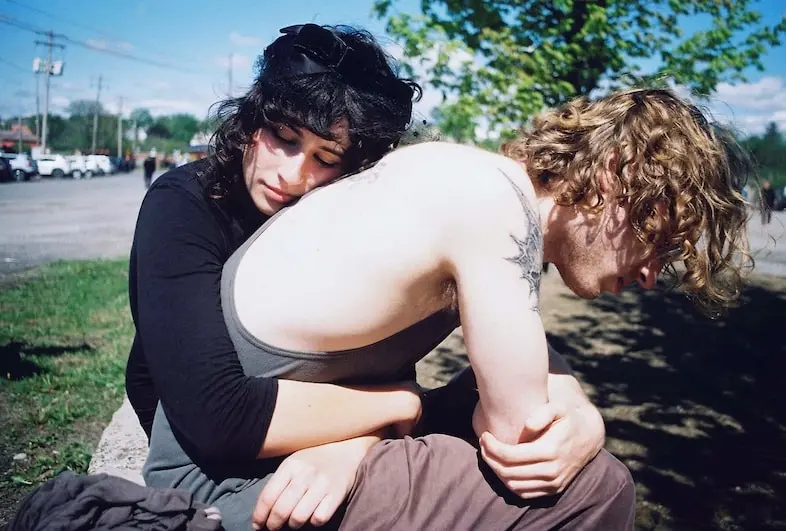
This external curiosity manifests in some of the series’ most arresting frames. One standout image features her friend Zola wrapping her arms around her partner Oliver from behind, captured precisely as Zola experiences romantic love for the first time. For Nieto, observing this dynamic is an exercise in profound fascination: "I find the idea of meeting someone with whom you can completely be yourself, someone who embraces the darker parts of you, and with whom you can connect on an emotional, intellectual, and physical level, incredibly magical."
The technical metrics of the series are characterized by a deliberate blurring of boundaries between public performance and private vulnerability. The archive spans thousands of frames, encompassing:
Winding Highway Transits: Blurry shots from car windows that visualize the state of perpetual motion.
Nocturnal Micro-Climates: Faces washed in the harsh neon glare of convenience stores, streetlamps, and underground club lighting.
Backstage and Domestic Spaces: Intimate portraits in cramped European apartments, backstage green rooms, and gritty concert venues.
The subjects of these photographs are split evenly between long-term confidants whom Nieto has tracked across years of personal evolution, and ephemeral acquaintances collected during brief stints in subcultural hubs. Whether documenting the gothic revivals of European youth or quiet morning-after cigarette breaks, the images collectively measure the emotional temperature of a generation redefining community in real-time.
Official Statements & Personal Reflections
The philosophy underpinning See You Sometime, Somewhere is rooted in an acceptance of impermanence—a rejection of the modern urge to curate permanent, flawless digital footprints in favor of preserving authentic, messy human interactions.
"The guiding principle was to follow what moved me emotionally," Nieto explains regarding her methodology. "I wanted to preserve how it felt to be close to someone, to inhabit a place temporarily, and everything that exists in between. The photographs became a way of giving those fleeting connections somewhere to remain."
This embrace of chance encounters is best encapsulated by the project’s title, which reads like a casual promise whispered from a train platform or a club exit. It is a philosophy tested and proven during her impromptu escape to Leipzig, which concluded with a cinematic twist. When her car broke down on the return journey, forcing her to hitchhike back to Berlin, she was picked up by a woman traveling with her dog. Only mid-journey did Nieto realize her savior was a celebrated German rock star. The hours spent discussing music with a legendary musician while a dog rested in her lap epitomizes the serendipitous magic that fuels the entire series.
Looking back on the years of image-making, Nieto’s reflections turn inward, touching on themes of existential metamorphosis:
"I think I’m quite obsessed with memory, death, and our ability to constantly be reborn as human beings. I feel like all the cities I’ve lived in, the people I’ve met, and the experiences I’ve had have shaped me in different ways, but I’ve never felt like one fixed person. We’re all constantly leaving parts of ourselves behind and becoming someone new. I’m fascinated by what remains of the people we once were, and how those different versions of ourselves continue to exist within us."
These statements elevate See You Sometime, Somewhere from a mere travelogue into a profound meditation on identity construction. Nieto’s camera acts as an archaeological tool, unearthing strata of past selves embedded in the friends and strangers she documents.
Future Outlook: The Next Chapter for Alicia Nieto
As See You Sometime, Somewhere approaches its official conclusion, the immediate future holds significant milestones for the young Mexican-born artist. Having accumulated a massive archive numbering in the thousands of photographs over her years in Europe, Nieto is currently curating the material for its next iterations.
Plans are firmly underway to synthesize the digital and physical archives into a definitive hardcover photo book, paired with a major gallery exhibition slated for next year. For an artist whose work deals intimately with the fear of loss and the fading of memory, translating ephemeral digital files and loose prints into a permanent, tactile artifact represents a poetic full circle.
"It feels strange to think that something that started so spontaneously has become such a big part of my life," Nieto reflects on the impending conclusion of the project. Yet, even as she prepares to draw a line under See You Sometime, Somewhere, her creative momentum shows no sign of slowing. Concurrently developing new photographic projects that explore parallel themes of identity and space, Nieto stands on the precipice of international acclaim.
By refusing to settle into a single geographic or artistic identity, Alicia Nieto has crafted a vital visual document of contemporary youth culture—one that reminds us that while people and places inevitably fade, the emotional echoes captured through the lens can live on indefinitely.