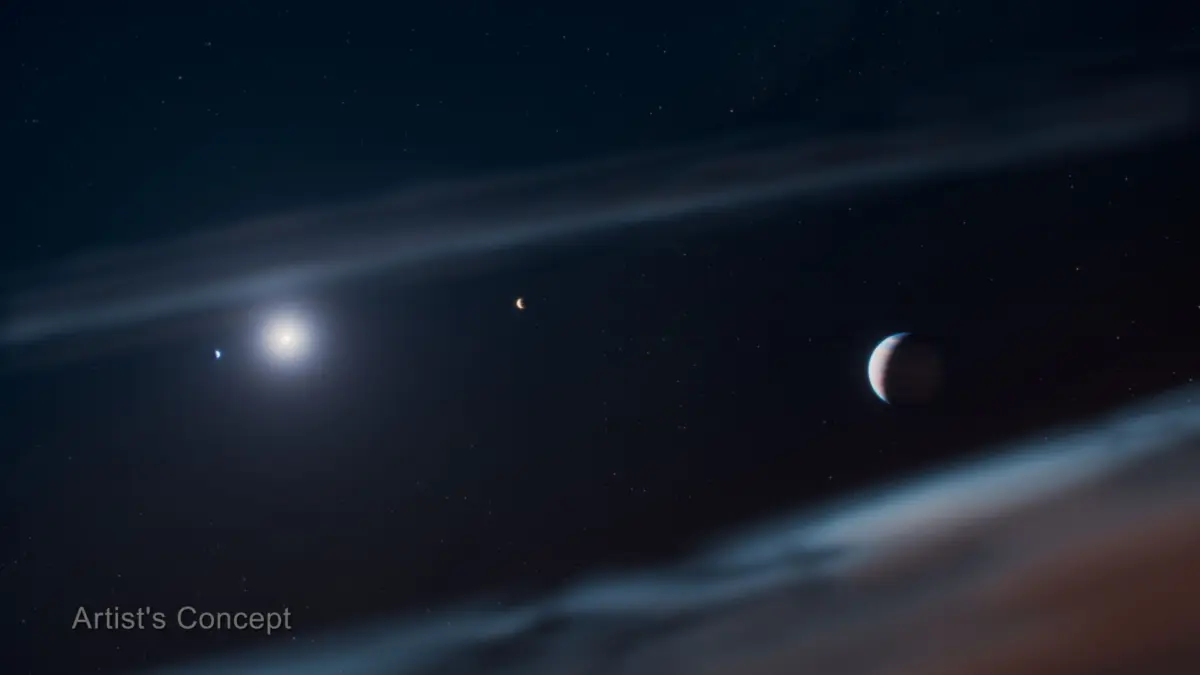
Deep in the cosmic neighborhood, roughly 63 light-years from Earth, a stellar nursery is currently scripting a masterclass in planetary formation. Known as Beta Pictoris, this vibrant system is astonishingly young—clocking in at less than one percent of the age of our own solar system. Anchored by a central star considerably more massive than our Sun, the system hosts a sprawling circumstellar disk of primordial dust and debris alongside a confirmed trio of massive gas planets.
For decades, Beta Pictoris has served as an astronomical laboratory, allowing scientists to peer directly into the violent, chaotic mechanics of planetary birth. Yet, despite decades of unprecedented technological refinement, one foundational puzzle piece has remained frustratingly out of reach: the detection of radio emissions generated directly by an exoplanet’s magnetic field.
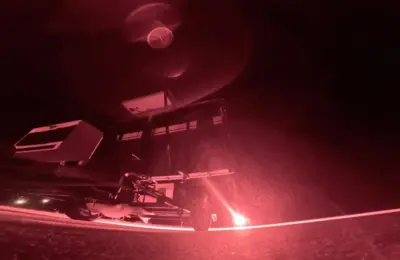
Now, a groundbreaking study spearheaded by researchers at Harvard University and the University of Oregon has shattered that long-standing technological barrier. Utilizing the raw sensitivity of South Africa’s MeerKAT radio telescope array, the research team has recorded low-frequency broadcasts emanating directly from Beta Pictoris b, a massive gas giant residing comfortably near the middle of the system.
While the researchers hasten to clarify that the signals are entirely natural—meaning, definitively, not of extraterrestrial intelligence—the implications are nonetheless monumental. This detection marks the absolute first time scientists have unequivocally linked radio emissions to an exoplanet outside our solar system. By confirming that Beta Pictoris b is actively broadcasting its intense magnetic heartbeat across interstellar space, astronomers have unlocked a revolutionary window through which to study planetary interiors, magnetospheres, and the invisible forces that dictate whether young worlds can ultimately harbor life.
Detailed Chronology: Unraveling the Beta Pictoris System
To fully appreciate the gravity of this recent discovery, one must trace the timeline of humanity’s unfolding relationship with the Beta Pictoris system, a journey defined by incremental technological triumphs and persistent cosmic detective work.
The 1980s: Discovery of the Debris Disk
The story of Beta Pictoris truly began in 1984, when astronomers Bradford A. Smith and Richard J. Terrile utilized ground-based telescopes—supported by early NASA-JPL data—to capture the first direct optical image of a massive circumstellar debris disk encircling the star. Long before any planets were physically spotted, this expansive ring of dust and gas provided the undeniable smoking gun that planet formation was actively occurring in real-time. It transformed Beta Pictoris from an ordinary luminous star into the poster child for protoplanetary disk research.
2008–2009: The Direct Imaging Breakthrough
For nearly twenty-five years, the worlds hidden within the Beta Pictoris disk remained completely theoretical. That changed dramatically between 2008 and 2009, when an international team of astronomers using the European Southern Observatory’s Very Large Telescope (VLT) in Chile directly imaged Beta Pictoris b.
Unlike the vast majority of exoplanets discovered via the "transit method" (noticing a dip in starlight as a planet crosses its host star) or the "radial velocity method" (detecting stellar wobbles), Beta Pictoris b was captured via direct imaging. Because the system is exceptionally young, its planets are still radiating intense thermal energy from the kinetic heat of their own formation. Combined with an orbital distance roughly equivalent to Saturn’s separation from our Sun, Beta Pictoris b shined brightly enough—and stood far enough from its blinding host star—to be visually distinguished by advanced coronagraphic hardware.
The 2020s: System Expansion and James Webb Insights
As observational technology advanced, the Beta Pictoris system continued to yield secrets. Astronomers later confirmed a second giant world, Beta Pictoris c, orbiting closer to the star. Most recently, reconstructed imagery harvested from NASA’s premier James Webb Space Telescope (JWST) revealed a third planetary sibling: Beta Pictoris d, whose orbital profile neatly mirrors that of Neptune in our own solar system.
Despite these spatial triumphs, studying the internal properties—specifically the magnetic fields—of these newborn giants remained a theoretical exercise. While gas giants like Jupiter and Saturn in our own solar system blast out powerful radio waves driven by their colossal magnetic fields and auroral activity, detecting those same signals across dozens of light-years was widely considered beyond the limits of modern instrumentation.
The Present: The MeerKAT Breakthrough
That limitation evaporated with the new study authored by the Harvard and University of Oregon researchers. By turning the formidable gathering power of South Africa’s MeerKAT radio telescope toward the Beta Pictoris system, the team isolated distinct, recurring radio pulses. Through rigorous data filtering and mathematical modeling, they successfully traced these signals back to their source: Beta Pictoris b. It is the culmination of years of theoretical modeling meeting observational reality.
Supporting Context & Metrics: Decoding the Signals
To understand why this discovery is making waves across the astrophysical community, it helps to examine the physical metrics of Beta Pictoris b and the nature of the signals it produces.
The Planetary Profile
Distance from Earth: Approximately 63 light-years.
Age of the System: Under a few tens of millions of years (less than 1% the age of our 4.5-billion-year-old solar system).
Mass: Several times more massive than Jupiter, placing it squarely in the "gas giant" classification. Because it lacks a solid surface, it cannot be "landed" on.
Orbital Radius: Roughly equivalent to the distance between our Sun and Saturn.
Thermal State: Its extreme youth means the planet is still sweltering, glowing brightly in infrared and thermal spectrums, making it a prime candidate for direct-observation studies.
The Physics of Auroral Radio Emissions
Why is a gas giant broadcasting radio waves? The answer lies in the dynamic interplay between magnetism and charged particles.
Young, massive planets typically possess extraordinarily powerful internal dynamos—convecting liquid metallic hydrogen deep within their interiors that generates intense magnetic fields. As stellar winds and charged particles stream through space, they are captured by these planetary magnetospheres. Funneled toward the planet’s magnetic poles, these accelerated particles interact with the upper atmosphere, producing hyper-powerful auroral displays.
As the planet rotates, these regions of localized magnetic activity sweep across space, beaming energy out in periodic pulses of radio waves. In essence, the planet’s magnetosphere is "shouting" into the void.
Prior to this discovery, astrophysicists had constructed robust theoretical frameworks predicting that exoplanets should exhibit these auroral radio emissions—analogous to the intense Jupiter-Io radio interactions observed by spacecraft in our solar system. However, capturing these faint signals against the roaring radio background of the universe—and definitively separating them from the fierce radio output of the host star—has proven to be an uphill battle until now.
Official Statements & Scientific Implications
While the study’s preprint has ignited widespread excitement, the authors maintain a rigorous, evidence-based approach that emphasizes caution and peer review.
"We want to be abundantly clear from the very beginning of our findings: this is a natural phenomenon," noted lead researchers in their preliminary paper shared via arXiv. "While detecting radio broadcasts from deep space naturally invites speculation, there is zero indication of artificial or technological origin. What we are witnessing is the raw, untamed physical power of a planetary magnetic engine operating in its absolute infancy."
Independent astrophysicists not directly involved in the study have praised the methodological rigor of the team, highlighting how the MeerKAT telescope’s design was uniquely suited for this type of faint-signal extraction.
Dr. Elena Vance, an exoplanet specialist unconnected to the study, remarked on the broader implications:
"For decades, we have mapped exoplanet masses, radii, and atmospheric compositions. But a planet’s magnetic field is the ultimate invisible shield—it protects atmospheres from being stripped away by stellar winds and plays a critical role in long-term habitability. By detecting radio emissions from Beta Pictoris b, we aren’t just checking a box on a theoretical list; we are opening up an entirely new diagnostic tool to measure the magnetic strengths of worlds light-years away."
Furthermore, confirming the existence of strong magnetic fields around young gas giants provides vital empirical data for testing models of planetary evolution. It helps scientists understand how magnetic dynamos ignite, how they evolve as planets cool over billions of years, and how they interact with surrounding circumstellar debris disks.
Future Outlook: The Dawn of Radio Exoplanetology
The detection of radio waves from Beta Pictoris b represents a monumental milestone, but it is ultimately just the opening salvo in what promises to be a vibrant new sub-discipline of astronomy: radio exoplanetology.
As the scientific community prepares the study for formal peer review, institutional eyes are already turning toward the next generation of ground- and space-based observatories. Facilities like the upcoming Square Kilometre Array (SKA)—currently under construction in South Africa and Australia—will boast unprecedented sensitivity and angular resolution, enabling astronomers to hunt for radio signatures from smaller, rockier exoplanets located much closer to their host stars.
Detecting magnetic fields around massive, newborn gas giants like Beta Pictoris b is relatively straightforward compared to the monumental challenge of finding similar signals around Earth-sized, rocky worlds. Terrestrial planets have significantly weaker magnetic fields, making their radio broadcasts vastly fainter and harder to isolate from stellar interference. However, the successful mapping of Beta Pictoris b provides a proof-of-concept that validates current theoretical models, giving telescope designers a concrete target metric to aim for.
As we look toward the future, the infant worlds of Beta Pictoris continue to remind us of our own cosmic origins. They offer a living, breathing time-capsule of the violent, energetic processes that forged our solar system over four billion years ago. And now, thanks to a faint, steady whisper caught by a telescope dish in the South African desert, we know that these distant worlds are not merely reflecting the light of their stars—they are shouting out across the cosmos, declaring their magnetic presence to anyone listening.