Executive Overview
Paris Fashion Week has long served as the crucible where high fashion is tested against the realities of contemporary culture, yet the Spring/Summer 2027 season has proven exceptionally volatile. Barely halfway through the grueling, high-stakes schedule, the French capital has played host to a dizzying succession of historical reinterpretations, star-studded front rows, and high-profile creative crossroads. From Jonathan Anderson’s botanical immersion for Dior—highlighted by the presence of global icon Rihanna in Les Jardins des Tuileries—to Glenn Martens’ poignant, archival homage to Raf Simons at Maison Margiela, the stakes for major luxury houses have rarely felt higher. Amidst this whirlwind of spectacle, Anthony Vaccarello teased what many industry insiders are reading as a potential swan song at Saint Laurent, complete with a golden crescendo and a haunting live performance by Charlotte Gainsbourg, while Apple Martin—daughter of Gwyneth Paltrow—captured global headlines with her runway debut at Chloé.
Yet, stepping into the historic Tennis Club de Paris on Avenue Georges Lafont, the atmosphere shifted sharply from retrospective nostalgia to radical structural experimentation. Here, Pierpaolo Piccioli presented his third ready-to-wear collection for Balenciaga, titled Les Coraux de la Liberté. Marking a bold new chapter for the storied maison, Piccioli’s SS27 outing sought to bridge an intellectual and technical chasm: the distance between the rarefied, slow-paced sanctity of Haute Couture and the fast-moving demands of contemporary ready-to-wear.
By translating the artisanal techniques, rigorous cuts, and sculptural DNA of the 55th Balenciaga Couture Collection into a robust spectrum of everyday menswear and womenswear, Piccioli positioned the house at the vanguard of modern luxury. The collection was not merely an exercise in archival referencing; it was a manifesto on the democratization of craftsmanship, anchoring ultra-high-level construction into the foundational wardrobe of the modern citizen.
Detailed Chronology: The Show and Its Setting
The transformation of the Tennis Club de Paris set an uncompromising tone long before the first look emerged onto the runway. Historically reserved for athletic pursuits, the venue’s cavernous interior was completely stripped of its recreational character. Stark, blindingly white walls and bleached wooden floorboards created an architectural vacuum, broken only by two symmetrical oblongs of minimalist white seating that lined the perimeter.
At the dead center of this aseptic, gallery-like space stood an imposing, organic centerpiece that instantly challenged the clinical rigidity of the room. Created by celebrated textile sculptor Aude Franjou, the installation—from which the collection took its name—was a monumental, coral-like structure of curling red and yellow tentacles constructed entirely from winding layers of natural linen fiber, stretching vertically almost to touch the ceiling.
Franjou’s inclusion was no accident of seasonal curation. Piccioli, clearly captivated by the dialogue between fine art and fashion during his visits to Paris Design Week the previous September, had watched as Franjou made history by scaling the interior of the historic July Column at the Place de la Bastille—the first time an artist had ever been granted such access. A full year later, Piccioli brought that artistic collaboration indoors, using Franjou’s monumental textile sculpture as the emotional and aesthetic anchor of his entire SS27 narrative.
The Front Row and the Arrival
As the industry’s elite slowly filtered into the white-washed arena, the seating arrangement reflected the cross-generational cultural cachet currently driving Balenciaga under Piccioli’s creative direction. Style visionary Law Roach mingled with legendary French actress Isabelle Huppert, while experimental musician Nia Archives shared space with Lauryn Hill, whose surprisingly punctual arrival drew approving murmurs from the fashion press.
When the house lights dimmed, the industrial soundtrack thwacked into life, vibrating through the bleached floorboards as the first models cut through the white expanse.
The Runway Narrative: From Monolith to Technicolor
The collection commenced with a striking, all-white opening segment that immediately established the technical rigor of the presentation. A masterclass in sculptural tailoring, the sequence featured a dramatic, sweeping cape and hyper-intricate floral detailing executed with an almost microscopic precision. This monochromatic prologue served as a deliberate palate cleanser before Piccioli unleashed a breathtaking explosion of the color wheel.
As the presentation progressed, the restrained palette shattered into vibrant blocks of royal blue, shocking pink, and glowing vermillion. These hues were deployed across an array of foundational wardrobe items:
- Blouson Jackets: Cut with exaggerated volumes that played on Cristóbal Balenciaga’s historic silhouettes.
- High-Collared Shirts: Engineered to frame the face with architectural austerity.
- Tunic Tops: Flowing garments that married ease of movement with severe structural lines.
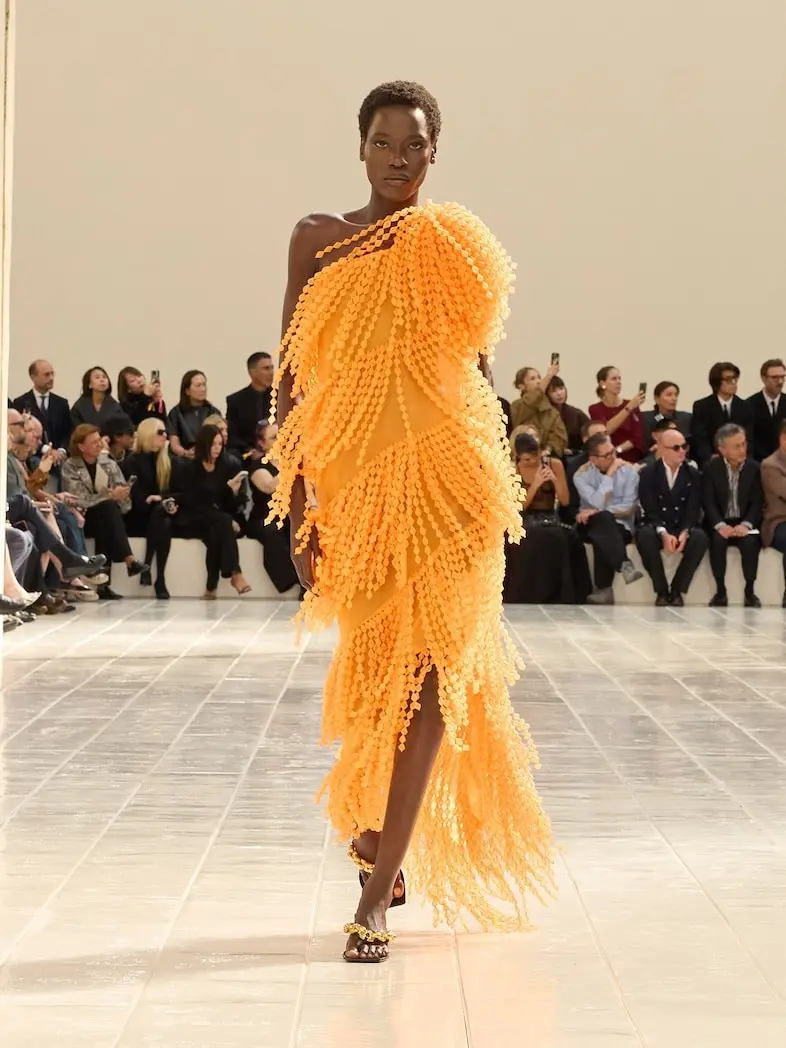
As the cadence of the show accelerated, the standout moments multiplied. Models traversed the runway in garments featuring dramatic Tudor-style shoulders, cocoon collar coats that enveloped the wearer in protective luxury, and avant-garde accessories that directly nodded to the natural world. Most notably, a series of high-necked collars rendered in a bulbous, frogspawn-like texture served as direct visual homages to Franjou’s sea-inspired central sculpture, blurring the line between wearable garment and kinetic sculpture.
Supporting Context & Metrics: Couture Meets the Street
To understand the true significance of Balenciaga SS27, one must examine the operational and philosophical shift Piccioli has engineered since taking the helm of the Kering-owned maison. Ready-to-wear collections in the modern luxury sector are frequently driven by commercial expediencies—logo-heavy accessories, accessible denim, and trend-chasing silhouettes designed for algorithmic virality. Piccioli, however, has consistently used his platform to challenge this trajectory, striving to reinfuse the daily wardrobe with the human touch of the atelier.
Technical Synthesis: The 55th Couture Collection
According to the official show notes distributed at the venue, the intellectual framework of SS27 rests entirely upon a process of backward engineering:
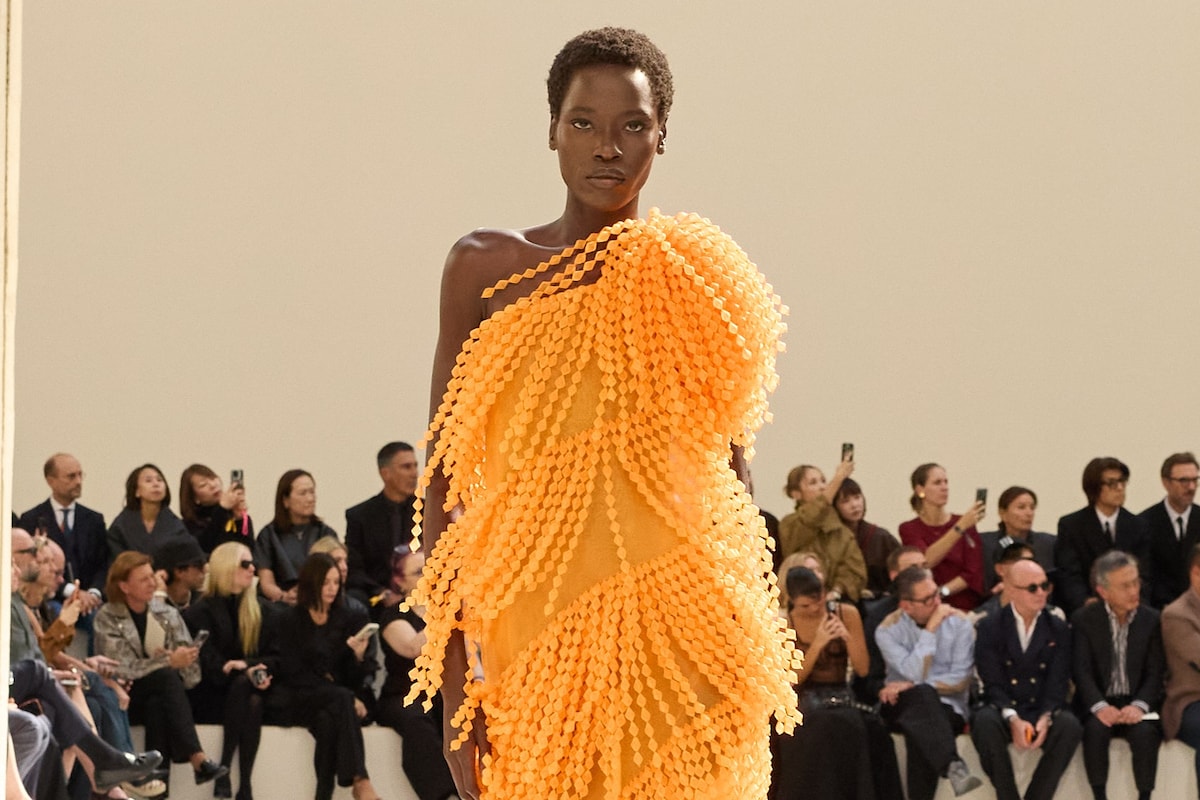
"Techniques originating in the 55th Balenciaga Couture Collection are applied to a spectrum of ready-to-wear clothing for both women and men. A wardrobe of prototypical ready-to-wear garments are redefined through studies of cut and construction, and their proximity to the hand."
This methodology represents a direct philosophical challenge to mass-market luxury production. By taking the intensely labor-intensive methodologies of haute couture—where garments are fitted to individual bodies through hundreds of hours of hand-stitching, internal boning, and sculptural manipulation—and scaling them down to the level of prototypical menswear and womenswear (shirts, coats, trousers, and skirts), Balenciaga is attempting to redefine what "ready-to-wear" actually means in the late 2020s.
Industry Metrics and Cultural Positioning
While comprehensive financial figures for the specific seasonal sell-through remain internal to Kering, market analysts tracking Paris Fashion Week metrics note a distinct shift in consumer engagement surrounding Piccioli’s tenure. Early digital analytics from data platforms such as Launchmetrics indicate that Balenciaga’s integration of fine-art collaborations—exemplified by the Aude Franjou partnership—generates significantly higher "earned media value" (EMV) than traditional celebrity-fronted marketing alone.
Furthermore, the brand’s deliberate pivot toward architectural tailoring and material innovation has repositioned its ready-to-wear offerings as long-term investment pieces rather than fast-fashion-adjacent luxury trends. This strategy aligns with a broader post-pandemic consumer movement toward "quiet luxury with teeth"—garments that possess immense technical complexity upon close inspection, even if their silhouette appears deceptively simple from a distance.
Official Statements & Industry Reception
The critical consensus emerging from the international press corps in the hours following the show has been overwhelmingly positive, with particular praise directed at Piccioli’s ability to honor the historic DNA of Cristóbal Balenciaga while maintaining his own distinct emotional warmth.
In an impromptu backstage briefing, Piccioli elaborated on the thematic intentions behind Les Coraux de la Liberté:
"Freedom in fashion is not about doing whatever you want; it is about mastering the rules of construction so completely that you can forget they are there. When we look at nature—like the organic forms of Aude’s coral sculptures—we see structures that are simultaneously rigid and fluid. That is what I wanted for the everyday wardrobe. A coat should protect you like armor, but it should feel as natural to wear as a second skin."
Industry critics have been quick to note how Piccioli’s vision differs radically from the hyper-ironic, meme-driven streetwear era that previously defined Balenciaga under Demna. While the house has retained its penchant for exaggerated proportions and boundary-pushing volumes, the underlying ethos has shifted from ironic pastiche to profound reverence for the human hand.
Writing for major fashion publications, critics highlighted the technical mastery required to translate the rigid structural integrity of Tudor shoulders and cocoon coats into garments that remain functional for urban commuters and global travelers alike. The integration of Franjou’s installation was universally praised as a masterstroke of spatial curation, preventing the minimalist white runway from feeling cold, and instead charging the entire presentation with a vital, organic pulse.
Future Outlook: The Architectural Trajectory of Balenciaga
As Paris Fashion Week hurtles toward its grand finale, the ramifications of Balenciaga’s SS27 presentation will likely resonate across the global luxury market for seasons to come. Piccioli has successfully staked out a unique territory within contemporary fashion: a space where the elite craftsmanship of the Parisian atelier is no longer locked away behind closed doors for the ultra-wealthy, but is systematically unpacked, studied, and reassembled for the everyday wardrobe.
Looking ahead, several key questions remain for the maison:
- Commercial Scalability: Can the intricate construction techniques derived from the 55th Couture Collection be successfully translated into high-volume retail production without compromising the integrity of the hand-finished details?
- The Art-Fashion Synergy: Will Piccioli continue his deep-dive into the contemporary art world, utilizing upcoming ready-to-wear runways as platforms for site-specific sculptural installations on the scale of Aude Franjou’s work?
- The Evolution of Silhouettes: Having firmly established a vocabulary of exaggerated volumes, Tudor shoulders, and organic, sea-inspired draping, how will the designer push these sculptural forms further in future collections?
What remains certain is that Pierpaolo Piccioli has fundamentally altered the trajectory of Balenciaga. By insisting that everyday garments deserve the intellectual and manual rigor of haute couture, he has offered a compelling counter-narrative to an industry too often obsessed with fleeting digital moments. For the modern consumer stepping out onto the asphalt in a vermillion blouson or a cocoon coat, Les Coraux de la Liberté serves as both a shield and a celebration—a reminder that true luxury lives in the proximity of the human hand.