Executive Overview
The modern software engineering landscape has undergone a seismic shift, prioritizing flexibility, location independence, and asynchronous workflows. While these benefits have liberated developers from the traditional 9-to-5 cubicle, they have inadvertently birthed a silent epidemic: chronic developer burnout.
Extended screen time, continuous integration and deployment (CI/CD) pressures, the blurring of physical boundaries between home and office, and deep social isolation have turned remote engineering into a high-risk occupation for mental fatigue.
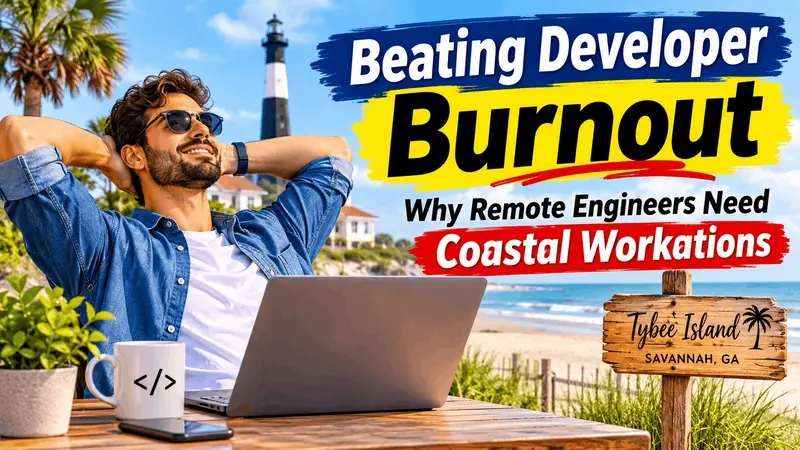
Enter the coastal workation—a strategic fusion of professional output and seaside restoration. Rather than taking a complete career break or squandering precious paid time off, remote engineers are packing their laptops and temporarily relocating to historic, coastal hubs like Savannah, Georgia.
By trading urban noise or isolated home offices for Atlantic breezes, historic green spaces, and structured outdoor routines, developers are discovering a viable framework to reset their mental energy, foster creative problem-solving, and reclaim work-life balance without sacrificing productivity.
Detailed Chronology: The Evolution of the Remote Developer’s Dilemma
To understand why the coastal workation has emerged as a crucial intervention, one must examine the progression of remote engineering culture over the past decade.
Phase 1: The Promise of Flexibility (Pre-2020)
Initially, remote work was championed as a utopian perk. Tech workers rejoiced at the elimination of grueling commutes, reclaiming hours of their day for personal enrichment. Early adopters enjoyed the quiet of home offices and the autonomy to schedule deep-focus coding sessions without mid-day office interruptions.
Phase 2: The Blurring of Boundaries (2020–2022)
As remote work scaled globally, the home environment underwent a systemic transformation. Kitchen tables became server racks and staging environments; couches became conference rooms. Without a physical commute to signal the end of the workday, engineers began logging in earlier and staying online later. Evening hot-fixes bled into family dinners, and weekend debugging sessions became the norm. The psychological barrier protecting personal time eroded entirely.
Phase 3: The Burnout Crisis and the Rise of "Workations" (2023–Present)
By 2023, tech industry data highlighted soaring rates of emotional exhaustion, depersonalization, and reduced professional efficacy among software developers. Realizing that staying put in the same stagnant environment only compounded mental fatigue, forward-thinking engineers began pioneering the "workation."
Rather than disconnecting completely, professionals sought out inspiring, geographically distinct environments—specifically coastal regions—where they could maintain active sprint cycles while utilizing nature as an emotional buffer against stress.

Supporting Context & Metrics: The Anatomy of Developer Burnout
Developer burnout is not merely a feeling of tiredness; it is a clinical state of physical, emotional, and mental exhaustion rooted in sustained occupational stress. Software engineering demands intense cognitive load: parsing complex codebase architecture, writing clean algorithms, managing legacy systems, and neutralizing critical production bugs.
[Intensive Cognitive Load] + [Zero Physical Commute] = [Errosion of Personal Boundaries]
                                                                  │
                                                                  ▼
[Continuous Screen Time] ---> [Mental Fatigue] ---> [Developer Burnout]
The Four Pillars of Remote Engineering Burnout
- Extended Screen Time and Mental Fatigue: Unlike traditional administrative roles that rely on verbal communication, developers stare at high-contrast IDEs (Integrated Development Environments) for 8 to 12 hours a day. This causes profound eye strain, cervicogenic headaches, and severe cognitive depletion, leaving little mental bandwidth for complex problem-solving.
- The Homogenization of Space: When your bedroom doubles as your sprint-planning room, the brain loses its ability to disengage. The absence of spatial transitions prevents psychological decompression.
- The Loneliness Epidemic: Virtual stand-ups and asynchronous Slack messages cannot replace organic human contact. Prolonged isolation stifles dopamine production and diminishes intrinsic motivation.
- The Tyranny of the Deadline: Technical debt, unexpected outages, and aggressive product roadmaps keep developers in a perpetual state of "fight or flight," preventing deep recovery cycles.
Official Industry Insights & Environmental Psychology
Environmental psychologists and remote work advocates have long touted the restorative properties of nature, a concept formalised in Attention Restoration Theory (ART). According to ART, natural environments—such as ocean shores, tidal marshes, and heavily canopied parks—engage our "soft fascination," allowing our directed-attention mechanisms to rest and recover from intensive tasks like programming.
"When a developer spends hours debugging an enterprise-level application, their prefrontal cortex is operating at maximum capacity. Exposing that same brain to the rhythmic movement of ocean waves or the open expanse of a coastal horizon triggers an involuntary neurological reset. It lowers cortisol levels and unlocks lateral thinking pathways crucial for innovative code architecture."
Furthermore, destination hubs that combine historic walkability with coastal proximity—such as Savannah, Georgia, and its neighboring Tybee Island—offer a unique therapeutic blend.
- Tybee Island’s Atlantic Shores: Providing instant access to North Beach and Back River Beach, allowing developers to swap screen glare for expansive ocean vistas during lunch breaks.
- Forsyth Park’s Green Canopy: Offering shaded pathways and historic architecture that encourage physical movement and tactile engagement with the physical world.
- The Historic District’s Walkability: Eliminating the dependency on automobiles, encouraging spontaneous exploration of local cafes, squares, and culinary arts.
Future Outlook: Building Sustainable Remote Work Practices
The coastal workation is more than a temporary escape; it is a laboratory for building sustainable, long-term work habits. As enterprise organizations increasingly embrace hybrid and remote-first models, the responsibility of preventing burnout falls heavily on the individual engineer’s ability to curate their environment.
Actionable Strategies for a Sustainable Coastal Workation
- Rigorous Connectivity Audits: Never sacrifice infrastructure for scenery. Prioritize accommodations with verified, high-speed fiber-optic internet and dedicated backup connections before booking.
- Establishing Hard Thermodynamic Boundaries: Treat your working hours with absolute discipline. Close the IDE laptop lid at 5:00 PM, step away from the desk, and transition immediately into a restorative outdoor activity like a beach walk or kayaking expedition.
- Designing a Ergonomic Mobile Workstation: Bring external peripherals—such as a portable ergonomic stand, a compact mechanical keyboard, and a mouse—to prevent physical strain during extended coding sprints.
- Time-Zone Synchronization: For engineers working across global distributed teams, map out core collaboration windows ahead of time so that evening leisure time remains strictly uninterrupted.
The Sample Remote Engineer’s Coastal Routine
| Time | Activity | Psychological / Professional Purpose |
|---|---|---|
| 7:00 AM | Morning shoreline walk or light yoga | Activate physical body and reset circadian rhythms |
| 8:00 AM | Breakfast & daily sprint planning | Mental alignment and priority mapping |
| 9:00 AM | Deep-focus coding (IDE / GitHub) | High-output technical problem solving |
| 11:00 AM | Screen-free micro-break | Cognitive decompression |
| 11:30 AM | Stand-ups & team collaboration | Asynchronous alignment / video syncs |
| 1:00 PM | Local culinary lunch experience | Cultural immersion & physical movement |
| 2:00 PM | Code reviews, testing, & deployment | Maintenance & system reliability tasks |
| 4:00 PM | Backlog grooming & inbox triage | Wrapping up open loops |
| 5:00 PM | Hard Stop / Laptop Close | Enforcing psychological boundaries |
| 5:30 PM | Kayaking, historic district walk, or beach visit | Reconnecting with the physical environment |
| 7:30 PM | Dinner & tech-free relaxation | Deep personal recovery |
Conclusion
The future of software engineering depends not just on the optimization of code, but on the optimization of the human beings writing it. Developer burnout is an unsustainable tax on the technology sector, costing companies millions in turnover, lost productivity, and diminished innovation.
By embracing intentional interventions like a coastal workation in historically and naturally rich environments like Savannah and Tybee Island, remote engineers can break the monotony of isolation and screen fatigue.
Ultimately, a change of scenery does not solve every systemic workplace stressor, but it serves as a powerful catalyst. It reminds developers that life exists far beyond the monitor, proving that the most efficient code is written by a mind that is healthy, balanced, and thoroughly recharged.