Executive Overview
In the fast-paced ecosystem of modern software engineering, system failures are not a matter of if, but when. From unexpected server crashes and sudden network partitions to cloud provider outages and database deadlocks, production environments are constantly under siege by entropy. For developers and architects cutting their teeth on interview projects or managing enterprise-scale infrastructures, understanding how to maintain continuous uptime is paramount.
While many concepts taught in Computer Science degree programs can initially feel like academic hurdles designed solely to pass examinations, the reality of building real-world systems reveals their true value. Chief among these practical cornerstones is redundancy—the intentional practice of duplicating critical system components to ensure uninterrupted operations when a primary component fails.
This article explores the mechanics of redundancy, examining how it eliminates single points of failure (SPOFs), differentiates from scaling, and dictates the resilience of production environments across banking, healthcare, e-commerce, and beyond.
Detailed Chronology: From Academic Theory to Production Realities
The trajectory of a software engineer typically follows a predictable path: abstract concepts are memorized in classrooms, temporarily shelved during early-stage development, and violently re-contextualized the moment a production system goes down at 3:00 AM.
[Academic Theory] ──> [Early Development] ──> [Production Deployment] ──> [The 3 AM Outage] ──> [Redundancy Adoption]Phase 1: The Academic Foundation
During undergraduate Computer Science studies, students encounter system architecture models, distributed systems theory, and fault tolerance. Terms like N-version programming, failover clusters, and active-passive replication are committed to memory for midterm assessments. At the time, these models often seem detached from the rapid-fire pace of writing code, building basic user interfaces, or deploying monolithic applications to a single cloud instance.
Phase 2: The Naive Architecture
When engineers build their first real-world projects—whether for an interview assignment, a hackathon, or an MVP startup—they naturally gravitate toward simplicity:
Users ──> Single Application Server ──> Single DatabaseIn this streamlined configuration, every request relies on a direct, linear path. It is cheap, easy to reason about, and requires minimal configuration.
Phase 3: The Breaking Point
As user bases grow or unforeseen hardware anomalies occur, the fragility of a single-path architecture becomes glaringly apparent. A memory leak crashes the application server, or a routine maintenance reboot takes the database offline. Suddenly, the application is entirely unavailable.
Phase 4: The Epiphany and Redundancy Integration
This painful realization forces engineers back to the fundamentals learned in school. They realize that building reliable software is not just about writing bug-free code; it is about expecting hardware and network infrastructure to fail. By integrating redundancy into the architecture, engineers transform fragile linear pipelines into robust, fault-tolerant networks.
Supporting Context & Metrics: Understanding Redundancy in Action
To appreciate redundancy, one must understand how it systematically alters the topology of a system.
What Is Redundancy?
Redundancy is the intentional duplication of critical components or functions within a system with the goal of increasing reliability and fault tolerance. If a primary component fails, a redundant backup steps in seamlessly.
Consider the contrast between a non-redundant and a redundant system design:
Non-Redundant Design:
Users ──> Single Server (Single Point of Failure)Redundant Design:
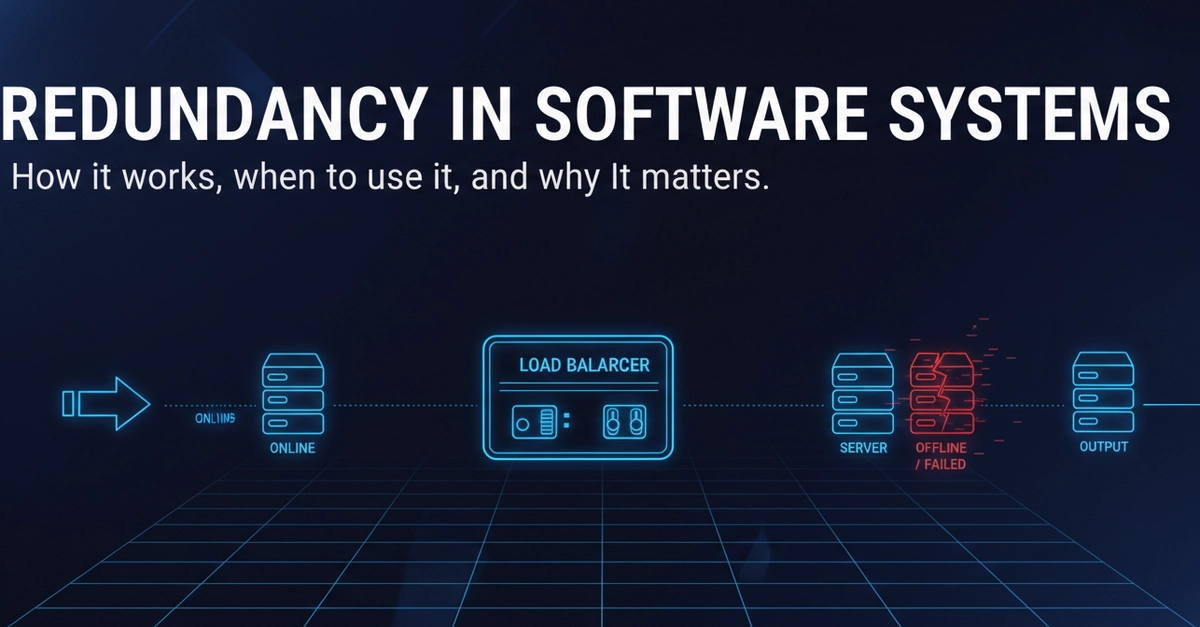
Users ──> Load Balancer ──┬──> Server A (Active)
                         ├──> Server B (Active)
                         └──> Server C (Active)
In the redundant model, if Server A suffers a catastrophic hardware failure, the load balancer’s health checks detect the anomaly and automatically reroute incoming traffic to Server B and Server C. To the end user, the transition is invisible.
The Anatomy of System Failures
System reliability is often measured in "nines" of availability (e.g., 99.9% uptime, colloquially known as "three nines"). Achieving higher availability requires mitigating risks across multiple architectural layers:
- Server Redundancy: Deploying multiple application instances behind a load balancer ensures that compute failures do not result in total service outages.
- Database Redundancy: Utilizing primary-replica (master-slave) configurations, multi-region clusters, or distributed consensus algorithms (such as Raft or Paxos) prevents data unavailability and catastrophic data loss.
- Network Redundancy: Maintaining redundant internet service providers (ISPs), DNS failover strategies, and multiple routing paths protects against localized network partitions.
- Storage Redundancy: Cloud-native storage services automatically replicate data across multiple availability zones (AZs) or physical disks to guarantee data durability.
Official Industry Perspectives & Architectural Insights
Industry leaders and senior systems architects consistently emphasize that system design must account for Murphy’s Law: anything that can go wrong, will go wrong.
According to distributed systems literature and architectural best practices promoted by major cloud providers (AWS, Google Cloud, Microsoft Azure):
- Eliminating Single Points of Failure (SPOFs): An SPOF is any component whose failure triggers the collapse of the entire system. Redundancy acts as the primary weapon against SPOFs. By introducing parallel processing pathways and automated health-checking mechanisms, systems can self-heal in real time.
- The Cost-Benefit Analysis: While redundancy dramatically increases uptime, it introduces architectural complexity, synchronization overhead, and financial costs. Industry consensus dictates that redundancy should be applied proportionally to the business impact of downtime.
Redundancy vs. Scaling: Clarifying the Distinction
A common point of confusion for developing engineers is distinguishing between redundancy and scaling. While both approaches frequently involve provisioning multiple servers or instances, their underlying motivations are fundamentally different.
| Dimension | Redundancy | Scaling |
|---|---|---|
| Primary Goal | Improve reliability and fault tolerance. | Handle increased load and throughput. |
| Trigger for Action | Component failure or risk of outage. | High traffic volume, CPU, or memory utilization. |
| Core Mechanism | Standby or active-active backup nodes. | Horizontal or vertical resource expansion. |
| Can it exist alone? | Yes, a system can be redundant without handling massive traffic. | Yes, a system can scale to handle traffic without multi-region failover. |
In mature production systems, however, redundancy and scaling operate in tandem. Horizontal scaling naturally introduces a degree of redundancy (e.g., having ten servers to handle traffic also means you have nine backups if any single server fails).
When to Use Redundancy (and When It’s Overkill)
Determining whether to implement redundancy requires a careful assessment of business requirements and risk profiles.
When Redundancy Is Essential
- User Dependency: When real users rely on your platform for daily workflows, where downtime immediately erodes trust and damages brand reputation.
- Severe Consequences of Downtime: In sectors like banking, financial payment gateways, healthcare applications, and e-commerce platforms, every minute of downtime directly translates to severe financial loss or compromised user safety.
- Production Environments: Any system serving live traffic should incorporate baseline redundancy to handle unexpected hardware failures gracefully.
When Redundancy Is Overkill
- Early-Stage MVPs & Prototypes: A startup building an initial proof-of-concept for ten users does not require the multi-region redundancy of Netflix.
- Internal Tools & Experimental Projects: If a system’s downtime affects no revenue and causes zero operational friction, the added infrastructure cost and deployment complexity of redundancy are unjustified.
Future Outlook
As software architecture evolves toward serverless computing, edge processing, and autonomous microservices, the implementation of redundancy is becoming increasingly automated. Cloud providers now abstract away much of the underlying server and storage replication, allowing developers to configure high availability with a single toggle switch or Infrastructure as Code (IaC) declaration.
However, the foundational principle remains unchanged. Whether writing code for a technical interview project or architecting global-scale cloud infrastructure, engineers must respect the inherent fragility of hardware and networks. By mastering redundancy, developers bridge the gap between abstract academic theory and resilient, production-ready engineering, ensuring that systems survive the inevitable storms of real-world operations.