Executive Overview
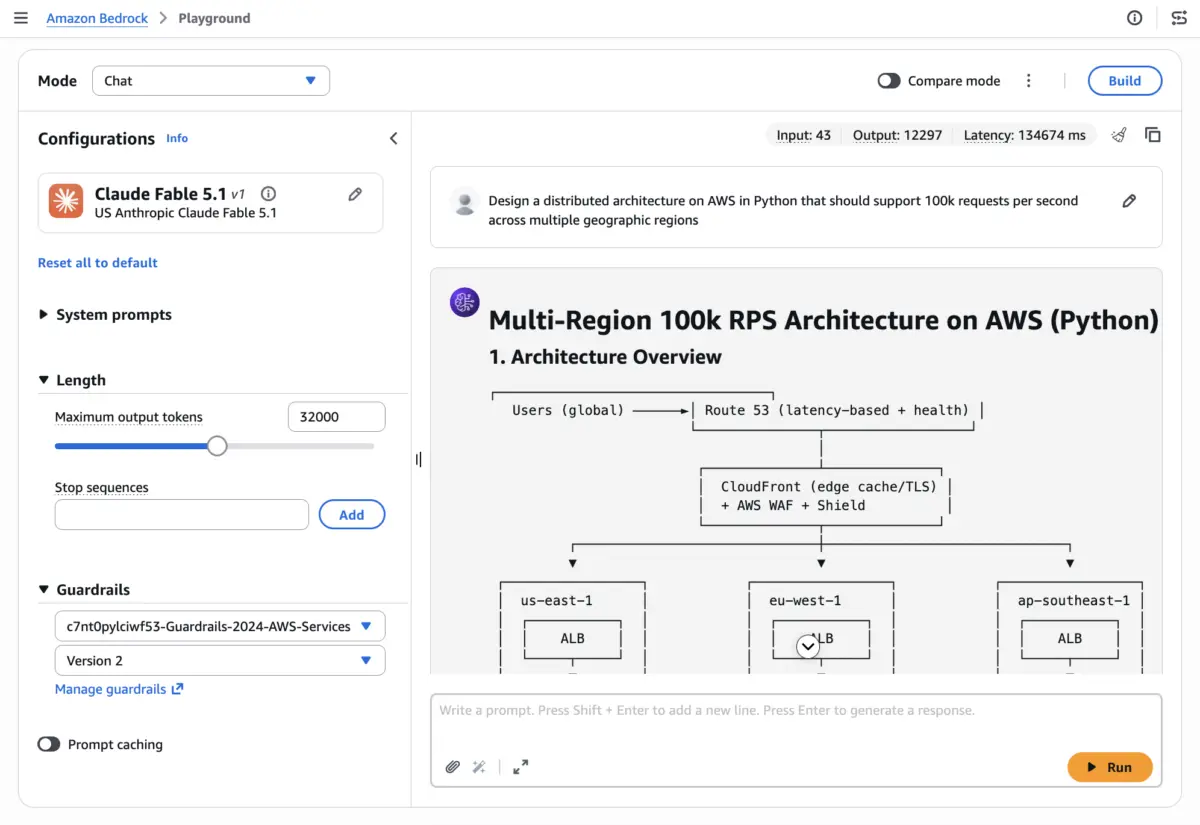
The landscape of enterprise artificial intelligence shifted significantly last week with the official arrival of Anthropic’s Claude Fable 5.1 on Amazon Web Services (AWS). Billed by its creators as a leap forward in frontier intelligence, this new model is engineered explicitly for ambitious, high-stakes, long-running tasks that span hours and weave across complex application ecosystems. Unlike previous iterations or more lightweight conversational agents, Claude Fable 5.1 is designed to take autonomous ownership of comprehensive software engineering projects, intricate scientific research initiatives, and multifaceted enterprise workflows.
Beyond its raw computational capabilities, the launch introduces a rigorous new framework for governance, safety, and compliance. Designated by Anthropic as a Covered Model, Claude Fable 5.1 comes packaged with specialized data retention policies and dedicated safety review procedures. AWS and Anthropic have collaborated to introduce innovative mechanisms—such as the aws_review data retention mode and Enterprise Frontier Safeguards (EFS)—ensuring that organizations can harness bleeding-edge frontier intelligence without compromising proprietary security controls or data sovereignty.
Available immediately through both Amazon Bedrock and the Claude Platform on AWS, this release marks a pivotal moment for enterprise cloud consumers looking to transition from experimental AI proofs-of-concept to deeply integrated, autonomous production workflows.
Detailed Chronology: The Evolution to Claude Fable 5.1
To fully understand the weight of the Claude Fable 5.1 deployment on AWS, one must examine the rapid trajectory of generative AI integration within enterprise cloud infrastructure over recent years.
The Shift Toward Autonomous Long-Session Workflows
Historically, large language models (LLMs) excelled at transactional, single-turn prompts—answering questions, summarizing short documents, or generating isolated snippets of code. While valuable, these capabilities constrained AI to an assistant role, requiring human operators to constantly orchestrate, review, and feed data back into the system.
As enterprises began demanding deeper integration, bottlenecks emerged. Complex software development, for instance, rarely happens in isolated functions. It involves maintaining architectural consistency across entire codebases, conducting thorough code reviews, refactoring legacy systems, tracking dependencies, and debugging performance bottlenecks over extended timelines.
Claude Fable 5.1 was architected specifically to dismantle these barriers. During its development phase, Anthropic focused heavily on extending context retention, reasoning stability, and execution endurance. When the model debuted on AWS last week, it immediately demonstrated the ability to own substantial portions of a software project autonomously. Rather than merely writing a single function, Fable 5.1 can navigate feature development across an entire multi-file repository, analyze performance profiles over extended sessions, and execute iterative code reviews with minimal human intervention.
Integration into the AWS Ecosystem
The deployment timeline moved swiftly from Anthropic’s model maturation to cloud availability. By making Claude Fable 5.1 accessible via Amazon Bedrock and the Claude Platform on AWS, the engineering teams ensured that enterprise developers could immediately provision the model using existing AWS security postures, VPC configurations, and monitoring pipelines.
This deep integration means organizations do not need to build out separate, vulnerable API pathways or manage external infrastructure to utilize Anthropic’s latest flagship intelligence. Instead, they can invoke Claude Fable 5.1 natively alongside other foundation models, embedding it directly into enterprise data lakes, CI/CD pipelines, and automated research workflows hosted on AWS.
Supporting Context & Metrics: Governance, Security, and the "Covered Model" Framework
While raw intelligence parameters and benchmark scores often dominate AI headlines, enterprise adoption ultimately hinges on security, compliance, and risk management. The introduction of Claude Fable 5.1 brings these concerns to the forefront through a robust governance model designed for highly regulated industries.
Understanding the "Covered Model" Designation
Anthropic has classified Claude Fable 5.1 as a Covered Model. This special classification applies to advanced models that present unique capabilities, requiring enhanced data retention protocols, specialized safety reviews, and stringent access policies regardless of where they are deployed.
Because models of this caliber possess advanced autonomous problem-solving capabilities, Anthropic and its cloud partners implement heightened oversight to mitigate potential risks, such as unintended code vulnerabilities, misuse in high-stakes environments, or data leakage.
The aws_review Data Retention Mode
To balance the necessity of safety evaluations with strict corporate data privacy standards, AWS has introduced a dedicated configuration known as the aws_review data retention mode within Amazon Bedrock.
- Data Lifecycle: Under this mode, user prompts and model outputs are retained for up to 30 days exclusively for human safety review.
- Internal Boundaries: Crucially, these reviews are conducted by authorized Amazon personnel within the secure AWS boundary.
- Legacy Comparison: This replaces legacy paradigms such as the
provider_data_sharemode. Under the current architecture enforced by Amazon Bedrock, customer data is strictly shielded; Amazon does not share proprietary prompt and response data with external model providers like Anthropic.
Enterprise Frontier Safeguards (EFS)
Complementing the data retention modes are the Enterprise Frontier Safeguards (EFS), a joint initiative engineered in close partnership between AWS and Anthropic. EFS is specifically designed for eligible enterprise customers who require access to high-tier Covered Models while operating under strict regulatory frameworks (such as HIPAA, GDPR, or financial services compliance).
EFS allows organizations to deploy Claude Fable 5.1 within a cloud environment over which they maintain absolute control. By coupling EFS with AWS Identity and Access Management (IAM), AWS Key Management Service (KMS) for customer-managed encryption keys, and Virtual Private Cloud (VPC) endpoints, enterprises can utilize frontier-class AI while maintaining complete residency and auditability over their data assets.
Official Perspectives and Technical Documentation
The release has generated significant commentary from cloud architects, security officers, and developer advocates across the AWS community.

Channy Yun, Principal Developer Advocate at AWS, highlighted the practical implications of the launch in his weekly developer roundup, emphasizing the model’s capacity for sustained, multi-application reasoning. "Claude Fable 5.1 is built for long-running, high-stakes work that runs for hours and spans many applications," Yun noted, pointing to its ability to shoulder heavy engineering workloads over extended developer sessions.
Navigating Technical Resources
For organizations eager to audit the model’s specifications and integration pathways, AWS and Anthropic have published extensive documentation:
- Amazon Bedrock Model Card: Developers can review comprehensive performance metrics, token limits, and operational parameters by consulting the Claude Fable 5.1 Model Card on Amazon Bedrock.
- Platform Implementation Guides: Detailed instructions on setting up environments, managing permissions, and configuring data retention modes are available via the Claude Platform on AWS User Guide.
- Data Privacy Specifications: Deep dives into compliance mechanics can be found on the AWS Bedrock Data Retention Documentation.
Future Outlook: What Claude Fable 5.1 Signals for Enterprise AI
The debut of Claude Fable 5.1 on AWS is more than just a routine model update; it serves as a leading indicator of where enterprise artificial intelligence is heading over the next several years.
Transitioning to Agentic Workflows
As foundation models evolve from reactive chatbots into proactive, autonomous agents capable of sustaining multi-hour workflows, the nature of software development and scientific discovery will undergo a structural transformation. We are moving away from an era where humans write every line of code and manually execute every repetitive test, toward an era of supervision and curation. Engineers will increasingly act as technical directors and architects, guiding autonomous entities like Claude Fable 5.1 as they construct, test, and optimize complex software systems from the ground up.
The Bar for Enterprise Security is Rising
The strict governance mechanisms introduced with Claude Fable 5.1—ranging from the aws_review retention protocols to Enterprise Frontier Safeguards—establish a new industry baseline. Going forward, enterprises will no longer accept a false dichotomy between high intelligence and high security. The market expectation is clear: access to frontier intelligence must be matched by impenetrable cloud controls, transparent data boundaries, and verifiable compliance mechanisms.
Engaging with the AWS Community
As organizations begin integrating Claude Fable 5.1 into their production environments, staying connected with the broader developer ecosystem will be essential. AWS continues to foster this growth through a robust calendar of events. Builders and technical leaders can engage with peers, share migration strategies, and explore advanced architectures at upcoming gatherings such as AWS re:Invent, regional AWS Summits, and local AWS Community Days. Furthermore, joining the AWS Builder Center provides direct access to collaborative spaces and resources designed to support developers navigating this next generation of cloud-native AI.
The arrival of Claude Fable 5.1 on AWS proves that the frontier of artificial intelligence is rapidly becoming operationalized. For enterprises willing to embrace long-session autonomous workflows backed by rigorous cloud governance, the tools to build the next generation of software and scientific breakthroughs are now fully within reach.