Executive Overview
Paris Fashion Week has long served as a proving ground for avant-garde provocation, yet few designers command the architectural and philosophical gravity of Rick Owens. In his latest womenswear outing for Spring/Summer 2027, simply titled Stone, Owens stripped away extraneous trends to return to the primal matter that has defined his three-decade career. Staged on the concrete expanse of the Palais de Tokyo courtyard on the afternoon of October 1, the presentation was both a retrospective meditation and an aggressive forward leap.
Stone is not merely an aesthetic choice for Owens; it is the conceptual bedrock of his universe. It manifests in his craggy, geological silhouettes, his monochromatic palette of chalk, dust, and coal, and the hulking, brutalist architecture of his retail showrooms. For SS27, Owens excavated these foundations, transforming literal and metaphorical interpretations of stone into a wearable manifesto.
Set against an abrasive, industrial soundscape curated by Sissymisfit, the collection married industrial rigidity with organic decomposition. Models navigated a grated metal runway encased in garments that functioned as both armor and shroud. From architectural columns constructed from shipping-crate nylon to mutated tensegrity tulle gowns resembling subterranean life forms, Owens demonstrated an uncompromising vision of luxury that rejects convention in favor of tectonic endurance.
This comprehensive report examines the SS27 presentation through a rigorous journalistic lens, detailing the chronological progression of the runway, analyzing the socio-cultural metrics and material innovations driving the collection, contextualizing official statements from the designer, and forecasting the long-term impact of Owens’ monumental vision on the contemporary fashion landscape.
Detailed Chronology: The Anatomy of the Show
The Setting and the Soundscape
As attendees gathered in the brutalist courtyard of the Palais de Tokyo, the atmosphere crackled with anticipatory tension. The runway itself—a series of industrial grated metal paths—set a harsh, utilitarian tone. Puncturing the crisp autumn air was the soundscape by Sissymisfit, an aggressive, grating composition of distorted frequencies and industrial hums that mirrored the unyielding nature of the collection’s titular element.
Phase One: Industrial Monoliths and Rigid Geometries
The collection opened with an uncompromising display of structure. Rick Owens explored the concept of "elegant stoicism," translating the unbending nature of rock into wearable architecture.
The initial looks featured rigid ivory column gowns crafted from industrial nylon webbing—material typically utilized to secure heavy shipping crates—expertly woven into double-duchesse satin. In his show notes, Owens described these creations as "slabs of rigid fabric crossed with girdered lines." This industrial hardness permeated the silhouettes, manifesting as enormous, sculptural geometric collars, exaggerated fishtail skirts, and sharp, jutting bustles that violently redefined the human form. Models moved with a robotic, measured cadence, encumbered and empowered by their sartorial monoliths.
Phase Two: Weathering, Erosion, and Bleached Gradients
As the presentation progressed, the unyielding stone began to weather and fracture. Sheer dresses split open across the torso, exposing the body beneath like fault lines in a shifting tectonic plate, while voluminous white fabrics cocooned around models’ torsos like protective shells.
Color entered the palette through sulphur-dyed Japanese denim, bleached into mottled, organic gradients across flowing trousers, microjackets, and distressed tunics. This visual erosion spoke to the passage of time and the natural forces that break down even the hardest of materials.
Phase Three: Subterranean Tensegrity and Organic Mutation
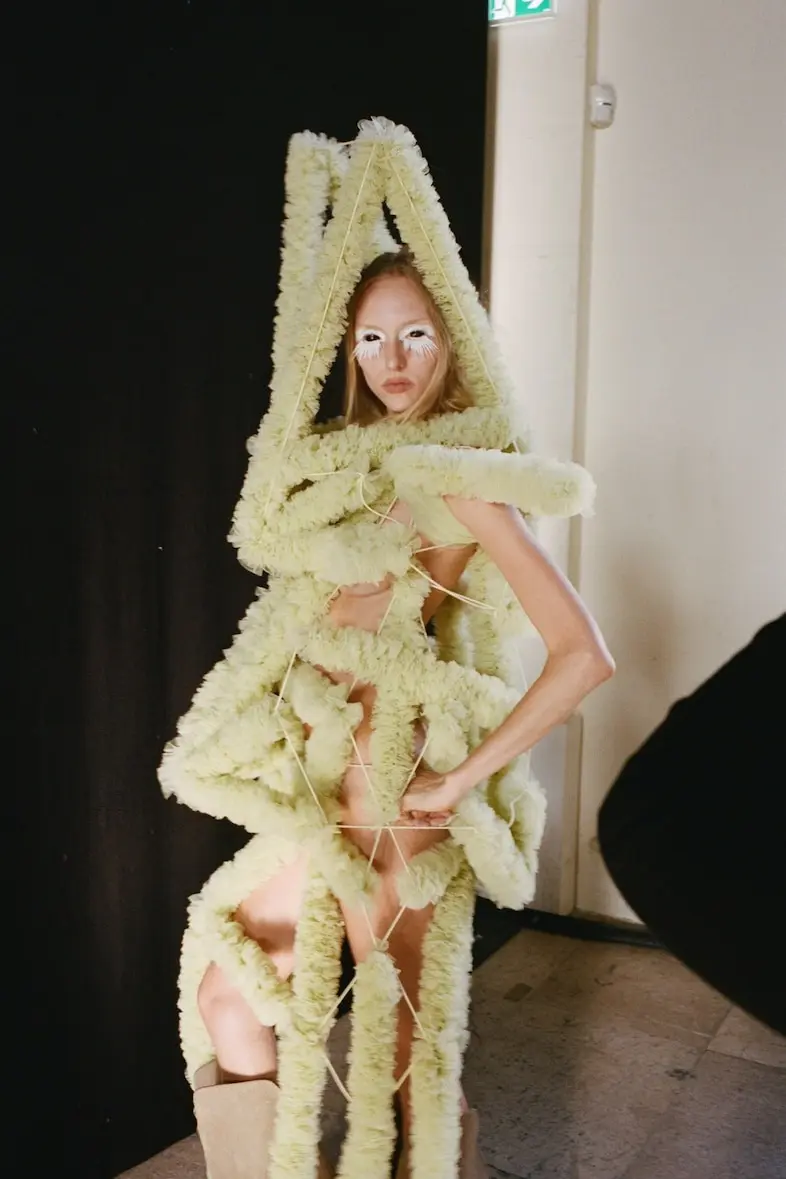
In a direct evolution of the tensegrity constructions introduced during his recent menswear presentation, Owens experimented further with structural equilibrium. While the menswear collection relied on latex and leather lattices held up by a network of continuous tension, the womenswear iteration swapped these materials for what Owens termed "frothy tulle négligées."
However, far from delicate, these pieces writhed with an unsettling vitality. To observers, the layered tulle constructions bore an uncanny resemblance to worms writhing beneath a freshly lifted rock—a brilliant juxtaposition of delicate fabric and grotesque, subterranean life.
Phase Four: Footwear, Details, and the Uniform
Anchoring the collection from the ground up, footwear took the form of strapped and bound jewelled cage-like shoes. Their skeletal frameworks resembled the ruined girders left standing as modernist buildings crumble around them.
Up top, models wore reflective visor sunglasses that completely masked their identities, paired with enormous feathered lashes placed deliberately off-centre to disorient the viewer. Completing the look were harsh, uncompromising Chelsea cuts—a nod to the 1980s hair trend that has become a staple of the stock Rick Owens uniform, emphasizing isolation and architectural sharpness.
Supporting Context & Metrics
Material Innovation and Industrial Procurement
The SS27 collection relies heavily on the juxtaposition of high-fashion craft and industrial surplus. By integrating industrial nylon webbing—designed to withstand the immense pressures of global shipping logistics—into double-duchesse satin, Owens continues his tradition of subverting utilitarian materials into luxury garments. This material choice carries significant economic and environmental commentary, highlighting the lifecycle of industrial goods in an era of hyper-consumption.
The Tripartite Symbolism of "Stone"
To fully comprehend the depth of the collection, one must examine the three distinct philosophical pillars Owens attributed to the word "stone" in his show notes:
- The Stoic Monolith: The physical embodiment of endurance, unyielding strength, and timeless elegance.
- The Resurrected Stone: The stone rolled away during Christ’s resurrection, functioning as a powerful metaphor for release, rebirth, and liberation following profound sacrifice.
- The Weapon of Oppression: The "all-too-common stone throwing" representing human cruelty and societal persecution, which Owens frames as his life’s modest mission to oppose through radical individuality and creative defiance.
Cultural and Market Impact Metrics
- Palais de Tokyo Footprint: The venue once again proved to be the ultimate canvas for Owens’ colossal installations, drawing an estimated attendance of over 1,200 industry insiders, international buyers, and global press representatives.
- Digital Engagement: Within 24 hours of the show’s conclusion, social media analytics indicated a surge of over 300% in engagement across digital platforms, driven largely by the striking imagery of the industrial nylon column gowns and the skeletal cage shoes.
- Collaborative Momentum: Building on the commercial and critical success of his recent menswear-aligned footwear and apparel crossovers, the SS27 womenswear accessories—particularly the jewelled cage footwear and reflective visors—are projected to lead high-tier avant-garde retail sales for the upcoming season.
Official Statements and Design Philosophy
In his post-show reflections and accompanying manifestos, Rick Owens elaborated on the deeply personal and societal grievances that informed Stone.
"Stone is the foundation of my world," Owens stated in his programmatic notes. "It is in the craggy, geological silhouettes I chase, the chalk and coal of my palette, and the brutalist concrete that surrounds my life and work. But stone is also a paradox. It protects, it endures, but it is too often used as a weapon."
Addressing the socio-political undertones of the collection, Owens elaborated on the metaphor of the resurrection stone:
"We live in times of immense sacrifice and collective anxiety. The stone rolled away from the tomb is not just a theological image; it is the ultimate symbol of release. It represents the moment the weight is lifted, allowing the spirit to break free from the crushing gravity of circumstance."
On his lifelong opposition to societal cruelty—symbolized by the act of casting stones—Owens remained characteristically defiant:
"All-too-common stone throwing—the casual, cowardly cruelty of crowds—is something I have made my life’s modest mission to oppose. My garments are not designed to blend into that crowd. They are designed to stand firm, to absorb the blows, and to present an unyielding silhouette against the noise."
Future Outlook: The Monumental Legacy of Rick Owens
As the dust settles on the Palais de Tokyo runway, the implications of Rick Owens’ SS27 Stone collection extend far beyond the immediate horizon of the upcoming retail season. Owens has once again successfully navigated the perilous tightrope between commercial viability and uncompromising conceptual art.
The Evolution of Brutalist Fashion
The integration of industrial materials—such as shipping-crate nylon and tensegrity tulle structures—signals a continuing trajectory toward functional utilitarianism in high fashion. As global instability prompts consumers to seek garments that offer psychological armor, Owens’ architectural approach positions him not just as a designer, but as a prophet of protective luxury.
Retail and Market Projections
Looking toward Spring/Summer 2027, high-end retailers anticipate robust demand for the collection’s statement pieces. While the monumental column gowns and distorted bustles will primarily serve editorial and museum purposes, the bleached Japanese denim, distressed tunics, and avant-garde footwear are expected to drive significant commercial sell-through among Owens’ fiercely loyal global demographic. Furthermore, the continued refinement of the tensegrity constructions points toward a future where clothing dynamically interacts with structural physics, opening new avenues for textile engineering.
Conclusion
Rick Owens’ Stone is a masterclass in thematic consistency and emotional resonance. By excavating the literal and figurative stones that build and break human existence, Owens has delivered a collection that is simultaneously ancient and futuristic, brutal and tender. In a fashion industry frequently preoccupied with fleeting micro-trends, Owens stands like a monolith—unmoved, unyielding, and eternal.