Amazon Web Services (AWS) has announced a fundamental evolution in serverless integration with the launch of its enhanced custom event bus for Amazon EventBridge. Purpose-built to resolve the friction that organizations face when scaling event-driven architectures across multiple teams and accounts, this new capability shifts the paradigm from complex, multi-bus topologies to a streamlined, centralized architecture.
For years, enterprises deploying modern cloud applications have wrestled with a classic scaling paradox. While starting small with a single custom event bus in one account offers velocity and simplicity, organizational growth necessitates a multi-account strategy for isolation and governance. To maintain event-driven workflows, teams traditionally had to stitch together multiple event buses using cross-account rules or intricate bus-to-bus configurations.
This workaround reintroduced the operational complexity that serverless computing was originally designed to eliminate. Platform teams lost holistic visibility into subscription graphs, routing charges compounded rapidly, and organizations requiring strict event ordering were forced to introduce heavy architectural workarounds or alternative technologies.
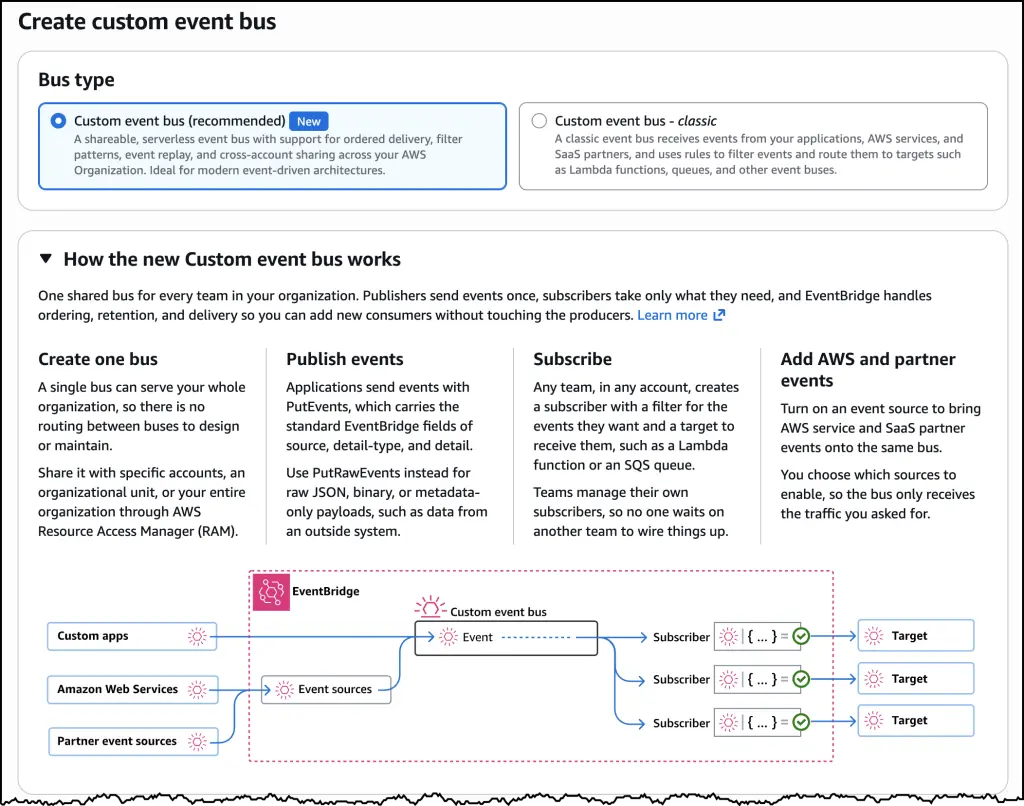
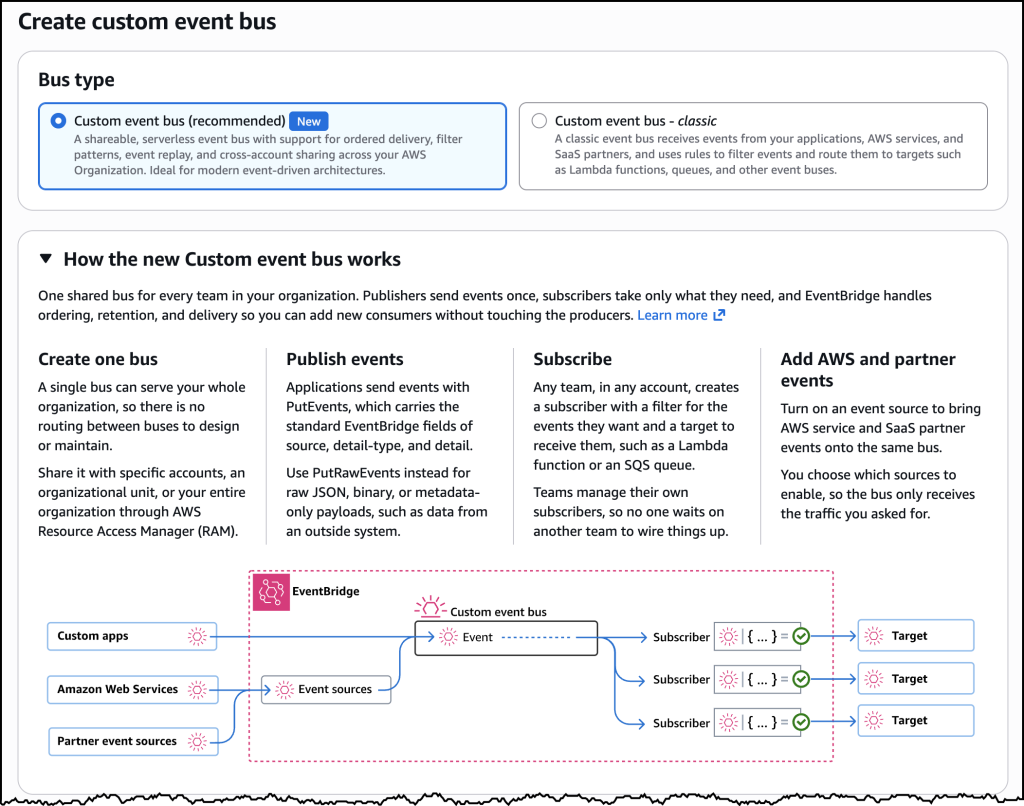
The enhanced custom event bus directly addresses these pain points. By introducing organization-wide resource sharing via AWS Resource Access Manager (AWS RAM), native event ordering via EventGroupId, a unified Subscriber resource, built-in content-based deduplication, JSONata-powered transformations, and a new ingress/egress pricing model, AWS is redefining how large enterprises orchestrate asynchronous workloads. Existing workloads remain fully supported under the newly designated "classic" tier, allowing engineering organizations to adopt the enhanced architecture at their own pace.
Detailed Chronology
The Architectural Evolution of Event-Driven Systems
To understand the significance of the enhanced custom event bus, it is necessary to examine how enterprise event-driven architectures have matured.
Phase 1: The Single-Account Paradigm
When developers first adopt Amazon EventBridge, the standard entry point is a single custom event bus housed within a single AWS account. This setup grants developers autonomy and low latency. Publishers emit custom JSON payloads, and local rules route those events to targets like AWS Lambda functions, Amazon Simple Notification Service (SNS) topics, or downstream HTTP endpoints.

Phase 2: The Multi-Account Proliferation
As microservices proliferate across an enterprise, security and governance best practices require decentralizing workloads into isolated AWS accounts. In this multi-account world, Team A in Account 1 often needs to react to domain events generated by Team B in Account 2.
To bridge this gap, platform engineers resorted to complex configurations:
- Setting up resource-based policies on destination buses.
- Writing cross-account rules that forwarded events across boundaries.
- Managing multiple bus-to-bus subscriptions that quickly escalated into a web of operational dependencies.
This proliferation introduced severe management overhead. Platform engineering teams lost centralized visibility into event flows, making it difficult to audit who was consuming what. Furthermore, the financial model of per-event charges across multiple hops caused infrastructure costs to compound unpredictably.
Phase 3: The Enhanced Custom Event Bus Era
Recognizing these friction points, AWS engineers embarked on a multi-year effort to redesign the custom event bus from the ground up. The result is a unified platform primitive capable of serving an entire AWS Organization simultaneously.
By integrating deeply with AWS RAM, the enhanced bus allows platform administrators to provision a single central backbone. Publishers emit events without needing to know downstream consumers, while application teams independently attach fine-grained subscriptions. By collapsing hundreds of fragmented cross-account pipelines into a single managed construct, AWS has restored the operational simplicity promised by serverless design.
Supporting Context & Metrics
The architectural improvements of the enhanced custom event bus are backed by distinct structural changes in how EventBridge manages throughput, data integrity, and cost allocation.

Scaling and Quotas
One of the primary historical bottlenecks of shared event buses was subscriber and rule limitation. Under the enhanced model, AWS has engineered the infrastructure to support a default quota of 10,000 Subscribers per single event bus, with higher limits available upon request. This massive capacity prevents platform teams from being forced to fragment their event strategies across arbitrary boundaries simply to accommodate scaling thresholds.
Granular Event Ordering
Event-driven design philosophies traditionally rely on asynchronous, non-sequential processing models where message arrival order is treated as irrelevant. However, domain-specific requirements—such as supply chain tracking, financial ledger updates, and IoT telemetry—frequently demand strict causal integrity.
The enhanced custom event bus introduces native ordering via the EventGroupId property:
- Selective Sequencing: Publishers attach an
EventGroupIdto payloads requiring chronological processing. EventBridge ensures that events sharing the sameEventGroupIdare delivered in strict sequence to subscribers configured for ordered delivery. - Asynchronous Coexistence: Other consumers on the same bus can continue to process payloads concurrently and out-of-order, preventing sequencing bottlenecks from slowing down the entire system.
- Synchronous Invocation & Reliability: To eliminate the historical necessity of placing an Amazon SQS queue between an event bus and AWS Lambda to guarantee serial processing, the enhanced bus supports synchronous invocation modes. This confirms successful downstream execution before acknowledging the event.
Advanced Payload Processing and Deduplication
Data hygiene is a critical challenge at scale. The new event bus introduces two powerful data-handling mechanisms:
- Content-Based Deduplication: When partial network failures or timeouts cause event sources to retry transmissions, duplicate events can pollute downstream systems. EventBridge can now cryptographically hash the meaningful portions of an event payload, automatically collapsing identical events that arrive within a five-minute window. This provides "exactly-once" delivery semantics for unstable sources without requiring developers to manually generate and track custom idempotency tokens.
- JSONata Transformations & Protocol Deserialization: Downstream consumers often require specific data schemas. Using built-in JSONata expressions, subscribers can dynamically reshape, filter, and extract attributes from events before delivery. Additionally, for organizations utilizing binary formats like Apache Avro or Protocol Buffers, EventBridge natively deserializes payloads to JSON, enabling rich filtering without forcing consumers to write custom parsing code.
The New Ingress and Egress Pricing Model
Financial governance in multi-account serverless environments has historically been difficult to attribute accurately. The enhanced custom event bus transitions away from legacy multi-hop pricing structures toward a transparent ingress and egress throughput model:
- Publishers pay strictly for events ingested into the bus.
- Subscribers pay for events delivered to their respective targets.
This clean separation eliminates compounding cross-account routing fees, providing clear cost-center visibility for finance and platform engineering teams alike.
Official Statements
While AWS has not published direct quotes from named executives in the initial launch documentation, the structural philosophy behind the release highlights a clear commitment to enterprise serverless maturity.
Product engineering leads close to the project have emphasized that serverless architectures must scale organizationally just as easily as they scale technically. By removing the administrative burden of cross-account policy management, AWS is signaling that platform engineering teams should act as internal service providers—offering secure, governed, high-throughput event backbones without acting as bottlenecks to application developers.
Furthermore, the retention of the classic event bus tier underlines AWS’s commitment to enterprise stability. By positioning the enhanced custom event bus as an opt-in resource labeled simply as Custom event bus while preserving Custom event bus – classic, AWS ensures zero regression risk for millions of existing production workloads currently running worldwide.
Future Outlook
The introduction of the enhanced custom event bus marks a pivotal milestone for cloud-native software engineering. As enterprises accelerate their transition toward decoupled microservice topologies, the complexity of event routing has threatened to undermine the core value proposition of serverless computing.
Looking ahead, we can anticipate several evolutionary trends stemming from this release:
- Consolidation of Auxiliary Infrastructure: With native event ordering and synchronous Lambda invocation built directly into the event bus, architectural patterns that previously required intermediate SQS queues or DynamoDB locking tables for sequencing will likely decline in popularity, reducing total cost of ownership and architectural latency.
- Advanced Governance Models: The integration with AWS RAM and the introduction of the unified
Subscriberresource pave the way for tighter enterprise compliance controls. Future iterations may see deeper integration with AWS Lake House architectures, data governance catalogs, and automated schema registry validation enforced natively at the subscriber boundary. - Global Availability Expansion: Currently available across major commercial regions—including US East (N. Virginia, Ohio), US West (Oregon), Europe (Ireland, Frankfurt, Stockholm, Spain), and Asia Pacific (Hong Kong, Malaysia, Mumbai, Singapore, Sydney, Thailand, Tokyo)—the feature is expected to roll out rapidly to remaining global regions and specialized government clouds.
Ultimately, the enhanced custom event bus transforms Amazon EventBridge from a tactical routing utility into a strategic, organization-wide nervous system. By balancing developer autonomy with centralized operational visibility, AWS has established a robust foundation for the next generation of enterprise-grade, event-driven applications.