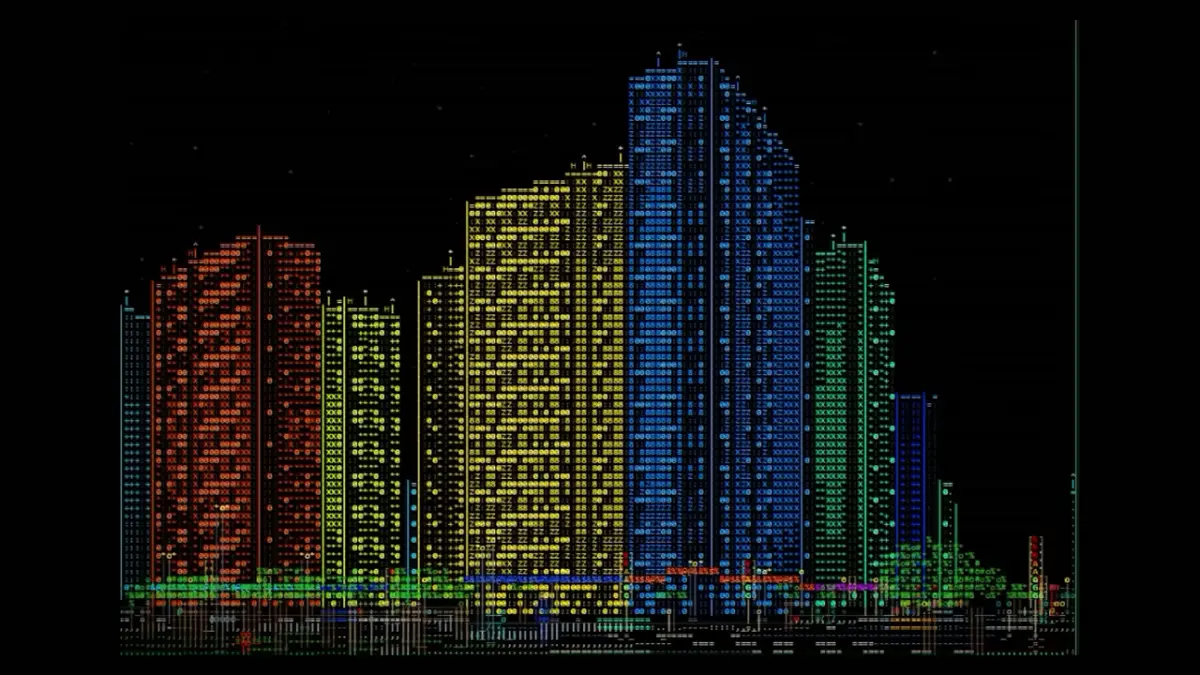
In an era dominated by hyper-realistic graphics, ray tracing, and multi-gigabyte installations, a single independent developer has captured the imagination of over a million internet users by turning the clock back to the foundational roots of computing. Grow Now! Games has unveiled a fully walkable, three-dimensional cyberpunk city rendered entirely in ASCII art—all contained within a single, lightweight HTML file. Eschewing industry-standard engines like Unity and Unreal, as well as traditional polygon meshes, textures, and fragment shaders, the project demonstrates an ingenious synthesis of retro aesthetics and modern algorithmic efficiency.
Operating entirely on text-based characters, the simulation relies on a custom-built ray-casting engine running on a grid-based spatial map. Every frame, the engine casts computational rays across a virtual landscape, calculating perspective, depth, and occlusion purely through character placement. What began as a viral 120×56 character prototype has quickly evolved into an increasingly sophisticated interactive experience. With recent updates pushing resolutions to 180×80 characters, introducing multi-level architectural interiors, and making the prototype publicly accessible via Ko-Fi, this text-based neon metropolis highlights a growing public appetite for creative technical constraints and alternative aesthetic paradigms.
Detailed Chronology
The Genesis of a Text-Based Metropolis
The project first entered public consciousness earlier this month when Grow Now! Games published a brief demonstration video showcasing a navigable cyberpunk city built completely out of keyboard symbols. The initial showcase resonated immediately across social media and developer forums, racking up more than a million views in a matter of weeks.
Unlike conventional retro-styled indie games that rely on pixel art or low-poly 3D assets masked by modern post-processing, this project committed entirely to the aesthetic limitations of early terminal interfaces. Yet, rather than presenting a static, flat 2D projection, the prototype offered a genuine first-person perspective, allowing users to "walk" through neon-drenched streets flanked by towering ASCII skyscrapers, wandering pedestrians, and passing vehicles.
Scaling Up: Resolution and Accessibility
Capitalizing on the overwhelming public response, the developer wasted little time refining the foundational code. In a subsequent update released shortly after the initial viral surge, Grow Now! Games addressed some of the project’s early visual limitations—most notably the heavy flickering inherent to early low-resolution terminal rendering.
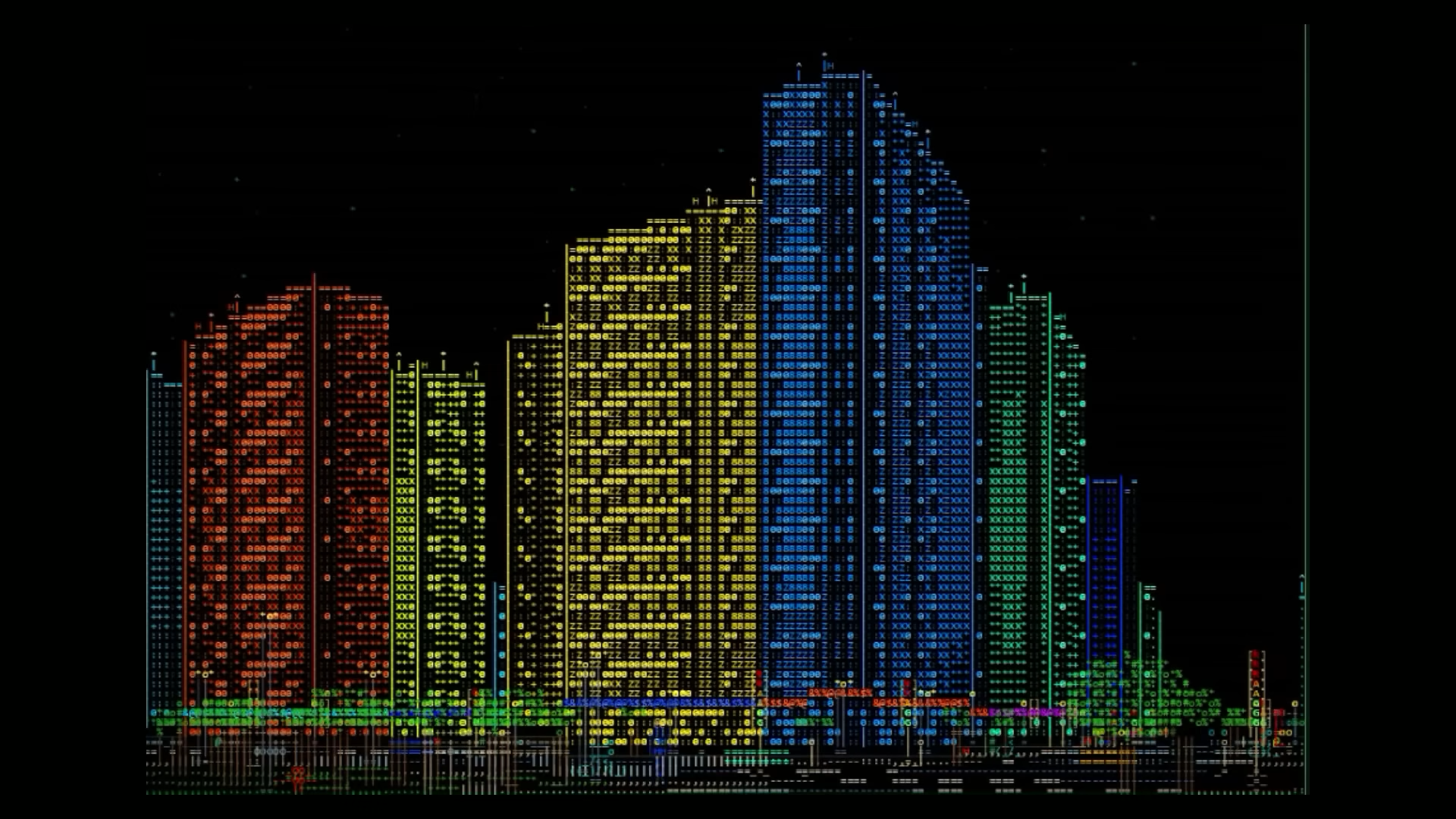
The most significant milestone in this second phase was the introduction of public accessibility. Curious developers, retro computing enthusiasts, and cyberpunk fans were given the opportunity to download and run the prototype directly through the creator’s Ko-Fi page. Alongside this release came a resolution bump to 180×80 ASCII characters, substantially smoothing out the visual fidelity and allowing for sharper geometric definition across the grid-based world.
Introducing Interiors and Verticality
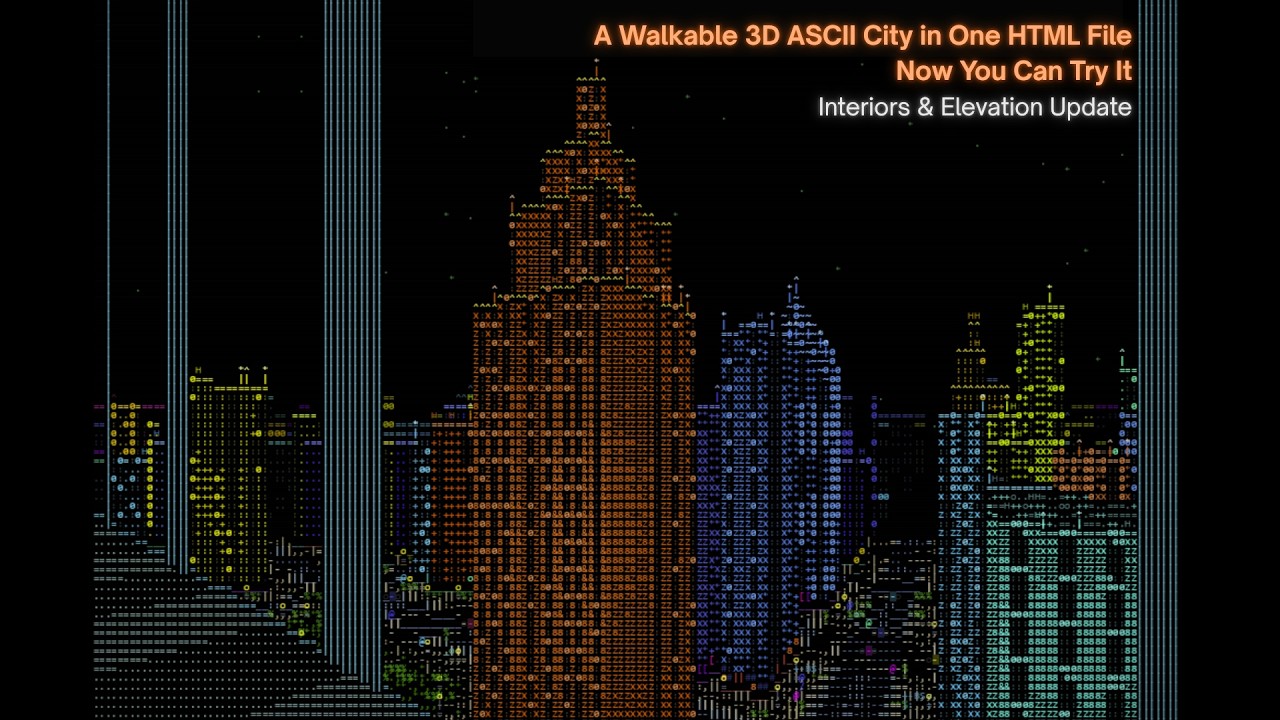
As development continued, the scope of the simulation expanded beyond simple street-level navigation. Grow Now! Games rolled out structural architecture updates that transformed flat building facades into fully realized volumetric spaces.
By introducing multi-floor environments and interior layouts, the project granted users the ability to look at the ASCII cityscape from entirely new vantage points. This structural leap transformed the experiment from a simple graphical gimmick into a genuine spatial exploration prototype, laying the groundwork for more complex gameplay mechanics down the line.
Supporting Context & Metrics
Technical Architecture: How the ASCII City Runs
To understand the technical marvel behind Grow Now! Games’ creation, one must look past the visual presentation and examine the underlying math. Traditional 3D rendering pipelines rely on vertices, triangles, UV mapping, texture samplers, and rasterization hardware. This project discards the entire modern graphics pipeline in favor of a bespoke, lightweight system packaged neatly into a single web document.
At its core, the simulation maintains a grid-based 3D database. This lightweight data structure stores the precise spatial coordinates of:
- Roads and transit paths
- Building footprints and height parameters
- Static environmental features such as trees
- Dynamic entities including moving cars and pedestrian NPCs
Every single frame, the renderer projects rays outward from the virtual camera’s position across the digital grid. When a ray intersects with a map object, the engine calculates the Euclidean distance to determine perspective scaling, character sizing, and depth priority—ensuring closer objects obscure those further away. The resulting surface normal or distance value is then mapped directly to a specific ASCII character based on density and luminance, creating an illusion of depth and shading out of standard keyboard punctuation.
The Metrics of Viral Appeal
The project’s swift ascent to viral fame offers quantifiable proof of a shifting sentiment within gaming culture.
- Over 1 Million Views: The original prototype demonstration video crossed the seven-figure view threshold within weeks of upload, outperforming many mainstream AAA trailer metrics relative to production budgets.
- Resolution Scaling: Moving from the initial 120 x 56 character grid to the refined 180 x 80 character grid yielded an approximate 114% increase in total on-screen render data, significantly improving edge detection and spatial clarity.
- Zero Dependencies: The entire executable payload remains contained within a single HTML file, requiring no third-party runtimes, dynamic link libraries (DLLs), or graphics card acceleration beyond basic browser-based JavaScript execution.
Official Statements & Developer Insights
In technical breakdowns accompanying the project releases, the creator behind Grow Now! Games demystified the internal mechanics driving the text-based world:
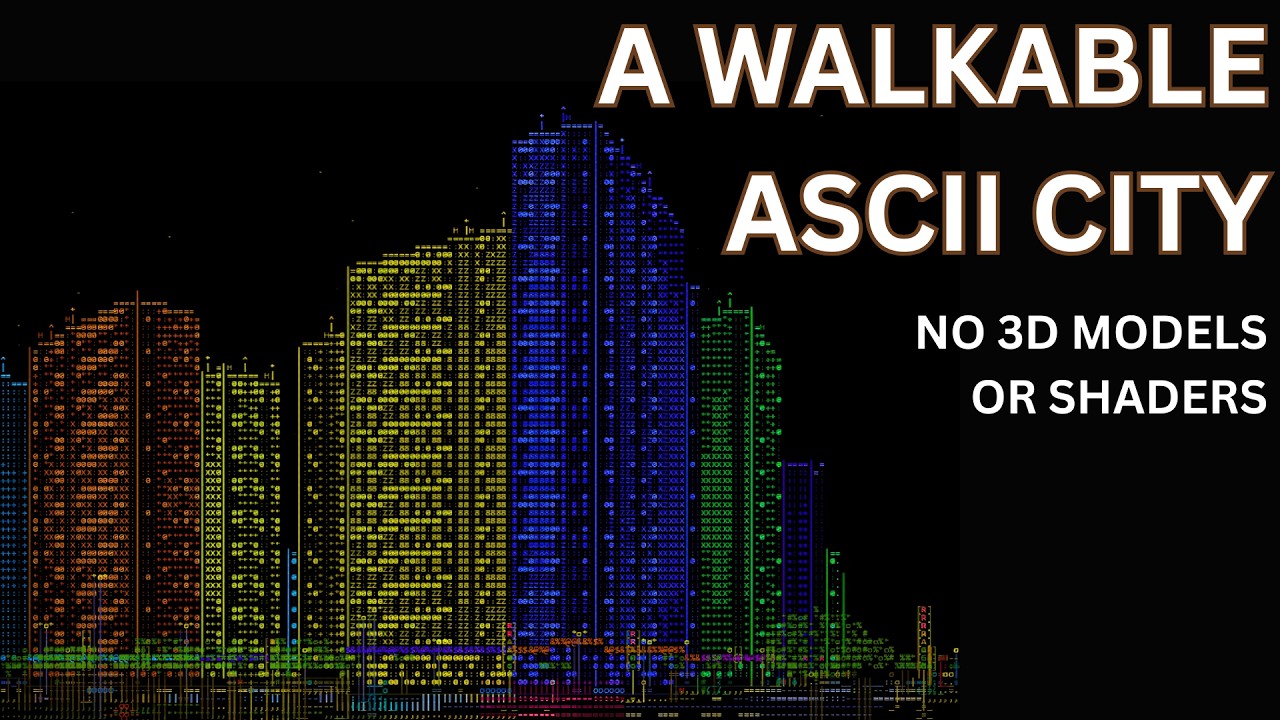
"There’s no Unity, there’s no Unreal, there’s no 3D models, textures, or shaders," the developer stated in project documentation. "Underneath the system, if you like, it’s a grid-based 3D world. The city stores where roads, buildings, trees, cars, and people are, along with things like building height. And every frame, the renderer casts rays out from the camera across that grid, finds the first thing each ray hits, and uses the distance to work out perspective, size, depth, and what should be hidden behind other things."
While acknowledging that the raw frame rendering produces noticeable visual artifacts and flickering—factors that make prolonged viewing strenuous on the eyes—the developer views these traits not as bugs, but as authentic stylistic signatures of terminal-based computing art. The enthusiastic reception from the gaming community has validated the notion that players are increasingly eager to embrace artistic expression that breaks free from the homogenized pursuit of photorealism.
Future Outlook
From Tech Demo to Fully Realized Game
While the project currently exists primarily as an interactive exploration prototype and a technical showcase, its trajectory points toward a more ambitious destination. Grow Now! Games has confirmed that future updates will move beyond structural enhancements like multi-floor interiors.
Among the most heavily discussed additions is the implementation of a functional dialogue system. Introducing narrative elements and interactive characters would effectively bridge the gap between a pure technical demonstration and a playable role-playing environment, breathing life into the cold, calculated syntax of the ASCII grid.
The Revival of Text-Based Artistry in Modern Gaming
This cyberpunk experiment does not exist in a vacuum. The broader indie development sphere has seen a steady undercurrent of creators challenging modern graphical bloat through stylized, text-driven mediums. Projects like Effulgence RPG—a turn-based title released last year that constructs its entire aesthetic out of ASCII symbols while tasking players with converting enemy components into weaponry—demonstrate that conceptual ingenuity often outweighs polygon counts.
As Grow Now! Games continues to iterate on its browser-based engine, the project serves as a compelling reminder of what can be achieved with creative constraints. By stripping away millions of lines of engine code and returning to the foundational elegance of text representation, the developer has not only crafted a mesmerizing digital dystopia but has also sparked a vital conversation about the enduring power of minimalist game design.