Executive Overview
The digital landscape of the 21st century is littered with the ghosts of disruptive software platforms that defined early internet culture. Among the most recognizable names from the peer-to-peer (P2P) revolution of the 2000s is LimeWire—a brand historically synonymous with the underground exchange of MP3s, digital piracy legal battles, and the wild-west era of desktop computing. Today, however, that legacy has undergone a radical transmutation. LimeWire has re-emerged not as a relic of digital copyright infringement, but as a sophisticated, Web3-integrated generative artificial intelligence (AI) platform and content-publishing ecosystem known as LimeWire Studio.
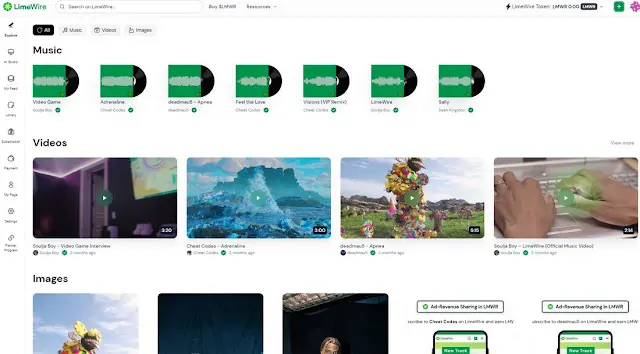
In its modern iteration, LimeWire bridges the gap between decentralized technologies and cutting-edge creative tools. By marrying generative AI image-creation models with blockchain-based digital asset minting, community-driven subscriptions, and a native cryptocurrency revenue-sharing model, the platform positions itself as a comprehensive monetization engine for modern digital artists, musicians, and designers. Far from merely serving as a consumer-facing novelty, LimeWire Studio has successfully attracted high-profile cultural figures—including prominent musicians like Deadmau5, Soulja Boy, and Sean Kingston—who utilize the ecosystem to publish, syndicate, and monetize NFT-backed audio, video, and visual media.
This investigative report examines LimeWire’s technological architecture, its innovative approach to AI-assisted content generation, its tokenomics and Web3 monetization frameworks, and its long-term viability in an increasingly saturated generative AI marketplace.
Detailed Chronology: The Evolution of a Digital Icon
To understand the current architecture of LimeWire Studio, one must chart its improbable historical trajectory across two distinct technological epochs.
Epoch 1: The P2P Paradigm (2000–2010)
Launched in 2000 by Mark Gorton, LimeWire originally operated as a Java-based Gnutella network client. At its peak, it was one of the most widely downloaded file-sharing applications in the world, facilitating the transfer of billions of files, predominantly music and film. However, its decentralized structure made it a primary target for the Recording Industry Association of America (RIAA). Following years of high-stakes litigation (Arista Records LLC v. Lime Wire LLC), a federal court ordered the shutdown of the platform in late 2010, leading to a permanent injunction and a massive multi-million-dollar copyright settlement. For over a decade, the brand lay dormant, remembered primarily as a cultural touchstone of early broadband internet culture.
Epoch 2: The Web3 and AI Renaissance (2022–Present)
The revival of the LimeWire brand began under new ownership, steered by serial tech entrepreneurs Julian and Paul Zehetmayr. Recognizing the convergence of generative AI capabilities and decentralized ledger technology, the leadership team pivoted the dormant brand away from file sharing entirely, transforming it into a legitimate, legal content publishing platform.
- The Initial Crypto Pivot (2022): LimeWire re-launched initially as a digital collectibles marketplace for music and art, introducing its native utility token, LMWR.
- The Integration of Generative AI (2023): Capitalizing on the generative AI boom catalyzed by models like Midjourney and OpenAI’s DALL-E, LimeWire integrated state-of-the-art text-to-image engines—including Stable Diffusion and DALL-E 2—directly into its creative suite.
- Studio Expansion and Monetization (2023–2024): The platform rolled out automated NFT minting on the Polygon and Algorand blockchains, tiered subscription options for content creators, and robust ad-revenue-sharing pools paid out in LMWR tokens. Today, the ecosystem functions as a holistic creator economy hub, bridging automated AI production with audience monetization.
Supporting Context & Metrics: The Technology and Tokenomics of LimeWire Studio
LimeWire Studio’s technical framework rests on three foundational pillars: advanced generative AI modeling, automated blockchain minting, and a crypto-centric ad-revenue-sharing model.
1. Generative AI Infrastructure
LimeWire does not rely on a single proprietary engine; instead, it aggregates industry-leading open-source and commercial models to provide a versatile toolkit for creators. The platform currently supports:
- Stable Diffusion 2.1 & Stable Diffusion XL (SDXL): Enabling highly detailed, photorealistic, and stylistically flexible image generation.
- DALL-E 2 Integration: Offering robust prompt interpretation and abstract visual design capabilities.
- Style Modifiers: Users can apply specialized filters and thematic paradigms—ranging from cinematic lighting and digital art to pixel art, anime, and analog film grain—giving creators granular control over their visual output.
- Proprietary AI Models: In addition to external integrations, LimeWire is actively developing its own proprietary AI models to further differentiate its creative capabilities from competitors.
2. Automated Blockchain Minting (NFT Integration)
Every piece of content generated and published within LimeWire Studio can be instantly transformed into a secure digital asset.
- Blockchain Agnosticism: Minting occurs automatically upon publication, utilizing either the Polygon or Algorand blockchains for low transaction fees and high throughput.
- Ownership and Royalties: NFTs minted on LimeWire grant verifiable digital ownership to collectors. Crucially, creators retain a 2.5% royalty on secondary market trades, ensuring sustained passive income as their digital collectibles circulate within the community.
3. The LMWR Token and Revenue Sharing Model
LimeWire’s economic engine is driven by its native cryptocurrency, LMWR, which facilitates seamless transactions across the ecosystem.
+--------------------------------------------------------------------------+
                    LIMEWIRE CREATOR REVENUE ECOSYSTEM
+--------------------------------------------------------------------------+

  [Creator Publishes Content] ---> [Audience Views / Subscribes]
                                          |
                                          v
  [Monthly LMWR Payout] <--- [Platform Ad Revenue & Subscription Pool]
           |
           +---> Tradeable on Exchanges (Kraken, Bybit, Uniswap)
+---> Reinvested into AI Prompt Credits- Ad-Revenue Sharing: Creators earn a direct cut of the advertising revenue generated when other users view their published images, music, and videos on the platform. Depending on the creator’s membership tier, this revenue share ranges from 50% up to 70%.
- Monthly LMWR Distribution: Earnings are disbursed monthly in LMWR tokens. These tokens can be liquidated on major international cryptocurrency exchanges—including Kraken, Bybit, and Uniswap—or reinvested directly into the platform to purchase additional generative AI prompt credits.
4. Tiered Pricing and Credit Matrix
LimeWire offers a flexible pricing model catering to casual creators and high-volume professional designers alike:
| Tier | Monthly Subscription | Monthly Credits | Estimated Image Generation Limit | Ad Revenue Share | Key Perks |
|---|---|---|---|---|---|
| Free | $0 | 10 credits | Up to 20 images/day | 50% | Basic tools, access to public community |
| Basic | $9.99 | 1,000 | Up to 2,000 images | 50% | Pro badge, full history, faster rendering, ad-free |
| Plus | $29.00 | 3,750 | Up to 7,500 images | 60% | Early access to new AI models, Pro badge |
| Pro | $49.00 | 5,000 | Up to 10,000 images | 70% | Maximum revenue share, priority generation |
| Advanced | $99.00 | 11,250 | Up to 22,500 images | 70% | Enterprise-level capacity, dedicated support |
Official Statements and Industry Reception
The strategic pivot of a legacy software brand into the Web3 and AI space has naturally drawn significant attention from tech analysts, venture capitalists, and the creative community.
In public commentary surrounding the launch of LimeWire Studio, co-CEO Julian Zehetmayr emphasized the platform’s democratic ambitions: "We are taking the complex, fragmented world of generative AI and combining it with the direct-to-consumer monetization models of the creator economy. By automating NFT minting and introducing a robust ad-revenue share paid in our native token, we are giving artists the financial tools they need to sustain their craft without relying on traditional gatekeepers."
Industry observers have noted that while the inclusion of cryptocurrency tokens and NFTs introduces a layer of complexity that may deter mainstream casual users, it simultaneously unlocks profound utility for digital-native artists accustomed to Web3 mechanics. The endorsement of the platform by high-profile artists such as Deadmau5 and Soulja Boy has further legitimized LimeWire Studio as a viable distribution channel for digital art and music collectibles, positioning it distinctively against closed-ecosystem alternatives like Adobe Firefly or Midjourney.
Future Outlook: Beyond Image Generation
As generative artificial intelligence continues to disrupt traditional creative industries, LimeWire Studio’s roadmap points toward a multi-modal future. While the platform currently centers its core utilities around advanced text-to-image processing, upcoming updates promise the integration of AI-driven music and video generation tools.
This strategic expansion will allow audio producers, filmmakers, and digital artists to leverage the same decentralized publishing, subscription gating, and revenue-sharing mechanisms currently enjoyed by visual designers. By developing proprietary AI models alongside integrations with industry standards, LimeWire aims to fortify its position as an all-in-one production studio.
Conclusion
LimeWire’s evolution from an illicit file-sharing pioneer into a regulated, blockchain-backed AI content platform is one of the most fascinating corporate transformations of the digital age. By successfully democratizing access to high-end generative AI tools while simultaneously rewarding creators with direct ad-revenue shares and tradeable digital assets, LimeWire Studio has carved out a unique niche. For digital creators seeking to experiment with generative art, mint verifiable assets, and monetize their output in a transparent ecosystem, LimeWire offers a compelling, forward-looking gateway into the future of digital creativity.