Executive Overview
Since the launch and operational commissioning of the James Webb Space Telescope (JWST), astronomers have been inundated with a surreal, high-definition "zoo" of cosmic phenomena from the dawn of the universe. Among the most confounding discoveries are thousands of microscopic, intensely luminous, ruby-colored pinpricks of light dubbed "little red dots." Spanning just a single pixel in deep-field infrared imaging, these entities have triggered one of the most polarizing debates in modern astrophysics.
Initially labeled "universe breakers" for challenging conventional galaxy formation timelines, these objects have recently forced researchers to rethink the mechanics of cosmic evolution. Two independent research teams—led by Anna de Graaff of the Max Planck Institute for Astronomy and Rohan Naidu of the University of Hawaiʻi—unveiled observations of unique little red dots that exhibit properties belonging to neither traditional galaxies nor standard supermassive black holes.
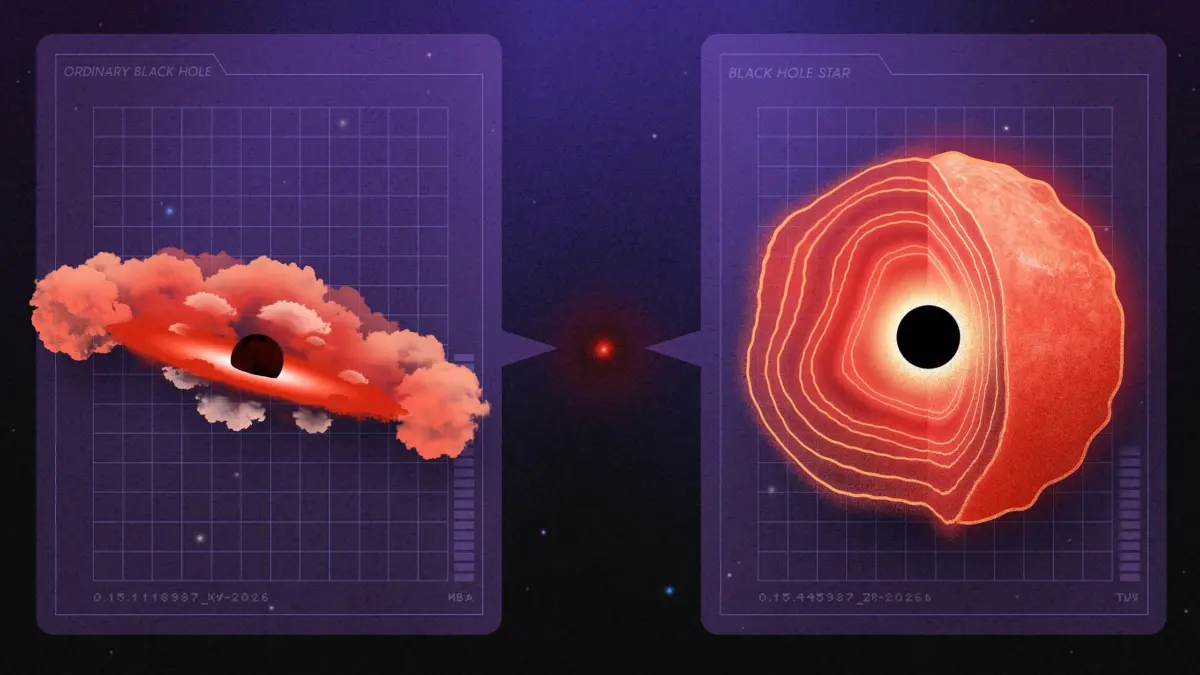
Instead, these astronomers propose a revolutionary hypothesis: they are witnessing a brand-new class of celestial body known as a "black hole star"—or quasi-star—where an actively feeding, massive black hole is completely cocooned inside a colossal, unstable envelope of hydrogen gas. While proponents argue that this theory solves enduring paradoxes regarding missing X-rays and steady luminosity, skeptics contend that conventional, edge-on supermassive black holes obscured by thick dusty toruses can adequately explain the data. This clash of interpretations has divided the astrophysical community, transforming JWST’s little red dots into the epicenter of a quest to uncover how the universe’s first giant black holes were born.
Detailed Chronology: From "Universe Breakers" to the Black Hole Star Hypothesis
Phase 1: The Discovery of the Little Red Dots (2022–2023)
When the James Webb Space Telescope began returning its deepest infrared images of the universe, it peered into the first billion years following the Big Bang—a chaotic epoch of dense hydrogen and helium clouds. Amidst this cosmic dawn, astronomers noted a persistent abundance of tiny smudges of light. Emitting long-wavelength red light with the blinding intensity of an entire galaxy, yet compressed into a single pixel, these objects were categorized in 2023 as "little red dots."
Initially, researchers assumed they were extraordinarily distant galaxies. However, standard cosmological models dictate that galaxies of such extreme brightness require hundreds of millions of years of gradual stellar accumulation to form. Because these dots appeared so early in cosmic history, they temporarily broke standard timelines, earning them the moniker "universe breakers."
Phase 2: Spectroscopy and the Emergence of the Black Hole Model (2023–2024)
To decode these anomalies, specialized survey programs—such as the Red Unknowns: Bright Infrared Extragalactic Survey (Rubies), led by Anna de Graaff, and Mirage or Miracle (MOM), co-led by Rohan Naidu—spent hours keeping the JWST trained on these pinpricks. By analyzing their spectra (the detailed breakdown of light wavelengths and colors emitted), researchers unlocked vital clues about atomic behavior within the dots.

The breakthrough came when spectra revealed that hydrogen emission lines were "smeared out" across multiple shades, a signature phenomenon known as a broad line. In traditional astrophysics, broad lines indicate that intense gravitational forces are whipping surrounding hydrogen clouds into a frenzy around an exposed black hole. Consequently, many astronomers pivoted: little red dots were not hyper-accelerated galaxies, but rather monstrous, supermassive black holes whose blue light was heavily veiled by thick veils of cosmic dust.
Yet, inconsistencies remained. Typical supermassive black holes flicker erratically as they violently consume matter, and they routinely beam high-energy X-rays across space. Most little red dots displayed neither behavior.
Phase 3: The Spring 2025 Bombshell and "Black Hole Star Date"
In the spring of 2025, de Graaff’s and Naidu’s teams independently unveiled two little red dots that defied all established categorizations. These objects lacked the typical signatures of exposed black holes while introducing a striking new feature: a Balmer break—a sharp surge in brightness at a specific red wavelength.
A Balmer break is traditionally the hallmark of a hot ball of hydrogen gas, such as the surface of a star or a galaxy of stars, powered internally by nuclear fusion at a uniform temperature of roughly 5,000 Kelvin. However, these objects were vastly too luminous to be normal stars.
Simultaneously, a third group led by Vadim Rusakov at the University of Manchester analyzed the broad lines of these anomalies. By digitally stripping away the effects of light scattering off free electrons, Rusakov’s team demonstrated that the smeared hydrogen lines did not stem from ferocious swirling gas near a naked black hole, but rather from a sluggishly churning shell of hydrogen gas.
On March 20, 2025—jokingly dubbed "black hole star date" by researchers—the three teams posted their findings, arguing that they had discovered a hybrid entity: a supermassive black hole functioning as the engine room inside a colossal, gassy stellar envelope.

Supporting Context & Metrics: Anatomy of a Quasi-Star
To understand the physics of a black hole star, one must look back to theoretical models proposed decades ago. In 2006, astrophysicists Mitchell Begelman, Marta Volonteri, and Martin Rees hypothesized the existence of quasi-stars to explain the sudden appearance of impossibly massive black holes in the early universe. In 2025 and 2026, Begelman, Jason Dexter, and Mauro Giavalisco successfully applied this quasi-star framework to the JWST’s little red dots.
Structural Mechanics of a Black Hole Star
- Scale and Proportions: If our Sun were replaced by a black hole star, its turbulent outer edge would stretch more than a dozen times farther than the orbit of Pluto.
- The Core Engine: Deep in the center, invisible to the outside universe, a massive black hole pulls in gas, generating intense internal heat and energy pressure. This outward pressure prevents the massive envelope of hydrogen from collapsing inward, replacing traditional nuclear fusion with gravitational accretion as the star’s engine.
- The Surface and Cocoon: Material swirling around the internal black hole emits energy that filters upward through a thick hydrogen shell. Near the surface, hydrogen atoms absorb bluer light while permitting redder light to escape, producing the characteristic 5,000-Kelvin red hump and Balmer break.
- Solving the Paradoxes: The enveloping shell of gas naturally acts as a shield, trapping X-rays and dampening the erratic flickering typical of exposed black holes. This successfully reconciles why little red dots are intensely red yet magnetically and radiatively subdued compared to local active galactic nuclei.
Official Statements and Perspectives
The scientific community remains deeply divided over the interpretation of JWST’s data, captured in statements from leading researchers in the field:
"In all the millions of [observations] we’ve taken with ground-based telescopes, there’s nothing that looks like these sources. We are seeing the seed. This is the birth of potentially every massive black hole in the universe."
— Anna de Graaff (Max Planck Institute for Astronomy) & Rohan Naidu (University of Hawaiʻi)
Despite the elegance of the black hole star model, prominent astrophysicists argue that standard models require no revision.
"The data is really compelling, but I’m a little bit more dubious about the interpretation… Standard galactic black holes are ringed by a thick doughnut of gas and dust, which can block most X-rays. I see no reason to suspect the little red dots of being anything other than standard supermassive black holes viewed edge-on."
— Roberto Maiolino (University of Cambridge)
Supporting the traditional black hole paradigm, Maiolino and Piero Madau published models in spring 2026 arguing that the orientation of observers dictates the color: edge-on views yield "little red dots" (obscured by dusty toruses), while top-down views reveal "little blue dots" (exposed black holes).

Reflecting on the widespread scientific debate, conference moderator Dale Kocevski (Colby College) noted:
"The group erupted into argument, and we couldn’t even get past the first bullet point… I have a sneaking suspicion that we’re both right. The universe is a messy place, and some little red dots are truly starlike black hole stars, while others are more like standard black holes."
Future Outlook and Verification
Resolving the identity of the little red dots represents a foundational milestone for modern cosmology. If the black hole star hypothesis holds true, these objects represent a critical evolutionary "puberty" stage for supermassive black holes—an ephemeral incubation phase lasting tens of millions of years before the central black hole consumes its gaseous cocoon and emerges into the open universe.
To definitively test this model, astronomers are actively pursuing specific observational signatures:
- Cosmic Population Censuses: If little red dots are indeed black hole stars confined to the early universe, their numbers should drop off steeply as the universe ages past 2 to 3 billion years. Recent multi-era surveys published in late 2026 by Kocevski and collaborators have shown preliminary evidence of this exact demographic fade.
- Mass Estimation Techniques: Ongoing research led by Naidu, de Graaff, and Eilers aims to refine techniques for measuring the mass of black hole "seeds" hidden within these stellar envelopes. Current data suggests these hidden black holes are significantly less massive (up to 1 million solar masses) than older, exposed counterparts, supporting the incubation theory.
- Advanced Numerical Modeling: Theorists continue to simulate the complex hydrodynamics of mass ejection and gas accretion at the edges of quasi-stars to generate precise predictive spectra that can be cross-examined against upcoming JWST observation cycles.
Whether these enigmatic pinpricks of light are revolutionary hybrid stars or merely standard black holes cloaked by dusty doughnuts, the James Webb Space Telescope has once again proven that the early universe operates under rules far stranger and more dynamic than humanity ever anticipated.