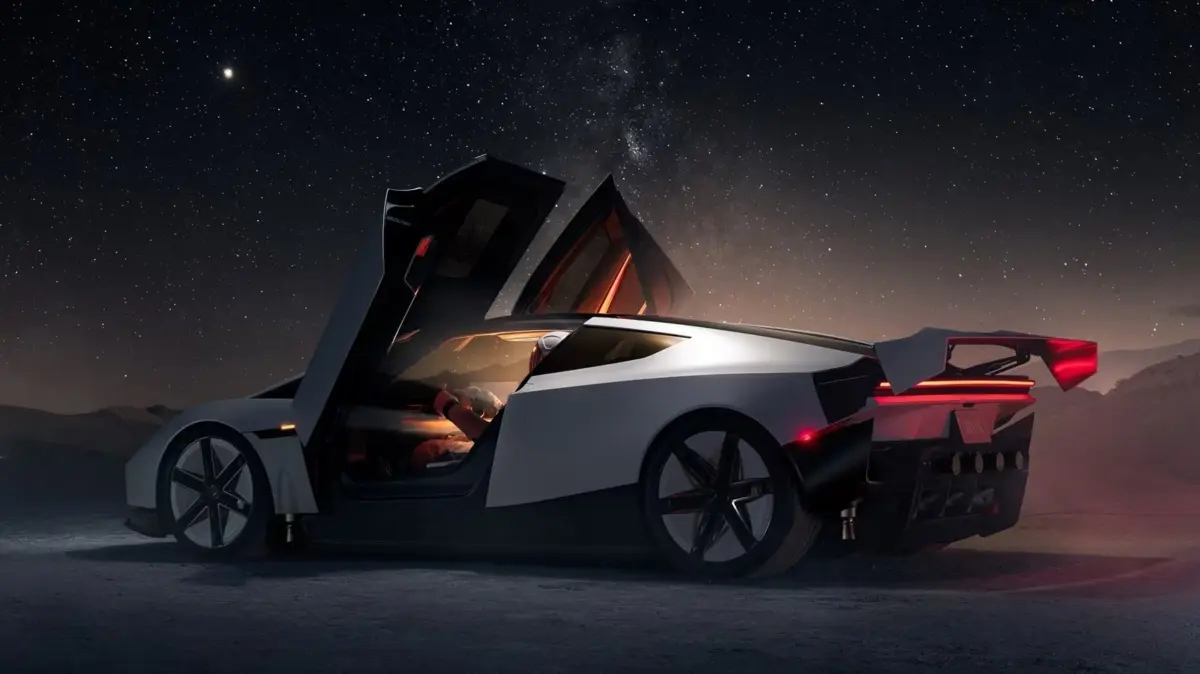
Tesla’s recent promotional blitz—highlighted by a gravity-defying stunt where a redesigned Roadster climbed a C-shaped ramp on a suction rig and hovered back down via rocket boosters—has once again thrust the company’s long-delayed sports car into the global spotlight. During an October event, CEO Elon Musk officially pinned a targeted production window of 2028 on the vehicle, alongside a staggering $250,000 reservation price tag for the "Thrust" trim level, which features cold-gas thrusters. "We enter production in 2028," Musk declared to a cheering audience. "Actually, for real."
For automotive enthusiasts and industry analysts alike, however, the announcement provoked an immediate sense of déjà vu. This is far from the first time Tesla has formally introduced the second-generation Roadster. Nearly a decade after its initial unveiling, the vehicle has transformed from a symbol of electric vehicle (EV) vanguardism into a cautionary tale of perpetual delays, shifting corporate priorities, and unfulfilled executive promises.
As Tesla navigates a turbulent operational landscape marked by slumping global sales, intense public scrutiny, and the political fallout from Musk’s polarizing tenure heading the federal Department of Government Efficiency (DOGE), the re-announced Roadster raises critical questions. Is this high-flying stunt the true dawn of a production-ready marvel, or simply another paper launch designed to distract from a brand under siege? This investigation examines the convoluted history of the second-generation Tesla Roadster, the systemic delays that have plagued its development, the socio-political backdrop of its creator, and whether the market still has an appetite for a $250,000 electric supercar.
Detailed Chronology: A Decade of Delays
To understand the skepticism surrounding the 2028 production target, one must retrace the winding, protracted timeline of the second-generation Roadster—a vehicle whose development cycle has now spanned multiple eras of modern technological and political history.
2008–2017: The Genesis and the First-Gen Foundation
The "Roadster" moniker holds profound historical significance for Tesla. Released in 2008, the original Roadster was a critical milestone that proved battery-powered vehicles could be both viable and high-performing. Conceived initially by original founders Martin Eberhard and Marc Tarpenning—before Elon Musk bought them out and assumed control—the original sports car was crammed into a modified Lotus Elise chassis. Despite its limited production run, it demonstrated that an EV could break the 244-mile barrier on a single charge, cementing its place as the spark that ignited Tesla’s commercial ambitions.
November 2017: The Grand Unveiling
Nearly a decade later, on November 16, 2017, Musk pulled the covers off a completely redesigned second-generation Roadster. Billed as a "hardcore smackdown to gasoline cars," the vehicle promised mind-boggling specifications: 0 to 60 mph in 1.9 seconds, a top speed exceeding 250 mph, and a 620-mile range powered by a 200 kWh battery pack. Alongside the Tesla Semi—a Class 8 electric truck that would also face severe production bottlenecks—the Roadster was slated for a commercial rollout in 2020. Reservations opened immediately, requiring steep down payments ranging from a $50,000 base deposit to the full $250,000 upfront for the limited "Founder’s Series."
2018–2020: The "SpaceX Package" and Early Slippage
In early 2018, Musk leaned further into sci-fi hyperbole, announcing a forthcoming "SpaceX option package" that would utilize roughly 10 small cold-gas rocket thrusters arranged around the vehicle’s body to dramatically enhance acceleration, cornering, and braking.
However, as the initial 2020 production window approached, signs of trouble emerged. During a July 2020 earnings call, Musk revised the timeline, stating that production would commence within the next 12 to 18 months. Compounding these delays, Musk admitted in an interview with podcaster Joe Rogan that year that Tesla had intentionally sidelined the Roadster to prioritize the development and launch of the Cybertruck—a vehicle that would subsequently endure its own marathon of production delays before hitting streets years later.
2021–2024: The Moving Goalposts
As the global supply chain fractured under the weight of pandemic-era disruptions, Tesla’s timelines dissolved entirely. In early 2021, Musk pushed the Roadster’s debut to 2022. By the end of 2022, that projection slipped again to 2023. Further adjustments and silence followed through 2023 and 2024, transforming the car into an industry-wide running joke. While customers watched their tens of thousands of dollars sit in Tesla’s accounts for years without tangible progress, the company directed its engineering bandwidth toward scaling higher-volume models like the Model Y and grappling with the commercial rollout of the Cybertruck.
Supporting Context & Metrics: Financial Stakes and Reputational Damage
The road to the 2028 Roadster release window has not been paved solely by engineering hurdles; it has been profoundly complicated by the unprecedented socio-political controversies surrounding Tesla’s mercurial chief executive.
The DOGE Fallout and Global Backlash
The years 2024 and 2025 marked a radical transformation in Musk’s public persona. Transitioning from a celebrated, tech-forward environmentalist to a polarizing political kingmaker, Musk accepted a high-profile role leading the newly formed Department of Government Efficiency (DOGE) under the administration of President Donald Trump.
The resulting "slash-and-burn" approach to federal agency budgets triggered widespread institutional and economic disruption. By July 2025, a study published in The Lancet projected that the sweeping federal cuts implemented by DOGE could contribute to millions of preventable health crises and fatalities by the end of the decade. Although Musk vigorously disputed these findings, the reputational damage was instantaneous and severe.
The fallout spilled directly onto Tesla’s balance sheets. The company faced coordinated global protests, boycotts, and a steep contraction in vehicle sales across key European and North American markets. By May 2025, amid intense media scrutiny, mounting family drama, and allegations concerning personal substance use, Musk officially stepped down from his DOGE post. Yet, the brand damage had been done, relegating high-end enthusiast projects like the Roadster to the back burner while Tesla scrambled to stabilize its core automotive business.
The Consumer Grievance Index
For reservation holders, the financial asymmetry became a point of acute frustration. Tesla had effectively secured interest-free loans from its most loyal and affluent supporters for nearly a decade.
High-profile figures and everyday consumers alike voiced their exasperation. Notably, prominent tech YouTuber Marques Brownlee—who has interviewed Musk multiple times—lamented on his Waveform podcast in September 2025: "Tesla has been sitting with my 50 grand for eight years and hasn’t done anything with it." Similar public complaints echoed from rival tech executives, including OpenAI CEO Sam Altman, who had also put down early stakes in the vehicle.
By the time Tesla quietly recommitted to the Roadster project in the spring of 2025, public trust in the vehicle’s delivery had hit rock bottom. Pop-culture parodies and internet memes routinely mocked the car’s vaporware status, treating it as an unattainable punchline akin to the Boring Company flamethrower.
Official Statements & Industry Perspectives
Tesla’s leadership has consistently attempted to reframe the Roadster’s extraordinary timeline as a testament to uncompromising engineering ambition rather than corporate mismanagement.
During the October unveiling event, Musk defended the relentless iterations, emphasizing that the vehicle’s technological scope had expanded far beyond a traditional sports car. "We are not just building a fast car; we are incorporating aerospace technology into a street-legal vehicle," Musk stated. According to Tesla’s engineering briefings, the delay was necessary to integrate next-generation battery chemistry, aerodynamic refinements, and the complex engineering required for the cold-gas thruster systems.
Industry analysts, however, remain deeply skeptical of these claims. Automotive manufacturing experts point out that a launch event lacking a concrete prototype testing schedule and binding supply-chain commitments falls short of a credible product rollout.
Furthermore, competitors in the electric hypercar space—such as Rimac, Lotus, and Pininfarina—have successfully brought multi-million-dollar electric performance vehicles to market during the very years Tesla has spent revising the Roadster’s specs. For the automotive establishment, Tesla’s reliance on dramatic stunt marketing serves primarily to sustain investor enthusiasm during periods of core margin compression and slowing EV adoption rates.
Future Outlook: Can the Roadster Deliver?
As Tesla looks toward its newly minted 2028 production target, the stakes could not be higher. The automotive landscape of the late 2020s will look vastly different from the one that greeted the initial 2017 unveiling. The market for high-performance electric vehicles is no longer an empty frontier; it is heavily contested by legacy luxury brands and nimble EV startups alike.
To successfully transition the Roadster from a stunt-driven concept to a functional reality on public roads, Tesla must clear several formidable hurdles:
- Capital Allocation and Core Stabilization: Tesla must successfully navigate its broader financial recovery, restoring volume sales and regaining consumer trust in markets alienated by political polarization.
- Engineering Realities of Aerospace Tech: Integrating cold-gas thrusters and rocket-derived propulsion tech into a passenger vehicle presents monumental regulatory, safety, and manufacturing challenges that have yet to be tested under Federal Motor Vehicle Safety Standards (FMVSS).
- Restoring Consumer Confidence: Persuading reservation holders—many of whom have kept capital locked up for over a decade—that the $250,000 "Thrust" trim is a legitimate vehicle rather than an expensive marketing exercise will require absolute transparency and verifiable factory tooling milestones.
Ultimately, Tesla’s October stunt proved that the company has lost none of its flair for theatrical engineering. Yet, as the industry moves past the era of perpetual vaporware promises, consumers and investors alike are no longer satisfied with driving upside down on the boulevard of broken dreams. They want delivery.