The modern paradigm of cloud-native software engineering has long been defined by a friction-filled dichotomy: the immense power of hyper-scale cloud infrastructure versus the developer experience (DX) velocity demanded by fast-moving product teams. For years, web and AI developers utilizing deployment platforms like Vercel have experienced a context-switching penalty whenever their applications required persistent data architecture. Provisioning cloud-native storage traditionally mandated a manual, multi-step descent into deeply technical cloud management consoles—requiring tedious navigation of security policies, access control lists, and credential generation.
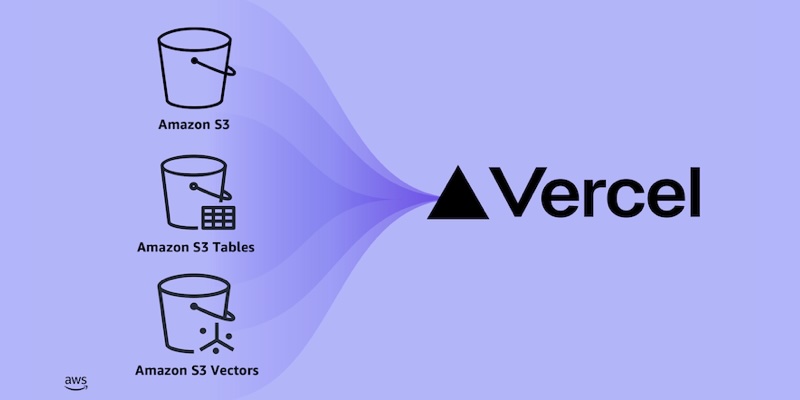
That operational wall has officially fallen. In a landmark integration announced today, Amazon Web Services (AWS) and Vercel have united to introduce native Amazon Simple Storage Service (Amazon S3) capabilities directly into the Vercel Marketplace and v0 by Vercel. This powerful convergence allows developers to provision, configure, and manage enterprise-grade S3 resources—spanning everyday object storage, high-performance analytics via S3 Tables, and specialized vector data stores for artificial intelligence agents—without ever leaving the Vercel ecosystem.
By bridging Vercel’s frictionless provisioning workflows with the industry-standard durability, performance, and scalability of Amazon S3, this release fundamentally reshapes how full-stack and AI-driven web applications are built. Developers can now orchestrate an entire application stack—from relational databases like Amazon Aurora and NoSQL stores like Amazon DynamoDB to vector and open table storage—directly inside Vercel, unified under a single AWS account and a consolidated bill.
Furthermore, the integration eliminates the vulnerabilities of static keys entirely. Leveraging short-lived OpenID Connect (OIDC) tokens exchanged securely via AWS Security Token Service (AWS STS), credentials are dynamically scoped and generated strictly at runtime. Whether building a simple media gallery, a complex Retrieval-Augmented Generation (RAG) AI assistant, or high-throughput clickstream data analytics, developers can now deploy production-ready cloud storage in mere seconds using simple natural language prompts or streamlined dashboard clicks.
Detailed Chronology: The Evolution of Cloud-Native Developer Workflows
To fully understand the significance of this release, one must examine the chronological trajectory of cloud development abstractions over the past decade.
The Era of Siloed Infrastructure
In the early days of cloud computing, infrastructure and application logic were treated as entirely distinct domains. Developers wrote code and subsequently handed it off to operations teams—or donned their "DevOps" hats—to manually provision servers, databases, and storage buckets through sprawling cloud provider consoles. Configuring an object store like Amazon S3 required generating long-lived AWS Identity and Access Management (IAM) access keys, hardcoding or securely injecting them into environment variables, and manually maintaining security boundaries to prevent catastrophic data leaks.
The Rise of Frontend-Centric Deployment Platforms
As platforms like Vercel revolutionized web development through zero-configuration deployments, continuous integration pipelines, and edge computing architectures, the gap between application code and backend infrastructure widened. While frontend developers could deploy globally distributed Next.js applications in seconds, connecting those applications to robust backend resources often meant breaking the flow of development to configure disparate cloud services.
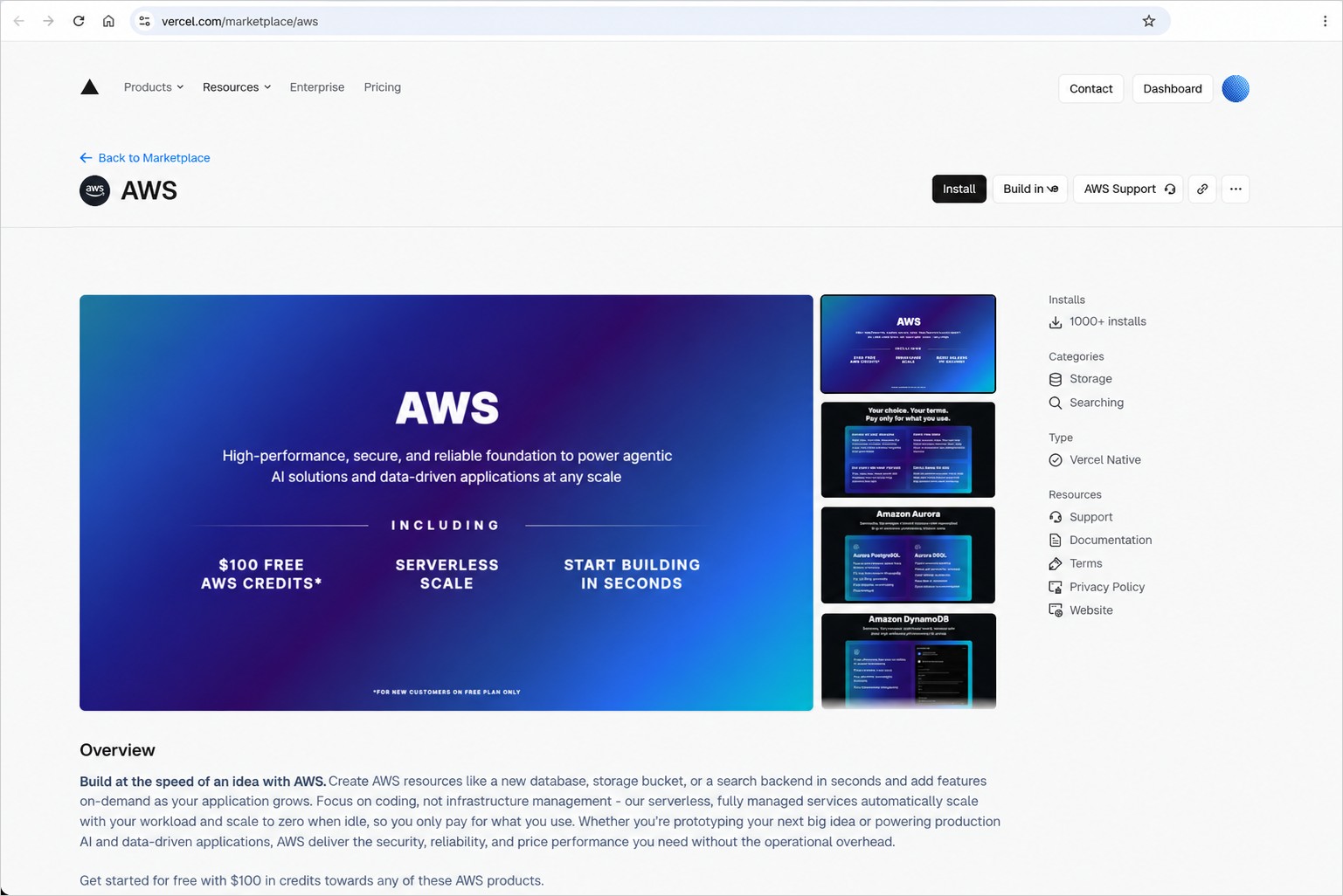
Recognizing this friction, AWS and Vercel began forging deeper architectural bridges. Previous milestones saw the integration of high-performance managed databases into the Vercel ecosystem, including Amazon Aurora, Amazon DynamoDB, and Amazon OpenSearch Serverless. These integrations established a precedent: developers craved the scalability of AWS paired with the deployment speed of Vercel.
The Modern Consolidation: Bringing S3 to Vercel and v0
The missing puzzle piece in this unification was scalable object, analytical, and vector storage. With today’s launch, Amazon S3—alongside its advanced specialized variants, S3 Tables and S3 Vectors—is natively embedded into the Vercel Marketplace and v0, Vercel’s generative UI and application design tool.
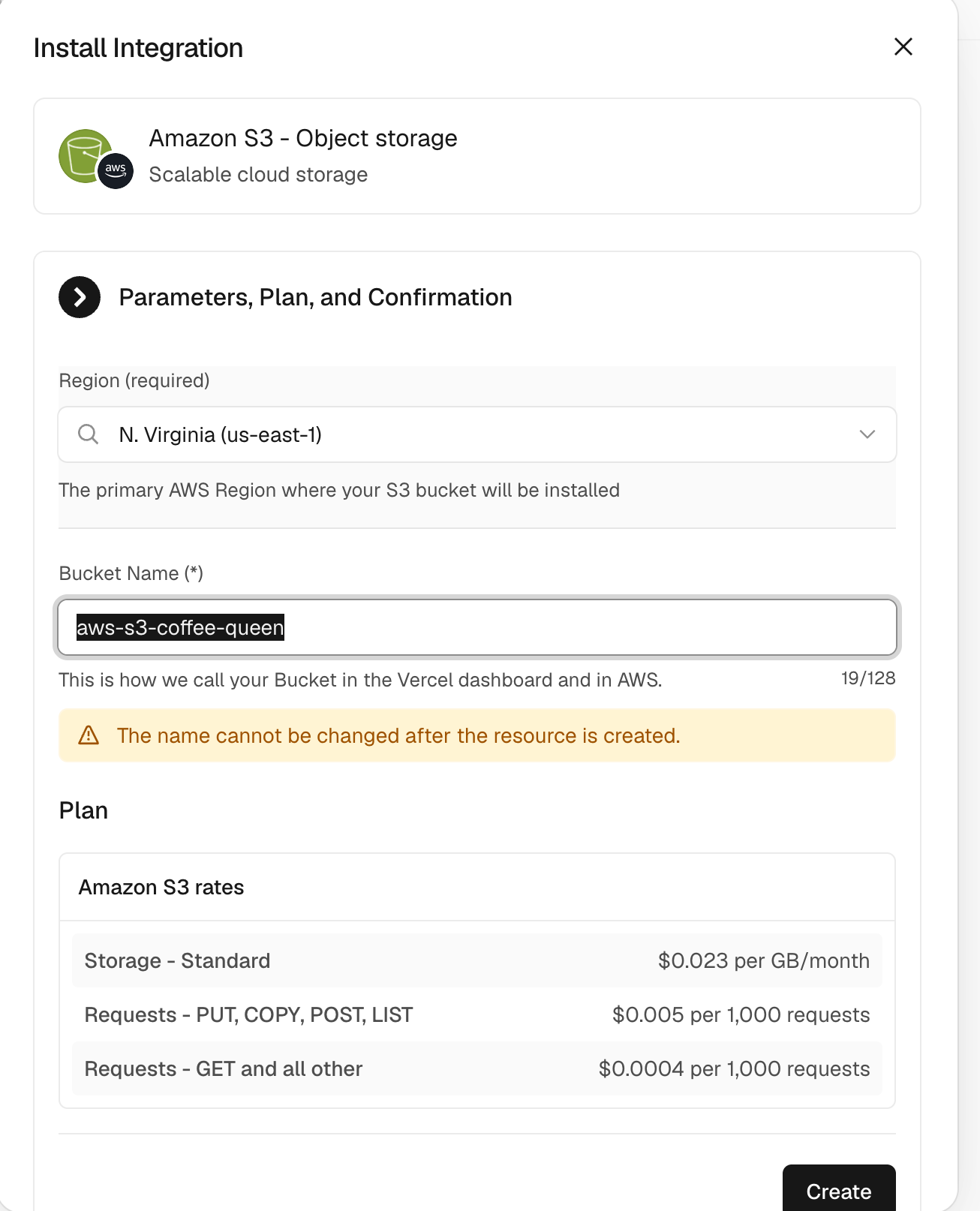
The integration process has been meticulously engineered for simplicity. From the Vercel dashboard, developers navigate to the Storage tab, select AWS, choose their desired bucket type and geographic region, and complete provisioning in seconds. Behind the scenes, the integration securely injects runtime variables such as AWS_REGION, AWS_ROLE_ARN, AWS_RESOURCE_ARN, and bucket identifiers into the project.
Rather than relying on static IAM credentials that risk exposure, runtime authorization is handled natively via Vercel’s OIDC integration (@vercel/functions/oidc). When a function executes, it trades a transient OIDC token with AWS STS for temporary, highly scoped credentials. This architecture represents the gold standard of modern cloud security: ephemeral, least-privilege access baked directly into the developer workflow.
Supporting Context & Metrics: Three Workloads, One Unified Platform
The inclusion of Amazon S3 on Vercel is not merely a generic file-upload utility; it spans three distinct architectural workloads tailored to modern application demands: everyday general-purpose object storage, large-scale analytics, and high-dimensional AI vector search.

1. Everyday General-Purpose Object Storage
For standard web workloads—such as user-generated media, document uploads, and static asset delivery—developers can instantly provision general-purpose S3 buckets. Utilizing the AWS SDK for JavaScript alongside Vercel’s OIDC credential provider, integrating file uploads into a Next.js API route is remarkably concise:
import  S3Client, PutObjectCommand  from "@aws-sdk/client-s3";
import  awsCredentialsProvider  from "@vercel/functions/oidc";

const s3 = new S3Client(
  region: process.env.AWS_REGION,
  credentials: awsCredentialsProvider(
    roleArn: process.env.AWS_ROLE_ARN,
  ),
);

export async function POST(request)
  const formData = await request.formData();
  const file = formData.get("file");

  await s3.send(new PutObjectCommand(
    Bucket: process.env.S3_BUCKET_NAME,
    Key: file.name,
    Body: Buffer.from(await file.arrayBuffer()),
    ContentType: file.type,
  ));

  return Response.json( success: true );
2. Analytics with Amazon S3 Tables
As applications scale, extracting business intelligence from raw data becomes critical. Amazon S3 Tables provide object storage purpose-built for analytics, engineered to automatically optimize query performance as data volumes surge. They offer fully managed Apache Iceberg tables with automated table maintenance and compaction, compatible with any Apache Iceberg REST Catalog-compliant engine.
Developers can now leverage lightweight analytical engines like DuckDB directly inside a Vercel Function. By attaching the S3 table bucket via its Amazon Resource Name (ARN), engineers can execute complex aggregate queries on massive datasets at the edge or within serverless functions:
import  DuckDBInstance  from "@duckdb/node-api";
import  awsCredentialsProvider  from "@vercel/functions/oidc";

const creds = await awsCredentialsProvider(
  roleArn: process.env.AWS_ROLE_ARN,
)();

const db = await DuckDBInstance.create();
const conn = await db.connect();

await conn.run("INSTALL aws; LOAD aws; INSTALL httpfs; LOAD httpfs; INSTALL iceberg; LOAD iceberg;");

await conn.run(`
  CREATE SECRET s3cred (
    TYPE s3,
    KEY_ID '$creds.accessKeyId',
    SECRET '$creds.secretAccessKey',
    SESSION_TOKEN '$creds.sessionToken',
    REGION '$process.env.AWS_REGION'
  );
`);

await conn.run(`
  ATTACH '$process.env.AWS_RESOURCE_ARN' AS s3tables (
    TYPE iceberg,
    ENDPOINT_TYPE s3_tables
  );
`);

const rows = await (await conn.run(`
  SELECT town_city, AVG(median_price) AS avg_price
  FROM s3tables."$process.env.S3_TABLES_NAMESPACE".town_monthly
  GROUP BY town_city
  ORDER BY avg_price DESC
  LIMIT 10
`)).getRowObjects();
3. Vector Search with Amazon S3 Vectors
With the explosive growth of generative AI and Retrieval-Augmented Generation (RAG) architectures, efficient similarity search is non-negotiable. Amazon S3 Vectors delivers purpose-built, cost-optimized vector storage for AI agents, inference workloads, and semantic search directly within S3.
By eliminating the need to manage a separate standalone vector database, S3 Vectors allows developers to store and query high-dimensional embeddings natively. Developers generate embeddings using their preferred machine learning model and query the index for semantic matches with minimal latency:
import  S3VectorsClient, QueryVectorsCommand  from "@aws-sdk/client-s3vectors";
import  awsCredentialsProvider  from "@vercel/functions/oidc";

const vectors = new S3VectorsClient(
  region: process.env.AWS_REGION,
  credentials: awsCredentialsProvider(
    roleArn: process.env.AWS_ROLE_ARN,
  ),
);

export async function POST(request)
  const  embedding  = await request.json();

  const result = await vectors.send(new QueryVectorsCommand(
    vectorBucketName: process.env.S3_VECTOR_BUCKET_NAME,
    indexName: "documents",
    queryVector:  float32: embedding ,
    topK: 5,
    returnMetadata: true,
  ));

  return Response.json( matches: result.vectors );
Generative App Development via v0
Perhaps the most futuristic dimension of this integration is its incorporation into v0 by Vercel. Developers can now utilize natural language prompts to orchestrate full-stack applications with integrated cloud storage. A prompt such as "Build a photo gallery where users upload images using AWS" automatically provisions a general-purpose S3 bucket. Asking for "A support bot that answers questions from my PDFs" instantiates an S3 Vectors bucket, while "An analytics dashboard for my clickstream data" provisions S3 Tables—complete with auto-configured connections and generated production-ready code.
Official Statements & Ecosystem Integration
The strategic alignment between AWS and Vercel reflects a broader industry movement toward developer-centric cloud architectures, where enterprise-grade infrastructure is accessed through high-level abstractions without sacrificing granular control.
Industry analysts and engineering leaders have lauded the integration for bridging the gap between enterprise compliance and developer agility. Because every S3 resource created through Vercel resides directly within the user’s own AWS account, organizations never sacrifice ownership, security posture, or governance. Teams maintain full access to native AWS management tooling, IAM auditing, and cost-allocation tagging, all while enjoying a unified billing structure.
Furthermore, developers have total flexibility regarding account architecture. New AWS accounts created directly through the Vercel integration are greeted with an onboarding incentive of $100 in AWS credits valid for six months, providing an optimal sandbox for prototyping and production testing. Alternatively, enterprises can seamlessly link their existing AWS accounts to leverage their established infrastructure, volume discounts, and enterprise agreements while utilizing Vercel to spin up new, managed S3 buckets on demand.
Future Outlook: The Next Frontier of Serverless and AI Integration
As web applications evolve into deeply contextual, AI-driven ecosystems, the boundary between application code and underlying data infrastructure will continue to dissolve. The partnership between AWS and Vercel points toward an immediate future where infrastructure provisioning is entirely intent-driven.
The inclusion of specialized storage primitives like S3 Tables and S3 Vectors within a frontend-leaning deployment platform signals that serverless architectures are fully equipped to handle heavy analytical and machine learning workloads. Developers no longer need to compromise between the lightning-fast deployment cycles of modern web frameworks and the raw computational and storage muscle of hyper-scale cloud providers.
Looking ahead, we can anticipate deeper automations in data pipeline orchestration, real-time edge caching optimizations, and enhanced agentic workflows where AI tools—assisted by resources like the AWS MCP (Model Context Protocol) Server—can autonomously manage, query, and scale cloud infrastructure based on application traffic patterns.
Getting Started
The integration carries no additional platform fee from Vercel; users pay only standard, usage-based Amazon S3 pricing for the resources consumed. Amazon S3, S3 Tables, and S3 Vectors are available starting today across all commercial AWS regions supported by Vercel.
To begin building your next high-performance web or AI application, visit v0.app or explore the official AWS integration page on the Vercel Marketplace. For troubleshooting, API exploration, and regional availability checks, developers are encouraged to leverage the AWS MCP Server and engage with the community on AWS re:Post for Amazon S3.