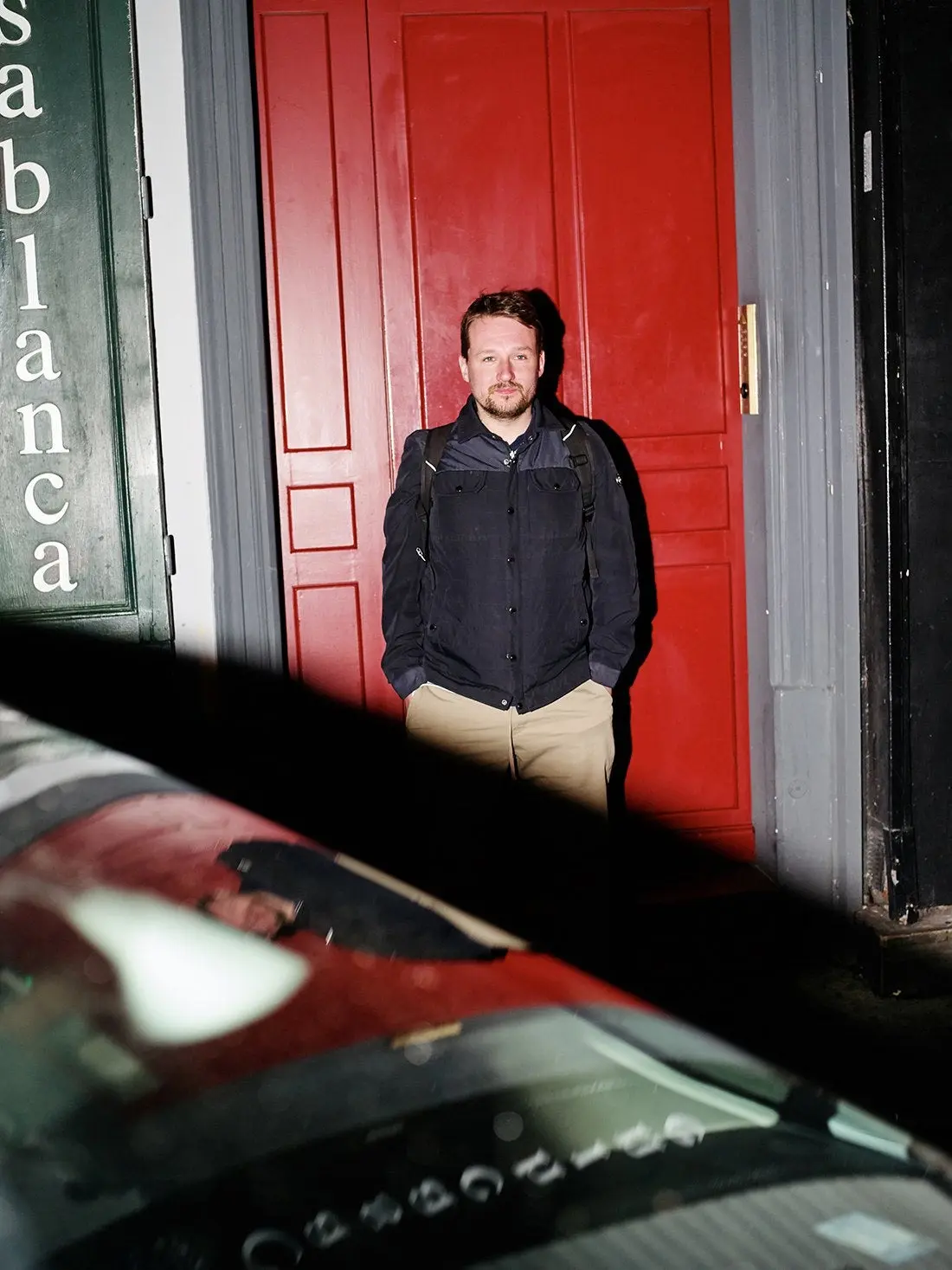
In an era defined by digital fragmentation and declining trust in legacy media, a single smartphone screen has become the window through which millions across the globe experience civic unrest in France. That window belongs to Rémy Buisine, a 32-year-old video journalist for the French digital-native media outlet Brut.
While covering the high-stakes demonstrations against pension reforms spearheaded by President Emmanuel Macron—reforms that sought to raise the minimum retirement age from 62 to 64—Buisine has redefined modern frontline reporting. Operating without traditional studio buffers, Buisine broadcasts raw, unedited, multi-hour livestreams straight into the feeds of millions of digital natives on TikTok, Facebook, and Instagram.
His journey from a rural horticultural graduate managing social media accounts for soccer players to an internationally recognized journalistic phenomenon mirrors the seismic shift in how news is consumed, validated, and weaponized. This report examines Buisine’s pivotal role in chronicling France’s turbulent street politics, the mechanics of his hyper-engaging livestream format, the profound personal and physical toll of his reporting, and the broader implications for the future of journalism in the digital age.
Detailed Chronology: Anatomy of a Frontline Protest
The Build-Up: Blending In on the Boulevard
The afternoon of April 6 began with the quiet hum of anticipation along the Parisian boulevards. By the time I rendezvoused with Buisine, the protest had already been in motion for half an hour. Sharing his live location digital footprint, Buisine was initially indistinguishable from the tens of thousands of demonstrators surrounding him. Eschewing a neon-yellow press armband for the moment, he wore a light navy puffer jacket and blue jeans, blending seamlessly into a crowd estimated anywhere from 57,000 by police to 400,000 by union organizers.
Spotting me first, Buisine flashed a quick smile, shouted my name over the ambient noise of the crowd, and immediately pivoted back to operational mode, dispatching a colleague to capture the rear flanks of the march.
As we walked toward the vanguard of the demonstration, Buisine operated with dual-wielded efficiency. One phone was dedicated to personal comms and immediate logistics, while the other captured the visceral imagery of protest signs for Brut’s Instagram account. Within thirty minutes, six distinct individuals—ranging from peer journalists to frontline volunteer medics—interrupted our walk to exchange greetings or ask when the livestream would go live. "Soon, soon," Buisine replied, maintaining a relentless forward momentum.
Gearing Up for the Frontline
Reaching the Montparnasse station near Brut’s headquarters, Buisine transitioned from civilian observer to embedded correspondent. From his backpack, he extracted hermetically sealed safety goggles and a military-grade gas mask. The goggles found a home in his right outer jacket pocket, while the gas mask looped over his neck, accompanied by a specialized tear gas decontaminant spray secured nearby.
At 3:29 p.m., a concussive blast echoed down the boulevard. The crowd’s immediate reaction was a mix of cheers, jeers, and the rhythmic, heavily accented chant of "ACAB." Near the Vavin metro station, clusters of masked individuals dressed entirely in black—the autonomous bloc noir—loitered with calculated stillness. Just feet away, near the historic Café de la Rotonde, a line of gendarmerie officers stood shoulder-to-shoulder with riot shields elevated.
The Escalation and the Clash
At 3:37 p.m., the gendarmerie delivered a definitive warning shot. The atmosphere shifted instantly; moderate protesters stepped back, while Buisine surged forward, phone raised, capturing the volatile kinetic energy of the scene. Two more warning shots rang out in rapid succession. The black-clad youths materialized on the frontline, one rhythmically striking a metal barricade against the asphalt. Recognizing the protocol agreed upon prior to the march—that I must retreat at the first sign of escalation, lacking proper protective gear and press credentials—I turned back. Behind me, Buisine dropped his bag, pulled out his helmet, and initiated his livestream.
Within sixty seconds, the first tear gas canister tore through the air, bursting into a cascade of sparks against the evening sky. Buisine was already broadcasting.
The Long Night at Place d’Italie
As the evening wore on, the demonstrations devolved into sporadic skirmishes. Buisine documented protesters breaching a building after a resident threw an object from a window, and captured the terrifying moment the awning of the Café de la Rotonde caught fire. Trapped for half an hour inside a battered bank surrounded by police forces, he maintained his composure and his feed.
By nightfall at the Place d’Italie, Buisine was surrounded by the most defiant elements of the crowd, kettled by police forces near the metro entrance. In a surreal display of digital celebrity intersecting with street politics, the trapped protesters began chanting in his honor: "Ah Rémy, allez, allez, allez!"
When the police finally cleared the blockade, the remaining crowd surged down Avenue d’Italie, hastily constructing barricades out of overturned garbage bins and burning wood. Three French deputies appeared, stripped of their official tricolor sashes, and submitted to five-minute interviews with Buisine.
At 10:54 p.m., following a grueling seven-and-a-half-hour shift comprising more than 28,000 steps, Buisine finally terminated his livestream. On TikTok alone, 1.8 million viewers had tuned in to watch the culmination of the day’s events.
Supporting Context & Metrics: The Rise of Brut and the Digital Native
From Rural Roots to Digital Vanguard
Buisine’s path to becoming the preeminent chronicler of French street protests is as unconventional as his medium. Growing up in a working-class village in northeastern France, he lacked familial connections to media elites. Struggling within traditional academic parameters, he graduated from a horticultural technical high school before securing an early gig managing social media accounts for professional soccer players.
Driven by an ambition to report, he relocated to Paris in August 2013, landing a community management role for Parisian radio stations. In 2015, capitalizing on the nascent livestreaming app Periscope, Buisine began broadcasting the contentious El Khomri labor law protests during his off-hours. Lacking formal journalism school training, he learned the craft on the asphalt, calibrating his angles based on audience real-time reactions and querying veteran reporters stationed at the barriers.
His organic traction caught the attention of the founders of Brut, who hired him as an inaugural team member in 2016. Initially met with skepticism by an institutional political class terrified of decentralized, algorithmic platforms, Brut and Buisine have since become unavoidable fixtures of French political life. The apex of this digital integration occurred in 2020, when Buisine conducted a grueling two-and-a-half-hour livestreamed interview with President Emmanuel Macron.
Metrics of Engagement and the Physical Toll
The metrics surrounding Buisine’s coverage highlight a profound generational migration away from traditional television news. During the peak of his livestreams, concurrent viewership routinely breaches 70,000, while channel follower counts spike by millions during periods of intense civil unrest. Over the course of the pension protests, Brut’s TikTok following surged by a million users, solidifying its baseline at 4.2 million.
However, this hyper-engagement is subsidized by immense personal risk. Buisine has been repeatedly targeted, struck by truncheons, and choked by tear gas—hazards that routinely cause his viewership numbers to spike into the hundreds of thousands. Reflecting on the darker side of his career, Buisine notes that the pension protests, while violent, paled in comparison to the grotesque injuries he witnessed during the Gilets Jaunes (Yellow Vests) movement starting in 2018: "hurt people, open skulls, people who’d lost an eye, people next to you whose lives have been upturned because they lost a hand."
His personal life has been entirely subsumed by his vocation. Unmarried, childless, and living alone, Buisine operates on an eternal "on-call" basis, fueled by adrenaline, strong black coffee, and a deep-seated empathy for the working-class grievances he grew up observing.
Official Statements and Institutional Perspectives
The institutional response to Buisine’s reporting underscores the widening chasm between traditional governance structures and digital-first media.
- The Executive Branch: President Emmanuel Macron’s administration has frequently found itself at odds with the decentralized nature of modern protest documentation. While the government maintains that structural pension reforms are vital for the fiscal solvency of the French state, the bypass of a parliamentary vote on March 16 was officially defended as a constitutional prerogative under Article 49.3. However, officials have privately and publicly expressed concern over the velocity at which unmediated footage of police interventions circulates on platforms like TikTok, often bypassing official government messaging.
- Law Enforcement Authorities: Representatives of the gendarmerie and the National Police have defended their tactical deployments, emphasizing that warning shots, tear gas, and kettling tactics are deployed strictly to maintain public order in the face of violent fringe actors (bloc noir) who infiltrate peaceful marches to destroy urban infrastructure.
- Legislative Observers: Opposition politicians, including various deputies who have granted impromptu street interviews to Buisine amidst burning barricades, argue that the government’s refusal to engage in meaningful dialogue has directly precipitated the escalation of street violence, validating the unfiltered documentation provided by independent digital journalists.
Future Outlook: The Paradigm Shift in Journalism
The phenomenon of Rémy Buisine offers a predictive glimpse into the future of global journalism. As legacy media organizations struggle with declining subscription revenues and eroding public trust among younger demographics, the model pioneered by Brut—combining radical transparency, unedited long-form mobile streaming, and direct audience interaction—is establishing a new benchmark.
Several key trends will define this transition over the coming decade:
- The Death of the Gatekeeper: The intermediation of news by institutional editors is rapidly being replaced by direct-to-consumer digital broadcasting. Journalists who can establish immediate, authentic rapport via smartphone lenses will hold more cultural and political sway than traditional broadcast anchors.
- Platform Vulnerability: As reliance on algorithmic platforms like TikTok, Instagram, and Meta ecosystems deepens, the independence of frontline journalists remains tethered to corporate content moderation policies and geopolitical shifts regarding data sovereignty.
- The Sustainability Crisis: Buisine’s lifestyle—operating with zero separation between personal existence and professional duty—highlights the unsustainable physical and psychological demands placed upon frontline digital reporters. The industry must soon address the burnout and trauma metrics associated with unshielded mobile journalism.
As Buisine’s schedule proves—transitioning seamlessly from tear-gassed Parisian boulevards to the wreckage of a collapsed building in Marseille—the demand for real-time, unfiltered human presence in reporting is insatiable. In an era of synthetic media and institutional fatigue, the shaky, tear-stained smartphone screen has become the most powerful truth-telling apparatus of our time.