For six years, the Florida-based enterprise ransomwarehelp.com projected an aura of high-tech salvation. Operating under the guise of an elite cybersecurity firm, it marketed itself as a beacon of hope for businesses paralyzed by digital extortion. The company’s public-facing posture was aggressively anti-extortion, boldly proclaiming, “Do not pay the ransom!” It promised a 99% success rate backed by a team of 80 global experts, proprietary cryptography algorithms, and advanced reverse-engineering techniques capable of restoring locked servers and encrypted databases without ever dealing with the threat actors themselves.
However, behind this sophisticated digital facade lay an egregious scam.
An indictment unsealed in Rhode Island has charged Juan Ricardo Palacio Escobar, the 52-year-old co-founder and chief technology officer of ransomwarehelp.com—who splits time between Miami and Medellín, Colombia—with federal wire fraud. According to federal prosecutors and a meticulously executed FBI sting operation, Palacio and his firm possessed no magical decryption tools. Instead, they engaged in a predatory cycle of deception: they secretly contacted the original ransomware gangs to purchase decryption keys on the victim’s behalf, and then billed their desperate clients exorbitant markups for complex, entirely fictitious "engineering hours" and cryptographic brute-force operations.
Palacio’s indictment is not an isolated incident; it represents a growing and deeply concerning trend within the cybersecurity landscape. Across the globe, unscrupulous entities are capitalizing on the panic of small-to-mid-sized business owners who face catastrophic data loss. The U.S. Department of Justice (DoJ) and federal law enforcement agencies are aggressively cracking down on these fraudulent operators, uncovering a shadow economy where so-called "incident response firms" act as double agents—colluding with cybercriminals to fleece victims while pretending to be their saviors.
Detailed Chronology: Anatomy of a Digital Sting and Deception
The dismantling of ransomwarehelp.com began with rising suspicions from legitimate cybersecurity professionals and culminated in a classic FBI sting operation designed to catch Palacio in the act.
The FBI Sting Operation
Federal investigators set up a sophisticated undercover operation to test the operational integrity of RansomwareHelp. Posing simultaneously as a corporate ransomware victim and as a fictitious cybercriminal extortion gang, federal agents initiated contact.

- The Initial Outreach: Undercover agents, acting as a hacked enterprise, supplied RansomwareHelp with a copy of a phony ransomware note, explicitly stating their reluctance to pay any extortion demands.
- The Front: True to form, RansomwareHelp’s representatives reiterated their strict company policy against negotiating with or paying threat actors, assuring the "victim" that their proprietary algorithms could handle the issue independently.
- The Secret Double-Cross: Almost immediately after receiving the client brief, Palacio contacted the FBI’s fake ransomware group posing as an intermediary. He aggressively negotiated for the lowest possible price to acquire a decryption key. The undercover FBI agents quoted him 0.2 Bitcoin, roughly valued at $13,000 at the time.
- The Markup: Less than 48 hours later, Palacio returned to the undercover agents posing as the victim company. He claimed that a diagnostic assessment had been completed successfully and quoted the firm $13,260 for the decryptor files.
- The Double-Down: The following day, Palacio messaged the FBI’s fake hacker persona once more, haggling the price down further to approximately $6,000 in Bitcoin. Ultimately, Palacio billed the federal undercover "victim" a total of $16,010—incorporating an upfront $2,750 diagnostic fee alongside the inflated decryption charges—while secretly pocketing the difference.
The 2024 Accounting Firm Investigation
Long before the FBI sting, independent security researchers were already uncovering the firm’s deceptive practices. Paul Ihme, co-founder of the security firm Soteria, shed light on a chilling encounter from 2024 involving a small accounting firm whose entire operational database and client records had been locked down by a Lockbit ransomware infection.
Desperate to save their business from total collapse, the accounting firm hired RansomwareHelp. The firm received a breathtaking recovery proposal totaling $438,880. According to the proposal, the exorbitant fee covered:
- "Professional configuration of forensic servers."
- "Expert engineering hours of programming to configure decryption algorithms."
- Eight intensive processing cycles related to the decryption process.
- The utilization of "510 preconfigured forensic servers of the maximum quantitative capacity located in different parts of the world," which would supposedly use brute-force processes to crack the encryption.
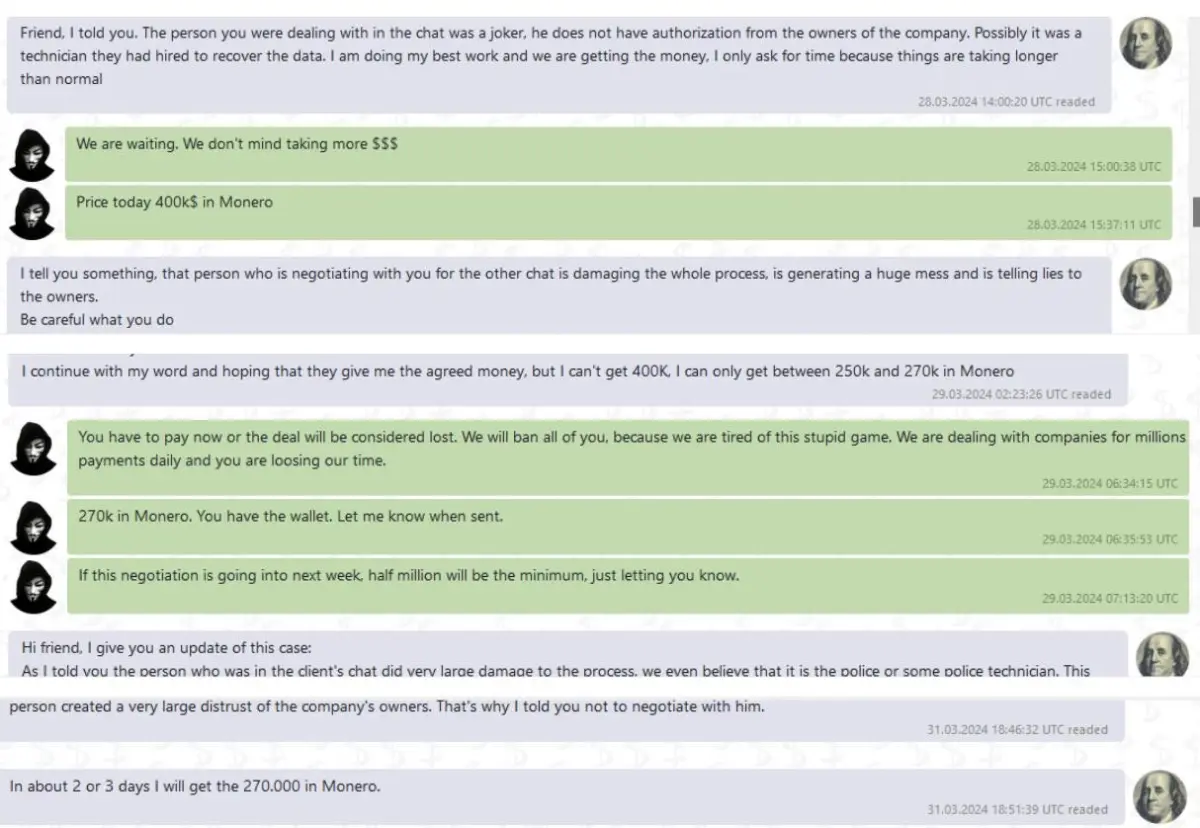
However, when Soteria was brought in to review the network, they uncovered a dark reality. RansomwareHelp had insisted on gaining unrestricted remote access to the victim’s network via AnyDesk remote desktop software, ostensibly to run diagnostics. In reality, Ihme discovered that this remote access was heavily leveraged to delete all copies of the original ransomware notes left on the victim’s machines.
By purging these notes—which contained darknet chat URLs and specific threat actor IDs—RansomwareHelp prevented the victim from communicating directly with the hackers. Had the victim seen
the chat logs, they would have realized that RansomwareHelp was already deep in negotiations with the Lockbit gang behind their backs, attempting to secure a cheap key while demanding the hackers keep the dual negotiation a secret.
When Lockbit grew impatient with RansomwareHelp’s stalling tactics, the gang threatened to increase the ransom by $100,000 for every day of delay. In panicked chats recovered later, RansomwareHelp begged Lockbit not to ruin the scheme:

"I tell you something, that person who is negotiating with you for the other chat is damaging the whole process," RansomwareHelp wrote to Lockbit, desperately trying to freeze out a competing legitimate negotiator hired by the accounting firm.
Ultimately, the accounting firm followed Soteria’s advice, severed ties with RansomwareHelp, and engaged a legitimate remediation firm. They successfully recovered their data by paying roughly half of what RansomwareHelp had attempted to extort from them.
Supporting Context & Metrics: Preying on the Vulnerable
The technical claims made by ransomwarehelp.com and similar fraudulent intermediaries often crumble under even casual scrutiny by experienced engineers.
Patently Farcical Technical Claims
Ihme noted that the technical jargon peppered throughout RansomwareHelp’s client proposals was nonsense designed to intimidate non-technical stakeholders. For instance, the proposal sent to the accounting firm claimed the company could break six distinct types of encryption, yet it listed irrelevant password-hashing algorithms like SHA-256—which are mathematically irreversible one-way functions, rendering them useless for cryptographic data decryption.
"If it were really true these guys could decrypt any ransomware out there, this guy would be a billionaire," Ihme remarked. "They were going after people who don’t have any technical knowledge, are desperate, and don’t have anyone advising them about how any of this stuff works."
The Macroeconomic Scale of Ransomware Deception
The market for ransomware remediation is valued in the billions, creating an environment ripe for opportunistic fraud. Small-to-medium-sized businesses (SMBs) are disproportionately targeted because they lack dedicated internal security operations centers (SOCs) or Chief Information Security Officers (CISOs). When hit with ransomware, SMB executives experience intense psychological panic, often viewing the attack as an existential threat to their enterprise. Fraudulent actors exploit this desperation by hiding behind complex invoices filled with pseudoscientific terminology, ensuring victims feel justified paying hundreds of thousands of dollars for work that consists of nothing more than emailing a cybercriminal on the dark web and forwarding a decryption key.

Official Statements and Crackdown: A Broad DOJ Sweep
The federal indictment of Juan Ricardo Palacio Escobar is part of an aggressive, coordinated crackdown by the U.S. Department of Justice targeting fraudulent actors within the cybersecurity and ransomware remediation sector. Federal regulators are drawing a hard line against intermediaries who exploit the trust of victims.
Recent enforcement actions underscore this systemic crackdown:
- Edward Dubrovsky: In early October, the FBI arrested 54-year-old Edward Dubrovsky, an executive at the Canadian cybersecurity firm Cybersteward, on cyber extortion and conspiracy charges.
- Zohar Pinhasi: Around the same time, the DoJ charged MonsterCloud CEO Zohar Pinhasi, 50, with wire fraud and conspiracy. According to federal charging documents, Pinhasi routinely told corporate clients he was successfully remediating attacks without paying hackers, only to secretly pay ransomware gangs behind his clients’ backs—funneling $8 million to threat actors while billing his customers a staggering $19 million.
- Angelo Martino: In July, Angelo Martino, a 41-year-old ransomware negotiator based in Land O’Lakes, Florida, was sentenced to 70 months in prison. Martino conspired directly with the notorious Blackcat/ALPHV ransomware group, leaking confidential client negotiation strategies to the hackers to help them maximize their extortion payouts.
These high-profile prosecutions signal a definitive shift in law enforcement strategy: the long arm of the law is no longer reaching only for the threat actors hiding behind darknet leak sites, but is actively dismantling the corrupt corporate enablers and fraudulent remediation firms operating in plain sight.
Future Outlook: Restoring Trust in Incident Response
The unmasking of ransomwarehelp.com and the concurrent prosecutions of executives at firms like MonsterCloud and Cybersteward expose a severe vulnerability in the incident response ecosystem. When companies seeking trusted guidance find themselves swindled by double-crossing intermediaries, the entire cybersecurity industry suffers a crisis of confidence.
As federal agencies continue to leverage sting operations and undercover cyber-operations to unmask dishonest providers, the industry is moving toward stricter accountability and transparency. Moving forward, regulatory bodies and professional cybersecurity associations are expected to push for tighter credentialing, mandatory disclosures of negotiation mechanics, and harsher criminal penalties for service providers who collude with threat actors.
For business leaders and organizations navigating the chaotic aftermath of a ransomware attack, the lesson of ransomwarehelp.com is stark: verify credentials carefully, demand transparency in remediation proposals, and remain deeply skeptical of any firm claiming to possess secret, proprietary algorithms capable of bypassing modern encryption without engaging the threat actors directly. In the high-stakes world of digital extortion, the greatest threat to a business may not always be the hacker at the digital gate, but the supposed savior standing right beside them.