Executive Overview
In a decision with broad implications for the artificial intelligence industry and environmental regulation, a federal judge has denied a motion by xAI to dismiss a high-stakes lawsuit accusing the Elon Musk-founded company of operating massive, unpermitted gas turbines to power its "Colossus" supercomputer facility near Memphis.
The ruling, delivered by U.S. District Judge Debra M. Brown, deals a major legal setback to xAI. The lawsuit—filed by the Southern Environmental Law Center (SELC) on behalf of the NAACP—alleges that xAI installed and operated at least 35 industrial combustion turbines producing upwards of 400 megawatts (MW) of electricity without obtaining mandatory preconstruction or operating air permits under the federal Clean Air Act.
xAI had sought to derail the litigation by advancing several legal theories: claiming that the gas turbines qualified as exempt "mobile sources," asserting that environmental plaintiffs lacked constitutional standing, and arguing that citizen enforcement provisions under the Clean Air Act violate Article II of the U.S. Constitution. Judge Brown rejected all three arguments, ruling that the plaintiffs hold statutory standing, the turbines are stationary sources governed by regional air control plans, and citizen suits do not encroach upon executive branch authority.
The ruling comes amid mounting public, regulatory, and political scrutiny surrounding the immense energy footprint of artificial intelligence infrastructure. As tech giants scramble to build gigawatt-scale data centers across the United States, the legal battle over xAI’s Memphis facility underscores growing friction between rapid AI expansion, public health, and federal environmental compliance.
Detailed Chronology
[June 2024] ─── xAI rapidly installs 35+ gas turbines for Colossus power demand
      │
[Mid-2024]  ─── Local communities raise air pollution concerns in South Memphis
      │
[Late 2024] ─── NAACP & SELC file Clean Air Act suit over unpermitted gas turbines
      │
[Early 2025]─── xAI files Motion to Dismiss (citing mobile exemption & Article II)
      │
[Oct 2025]  ─── DOJ motion attempting to limit community standing is rejected
      │
[Oct 2026]  ─── Judge Debra M. Brown denies xAI's dismissal motion; trial proceeds
The Rapid Construction of Colossus
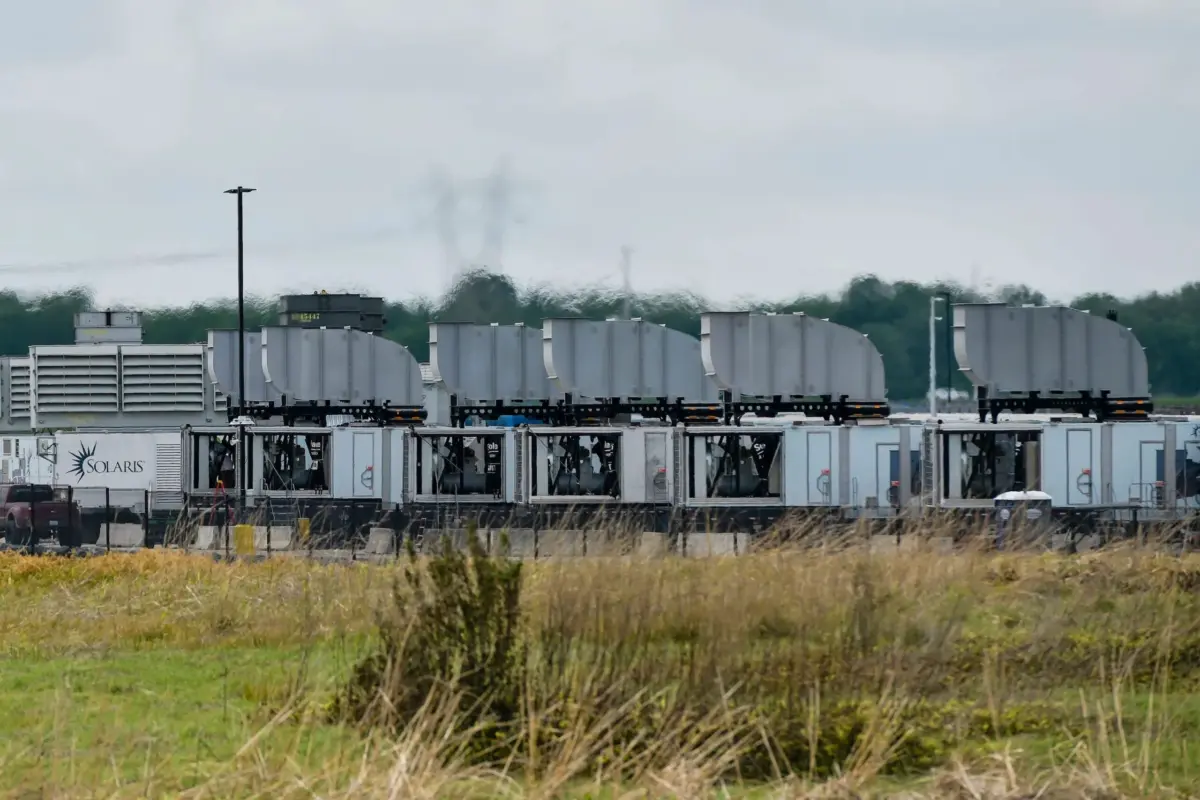
The origins of the legal dispute trace back to the summer of 2024, when xAI launched an aggressive push to assemble its flagship "Colossus" supercomputer cluster outside Memphis, Tennessee. Designed to train next-generation large language models, the data center required immediate, massive electric power—exceeding the capacity that local electric utilities could supply on short notice. To bridge the gap, xAI deployed dozens of natural-gas-fired combustion turbines directly at the site.
Community Backlash and Legal Filing
By late 2024, community groups and environmental advocates noticed significant industrial emissions emanating from the facility. The SELC, acting on behalf of the NAACP, initiated legal action under the Clean Air Act’s citizen suit provision. The complaint charged xAI with operating an unpermitted major stationary source of air pollution, bypassing standard public notice, environmental impact assessments, and mandatory preconstruction permits required by federal and state regulations.
Motions to Dismiss and Federal Intervention
In response to the lawsuit, xAI filed a motion to dismiss, arguing that its containerized, temporary gas turbines were exempt from stationary source rules because they were technically mobile power units. Furthermore, xAI challenged the constitutional validity of the Clean Air Act’s citizen suit provision, alleging it impermissibly delegated executive power to private entities. Concurrently, the U.S. Department of Justice (DOJ) pursued legal arguments aimed at restricting the scope of citizen standing—an effort that federal courts rejected.
The October Decision
In late October, Judge Debra M. Brown formally denied xAI’s motion to dismiss in full. The ruling affirmed the legal standing of impacted community members, classified the gas turbines as stationary pollution sources subject to permitting laws, and upheld the constitutional validity of citizen-led environmental enforcement.
Supporting Context & Metrics
The Environmental and Energy Footprint of Colossus
The power footprint of xAI’s Memphis installation highlights the operational demands of modern AI supercomputing. The facility relies on an array of high-efficiency graphics processing units (GPUs) that require constant, uninterrupted power.
| Metric / Parameter | Value / Impact | Regulatory Context |
|---|---|---|
| Estimated Turbine Capacity | >400 Megawatts (MW) | Equivalent to powering hundreds of thousands of homes |
| Turbine Units Deployed | At least 35 industrial combustion units | Operated off-grid to bypass local utility delays |
| Key Air Pollutants | Nitrogen Oxides ($textNO_x$), VOCs, Particulates | Key precursors to smog and severe respiratory issues |
| Primary Regulatory Mechanism | Clean Air Act (Title V & New Source Review) | Mandates preconstruction pollution control technology |
| Regional SIP Context | Mississippi / Tennessee Implementation Plans | Defines stationary vs. mobile emission source criteria |
Local Air Quality and Environmental Justice Considerations
The deployment of over 400 MW of unpermitted gas generation carries significant implications for regional air sheds. Gas-fired combustion turbines emit substantial volumes of nitrogen oxides ($textNO_x$) and volatile organic compounds (VOCs), which react in sunlight to form ground-level ozone (smog). The area surrounding South Memphis already faces cumulative industrial pollution loads. Environmental justice organizations contend that bypassing standard preconstruction permits deprived local residents of mandatory air quality modeling, emissions control technology mandates (such as Best Available Control Technology, or BACT), and formal public comment periods.
       [Unpermitted Gas Turbines]
                  │
     Emits NOx + VOCs into air shed
                  │
   Sunlight Reaction ──> Ground-Level Ozone (Smog)
                  │
    [Elevated Respiratory & Health Risks]
                  │
   [Impacts Overburdened South Memphis Communities]
Deconstructing the "Mobile Source" Legal Argument
A central pillar of xAI’s defense was the claim that its containerized gas turbines constituted "mobile sources" rather than "stationary sources." Under the Clean Air Act, mobile sources—such as automobiles, locomotives, and portable machinery—are regulated under distinct legal frameworks that differ from stationary industrial facilities like power plants.
Judge Brown scrutinized this classification under Mississippi’s State Implementation Plan (SIP). The court determined that arraying dozens of heavy industrial turbines at a single location for extended periods to continuously energize a fixed infrastructure complex disqualifies the equipment from mobile exemption status. The ruling establishes an explicit judicial precedent: corporate entities cannot avoid stationary source permitting simply by mounting large-scale industrial generators on semi-portable skids or containers.
Official Statements & Legal Arguments
The Constitutional Ruling on Citizen Suits
In her written decision, Judge Debra M. Brown addressed xAI’s challenge to the constitutionality of citizen-led enforcement actions under Article II of the U.S. Constitution (the "Take Care Clause") and the private nondelegation doctrine.
"Because the plaintiffs have statutory standing under the Clean Air Act, because the combustion turbines are not ‘mobile sources’ under Mississippi’s [State Implementation Plan], and because the citizen suit provision does not violate Article II of the Constitution or the private nondelegation doctrine, the plaintiffs’ claims will proceed," Judge Brown wrote.
Addressing xAI’s argument that private citizen suits unconstitutionally usurp federal executive authority, Judge Brown clarified the distinct legal boundary:
"Because citizen suit plaintiffs sue on their own behalf, in their own name, and seek penalties that redress harm to themselves, they are not exercising the federal government’s executive power."
Civil Rights and Environmental Advocates React
The decision was praised by civil rights leaders and environmental attorneys who view the case as a crucial test for corporate compliance in the AI era.
"The courts have repeatedly rejected attempts by xAI and the DOJ to dismiss the NAACP’s Clean Air Act case, affirming our right to pursue justice for communities impacted by pollution," said Abre’ Connor, Director of Environmental and Climate Justice at the NAACP. "Our position has been clear: xAI cannot operate gas turbines without the required permits."
Representatives for xAI and its affiliate, SpaceX, did not immediately issue a public response following the release of the judicial opinion.
Industry Backlash & Future Outlook
The legal challenges confronting xAI reflect a broader, nation-wide public and regulatory reaction against the rapid expansion of data centers. The surge in generative AI applications has driven unprecedented demand for electrical power, overwhelming localized grids and driving hyper-scalers toward fossil-fuel-based self-generation.
      Accelerated AI Model Training
                  │
      Explosive Power Demand (GW Scale)
                  │
 ┌────────────────┴────────────────┐
 │                                 │
Off-Grid Gas Turbines      Grid Over-Allocation
 (e.g., xAI Memphis)        & Cost Shifting
 │                                 │
 └────────────────┬────────────────┘
                  │
       Public & Legal Backlash
                  │
 ┌────────────────┼────────────────┐
 │                                 │
State Moratoria   Banning Tech NDAs   Midterm Election
(e.g., NY State)   (Amazon/MSFT)       Political Risk
Policy Moratoria and Legislative Fallout
The controversy around the Colossus facility coincides with a wave of legislative interventions designed to curb unmitigated data center growth:
- State-Level Moratoria: New York State recently enacted a comprehensive moratorium on the construction of new data centers, pausing development until comprehensive studies evaluate the long-term impacts on grid stability, electricity rates, and state decarbonization goals.
- Prohibitions on Non-Disclosure Agreements: Public outrage over secret municipal deals led major cloud providers—including Amazon Web Services and Microsoft—to announce policies renouncing the use of NDAs in their negotiations with local utility commissions and economic development authorities.
- Electoral Significance: The intersection of grid reliability, air quality, and tech infrastructure has emerged as a major issue in localized legislative contests and federal elections, as voters push back against rising utility bills and localized industrial pollution.
Regulatory Implications for the AI Sector
As the NAACP’s lawsuit against xAI proceeds toward discovery and potential trial, the legal outcome could establish a legal baseline for the entire technology industry. Hyper-scalers seeking to deploy rapid, off-grid natural gas generation to power next-generation computing clusters will face strict regulatory enforcement under federal air quality standards. The federal court’s rejection of the "mobile source" loophole ensures that AI infrastructure projects—regardless of their construction speed or technological scope—remain subject to public environmental oversight and full statutory compliance.