Executive Overview
Federal law enforcement agencies in the United States and Europe are rapidly unraveling the operational infrastructure of ShinyHunters, a notorious cybercriminal syndicate responsible for high-profile data breaches and tens of millions of dollars in extortion demands. Investigators probing the group’s brazen September 2026 compromise of the Federal Bureau of Investigation’s recruitment portal, fbijobs.gov, have expanded their focus beyond traditional threat actors.
According to sources close to the investigation, federal authorities have identified executives at two separate ransomware negotiation and cybersecurity firms who maintained suspiciously close relationships with the extortion collective. Shockingly, evidence recovered from encrypted communications suggests that at least one U.S.-based executive actively assisted ShinyHunters in operating a victim-shaming portal designed to pressure organizations into meeting ransom demands.
The ongoing federal crackdown marks a significant turning point in the global fight against cyber extortion. For years, the boundary separating legitimate incident response firms, ransomware negotiators, and the cybercriminals themselves has occasionally blurred. However, the recent arrests of prominent figures—including Canadian cybersecurity executive Edward Dubrovsky and the detention of alleged ShinyHunters administrator "Rey" in Jordan—expose a darker reality: that certain trusted intermediaries may be crossing the line from remediation to active conspiracy.
Detailed Chronology of an Investigation
The Evolution of ShinyHunters and the FBI Breach
Since emerging around 2019, hackers aligned with the ShinyHunters brand have claimed responsibility for dozens of massive corporate and institutional data breaches. While the syndicate was initially operated primarily by individuals based in France, law enforcement attrition gradually decimated the original core. Control eventually passed to a teenage hacker from Amman, Jordan, known online as "Rey." According to FBI estimates, ShinyHunters has successfully extorted upwards of $70 million from victims globally in 2026 alone.
The group’s campaign reached an unprecedented level of audacity in late September 2026, when they breached fbijobs.gov. The hackers taunted federal law enforcement by threatening to publish sensitive internal files, including applicants’ Social Security numbers, home addresses, specialized unit details, and private medical and psychological records.

The attack on the FBI’s infrastructure triggered an immediate, high-priority response. On October 3, 2026, Reuters reported that "Rey" had been detained by Jordanian authorities and was actively cooperating with federal investigators.
The Netherlands Raids and the Signal Leaks
Rey’s ascension to administrative control had been facilitated by a sudden vacuum at the top. On the evening of September 15, 2026, Dutch law enforcement executed a dramatic raid involving flash-bang grenades to apprehend convicted hacker and ShinyHunters suspect Pepijn van der Stap.
Police successfully seized Van der Stap while he was actively logged into his Signal messaging account. This tactical win allowed investigators to harvest a goldmine of recent communications with frequent contacts, including ransomware negotiators stationed in Canada and the United States.
Sources indicate that Van der Stap’s decrypted Signal messages served as the foundational blueprint for unraveling a broader web of corruption. Notably, Dutch outlet RTL reported that the chat logs contained indicators pointing to a thwarted murder-for-hire plot allegedly ordered by Van der Stap against overseas targets, though those orders were never executed.
Arrest of Edward Dubrovsky
Building upon the digital evidence recovered from Van der Stap’s device, the FBI executed an arrest on October 9, 2026, taking 54-year-old Canadian cybersecurity executive Edward Dubrovsky into custody. Dubrovsky, who had recently published a book on navigating cyber extortion that advocated for always engaging with hackers, was formally charged in U.S. federal court with threatening to disclose hacked data and interfering with interstate commerce through extortion.

Prosecutors subsequently requested that Dubrovsky remain in custody pending trial, with court records placed under seal. According to investigative sources, Dubrovsky’s chats with Van der Stap revealed that the Canadian executive possessed advanced knowledge of the ShinyHunters breach targeting FBI servers—yet failed to notify the bureau before the syndicate publicly threatened the agency. Furthermore, records showed Dubrovsky and an executive at a major U.S. consulting firm routinely received internal details regarding fresh ShinyHunters victims before the victim organizations themselves were even aware of the compromises.
Supporting Context & Metrics: The "Shinywire" Infrastructure
Federal investigators believe that the operational depth of these rogue intermediaries extended far beyond mere information sharing. Sources close to the probe point to "shinywire[.]com," a now-defunct extortion website that operated from May 3, 2026, until October 16, as a prime example of insider collusion.
Inside Shinywire
The Shinywire portal hosted entries for nearly 100 organizations compromised by ShinyHunters. Each targeted profile featured samples of stolen data and urged corporate executives to negotiate payment terms, warning that non-compliance within a strict seven-day window would trigger the complete public release of confidential files on the group’s Tor-based leak site.
Prominent victims listed on Shinywire included American medical technology giant Intuitive Surgical, which suffered a credential compromise via targeted phishing in March 2026. Investigators have gathered evidence suggesting that at least one executive at a prestigious U.S.-based consulting firm—employing over 1,000 associates—played a direct, active role in managing and operating the Shinywire platform. Because formal charges have not yet been filed against this specific individual or firm, their identities remain withheld.
The Corporate Fallout: Cypfer, CyberSteward, and "Ghostbyte"
The legal and professional fallout has severely impacted prominent players in the incident response industry. Prior to his arrest, Dubrovsky was embroiled in a bitter legal dispute in Ontario against Daniel Tobok, the former chief executive of Cypfer, a global cybersecurity firm with offices spanning North America, Europe, the Middle East. Dubrovsky had filed a lawsuit accusing Tobok of freezing him out of business decisions following a falling out, while Tobok filed a counter-claim alleging unfair competition through another venture, CyberSteward Inc.

Adding a bizarre historical layer to the saga, former colleagues of Tobok revealed that he was known among early ransomware actors nearly a decade ago by the handle "Ghostbyte." In 2018, a Canadian victim of the Russian-language Dharma ransomware affiliate program was instructed by extortionists to contact an IT professional for payment guarantees, pointing them to the email address [email protected]. Digital intelligence firm Constella Intelligence later linked an email address frequently used by Tobok ([email protected]) to online accounts utilizing the username "ghostbyte," including a Snapchat profile. Constella also traced the Dharma representative’s wallet to transactions totaling 43 Bitcoin (valued at approximately $3.5 million today).
Official Statements and Industry Metrics
Corporate Responses
In official statements, representatives for Cypfer distanced themselves from the legal turmoil surrounding Dubrovsky and historical allegations. Cypfer maintained that it possesses no business model involving ransomware payments, had no prior knowledge of Dubrovsky’s arrest, and has not been targeted by law enforcement. The firm noted it was recently acquired by Apros Group, a holding company led by former FBI special agent Jason Hogg.
The Economics of Extortion and Conflicts of Interest
The intersection of ransomware negotiation and corporate incident response has long been scrutinized for structural conflicts of interest. Mark Camillo, CEO of CyberAcuView, an industry group founded by major cyber insurers, highlighted the inherent dangers of fee structures tied directly to the size of ransom payments. While some firms operate on flat retainers, others charge a percentage of the final transaction.
"It has come to the industry’s attention that many of the ransomware payers charge a percentage of the final payment which may or may not be disclosed," Camillo explained. "This makes no sense if they are also the negotiator. There needs to be more transparency in the process as no one in the ecosystem should be profiting purely on the size of the ransomware transaction or payment itself."
Regulatory and Legal Enforcement Actions
Federal authorities are aggressively clamping down on unethical and illegal mediation practices. On October 7, 2026, the U.S. Department of Justice charged MonsterCloud CEO Zohar Pinhasi with wire fraud and conspiracy. Prosecutors allege Pinhasi charged corporate clients $19 million for ransomware remediation while secretly paying hackers only $8 million behind the clients’ backs.

Similarly, in July 2026, Florida ransomware negotiator Angelo Martino was sentenced to 70 months in prison for conspiring with the BlackCat/ALPHV ransomware gang to provide confidential client negotiation strategies, thereby maximizing extortion payouts.
Future Outlook
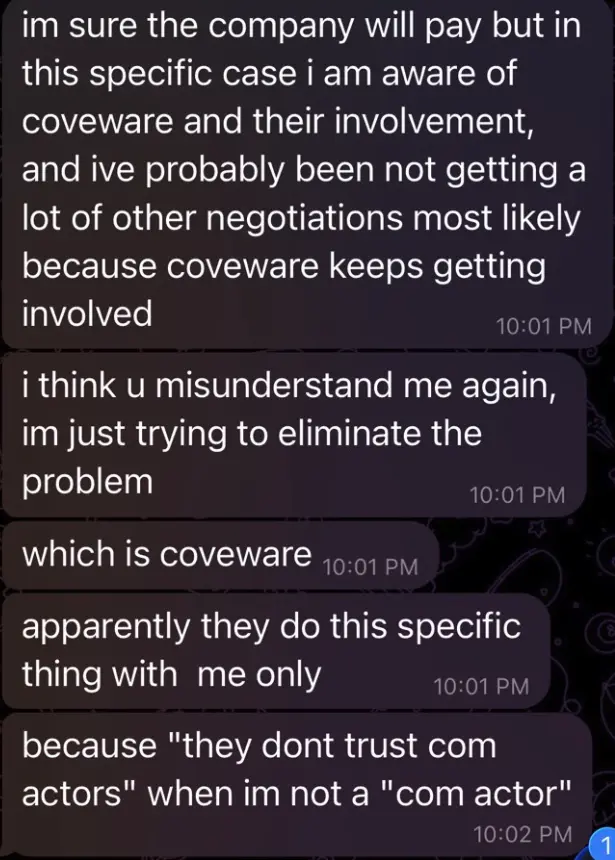
The infiltration of ransomware negotiation networks by federal investigators marks a watershed moment in cybersecurity enforcement. For years, criminal syndicates like ShinyHunters viewed security intermediaries as useful vectors for monetization. However, internal Telegram logs recovered from ShinyHunters channels reveal growing frustration among hackers—notably directed at firms like Coveware and Unit 221B, which consistently advise corporate victims against paying ransoms. In May 2026 chats, ShinyHunters leadership lamented that Coveware’s public guidance was severely undermining their collection rates, going so far as to discuss ways to "eliminate the problem."
As the Justice Department expands its investigations into corrupted consulting executives and fraudulent negotiators, the cyber insurance and incident response industries face an existential reckoning. The traditional playbook of silent payouts and behind-the-scenes brokering is rapidly giving way to heightened regulatory scrutiny, public accountability, and aggressive federal prosecution. Moving forward, structural transparency, mandatory disclosure of negotiation fees, and a zero-tolerance policy for insider collusion will be essential to restoring trust in the global cybersecurity ecosystem.