Executive Overview
In an era dominated by hyper-optimized athletic regimens, grueling pre-dawn wake-up calls, and the relentless pursuit of peak performance at all costs, the prevailing narrative surrounding endurance sports can feel profoundly intimidating. For decades, the cultural archetype of the marathon runner has been rigidly defined: an ultra-disciplined individual sacrificing comfort, sleep, and social life for splits, cadence, and mileage.
Yet, a quiet revolution is taking place on the asphalt, dirt paths, and running tracks of Europe’s metropolitan hubs. It is a movement championed by everyday athletes who refuse to let training consume their entire existence. Enter Hong, a Berlin-based graphic designer, international flight attendant, and accidental endurance athlete currently preparing for her seventh marathon.
Hong’s journey shatters the traditional paradigm of distance running. Once firmly self-identified as a "non-runner," she has systematically transformed her relationship with physical endurance not through self-flagellation or militaristic discipline, but through a deeply personalized philosophy centered on absolute comfort, psychological well-being, and community integration. Balancing an erratic aviation schedule, creative professional demands, and a vibrant social life, Hong’s weekly routine serves as a fascinating case study in modern athletic sustainability.
This in-depth feature explores Hong’s meticulously balanced seven-day training blueprint, examining how she merges high-intensity track workouts, cross-training, and rigorous physiotherapy with spontaneous singing, canine pacing partners, art gallery visits, and post-run dumpling brunches. By investigating her holistic methodology, we uncover a broader cultural shift in endurance sports—one where consistency and comfort are no longer viewed as mutually exclusive, but rather as symbiotic pillars of long-term athletic success.
Detailed Chronology: Anatomy of a Balanced Training Week
To truly understand how Hong manages to train for demanding 42.195-kilometer races while maintaining a demanding dual-career lifestyle, one must examine her schedule day by day. Her routine is not a rigid cage, but a flexible framework designed to protect her mental energy while steadily building physiological resilience.
Monday: Combating Fatigue with Rhythms and Canines
As the global workweek begins, Hong faces her first major hurdle: transitioning from the logistical demands of her career as a flight attendant and the creative focus of a designer into an active mindset. Mondays often test her baseline motivation.
"I’m definitely someone who loves hitting the snooze button and is entirely non-functional before my morning coffee," Hong notes. To combat the Monday lethargy, she relies heavily on curated auditory stimulation. Her running playlist—a dynamic mix of disco, house, and techno—acts as an immediate neurological catalyst, pulling her out of sluggishness and establishing the cadence for her stride.
Monday runs are also characterized by strategic psychological hacks. When physical fatigue sets in mid-run and cardiovascular pressure mounts, Hong employs an unconventional yet remarkably effective tactic: she starts singing.
"If I run out of breath, I shift down a gear and start singing," she explains. "It forces me to slow down and get my breathing back under control. It instantly makes the run more enjoyable, and I always notice people cracking a smile as I jog past them singing."
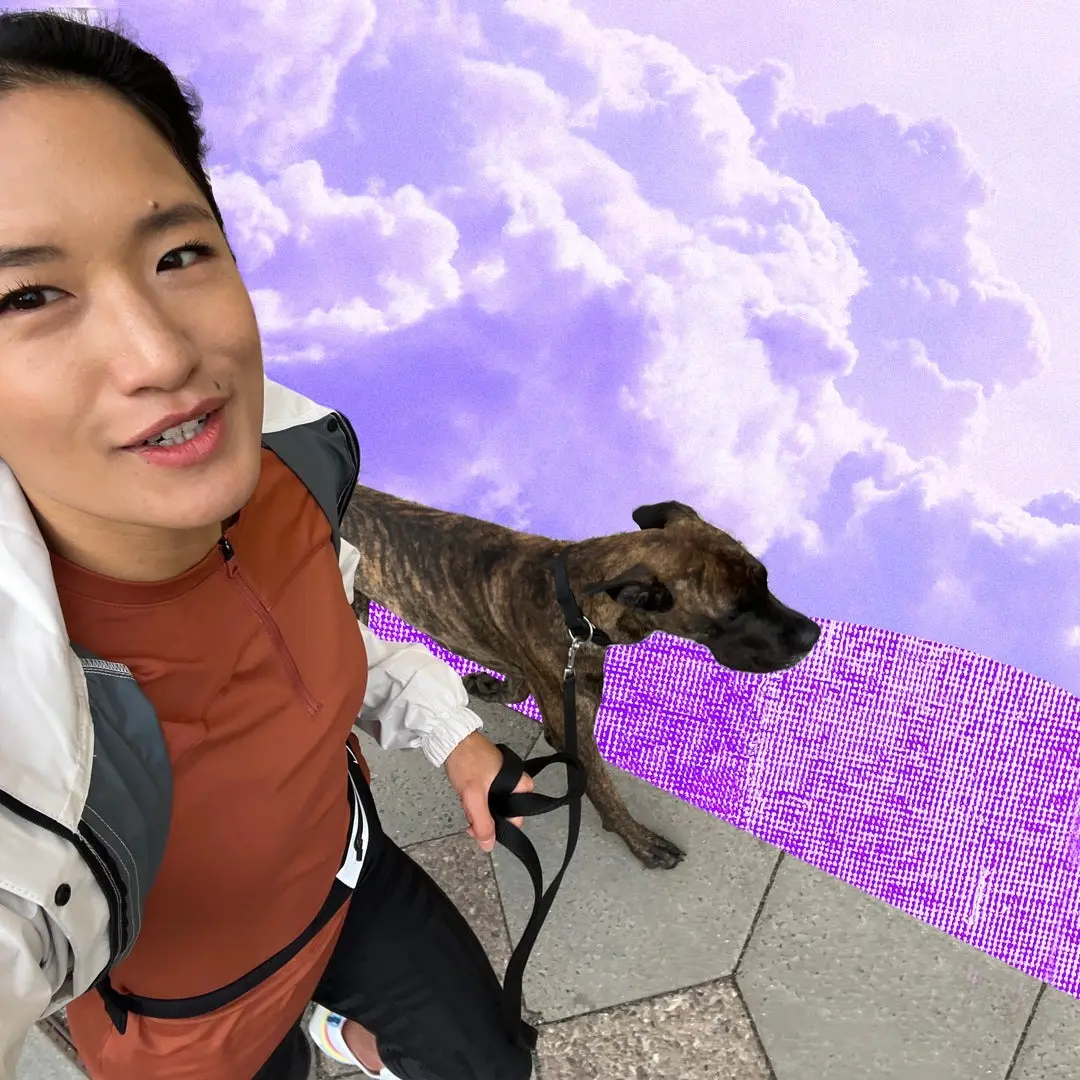
To inject an element of unpredictable play into her mileage, Monday’s session frequently incorporates canine companionship. By borrowing a friend’s energetic dog, Mia, Hong transforms a solitary training loop into an interactive dynamic. "Mia has so much energy, and it’s so fun to race her. At the beginning, she pulls me; at the end, I pull her. I might not be as fast as her over a sprint, but when it comes to endurance, I win."
Tuesday: The Foundation of Longevity—Cross-Training and Mobility
True marathon preparation extends far beyond logging miles on the pavement. On Tuesdays, Hong deliberately steps away from running to focus on structural integrity. Her regimen includes dedicated yoga sessions, targeted strength training designed to bulletproof her joints against repetitive impact injury, and regular physiotherapy appointments.
This holistic approach is the linchpin of her training philosophy. By building a robust, injury-resistant musculoskeletal foundation, Hong ensures that when she does push her boundaries during runs, her body can absorb the shock without breaking down.
Furthermore, this multi-disciplinary approach prevents the debilitating physical exhaustion that plagues many amateur runners. By integrating structured rest and active recovery into her weekly architecture, Hong ensures that a grueling workout does not result in a week-long physical deficit. Instead, she wakes up the following morning primed and ready for the next phase of her cycle.
Wednesday: Professional Realities and Cultural Respite
As a long-haul flight attendant, Hong’s geographical location is in a state of perpetual flux. When she touches down in her home base of Berlin, her social calendar immediately fills up with friends, family, and cultural explorations.
Wednesday serves as a deliberate mental and physical buffer. Rather than forcing a high-intensity cardiovascular session into a day already brimming with social obligations, Hong embraces restorative downtime. She frequently trades running shoes for gallery sneakers, immersing herself in Berlin’s thriving contemporary art scene. This psychological disengagement from performance metrics is crucial; it prevents burnout and ensures that running remains a passionate outlet rather than an oppressive second job.
Thursday: Pushing Limits with the Right Equipment
If Monday and Wednesday are about rhythm and recovery, Thursday is where the crucible of marathon preparation takes center stage. Thursday is track day—a high-intensity session designed to test velocity thresholds, lactate tolerance, and pacing discipline.
"Some people think marathon runners bounce out of bed at 5:00 AM and effortlessly run 20 kilometers," Hong observes. "In reality, I need an extra dose of motivation sometimes, too."
On days when she pushes her physical limits, equipment plays a pivotal role in her psychological safety net. During these high-stress track workouts, Hong relies on the Nike Invincible 3. Engineered for maximum cushioning and energy return, the shoe provides a secure, highly responsive platform across various track surfaces. The "bouncy" sole mitigates the high-impact stress of fast intervals, allowing her to lean into her competitive drive without fearing joint overload.
Friday: Active Recovery and Social Integration
Following the intense physiological demands of Thursday’s track workout, Friday is designated as a low-impact recovery day. Aside from a gentle, restorative yoga flow, Hong avoids high-intensity movement.
Instead, she pours her energy back into her social fabric. Reconnecting with friends over coffee or visiting local exhibitions allows her to savor her time in Berlin before her next flight roster pulls her away. This constant negotiation between athletic ambition and lifestyle integration defines her unique approach to endurance sports.
Saturday: The Meditative Standard Route along the Landwehrkanal
Weekends in Berlin offer space for longer, more contemplative efforts. Saturday’s run is a staple of Hong’s routine: a scenic, varied-terrain route along the historic Landwehrkanal.
The path presents a changing tactile landscape—transitioning from smooth asphalt to soft grass and occasional patches of mud. This textural variety engages stabilizing muscles while providing a deeply therapeutic mental escape.
"I’ll have an engaging podcast playing in my ears so I can completely mentally switch off," she describes. "Sometimes, I don’t listen to anything at all and just take in the city’s ambient sounds. I love watching the people around me as I run."
True to her philosophy that the post-run experience is just as important as the miles logged, Saturday’s session concludes with a deliberate ritual: a specialized coffee and a light snack from a local market stall in Kreuzberg.
Sunday: Community Synergy and Long Runs
The culmination of Hong’s training week takes place on Sunday, characterized by the traditional long-run format executed in tandem with her running community, the Joy Run Collective.
Navigating longer distances—particularly through the sprawling, scenic expanses of Berlin’s Tiergarten—demands careful preparation, especially during colder seasonal transitions. "Because of the longer duration and the cold, I want to be well-prepared, so I bundle up warmly," she notes.
The psychological weight of a long endurance run is fundamentally altered when shared with a collective. Group dynamics distribute the effort, turning a potentially grueling test of willpower into a shared social experience.
The ultimate reward awaits at the finish line. Following Sunday’s long run, the collective gathers for a communal brunch. For Hong, this week-long anticipation culminates in a specific culinary treat: homemade dumplings prepared by a fellow runner, serving as both a nutritional replenishment and a celebration of community bonds.
Supporting Context & Metrics: The Modern Amateur Endurance Landscape
Hong’s trajectory from self-proclaimed non-runner to a seasoned athlete training for her seventh marathon highlights a profound demographic shift within the global running community. According to recent sports industry analytics, participation in endurance events is increasingly driven by individuals who reject the "no pain, no gain" dogma of 20th-century athletics.
The Psychology of Comfort-Driven Performance
Traditional sports science historically viewed comfort and high-level performance as diametrically opposed forces. However, contemporary kinesiology and sports psychology increasingly validate Hong’s intuitive approach:
- Lower Cortisol, Better Adaptation: Chronic psychological stress—whether from overtraining or rigid lifestyle restrictions—elevates cortisol levels, which in turn impairs muscle protein synthesis and prolongs recovery times. By prioritizing mental ease, social connectivity, and enjoyable routines, athletes can optimize their endocrine response to physical stress.
- The Role of Specialized Footwear: Innovations in footwear engineering, such as high-stack, highly cushioned trainers like the Nike Invincible 3 utilized by Hong, have democratized distance running. By reducing cumulative impact forces on the knees, hips, and lower back, modern shoe technology allows everyday runners to accumulate high weekly mileage without incurring the debilitating overuse injuries that historically sidelined casual athletes.
- Community as a Performance Enhancer: Studies in social psychophysiology consistently demonstrate that exercising within a supportive community environment reduces perceived exertion (RPE). Running alongside peers releases endorphins and oxytocin, buffering the nervous system against physical fatigue and fostering long-term behavioral consistency.
Comparative Training Metrics: Traditional vs. Holistic Models
| Metric / Parameter | Traditional Hardcore Model | Hong’s Holistic Model |
|---|---|---|
| Wake-up Time | 04:30 AM daily, mandatory | Flexible, respects natural circadian rhythms |
| Pacing Strategy | Rigid, data-obsessed splits | Intuitive pacing, adjusted via singing/breathing |
| Recovery | Passive rest, viewed as "time lost" | Active recovery, yoga, physiotherapy, art galleries |
| Social Life | Often sacrificed for training goals | Integrated via running groups, brunches, and outings |
| Motivation Driver | External validation, strict metrics | Internal well-being, sensory rewards (coffee, snacks) |
Official Statements and Personal Philosophy
Reflecting on her four-year evolution in the sport, Hong offers a perspective that resonates deeply with a new generation of athletes. Now in her thirties, she articulates a profound sense of physical and mental empowerment that transcends mere finishing times.
"I started running four years ago. At 30, I am healthier and fitter than I ever was in my twenties," Hong reflects. "But running is so much more than physical training. I’ve gained an immense amount of self-confidence as a runner because I now know how hard I can push myself, even when I’m feeling a bit low."
Her journey serves as a powerful counter-narrative to the perfectionism that often permeates social media fitness culture. By proving that elite-level endurance goals can be achieved without sacrificing mental health, professional aspirations, or personal joy, she dismantles the barriers that keep many prospective runners on the couch.
"I’ve learned a vital lesson: consistency and comfort do not have to be mutually exclusive," she concludes. "I can set new boundaries for myself and feel completely comfortable while doing it. Next stop: my 7th marathon."
Future Outlook: The Evolution of Everyday Endurance
As the global running community continues to expand into urban centers like Berlin, London, New York, and Tokyo, the archetype of the marathoner is undergoing a permanent metamorphosis. The future of endurance sports belongs not to the joyless ascetic, but to the integrated athlete.
Hong’s routine offers a visionary blueprint for the future of fitness:
- Flexibility over Dogma: Training programs must bend to accommodate the realities of modern professional and personal lives rather than demanding total life subjugation.
- Sensory Rewards as Fuel: Integrating micro-luxuries—such as specialized post-run snacks, coffee culture, playlists, and canine companions—creates sustainable behavioral feedback loops.
- Holistic Longevity: Treating physical therapy, mental rest days, and strength training as non-negotiable elements of a running schedule ensures that athletes can enjoy decades of active mobility rather than burning out within a single racing season.
For Hong, the road ahead is paved with familiar landmarks: the sonic energy of techno and disco, the comforting cushion of advanced footwear, the camaraderie of the Joy Run Collective, and, of course, the promise of a warm dumpling brunch waiting at the finish line. As she laces up for her seventh marathon, she carries with her a simple, resonant truth: you don’t have to suffer to endure.
Hong’s 3 Essential Pillars for Maximizing Running Enjoyment
- Invest in Comfort: Prioritize footwear and apparel that make every step feel secure, supported, and physically pleasurable.
- Curate Your Soundtrack: Utilize dynamic playlists (ranging from disco and house to techno) to rewrite your neurological state when motivation wanes.
- Design the Entire Experience: Pair scenic, engaging routes with meaningful social connections and a delicious post-run reward to transform training into a holistic lifestyle.