Executive Overview
In the collective imagination of modern fitness culture, the marathon runner is often stereotyped as an ascetic creature of the early dawn—someone who leaps out of bed at 4:30 AM without a second thought, clinically tracking every heart rate zone, carbohydrate gram, and micro-recovery metric. Yet, inside bustling metropolises across the globe, a quiet counter-revolution is taking place. A new wave of endurance athletes is proving that high-performance training and a holistic, comfort-first lifestyle do not have to be mutually exclusive.
Enter Hong, a Berlin-based graphic designer, international flight attendant, and seasoned endurance athlete currently preparing for her seventh marathon. Hong’s journey challenges the punishing, uncompromising dogmas traditionally associated with long-distance running. Instead of viewing training as a daily penance, she treats it as an integrated lifestyle choice where physical exertion meets creative expression, social connection, and intentional rest.
This in-depth feature explores Hong’s weekly training regimen, dissecting how she balances a demanding dual-career schedule with serious mileage. By examining her routine—ranging from high-intensity track sessions along the Landwehrkanal to community long runs through the Tiergarten—we uncover a sustainable blueprint for modern athletic success. Her philosophy centers on a singular, powerful thesis: consistency is born not from self-deprivation, but from comfort, joy, and community.
Detailed Chronology: A Week in the Life of a Marathon-Bound Designer
To understand how Hong manages to log high mileage while juggling international flight schedules and design projects, one must examine the architecture of her week. Her routine is not a rigid military schedule, but a carefully calibrated flow state that honors both her professional obligations and her physical limits.
Monday: The Sonic Lifeline and the Joy of Pacing
Mondays in Berlin can be gray and unforgiving, and for someone splitting time between the design studio and long-haul aviation shifts, the psychological hurdle of starting a training week is real. Hong is the first to admit her complex relationship with mornings: "Like many others, I love hitting the snooze button, and before my morning coffee, I am practically useless."
To combat sluggishness on Monday, Hong relies on her ultimate psychological anchor: her running playlist. Curated with a blend of driving house, electronic beats, and disco tracks, the music acts as a visceral catalyst. However, Hong’s approach to speed is refreshingly non-dogmatic. When fatigue sets in mid-stride, rather than fighting her body or spiraling into negative self-talk, she employs a unique tactical adjustment: she begins to sing.
"If I run out of breath, I dial it back and start singing. It forces me to slow down and regain control of my breathing. The run instantly becomes more fun, and I notice people smiling as I jog past them humming a tune."
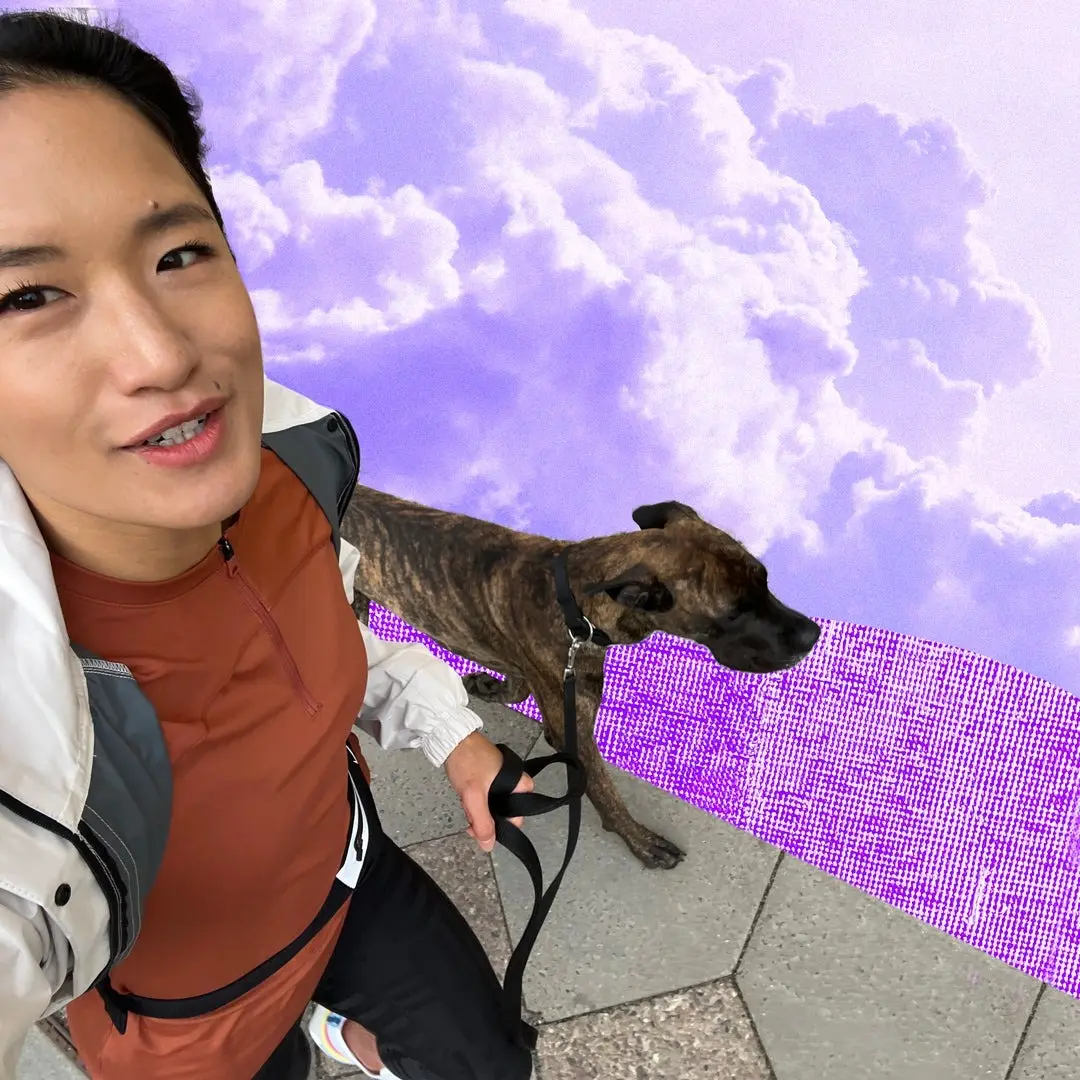
For Monday’s aerobic session, Hong also enlists canine company, borrowing a friend’s dog, Mia. High-energy and endlessly enthusiastic, Mia transforms a solitary training loop into an interactive dynamic. As Hong notes with a laugh, "At the beginning, she pulls me; at the end, I pull her. I might not be as fast as her, but when it comes to sheer endurance, I win."
Tuesday: The Architecture of Prevention (Cross-Training and Mobility)
High-mileage running without adequate cross-training is a direct ticket to the orthopedic clinic. Recognizing this, Hong dedicates Tuesdays entirely away from the asphalt. Her training philosophy views running as only one piece of a much larger kinetic puzzle.
Tuesday’s agenda consists of targeted strength training to fortify joints and tendons against the repetitive impact of marathon mileage, complemented by dynamic yoga sessions and regular physiotherapy appointments. This holistic triad—strength, mobility, and recovery—forms the structural foundation that allows Hong to safely push her comfort zone later in the week. By investing in injury prevention on Tuesday, she ensures her body remains resilient, eliminating the debilitating post-run burnout that sidelines so many amateur athletes.
Wednesday: Global Horizons and Active Recovery
As a flight attendant, Hong’s professional life is defined by constant transit across time zones and continents. Consequently, when she touches down in Berlin, her social capital and personal relationships demand as much intentional cultivation as her physical stamina.
Wednesday serves as a structured recovery day, purposefully devoid of running shoes. Instead, Hong channels her energy into her social life and cultural curiosity. Bouncing between local art exhibitions and catching up with friends over coffee, she treats mental stimulation and emotional connection as vital components of her overall wellness ecosystem. In endurance sports, overtraining is an invisible predator; Hong’s Wednesday routine acts as a psychological buffer, ensuring her mind stays as fresh as her legs.
Thursday: Pushing the Limits on the Track
If Monday is about rhythm and Monday blues, Thursday is about raw, unfiltered athletic development. This is the day Hong steps onto the running track for her high-intensity interval workouts—a critical stimulus for marathon preparation.
Despite her affinity for comfort, Hong possesses a competitive streak. "I love competitions. It gives me an incredible amount of joy to challenge myself," she explains. Thursday’s track session is designed to test velocity thresholds and lactate clearance: how fast can she run, and how long can she maintain that pace under physiological duress?
Footwear plays a pivotal role here. During these high-stress sessions, Hong relies on the Nike Invincible 3. Offering a heavily cushioned, highly responsive "bouncy" foam architecture, the shoe provides a secure platform across various track surfaces while absorbing the high-impact forces inherent to speed work. The result is a shoe that supports aggressive training without sacrificing the underfoot comfort Hong demands.
Friday: The Art of the Decompression
Coming off Thursday’s punishing track session, Friday is designated as a sanctuary for systemic recovery. Aside from a gentle restorative yoga flow to flush out metabolic waste from the muscles, Hong keeps the physical demands low.
She uses the day to further immerse herself in Berlin’s vibrant cultural landscape, visiting galleries and museums with friends. For an international traveler who spends days at 35,000 feet, planting roots in the city through shared cultural experiences is grounding. It reinforces the core philosophy of her training model: life must be lived around running, not entirely consumed by it.
Saturday: The Ritualistic Long Loop and Urban Observation
Saturday morning marks a sacred Berlin ritual: the long, meditative run along the Landwehrkanal. This route offers a dynamic sensory tapestry, alternating between hard asphalt, soft grass, and unpredictable patches of mud.
For Hong, this run is as much about mental de-escalation as it is about cardiovascular conditioning. With an engaging podcast playing in her ears—or sometimes complete silence, allowing her to absorb the ambient noises of the waking city—she slips into a flow state.
"I love watching the people around me as I run. After the loop, I reward myself with a coffee and a small snack at the market stall in Kreuzberg."
This post-run reward is not viewed as a "cheat" or an unearned indulgence, but rather as an essential psychological milestone that closes the training loop with positive reinforcement.
Sunday: Community, Mileage, and Dumplings
Sunday is the crown jewel of Hong’s training week: the long-distance endurance run executed in concert with her running community, the Joy Run Collective.
Long runs are notoriously daunting when tackled in isolation, but collective suffering and shared pacing transform them into communal celebrations. Because Sunday’s route through the Tiergarten involves extended time on feet—often in bracing, unpredictable Berlin weather—preparation is key. Hong meticulously layers up, packs nutrition, and leans on the collective energy of the pack.
The true incentive, however, waits at the finish line. Following the completion of the long-haul mileage, the collective gathers for a communal brunch. This week’s host has prepared handmade dumplings—a culinary reward Hong admits she has been anticipating since Tuesday.
Supporting Context & Metrics: The Physiology of Sustainable Endurance
Hong’s trajectory from a self-proclaimed "non-runner" to a veteran of seven marathons highlights a broader shift in endurance sports science and consumer culture. For decades, the narrative surrounding marathon training was dominated by a "no pain, no gain" ethos that often alienated beginners and led to high rates of overuse injuries.
The Shift Toward Holistic Longevity
Contemporary sports medicine increasingly validates Hong’s intuitive approach. Research published in endurance physiology journals emphasizes that parasympathetic recovery—incorporating adequate sleep, active mobility, and nutritional anticipation—is just as critical to mitochondrial adaptation as the stress stimulus of the run itself.
- Injury Mitigation Statistics: Studies tracking amateur marathon runners indicate that up to 50% experience an overuse injury annually, most commonly involving the patellofemoral joint, Achilles tendon, or plantar fascia. Hong’s inclusion of dedicated strength training and physiotherapy on Tuesdays directly targets these vulnerability points, stabilizing core and hip musculature to offset kinetic imbalances.
- The Psychology of Consistency: Behavioral psychology underlines the importance of intrinsic motivation and positive reinforcement—such as Hong’s post-run coffee and weekend dumplings. When exercise is paired with immediate, pleasurable rewards rather than austere deprivation, long-term adherence rates spike significantly.
Equipment as an Enabler of Comfort
Hong’s insistence on footwear technology—specifically selecting high-energy-return shoes like the Nike Invincible 3 for heavy track days—underscores how modern gear engineering protects the runner. Maximally cushioned shoes reduce peak tibial shock loads, allowing athletes to log higher weekly mileage with reduced cumulative skeletal fatigue.
Official Statements and Personal Philosophy
Reflecting on her four-year evolution in the sport, Hong offers a perspective that resonates far beyond the running community. Now in her early thirties, she finds herself operating at a physical and mental peak.
"I started running four years ago. At 30, I am healthier and fitter than I ever was in my twenties. But running is so much more than physical training. As a runner, I’ve gained immense self-confidence because I now know how hard I can push myself, even when I feel a bit low."
This sentiment encapsulates the transformative power of endurance sports when approached with self-compassion. Far too often, fitness culture weaponizes guilt to drive performance. Hong’s narrative inverts this dynamic, proving that comfort and ambition are not binary opposites, but complementary forces.
"I’ve learned a vital lesson: consistency and comfort do not have to exclude one another. I can set new boundaries for myself and feel entirely comfortable while doing it. Next stop: my 7th marathon."
Future Outlook: The Next Horizon
As Hong finalizes her preparations for her seventh marathon, her journey serves as a timely case study for the future of urban athletics. The modern endurance athlete is no longer willing to sacrifice lifestyle, mental health, or professional identity on the altar of a finishing time.
Instead, the future belongs to the "hybrid athlete"—individuals who design their lives symmetrically, balancing high-output physical goals with creative careers, social ecosystems, and unapologetic self-care. Whether she is navigating international time zones as a flight attendant, sketching new graphic design layouts in her Berlin studio, or harmonizing down the Landwehrkanal with a quiet hum, Hong has cracked the code of sustainable performance.
For those looking to replicate her success, Hong distills her methodology into three simple, golden rules for on-the-run happiness:
- Invest in Equipment That Works for You: Prioritize comfortable, supportive footwear that mitigates impact and protects your joints across varied urban terrain.
- Curate Your Soundtrack: Build a dynamic playlist (disco, house, techno) to serve as a psychological safety net when motivation wanes.
- Plan the Destination, Not Just the Route: Combine scenic, engaging paths with intentional post-run rewards—whether that is a specialty coffee in Kreuzberg or a table full of homemade dumplings with your community.
As Hong laces up for her next long run through the crisp air of the Tiergarten, one thing is certain: the journey to 42.195 kilometers has never looked so comfortable.