Executive Overview
In the rapidly evolving landscape of commercial spaceflight, speed and scale are often the metrics that dominate headlines. When SpaceX launched Starship 40 from its Starbase facility in South Texas on July 24, the vehicle executed an astonishing display of velocity. Traversing thousands of miles from the Gulf of Mexico to the remote expanse of the Indian Ocean in roughly 65 minutes, the massive spacecraft underscored the immense potential of point-to-point suborbital travel. Yet, while the outbound journey was measured in minutes, the return trip home is an exercise in maritime endurance. SpaceX has confirmed that bringing the salvaged upper-stage rocket back to its Lone Star State birthplace will take several months.
What makes Starship 40’s voyage home uniquely captivating is not just its leisurely pace, but the very fact that it has a home to return to. During previous flight tests, SpaceX’s towering upper stages met their end at the bottom of the sea, intentionally sacrificed to the pressures of atmospheric reentry and ocean impact. Starship 40, however, defied expectations. While it is certainly in no structural condition to fly again, the 171-foot-tall upper stage survived its water impact largely intact.
This unexpected stroke of fortune has gifted SpaceX engineers a priceless engineering artifact: a physical test article that endured the crucible of a hypersonic descent, rather than a collection of scattered debris or inferred telemetry data. The ensuing recovery operation—spanning remote South Pacific island chains, specialized heavy-lift semi-submersible vessels, and global shipping lanes—reads less like a routine aerospace logistics task and more like an epic marine salvage expedition. As SpaceX marches steadily toward its ultimate ambition of a fully reusable launch system featuring propulsive tower catches, the post-splashdown odyssey of Starship 40 provides a rare, tangible window into the grueling physical realities of interplanetary-class rocket design.
Detailed Chronology: From Launch Pad to Ocean Floor
The Launch and Suborbital Sprint
The story of Starship 40 began on a late July morning at SpaceX’s sprawling Starbase facility in Boca Chica, South Texas. The mission profile for this specific flight test was multifaceted. Beyond testing the general flight dynamics of the integrated Starship vehicle, the primary mechanical objective was to evaluate the upper stage’s payload deployment architecture.
During its frantic 65-minute suborbital arc, the spacecraft successfully deployed 20 next-generation Starlink V3 satellites into space. However, this deployment was not part of an operational commercial constellation expansion. The satellites were sent on a brief, transient trajectory designed specifically to test the payload deployment system under actual flight conditions. Approximately 20 minutes after separation, the unpowered Starlink units reentered the Earth’s atmosphere and safely burned up, fulfilling the mission’s planned parameters.
With the deployment phase concluded, Starship 40 transitioned into the high-stakes terminal phase of its flight: atmospheric reentry. Traveling at hypersonic speeds, the upper stage slammed into the upper atmosphere, its thermal protection system subjected to extreme plasma friction and blistering temperatures. Previous vehicles had suffered significant structural compromises during this phase, but Starship 40 held together. Descending through the cloud cover over the designated target zone in the Indian Ocean, the vehicle executed a controlled terminal orientation and successfully executed a vertical splashdown, coming to rest on the ocean surface in remarkably solid condition.
The 24-Day Ocean Sojourn
While the splashdown was a monumental success, it marked the beginning of a logistical gauntlet. The physical location of the splashdown—thousands of miles away from any major SpaceX infrastructure—meant that recovery efforts could not begin immediately. For 24 days, Starship 40 drifted and bobbed in the remote swells of the Indian Ocean, tethered or monitored remotely as SpaceX coordinated its maritime response team.
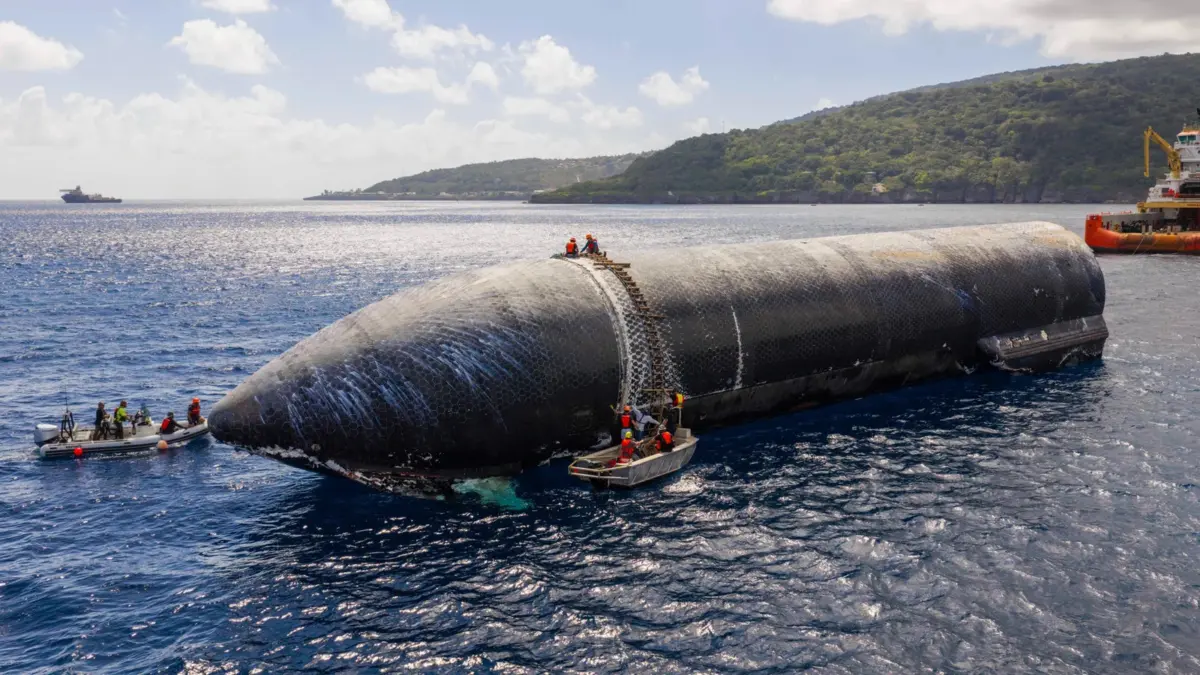
During this 24-day period at sea, the salt water and relentless wave action battered the already heat-stressed exterior of the vehicle. Yet, the hull integrity remained sound enough for the next phase of the operation to proceed. SpaceX’s recovery assets, anchored by the nearly 300-foot-long offshore tug Normand Ranger, reached the splashdown site and secured the spacecraft. From there, the Normand Ranger meticulously towed the 171-foot behemoth across hundreds of miles of open ocean toward the relative shelter of Christmas Island, an Australian external territory situated south of Indonesia.
The Submersible Lift Operation
The arrival at Christmas Island set the stage for one of the most delicate maritime maneuvers ever attempted for an aerospace vehicle. Transferring a multi-ton, 171-foot steel rocket from open ocean tugs onto a transatlantic transport vessel requires precise engineering and steady sea conditions.
At Christmas Island, the Normand Ranger handed over its precious cargo to a massive, 710-foot-long heavy-lift transport ship known as the Forte. The transfer process utilized the specialized capabilities of the Forte, a vessel designed for moving oversized, unwieldy industrial cargo.
- Ballast Adjustment: The crew of the Forte maneuvered the ship into position and flooded its internal ballast tanks, causing the vessel to list and submerge its expansive cargo deck directly beneath the ocean’s surface.
- Alignment: Working in coordination with surface teams, the recovery crew gently guided the floating Starship 40 directly over a custom-built cradle mounted on the submerged deck of the Forte.
- The Lift: Once the rocket was precisely aligned within the cradle supports, the Forte began pumping the ballast water out of its tanks. As the ship gradually emptied its tanks, its buoyancy took over, slowly lifting the massive cargo deck—and the rocket resting upon it—out of the water and into the air.
While lifting a rocket out of the ocean in this manner is a first for the space industry, shipping experts emphasize that the underlying methodology is well-established. Maritime historian and shipping expert Sal Mercogliano noted the routine nature of the operation for heavy-lift vessels. "Ships like Forte do this every day," Mercogliano explained in his broadcast analysis. "This is a very common occurrence in the shipping industry, whether it’s large objects like this, barges, cranes, ships—you name it."
Supporting Context & Metrics
To truly comprehend the magnitude of Starship 40’s journey, one must examine the physical scale of the hardware and the geographic scope of the voyage.
Dimensional and Logistical Metrics
- Vehicle Height: Starship 40 stands at an impressive 171 feet (approximately 52 meters) for its upper stage alone.
- Flight Duration: The initial outbound rocket flight covered thousands of miles from Texas to the Indian Ocean in just 65 minutes.
- Drift Period: The spacecraft spent 24 days drifting or being held stationary in the Indian Ocean prior to the arrival of formal heavy-lift recovery assets.
- Tug Vessel Size: The Normand Ranger, which handled the initial open-ocean tow, measures nearly 300 feet in length.
- Transport Vessel Size: The Forte, the heavy-lift ship tasked with carrying the rocket back across oceans, spans an enormous 710 feet.
- Projected Return Timeline: The total return transit is slated to take several months, with current shipping telemetry indicating a projected arrival at the Port of Brownsville, Texas, around October 8.
The Engineering Value of a Recovered Hull
In aerospace development, telemetry is king, but physical artifact analysis is the ultimate validator. Prior to the successful recovery of Starship 40, SpaceX engineers had to rely on digital data streams, onboard camera feeds, and microscopic fragments of debris washed ashore to understand how their thermal protection systems and structural welds behaved during reentry.
By securing an intact, flown upper stage, SpaceX has bypassed months of guesswork. Even before the ship docked at Christmas Island, preliminary field operations allowed engineering teams to harvest crucial heat-shield tile samples directly from the hull. These physical samples provide ground-truth data on how the newly formulated materials withstood the intense thermal shock of Mach-25 atmospheric compression.
Official Statements & Industry Perspectives
SpaceX has maintained its characteristic methodical approach regarding the operation, balancing transparency with proprietary operational security. Through official channels, the company acknowledged the profound value of the retrieved hardware.
Following the initial extraction milestones, SpaceX released statements emphasizing the diagnostic windfall provided by the mission. Engineers studying the retrieved heat-shield tiles and structural joints have already gained what the company formally termed "vital insight" into the thermal mechanics of the upper stage. This feedback loop is considered the lifeblood of the Starship program, where rapid iteration cycles depend on real-world failure analysis (or, in this case, unexpected survival analysis).
External analysts have echoed the significance of the event. While critics of commercial space programs often point to the environmental and logistical complexities of ocean splashdowns, maritime and aerospace authorities view the operation as a masterclass in cross-sector logistics.
Sal Mercogliano’s evaluation highlights how the commercial space sector is increasingly intersecting with traditional heavy industry. "The ability to leverage standard, globally available heavy-lift shipping architecture to solve bespoke aerospace recovery problems demonstrates a high level of operational maturity," Mercogliano noted. Instead of building custom recovery fleets from scratch for every contingency, SpaceX’s utilization of commercial heavy-lift titans like the Forte illustrates a pragmatic integration of existing maritime capabilities to support avant-garde rocket development.
Future Outlook: Toward Full Reusability
The ultimate destination for Starship 40 is not a permanent museum exhibit, nor is it another launch pad. Once the Forte completes its transoceanic voyage—potentially navigating around the notoriously treacherous Cape of Good Hope before heading across the Atlantic and into the Gulf of Mexico—the rocket will arrive at the Port of Brownsville. From there, it will be transported back to SpaceX’s Starbase facility for exhaustive metallurgical, structural, and thermal autopsy.
Every bolt, seam, and surviving tile on Starship 40 will be subjected to non-destructive testing, microscopic analysis, and stress evaluations. The insights gleaned from this physical examination will directly influence the design iterations of subsequent Starship generations currently sitting on the factory floor in Texas.
However, ocean recoveries via heavy-lift ships and multi-month maritime detours are intended to be transitional phases rather than permanent fixtures of the SpaceX operational playbook. The ultimate vision for the Starship system is absolute, aircraft-like operational cadence.
SpaceX’s long-term engineering roadmap aims to eliminate ocean splashdowns entirely for the upper stage. The company is actively scaling its infrastructure to enable both the Super Heavy booster and the Starship upper stage to return directly to their launch and integration sites at Starbase, Texas. This vision relies on the dramatic "catch" mechanism—using the mechanical chopsticks of the massive launch tower to pluck returning vehicles out of the air mid-descent.
Until tower catches for upper stages become routine reality across all flight profiles, however, the oceans will remain a secondary testing ground. Starship 40’s epic, multi-month odyssey from the skies of the Indian Ocean, across remote island chains, and back to the Gulf of Mexico stands as a testament to the tenacity of modern aerospace engineering—proving that even when a rocket’s flight ends in the water, the journey to the stars is only just beginning.