Executive Overview
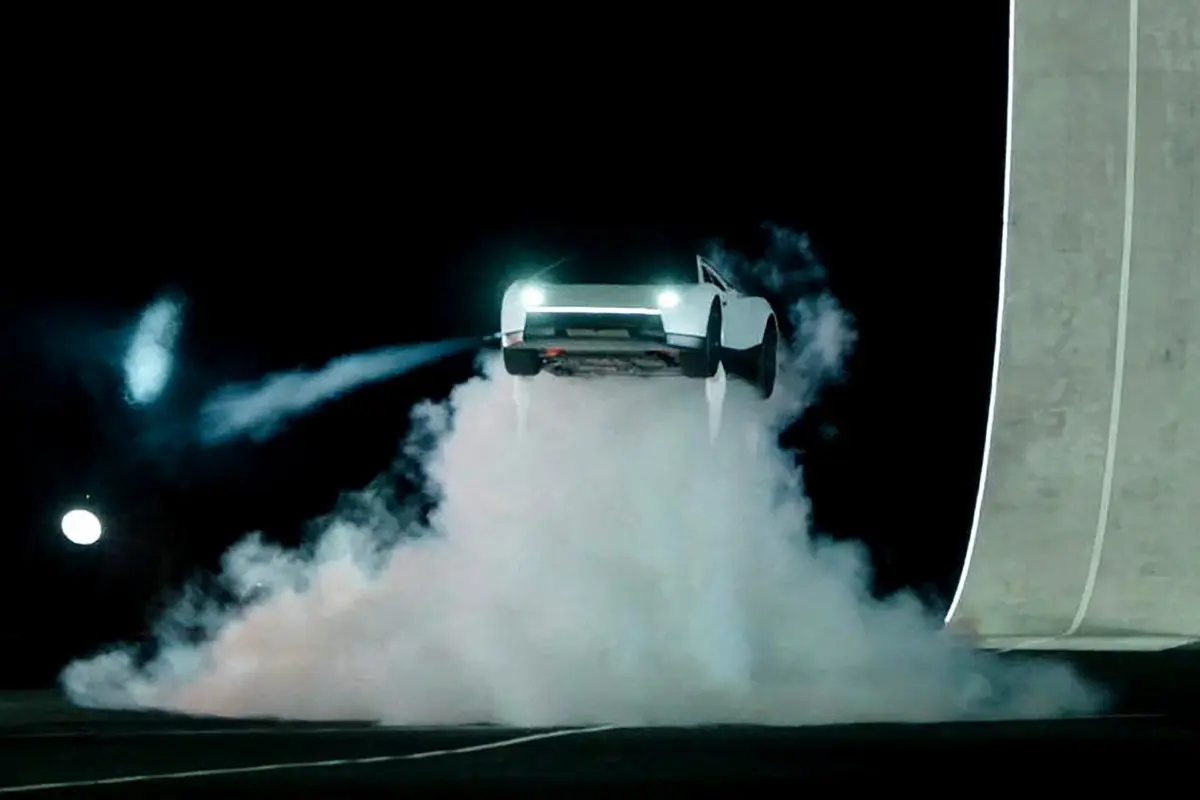
In the sprawling landscape of modern technology and automotive history, few spectacles match the theatricality of an Elon Musk product launch. On a brisk Thursday evening in Texas, the billionaire entrepreneur took to the stage to pull back the curtain on a machine that seemed to leap straight out of science fiction: the long-delayed, highly anticipated new Tesla Roadster. Boasting performance specs that defy conventional physics—including a 0-to-60 mph acceleration time of 0.8 seconds and a design language fusing a 1970s Lotus Esprit with an SR-71 Blackbird spy plane—the vehicle’s marquee feature was its ability to briefly elevate off the ground using SpaceX-derived cold gas thrusters.
Yet, beneath the roaring crowds, the compressed-air pyrotechnics, and the viral livestream clips lies a much deeper corporate strategy. The "flying car" is not merely a nostalgic callback or a high-performance luxury toy for the ultra-wealthy. It is a calculated distraction and a profound signaling mechanism.
Industry analysts and financial experts are increasingly realizing that this high-octane showcase marks the sunsetting of Tesla as we know it: an independent, publicly traded electric vehicle manufacturer. Instead, the dazzling display of SpaceX rocket science integrated into an automotive chassis serves as the ideological and operational prelude to the mother of all corporate combinations: a megamerger between Tesla and SpaceX.
As Tesla pivots away from traditional vehicle production toward autonomous robotaxis and humanoid robotics, the company’s financial realities demand a radical restructuring. By folding Tesla into the private-public aerospace juggernaut that is SpaceX, Musk can leverage unparalleled capital-raising mechanics, shore up softening automotive profit margins, and fund his grand ambitions of artificial intelligence dominance, orbital data centers, and multi-planetary colonization.
Detailed Chronology: From the Texas Spectacle to the Vision of Tomorrow
The evening’s events in Texas were meticulously choreographed to evoke maximum wonder. A gigantic, C-shaped ramp dominated the testing ground. The new Roadster ascended the apex of the curve, utilizing an advanced downforce-generating fan system to remain miraculously stuck upside down before breaking free, executing a controlled flip, and touching down amid a billowing cloud of compressed air. To cap off the demonstration, the vehicle vaulted over a neat row of parked Tesla sedans, incorporating an additional roll mid-air.
While breathtaking, the stunt is part of a storied tradition of Musk-led PR maneuvers. It immediately recalls the unforgettable 2018 stunt when Musk’s original cherry-red Roadster was launched into the cosmos atop a SpaceX Falcon Heavy rocket—a vehicle that continues its silent, lonely solar orbit to this day, occasionally drifting near a Mars trajectory.
However, the subtext of the Texas gathering was far more consequential than a simple car stunt. Musk explicitly stated that the new Roadster will be the very last manually drivable vehicle the company ever designs and builds. This declaration serves as a definitive turning point for Tesla’s corporate trajectory.
The future, according to Musk, belongs entirely to the Cybercab—a radical, driverless vehicle devoid of steering wheels or pedals designed to populate a vast, on-demand robotaxi fleet. Hand in hand with the Cybercab is Optimus, Tesla’s humanoid robot. Musk has publicly floated staggering valuations, claiming Optimus will single-handedly push Tesla’s market capitalization from its current $1.4 trillion plateau to an astronomical $25 trillion. Priced at roughly $30,000 per unit, these robots are envisioned to eradicate human drudgery: assembling Cybercabs, mowing lawns, tending bars, caring for the aging population, and ultimately serving as foundational labor units for the colonization of the moon and Mars.
The timeline for these consumer-facing "rocket" trims, however, stretches the limits of buyer credulity. Much like the original 2017 Roadster announcement—which saw devoted fans plunk down $50,000 reservations ($250,000 for the elite Founder Series)—Tesla is once again opening its order books. The company has structured the new Roadster into tiers: a $50,000 "Performance" trim, a $250,000 "Thrust" variant, and an opaque, invite-only "Rocket" version equipped with the aforementioned flight capabilities. Deliveries, conveniently, are not slated to begin until 2028. In the world of Musk-driven timelines, the traditional caveat emptor remains the golden rule.
Supporting Context & Metrics: The Shifting Sands of Tesla’s Balance Sheet
To understand why Musk is so eager to redirect public attention toward space-age stunts and futuristic robots, one must examine the hard financial realities of Tesla’s core business model.
By all standard metrics of automotive manufacturing, Tesla remains a colossus. In 2025 alone, the company delivered more than 1.6 million manually driven vehicles, generating approximately $95 billion in revenue, driven primarily by automotive sales alongside burgeoning solar and energy storage sectors. For decades, Tesla shouldered the monumental burden of proving to a skeptical global market that electric vehicles were not a passing fad, ultimately capturing a dominant share of the global EV market.
Yet, despite these massive gross revenue figures, the ground is shifting beneath Tesla’s feet:
- Shrinking Margins: Profit margins are actively compressing as price wars intensify globally.
- Stagnant Lineup: Tesla has not introduced an all-new, non-flying consumer vehicle since the rollout of the Cybertruck in 2019.
- Product Retirements: Production of the higher-priced Model S sedan and Model X SUV has quietly wound down, leaving the Model 3 sedan and Model Y crossover to shoulder the entirety of the automotive division’s weight.
- Global Headwinds: Intense competition from aggressively priced Chinese EV manufacturers has eroded market share—particularly in Europe, where political controversies and Musk’s alignment with right-wing movements have directly impacted regional sales.
- Regulatory and Tax Shifts: Government regulatory credits, which historically padded Tesla’s balance sheets to the tune of billions of dollars, are fading, while the rollback of federal consumer tax credits has cooled the broader U.S. electric vehicle market.
Faced with these structural headwinds, Musk has swiftly recognized that selling millions of moderately priced consumer EVs is a low-margin, high-stress business. Traditional automotive executives understood this reality decades ago, which is why they continually expand into high-margin segments like large SUVs and premium light trucks. Musk, however, views traditional car manufacturing merely as a bootstrapping phase—a grueling means to an end. The automotive enterprise provided the capital, global supply chains, and manufacturing expertise required to build the foundation for a future where a Cybercab rolls off an assembly line every 10 seconds and armies of Optimus robots march out of industrial bays.
Official Statements & Industry Analysis: The Mechanics of a $3.5 Trillion Megamerger
The convergence of Tesla and SpaceX is no longer whispered about strictly in internet forums; it is treated by institutional Wall Street analysts as an increasingly probable corporate restructuring.
Barclays analyst Dan Levy recently captured industry sentiment by suggesting that a Tesla-SpaceX tie-up is "almost a done deal." Under the prevailing mechanics of such a transaction, SpaceX would act as the acquiring entity, allowing current Tesla investors to swap their public shares for equity in SpaceX. The resulting combined mega-corporation would command an unprecedented market valuation estimated at roughly $3.5 trillion.
The strategic rationale for this union centers entirely on capital mobilization and technological cross-pollination. Converting Tesla’s vast manufacturing footprint from consumer cars to autonomous Cybercabs and humanoid robots requires staggering capital expenditures. Furthermore, Tesla finds itself locked in an existential, capital-intensive artificial intelligence arms race with deep-pocketed competitors like Anthropic and OpenAI, requiring massive investments in data-center construction.
Herein lies the true brilliance of incorporating SpaceX technology into the Tesla narrative. SpaceX possesses an unmatched ability to continually raise astronomical sums from public and private capital markets with minimal regulatory friction regarding consumer safety recalls or automotive unions. More futuristic still is the looming prospect—discussed in internal speculative circles—of SpaceX utilizing its heavy-lift launch capabilities to deploy solar-powered data centers directly into Earth’s orbit, harvesting infinite, unobstructed solar energy to power Tesla’s massive A.I. training workloads.
Future Outlook: The Rise of the Galactic Mega-Entity
As the smoke clears from the Texas Roadster unveiling, the implications for the future of transportation and corporate conglomeration become stark.
For everyday consumers and long-term investors who bankrolled Tesla through its turbulent adolescence, the transition represents a bitter-sweet milestone. They funded a green-energy revolution that fundamentally transformed global transit, only to watch the traditional car company dissolve into an interplanetary, artificial intelligence, and robotics conglomerate.
The Roadster event was, above all, a masterclass in deflection and a nostalgic throwback to the carnival-barker showmanship that built the Tesla mystique. The integration of cold-gas thrusters was a direct technological descendant of the Falcon 9 booster rockets that routinely execute precision propulsive landings on ocean droneships or get caught by mechanical launch towers.
Saying goodbye to Tesla as an independent car company may feel abrupt, but it is entirely aligned with Elon Musk’s ultimate worldview. The terrestrial automobile was never the final destination; it was merely the booster stage used to launch a much larger, more ambitious vision into the cosmos. As Tesla fades into the architecture of SpaceX, the resulting entity promises to redefine corporate scale, pushing past mere automotive manufacturing into the realm of speculative science fiction—leaving corporate monopolies of cinematic lore looking modest by comparison.