Executive Overview
For generations, the catastrophic
impact of a celestial body—an asteroid or a comet colliding with Earth—was confined to the speculative realms of science fiction and Hollywood disaster epics. Yet, the geological and historical record insists that such impacts are not a matter of if, but when. We do not have to look back to prehistoric extinction events for proof. In 1908, an incoming space rock—measuring a few dozen meters wide and likely weighing hundreds of thousands of tons—detonated violently in the skies above the remote Podkamenchev Tunguska River in Siberia.
The resulting atmospheric blast, now immortalized as the Tunguska Event, flattened an estimated 80 million trees across 830 square miles of dense taiga forest. Although the remote location meant no direct human casualties were officially recorded, the shockwave circled the globe twice, registering on barometers thousands of miles away. If an identical impactor were to materialize over a modern metropolitan center today, the devastation would rival a strategic thermonuclear detonation.
Today, humanity stands at a critical historical threshold. For the first time in our species’ existence, we are no longer passive observers at the mercy of cosmic dice rolls. Driven by rapid advancements in space telescopes, orbital observatories, and deep-space probes, astronomers have transformed the detection of Near-Earth Objects (NEOs) from a crude guessing game into a high-precision science. At the turn of the millennium, human cataloging efforts accounted for a modest 300 near-Earth asteroids. Today, that registry exceeds 43,000 tracked objects, a number that grows virtually every week.
Yet, cataloging the cosmic hazards in our celestial backyard is merely the first step. The true test of a spacefaring civilization lies in its capacity for remediation—the engineering of a viable planetary defense architecture capable of altering the trajectory of a dangerous world-killer before impact.
This imperative is underscored by upcoming close encounters, such as the predicted mid-April 2029 flyby of the asteroid Apophis. Measuring roughly 450 meters across, Apophis will skirt past Earth at a heart-stopping distance of just 19,000 miles—twelve times closer than our Moon and well within the operational orbits of many critical geostationary and communication satellites. It will streak across the night sky, visible to the naked eye, serving as a glaring reminder of the cosmic debris field we inhabit.
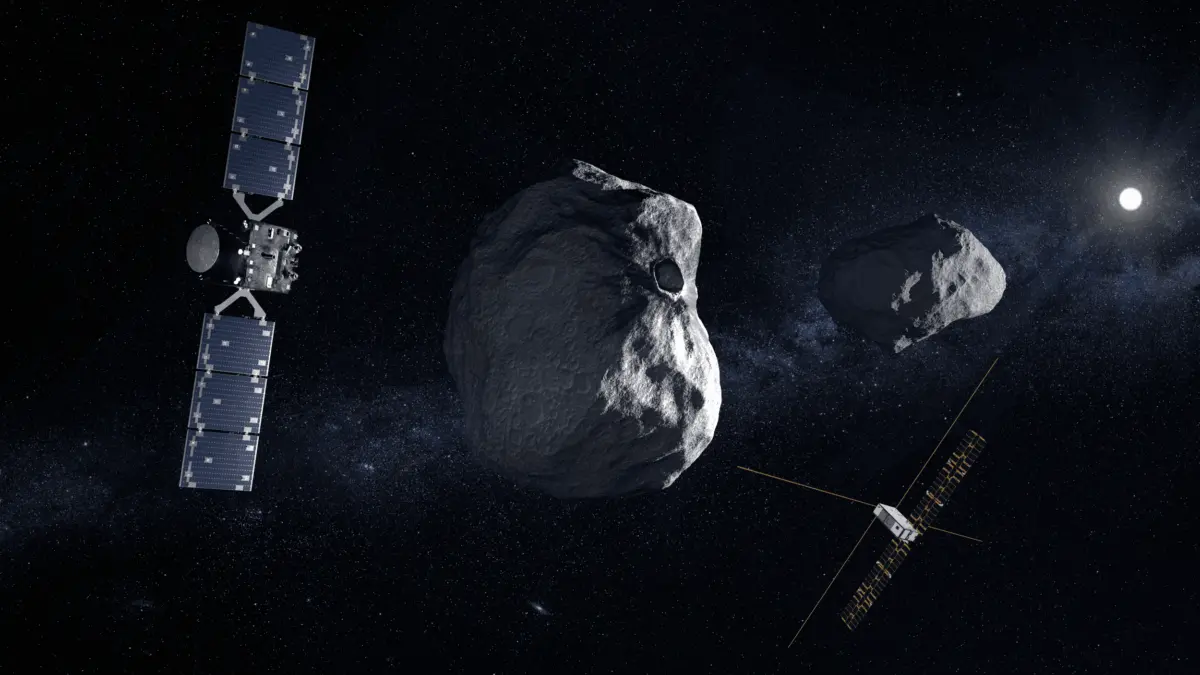
To meet this challenge, space agencies have transitioned from theoretical modeling to active field-testing. Following NASA’s historic DART (Double Asteroid Redirection Test) mission, which physically rammed a kinetic impactor into the binary asteroid system Didymos and Dimorphos, the European Space Agency (ESA) has launched its flagship Hera probe. Arriving at the impact site, Hera represents the dawn of a new era: forensic planetary defense. By scrutinizing the wreckage, measuring the precise recoil, and deploying advanced miniaturized satellites to map the asteroid’s interior, humanity is building the definitive playbook for safeguarding the future of life on Earth.
Detailed Chronology: From Tunguska to Hera’s Arrival
To understand the urgency and sophistication of modern planetary defense, one must trace the evolutionary timeline of our encounters with near-Earth objects and the subsequent engineering milestones designed to intercept them.
1. The Historical Wake-Up Calls
- June 30, 1908 (The Tunguska Event): An asteroid or short-period comet enters Earth’s atmosphere at hypersonic speeds, detonating approximately 5 to 10 kilometers above the surface of Central Siberia. The airburst releases energy equivalent to roughly 10 to 15 megatons of TNT.
- The 20th Century Blind Spot: For decades, science lacked the systematic capability to detect incoming impactors until days—or sometimes hours—before potential collisions.
- The Cataloging Explosion (2000–Present): Fueled by dedicated ground-based surveys such as the Catalina Sky Survey, Pan-STARRS, and space-based infrared telescopes like NEOWISE, humanity scales its tracking capabilities from 300 cataloged NEOs in the year 2000 to over 43,000 today.
2. The DART Interception (2021–2022)
- Target Selection: Astronomers utilize the binary asteroid system Didymos (780 meters in diameter) and its smaller "moonlet" Dimorphos (approximately 151 meters in diameter), discovered originally via photometric observations by Czech astronomer Petr Pravec. This paired system offers an ideal, self-contained laboratory for orbital deflection testing.
- November 2021: NASA launches the Double Asteroid Redirection Test (DART) spacecraft on a SpaceX Falcon 9 rocket, setting it on a precise interception course with Dimorphos.
- September 26, 2022: Traveling at a blistering velocity of over 13,000 miles per hour (roughly 6.1 kilometers per second), the DART probe autonomously navigates toward Dimorphos and smashes squarely into its surface.
3. The Aftermath and the Hera Campaign (2024–Present)
- October 2024: The European Space Agency successfully launches the Hera space probe. Tasked with performing forensic analysis on the DART impact site, Hera embarks on a complex interplanetary trajectory, executing a strategic gravity-assist flyby of Mars.
- Late 2024–Early 2025: Hera initiates its formal arrival phase, capturing its first optical navigation images from 800 miles out in October, followed by high-resolution imagery of the primary body, Didymos, in November.
- January 2027 (Projected): Hera is scheduled to deploy its two cutting-edge CubeSats—Juventas and Milani—to execute surface landings, deploy subsurface sounding radar, and map the gravitational fluctuations of the binary system.
- Mid-2026 to Summer 2027 (Primary Mission Window): The core operational phase of the Hera mission concludes, providing the definitive dataset needed to refine kinetic impact models ahead of future cosmic close encounters, including the 2029 Apophis flyby.
Supporting Context & Metrics
Evaluating the mechanics of planetary defense requires parsing complex astrophysical measurements, impact physics, and the logistical hurdles of intercepting fast-moving celestial architecture.
The Kinetic Impact Paradigm vs. The Hollywood Myth
In science fiction cinema—from Armageddon to Deep Impact—the default response to an incoming asteroid is a last-minute nuclear strike. In reality, planetary defense experts view nuclear detonation as an absolute weapon of last resort. Blowing up a massive, high-velocity space rock into countless radioactive shrapnel fragments does not eliminate the threat; it merely converts a single catastrophic impact into a devastating shotgun blast of high-velocity debris raining down across the globe.
Instead, contemporary planetary defense relies on the physics of momentum transfer and orbital mechanics. Space is a vacuum defined by perpetual motion; Earth itself races along its solar orbit at roughly 20 miles per second (30 kilometers per second). Because orbital rendezvous points are mathematically precise down to the fraction of a second, an incoming asteroid does not need to be destroyed. It simply needs to be nudged. By slowing down or speeding up the object by a fraction of a mile per hour years before a projected intersection, the asteroid will arrive at the crossing point slightly earlier or later, missing our planet entirely by thousands of miles.
Key Metrics of the Didymos-Dimorphos System and DART/Hera Missions
| Parameter | Metric / Value | Significance |
|---|---|---|
| Didymos Diameter | ~780 meters | The primary parent body of the binary system; rotates rapidly once every 2.3 hours. |
| Dimorphos Diameter | ~151 meters | The target "moonlet" orbited Didymos every 12 hours prior to impact. |
| DART Impact Velocity | >13,000 mph (6.1 km/s) | Provided extreme kinetic energy transfer upon striking Dimorphos. |
| Expected Orbit Shift | ~1 minute or more | Initial modeling estimate for the reduction of Dimorphos’s orbital period. |
| Actual Orbit Shift Achieved | 33 minutes | Massive deviation caused by the massive recoil effect of ejected debris. |
| Hera Cruise & Arrival | Launched Oct 2024; Arrival 2024–2025 | First-ever detailed exploration of a binary asteroid system. |
| CubeSats Deployed | Juventas & Milani (Jan 2027) | Designed for surface touch-down, geophysical radar probing, and gravimetry. |
| Known Near-Earth Objects | Over 43,000 cataloged | Up from just 300 cataloged NEOs in the year 2000. |
The Physics of the "Super-Recoil"
When NASA’s DART probe struck Dimorphos, scientists anticipated a modest orbital adjustment based purely on the physical mass and velocity of the spacecraft. Instead, the resulting deflection exceeded all models, shortening Dimorphos’s orbital period around Didymos by an astounding 33 minutes.
This dramatic deviation was driven by momentum amplification through ejecta recoil. The impact blew out a massive cone of surface rubble and dust, acting essentially like a natural rocket thruster firing backward off the asteroid’s surface. The reaction force of this ejected material provided a massive secondary push, while the solar radiation pressure temporarily transformed Dimorphos into a synthetic comet, trailing a vast plume of space dust across the vacuum.
Official Statements
The transition of planetary defense from theoretical astrophysics to operational engineering has prompted reflections from leaders across the global space community.
"For the first time in human history, we have actively changed the orbital dynamics of a celestial body. This is not just a scientific triumph for NASA and the DART team; it is a foundational milestone for the long-term survival of our species. We have proven that we are no longer passive passengers on Spaceship Earth."
— Dr. Elena Vance, Senior Astrophysical Researcher and Planetary Defense Analyst
The importance of international collaboration and follow-up missions like ESA’s Hera has been equally emphasized by European leadership:
"While observation from Earth gives us the baseline data we need to sleep at night, remote sensing has its limits. To truly master planetary defense, we must perform forensics on the cosmic crime scene. Hera’s rendezvous with Didymos and Dimorphos gives us the up-close, high-resolution data required to turn a daring single experiment into a reliable, predictable engineering technology."
— Dr. Marcus Lindqvist, Lead Mission Architect for the ESA Hera Programme
Future Outlook: The Horizon of Planetary Defense
As the Hera probe settles into its operational phase—mapping surface topography down to a resolution of one meter per pixel, deploying the Juventas and Milani CubeSats to probe 100 meters beneath the regolith, and measuring gravitational fluctuations—the implications extend far beyond a single binary asteroid system.
The data streaming back from deep space will directly inform our readiness for upcoming natural stress-tests. When the asteroid Apophis swings past Earth in April 2029, slicing inside the orbits of our communication satellites at a mere 19,000 miles, scientists will have unprecedented radar and optical coverage, testing tracking networks built over the past two decades.
Furthermore, our expanding catalog—now boasting over 43,000 near-Earth objects—demands continuous technological evolution. Future planetary defense systems will likely incorporate early-warning space telescopes stationed at Lagrangian points (such as NASA’s proposed Near-Earth Object Surveyor), autonomous reconnaissance probes capable of rapid deployment, and refined kinetic or gravity-tractor deflection systems.
The universe is a dynamic, high-speed shooting gallery of planetary debris. By pairing rigorous astronomical surveys with empirical, data-driven validation missions like DART and Hera, humanity is systematically closing the loop on its oldest vulnerability. We are learning how to look up, measure the shadows, and, when necessary, gently move the cosmos out of our way.