Executive Overview
In the world of enterprise software, few markets move as deliberately as property and casualty (P&C) insurance. For over two decades, Guidewire has anchored this cautious sector, supplying the foundational core systems—policy, billing, and claims—that keep major insurers running. Founded in 2001, Guidewire operates in an industry where digital transformation is historically measured in years, not quarters. Yet, despite catering to some of the slowest-moving buyers in B2B software, Guidewire finds itself at the bleeding edge of enterprise evolution.
In a macroeconomic climate where the market has systematically repriced any asset bearing the smell of "legacy software," Guidewire continues to trade at a steady multiple of roughly 10x Annual Recurring Revenue (ARR). But beneath this seemingly traditional valuation lies a company undergoing a radical transformation. Having spent the better part of a decade accepting slower reported top-line revenue to migrate its massive customer base from on-premise infrastructure to the cloud, Guidewire is now aggressively pivoting toward artificial intelligence.
The turning point arrived on October 27 at the CONNECTIONS conference in Las Vegas, where Guidewire announced a definitive agreement to acquire hyperexponential (hx) for a base purchase price of $1.7 billion in cash, augmented by up to $400 million in contingent consideration. In doing so, a public company whose core systems are frequently priced as legacy software paid a premium valuation multiple to capture best-in-class AI underwriting capabilities.
This deep-dive analysis examines Guidewire’s fiscal 2026 performance, its massive $1.7 billion AI acquisition, the strategic mechanics of its multi-year cloud transition, and the delicate balancing act between aggressive share repurchases and balance sheet leverage.
Detailed Chronology & Financial Performance
Fiscal 2026: Closing the Books on a Transformational Year
Guidewire closed its fiscal 2026 on July 31, delivering a financial report that underscored the ongoing mechanics of its cloud transition. Total revenue for the fiscal year reached $1,475.4 million, representing a 23% year-over-year increase. However, a closer look at the revenue mix reveals the intentional friction of Guidewire’s business model evolution: subscription and support revenue surged by 33%, while traditional license revenue contracted by 7%.
This divergence is not a sign of weakness, but rather the desired outcome of a multi-year strategy. By intentionally transitioning customers from upfront-recognized term licenses to ratably-recognized cloud subscriptions, Guidewire has systematically traded near-term reported revenue for long-term recurring predictability.
Key metrics from the fiscal year underscore this operational strength:
- Annual Recurring Revenue (ARR): Reached $1,237 million at current exchange rates, up 19% in constant currency.
- Fully Ramped ARR: Landed at $1,573 million, reflecting a robust 22% constant-currency growth rate.
- Retention and Cash Flow: According to the company’s Chief Financial Officer, ARR gross attrition hit its lowest level since Guidewire began tracking the metric. Meanwhile, the operating cash flow margin expanded to a healthy 26%, generating $389.7 million in operating cash flow for the year.
The Q4 Earnings Reaction and Valuation Reality
Despite beating consensus expectations across every major line in the fourth quarter—posting adjusted earnings per share of $0.99 on $411.08 million in revenue, versus forecasts of $0.93 and $402.73 million, respectively—Guidewire’s stock experienced a sharp pullback. Following guidance that fell slightly below aggressive consensus estimates, shares slid 15% in after-hours trading and eventually hovered near $140.09 by early September, before recovering somewhat to close at $168.86 on October 16, yielding a market capitalization of approximately $13.85 billion. Adjusting for $1,215.3 million in cash and investments against roughly $704 million in debt, the enterprise value settled near $13.3 billion.
This valuation compression highlights a profound disconnect between the high-growth software market and traditional enterprise vendors. According to Sapphire’s 2026 Software x AI report, public software companies growing at 25% or more command an average enterprise value-to-next-twelve-months (NTM) revenue multiple of 8.3x. Guidewire, guiding for revenue growth of roughly 16% for fiscal 2027, is priced almost precisely in line with broader public market benchmarks, despite boasting SaaS-like retention and mission-critical stickiness.
Supporting Context & Metrics
The $336 Million Signed Backlog: Fully Ramped ARR
One of the most misunderstood mechanisms in Guidewire’s financial architecture is the distinction between reported ARR and fully ramped ARR. Guidewire defines fully ramped ARR as the annualized recurring value of active contracts, inclusive of every fixed price increase scheduled within the first five years of an agreement.
At the close of fiscal 2026, fully ramped ARR exceeded reported ARR by $336 million, establishing a staggering 27% cushion on the existing base. This gap widened significantly from $255 million a year prior. For enterprise software investors, this metric provides rare visibility into future growth. The fiscal 2027 constant-currency ARR guidance of 18% is not built on speculative pipeline generation; more than half of the net new ARR required to hit that target is already legally signed, with predefined ramp dates baked into long-term contracts.
Large enterprise insurers rarely swap core operational backbones overnight. They prefer to start small, prove out the implementation, and scale into the platform. While most software vendors offer initial discounts and hope to capture price increases at renewal, Guidewire codifies these step-ups directly into year-one contracts. This transforms future expansions into signed backlog on day one.
The Long March to the Cloud
Guidewire’s deliberate suppression of reported revenue in favor of cloud migration is best illustrated by its fourth-quarter results. Total revenue grew a modest 15% to $411.1 million, weighed down by an 18% drop in license revenue ($77.1 million) as term licenses gave way to cloud subscriptions. Management estimates that these ongoing migrations will trim fiscal 2027 license revenue by $46 million and support revenue by approximately $8 million.
The payoff for this multi-year sacrifice is now unmistakable:
- Cloud ARR Dominance: Total cloud ARR expanded by 35%, accounting for 84% of Guidewire’s total ARR base.
- Margin Expansion: Subscription and support gross margins reached 75% in the second quarter, up significantly from 69% in the prior-year period.
- Enterprise Validation: Guidewire closed 26 core cloud deals in Q4 alone, bringing its annual total to 62. The crown jewel of the period was Nationwide, which signed a multi-year agreement to migrate its entire InsuranceSuite estate to the Guidewire Cloud Platform.
Once an insurer’s primary system of record runs production workloads natively in the vendor’s cloud, the switching costs become insurmountable. Guidewire successfully traded several years of optical top-line growth to build an economic moat that legacy on-premise vendors can never breach.
Official Statements & Strategic Shifts: The Hyperexponential Acquisition
Buying AI Growth at 20x+ ARR
If Guidewire’s organic cloud transition represented a slow, methodical burn, its acquisition of hyperexponential (hx) is a lightning strike. Announced on October 27 at the CONNECTIONS conference, Guidewire agreed to acquire hx for a base purchase price of $1.7 billion in cash, plus up to $400 million in contingent consideration tied to specific recurring revenue milestones.
Headquartered in London, hyperexponential provides advanced, AI-powered underwriting and pricing software specifically tailored for commercial and specialty P&C insurers. Having previously served as an official Guidewire technology partner, hx was already deeply integrated into the ecosystem. However, rather than continuing a partnership model, Guidewire opted to bring the technology in-house.
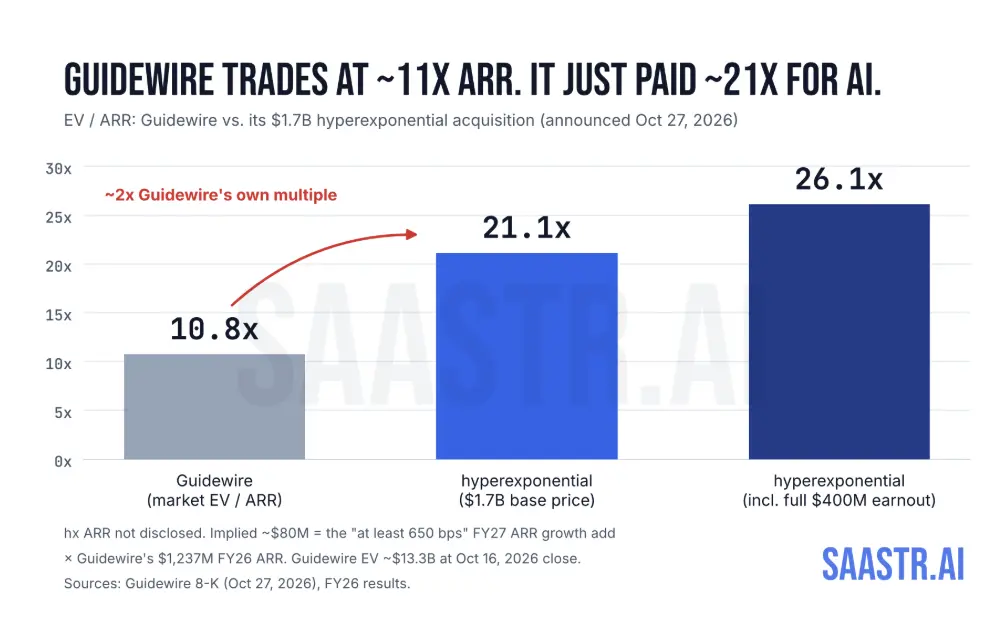
While management did not disclose hx’s exact standalone revenue, they provided a vital directional metric: the transaction is projected to add at least 650 basis points to fiscal 2027 ARR growth. Applied to Guidewire’s $1,237 million ARR base, 650 bps translates to roughly $80 million in acquired ARR.
This implies that Guidewire—a public company valued by the market at roughly 10x ARR—just paid upwards of 20x ARR for an AI-native asset in its own vertical. This transaction embodies the modern corporate playbook: when a legacy-priced public giant needs to accelerate its AI roadmap faster than internal research and development can deliver, it uses its balance sheet to buy market leadership.
Reversing Past Strategy and Remaking the Balance Sheet
The hx acquisition marks a notable pivot from statements made earlier in the year by CEO Mike Rosenbaum. Previously, management maintained that Guidewire would strictly own the core system of record while partnering with best-of-breed providers for ancillary AI applications. Furthermore, Guidewire already maintains its own pricing solution—PricingCenter—which performed admirably with 12 closed deals in fiscal 2026, beating internal forecasts.
Yet, as complex commercial and specialty risk markets demand increasingly sophisticated pricing models, leadership concluded that building an agentic underwriting engine from scratch would take too long. Rosenbaum framed the acquisition as an absolute commitment to leading the industry-wide transformation toward agentic underwriting across every segment of commercial insurance.
To fund this massive transaction, Guidewire is fundamentally altering its capital structure. The company plans to finance the deal using existing cash reserves alongside $1 billion in new term loans orchestrated by Bank of America and Citibank. Guidewire concluded fiscal 2026 with $1,215.3 million in cash and short-term investments, even after deploying a staggering $606.3 million toward share buybacks during the year.
Following the closing of the hx deal, Guidewire’s cash reserves will drop to roughly $500 million, while total debt will surge from approximately $704 million to roughly $1.7 billion. Over a compressed 15-month window, Guidewire will have committed roughly $2.3 billion to combined share buybacks and acquisitions—a bold deployment of capital against an annual operating cash flow of $389.7 million.
Future Outlook & Strategic Horizon
Reshaping ARR and AI Product Monetization
The addition of hyperexponential fundamentally alters Guidewire’s medium-term financial trajectory. Organic fiscal 2027 ARR growth was initially guided at a steady 18% in constant currency. With hx integrated, reported ARR growth is expected to climb toward the mid-20% range.
Management plans to provide updated guidance during its December 2026 earnings call, where it will explicitly separate organic growth from acquired inorganic contributions. Market analysts will watch this distinction closely, as the valuation multiple Guidewire commands will ultimately anchor to its underlying organic performance.
Beyond hx, Guidewire’s broader AI strategy is already bearing fruit. In August, the company rolled out the Quasar release, featuring an Agentic Framework designed to let insurers build, deploy, and manage custom AI agents natively on the platform. Standalone AI-driven products are also outperforming sales expectations:
- ProNavigator: Acquired in October 2025 to bolster knowledge management for claims and underwriting, ProNavigator notched 14 wins in Q4 and 28 for the full fiscal year.
- PricingCenter: Closed 8 deals in Q4, bringing its annual total to 12.
Guidewire is also deploying AI inward to solve its own operational bottlenecks. Over the next six months, the company is rolling out AI-powered project harnesses to every implementation partner. By reducing the complexity and duration of core system implementations—historically the primary friction point in converting signed software contracts into live, revenue-generating deployments—Guidewire aims to pull ARR realization forward. Pleasingly for investors, management confirmed that the integration of AI capabilities has not lengthened core sales cycles.
Capital Allocation and the Road Ahead
Guidewire’s aggressive capital allocation strategy in fiscal 2026—where it repurchased 4,085,350 shares at an average price of $148.41, totaling $606.3 million (representing 156% of its operating cash flow)—demonstrates a management team acutely aware of its stock price disconnect. By exhausting nearly its entire buyback authorization while loading up on term debt for a transformative $1.7 billion acquisition, Guidewire is placing a high-conviction bet on its future.
For an enterprise software titan generating $1.2 billion in ARR with elite gross retention, premium-indexed pricing, and an expanding cloud monopoly, trading at 10x ARR may look remarkably cheap to strategic acquirers and long-term investors alike. As the hyperexponential integration takes hold and the company separates organic momentum from acquired AI growth in December 2026, Guidewire is positioning itself not merely as a defender of legacy P&C systems, but as the undisputed operating system for the autonomous insurance enterprise of the future.