Executive Overview
In the rapidly evolving landscape of artificial intelligence and machine learning, modern cloud-native applications face a persistent performance bottleneck: the tension between hyper-targeted data scoping and global similarity search recall. Whether powering multi-tenant retrieval-augmented generation (RAG) pipelines, autonomous AI agents scouring individualized user documents, or massive enterprise support knowledge bases, software architectures frequently demand that vector searches operate exclusively within rigidly defined boundaries—such as specific user accounts, regulatory domains, tenants, or chronological windows.
Historically, executing these filtered queries posed significant engineering compromises. Vector search engines often evaluated similarity indices and metadata constraints concurrently (a legacy approach termed "post-filtering" or "tandem evaluation"), frequently resulting in depleted recall rates. If a user or tenant accounted for a small fraction of a massive vector index, traditional engines struggled to surface the most relevant matches, forcing developers to compromise between search accuracy and strict data isolation.
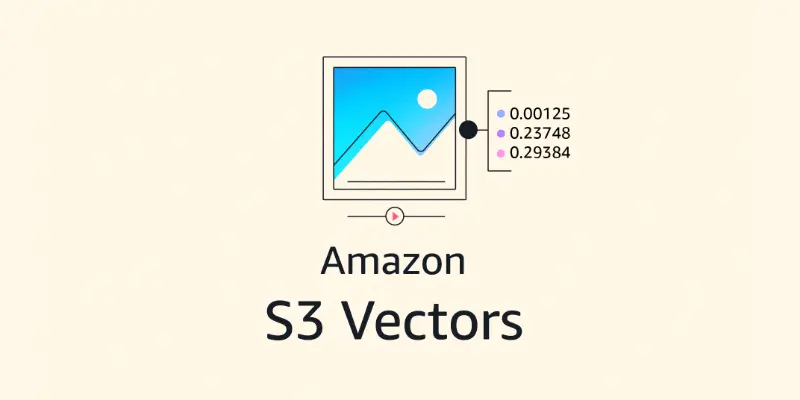
Addressing this critical infrastructure challenge head-on, Amazon Web Services (AWS) has announced the official launch of metadata pre-filtering for Amazon S3 Vectors. Authored by Daniel Abib, this architectural enhancement fundamentally reimagines query execution order. By evaluating application-defined metadata filters before initiating the vector similarity search, the enhanced framework guarantees that computational cycles are directed exclusively toward the subset of vectors that matter.
The update introduces robust prefix-matching capabilities via the $startsWith operator for complex hierarchical paths, URLs, and document identifiers. Furthermore, it supports up to 2 KB of filterable metadata per vector and up to 100 filter constraints per individual query. Crucially, AWS has rolled out this capability with zero friction: it introduces no additional financial costs, demands no costly data re-ingestion pipelines, and requires no structural modifications to existing client query syntax. Available immediately across all commercial AWS regions where Amazon S3 Vectors is operational—including AWS China regions—this release marks a definitive leap forward in scalable, high-recall vector search engineering.
Detailed Chronology & Technical Mechanics
The integration of metadata pre-filtering into Amazon S3 Vectors represents a meticulously engineered architectural progression designed to solve real-world data isolation and relevance challenges. To fully appreciate the significance of this update, it is essential to trace how vector indexes operate under the hood, examine the operational differences between legacy and modern index modes, and evaluate the step-by-step workflow required to implement the new features.
The Mechanics of Index Modes: CLASSIC vs. ENHANCED
At the core of the Amazon S3 Vectors architecture lies the concept of the index mode, which dictates how metadata filters intersect with high-dimensional vector math.
-
The Legacy Approach (
CLASSICMode):
Prior to the introduction of pre-filtering, S3 Vectors indexes operated in what AWS designates asCLASSICmode. In this configuration, the engine executed the vector similarity search and the metadata filter evaluation in tandem. As the search algorithm traversed the index to identify the nearest neighbors based on distance metrics (such as cosine similarity), it validated each candidate vector against the specified metadata filter on the fly.While effective for broad queries, this approach faltered when applied to highly selective filters. For instance, if an enterprise application queried an 8-million-document support ticket index for a single customer accounting for only 400 tickets, the tandem evaluation drew candidate vectors from the entire corpus of 8 million. Consequently, the final result set often missed critical, highly relevant matches belonging to that specific customer because the vector search space was diluted by millions of irrelevant records. Existing S3 Vectors indexes continue to default to
CLASSICmode until explicitly upgraded by administrators, ensuring backward compatibility. -
The Modern Paradigm (
ENHANCEDMode):
When an index is configured in—or updated to—ENHANCEDmode, the processing pipeline is inverted. S3 Vectors resolves the metadata filter first, narrowing the operational search space exclusively to the vectors that satisfy all specified conditions. Once this filtered subset is established, the similarity search executes entirely within that precise boundary.Revisiting the support knowledge base scenario: when searching across 8 million tickets for a specific customer’s 400 historical entries, resolving the
customer_idfilter first ensures that the similarity search engine evaluates all 400 candidate vectors. The agent is thus guaranteed to surface the customer’s prior error occurrences with maximum possible recall. According to AWS telemetry, this pre-filtering methodology yields up to 5x more matching vectors on highly selective queries compared to legacyCLASSICexecution.
Step-by-Step Implementation Walkthrough
Implementing metadata pre-filtering within a modern AWS ecosystem follows a clean, three-step pattern mirroring standard cloud-native application design. The following walkthrough illustrates how to build a product-catalog index, populate it with richly annotated vectors, and execute precise, multi-attribute filtered queries.
Step 1: Creating an Enhanced Vector Index
The foundational step involves provisioning a vector index using the AWS CLI. Developers must define the index name, target vector bucket, dimensional scale, and the mathematical distance metric aligned with their chosen embedding model.
aws s3vectors create-index
  --index-name product-catalog
  --vector-bucket-name my-vector-bucket
  --dimension 1536
  --distance-metric cosine
In this command, the --dimension parameter (1536) matches the standard output size of industry-standard embedding models like OpenAI’s text-embedding-ada-002 or text-embedding-3-large, while --distance-metric cosine aligns with how those models are mathematically trained for semantic text analysis.
Step 2: Ingesting Vectors with Rich Metadata
Once the index is provisioned, applications write vector embeddings using the PutVectors API. Each vector can carry up to 2 KB of application-defined metadata. Crucially, S3 Vectors treats every metadata field as filterable by default, eliminating the need to define a rigid schema upfront.
aws s3vectors put-vectors
  --index-name product-catalog
  --vector-bucket-name my-vector-bucket
  --vectors '[
    "key": "doc-001",
    "data": "float32": [0.1, 0.2, 0.3, ...],
    "metadata":
      "tenant_id": "t-10428",
      "category": "legal",
      "created_date": "2026-03-15",
      "active": true

  ]'
In this payload, tenant_id scopes data access to a single multi-tenant client, category narrows the classification space, created_date preserves temporal context, and active acts as a boolean state flag.
Step 3: Executing Filtered Similarity Queries
With data ingested, applications query the index using the QueryVectors API. The filtering grammar utilizes a compact JSON syntax where bare key-value pairs represent exact equality matches, complemented by logical operators such as $and, $or, and numeric boundaries.
aws s3vectors query-vectors
  --index-name product-catalog
  --vector-bucket-name my-vector-bucket
  --query-vector '"float32": [0.1, 0.2, 0.3, ...]'
  --top-k 50
  --return-metadata
  --filter '"$and": [
    "tenant_id": "t-10428",
    "category": "legal",
    "active": true
  ]'
The engine evaluates the $and filter criteria first, isolates the exact subset of vectors matching tenant_id, category, and active status, and subsequently returns the top 50 most mathematically similar vectors from that isolated subset.
Advanced Filtering with $startsWith
To accommodate complex enterprise document stores where folder hierarchies, URIs, and compound classifications are embedded directly into string identifiers, AWS has integrated the $startsWith prefix-matching operator.
--filter '"$startsWith": "document_id": "matter-4417/exhibits/"'This operator seamlessly integrates with existing filtering primitives—including equality checks, numeric ranges ($gt, $lt), set memberships, existence validations, and boolean logic—allowing developers to target subtrees within hierarchical keys in a single evaluation pass.
Upgrading Legacy Indexes
Migrating existing production environments from CLASSIC to ENHANCED mode is frictionless. Administrators execute a single update command via the AWS CLI:
aws s3vectors update-index-mode
  --vector-bucket-name my-vector-bucket
  --index-name product-catalog
  --index-mode ENHANCED
This modification applies entirely in-place. It requires zero data re-ingestion, preserves existing application query code, and immediately activates pre-filtering optimization. To standardize configurations moving forward, engineering teams can configure bucket-level defaults:
aws s3vectors put-vector-bucket-default-index-mode
  --vector-bucket-name my-vector-bucket
  --default-index-mode ENHANCED
Supporting Context & Metrics
To understand why metadata pre-filtering represents a paradigm shift for cloud architects, one must examine the empirical data surrounding vector recall degradation in multi-tenant and highly scoped environments.
In traditional vector database implementations, when a query is accompanied by a restrictive metadata filter (e.g., retrieving documents belonging to a specific enterprise client that comprise less than 0.01% of the total vector store), post-filtering algorithms frequently return suboptimal result sets. Because the approximate nearest neighbor (ANN) graph traversal is computed across the global index before filter application, the engine often exhausts its candidate pool (top-k) on irrelevant global vectors, discarding valid local matches.
AWS’s internal benchmark metrics demonstrate that switching an index to ENHANCED pre-filtering mode on highly selective queries yields up to a 5x increase in successfully returned matching vectors.
Comparative Query Behavior Analysis
Consider the practical output disparity on an identical index and query before and after enabling pre-filtering.
Before Pre-Filtering (CLASSIC Mode):
A tenant-scoped query requesting the top 10 matches:
aws s3vectors query-vectors
  --vector-bucket-name my-vector-bucket
  --index-name product-catalog
  --query-vector '"float32": [0.1, 0.2, 0.3, ...]'
  --top-k 10
  --return-metadata
  --filter '"tenant_id": "t-10428"'
Result: Returns only two qualifying vectors out of the ten requested, because the tandem search algorithm failed to surface the remaining tenant-specific matches buried within the broader index structure.
  "vectors": [
     "key": "doc-114", "distance": 0.41 ,
     "key": "doc-322", "distance": 0.55
  ],
  "distanceMetric": "cosine"
After Pre-Filtering (ENHANCED Mode):
Executing the exact same query post-upgrade:
  "vectors": [
     "key": "doc-018", "distance": 0.09 ,
     "key": "doc-207", "distance": 0.13 ,
     "key": "doc-114", "distance": 0.41 ,
    ... 7 more
  ],
  "distanceMetric": "cosine"
Result: The engine successfully delivers the full, requested complement of 10 highly relevant vectors drawn directly and exclusively from the target tenant’s document repository.
This performance delta directly impacts core AI workloads:
- Multi-Tenant RAG: Ensures absolute data isolation between corporate clients while maintaining sub-second vector retrieval speeds and maximum semantic relevance.
- Autonomous AI Agents: Empowers agentic architectures to search individual user files or restricted workspace directories without inadvertently hallucinating or leaking cross-user context.
- Compliance & Licensing: Streamlines legal and regulatory document discovery by instantly restricting searches to specific jurisdiction windows, security classifications, or active licensing periods.
Official Statements & Industry Impact
The release of metadata pre-filtering for Amazon S3 Vectors has drawn immediate praise from cloud architects, enterprise software developers, and database specialists across the global AWS community.
In his official launch announcement, AWS engineer and technical writer Daniel Abib emphasized the core design philosophy driving the feature:
"Most applications never search a whole index. They search the part of it that belongs to a particular user, account, or category, and they express that scope as a metadata filter. Semantic search, retrieval-augmented generation (RAG), and agentic applications all need the same thing from a filtered query: a similarity search that covers the vectors matching the filter, and returns the closest of them. With pre-filtering, a filtered query returns more of the relevant matches your index contains, giving you higher recall on filtered searches."
Industry analysts note that as enterprises rapidly transition from experimental generative AI pilots to mission-critical production deployments, data governance, tenancy isolation, and query precision have become non-negotiable requirements. By embedding advanced metadata filtering directly into the object storage infrastructure layer without imposing supplementary pricing tiers or requiring complex data migration scripts, AWS has significantly lowered the architectural barrier to building secure, enterprise-grade AI systems.
Furthermore, the integration of hierarchical prefix matching via $startsWith signals AWS’s deep understanding of real-world enterprise data structures. Organizations utilizing complex URI paths, nested project directories, and multi-tiered taxonomy schemas can now enforce fine-grained access control and precise search scoping without engineering cumbersome custom middleware layers.
Future Outlook & Conclusion
The introduction of metadata pre-filtering marks a watershed moment for Amazon S3 Vectors, bridging the historical divide between rigid structured database filtering and fluid, unstructured vector similarity search. By decoupling filter resolution from vector distance computation and prioritizing pre-evaluation on ENHANCED indexes, AWS has eliminated the recall penalties that long plagued multi-tenant and highly scoped AI architectures.
Looking forward, the roadmap for vector search on AWS points toward even tighter integration with generative AI orchestration frameworks, automated metadata tagging, and advanced graph-based relationship mapping. As agentic AI systems grow increasingly autonomous—requiring rapid, highly contextualized data access across millions of dynamic enterprise touchpoints—architectures that guarantee uncompromising recall alongside strict security scoping will form the bedrock of the next generation of software engineering.
For engineering teams currently operating RAG pipelines, customer support knowledge bases, or multi-tenant document repositories on AWS, the path forward is clear. By auditing existing vector bucket configurations, transitioning legacy CLASSIC indexes to ENHANCED mode, and leveraging the new $startsWith prefix-matching capabilities, organizations can immediately unlock up to 5x higher retrieval recall—all without altering application query logic or incurring additional infrastructure costs.
To begin implementing metadata pre-filtering today, developers can access the comprehensive Amazon S3 Vectors Documentation, review regional pricing and availability guidelines via the Amazon S3 Pricing Page, and engage with the engineering community through AWS re:Post for S3.