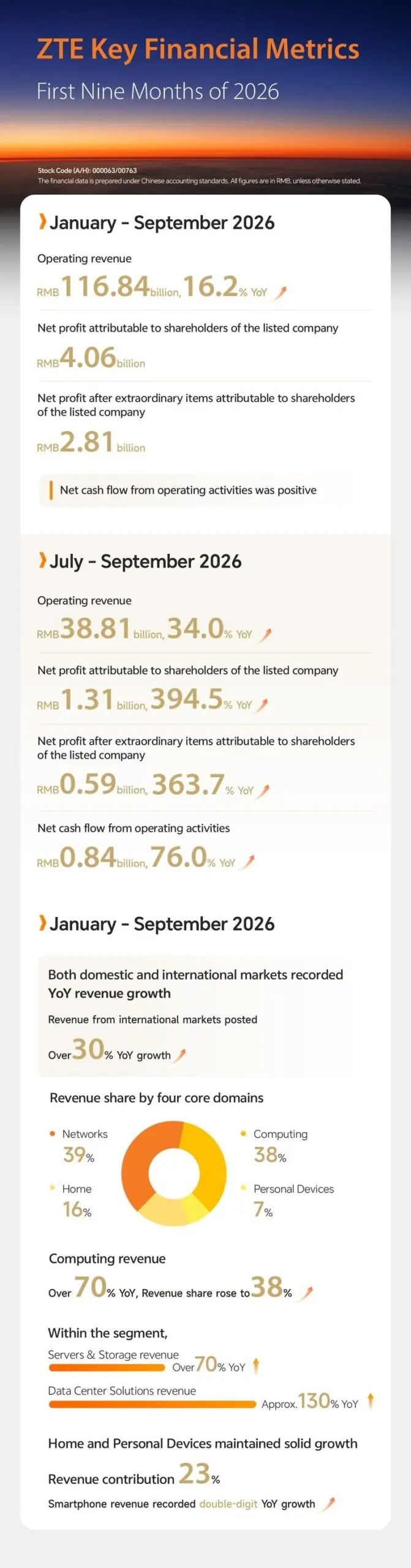
SHENZHEN, CHINA — October 26, 2026 — ZTE Corporation (0763.HK / 000063.SZ), a globally recognized leader in integrated information and communication technology (ICT) solutions, has announced its financial results for the first nine months of 2026. Demonstrating resilient financial fortitude despite shifting macroeconomic headwinds and changing domestic carrier capital expenditure cycles, the company reported a total operating revenue of RMB 116.84 billion, representing a robust 16.2% increase year-on-year.
The latest financial disclosure underscores ZTE’s successful pivoting toward high-growth technology vectors, anchored by its aggressive pursuit of Artificial Intelligence (AI) as an enterprise-wide strategic priority. Through the execution of its overarching "Connectivity + Computing" framework, the company has managed to structurally diversify its revenue streams, insulate itself against localized infrastructure downturns, and scale its presence internationally.
Executive Overview: A Transformative Quarter of AI-Driven Expansion
During the first three quarters of 2026, ZTE achieved critical operational milestones, balancing top-line expansion with prudent cost discipline. According to the company’s official financial announcement, the net profit attributable to shareholders of the listed company reached RMB 4.06 billion, while net profit after extraordinary items attributable to shareholders settled at RMB 2.81 billion. Operating activities continued to generate healthy liquidity, reflected by a positive net cash flow from operating activities.
The third quarter alone showcased accelerated momentum across all primary business segments. ZTE recorded a quarterly operating revenue of RMB 38.81 billion, marking a significant 34.0% surge compared to the same period in 2025. Profitability metrics experienced even sharper surges: net profit attributable to shareholders skyrocketed by 394.5% year-on-year to hit RMB 1.31 billion. Concurrently, net profit after extraordinary items attributable to shareholders rose 363.7% to RMB 0.59 billion, while net cash flow from operating activities jumped 76.0% year-on-year to total RMB 0.84 billion.
These impressive financial gains are the direct manifestation of ZTE’s strategic alignment with global digital transformation trends. As telecommunications operators scale back traditional network infrastructure spending, ZTE has successfully captured emerging global demand for AI computing clusters, high-speed fiber upgrades, 5G-Advanced architectures, and next-generation smart terminals.
Detailed Chronology and Segment Performance: The Engines of Growth
The first nine months of 2026 saw ZTE systematically execute its strategic blueprint across four primary operational pillars: Networks, Computing, Home Devices, and Personal Devices.
The Computing Business: Scaling New Heights
ZTE’s computing division emerged as the crown jewel of its 2026 fiscal performance, recording a phenomenal revenue increase of over 70% year-on-year. The computing segment now accounts for a substantial 38% of the company’s total revenue mix.
Within this vertical, dedicated servers and storage solutions surged by over 70% year-on-year, while data center solutions experienced explosive growth, climbing nearly 130% year-on-year. As enterprise AI adoption transitions from basic infrastructure training toward complex, high-volume inference applications, ZTE has positioned itself at the cutting edge of the market. Rather than competing purely on raw computing capacity, ZTE has focused on end-to-end token efficiency. By optimizing total cost of ownership (TCO) through advanced compute-network synergy and system-level orchestration, the company enables AI factories to deliver higher effective inference performance at a lower cost per token.
To support massive AI clusters spanning tens of thousands—and increasingly exceeding 100,000—accelerators, ZTE introduced innovative hardware architectures. The company’s flagship OEX SuperPod features an orthogonal, backplane-free interconnect architecture designed for multi-chip coordination. A single system accommodates up to 128 GPUs, while clusters scale elastically to the 100,000-GPU threshold. Furthermore, to address severe thermal and energy constraints in modern AI data centers (AIDCs), ZTE engineered an energy-efficient AIDC solution combining compute-power synergy with source-grid-load-storage integration, orchestrating computing, power, and thermal resources dynamically.
Networks and 6G Horizons
While computing serves as the primary growth accelerator, ZTE’s foundational Networks business continues to maintain global leadership across 5G, core networks, optical transport, and fixed broadband technologies. To meet the ultra-low latency and massive bandwidth demands of the AI era, ZTE is actively embedding intelligence directly into network architectures.
Looking toward the next decade, ZTE has positioned itself as an early pioneer in 6G commercialization. Guided by two strategic pillars—the deep integration of 6G with AI, and the convergence of space and terrestrial networks—the company leverages its end-to-end capabilities spanning standards, chipsets, architectures, and algorithms. ZTE has accumulated more than 5,000 core 6G patents, establishing an unshakeable long-term competitive moat.
Home and Personal Devices: Intelligent Ecosystems and AI Agents
ZTE’s Home and Personal Devices divisions demonstrated remarkable resilience and market penetration, collectively contributing 23% to the company’s total revenue, with robust growth recorded across both domestic and international fronts.
- Home Terminals: Operating under a three-pillar strategy—connectivity as the foundation, AI as the core, and screens as the interface—ZTE delivered an extensive portfolio of AI smart displays, AI set-top boxes, and IP cameras. For the second consecutive year, home terminal shipments exceeded 100 million units, cementing ZTE’s status as the world’s number-one market share leader for the fifth consecutive year. The company also captured the global top spot in Wi-Fi 7 product shipments, while cumulative shipments of its Fiber-to-the-Room (FTTR) products surpassed 40 million units.
- Personal Devices & AI Agents: ZTE is fundamentally reshaping the smartphone landscape through the commercialization of AI agent-powered devices. The debut of the nubia NaviX Ultra—recognized as the world’s first AI agent smartphone—represents a paradigm shift away from traditional app-by-app interactions toward automated, agent-assisted task execution under user authorization. Powered by the Doubao Mobile Assistant and backed by rigorous privacy protocols, the device pioneers a new consumer hardware category. Meanwhile, in international gaming markets, the nubia Neo 5 series (including the Neo 5 GT Special Edition and Neo 5 Max PadPhone) gained substantial traction across Southeast Asia and Latin America. In mobile internet, ZTE maintained its global crown in 5G FWA & MBB shipments for the fifth consecutive year.
Supporting Context & Metrics: Global Reach and Smart Manufacturing
ZTE’s revenue diversification was powerfully reinforced by its international expansion. International market revenue grew by over 30% year-on-year, propelled by accelerated 5G rollouts, fiber deployments, and rising overseas demand for Chinese technological ecosystems.
Simultaneously, ZTE has internalized its own technological innovations through its advanced "AI + Manufacturing" initiatives. Utilizing its five smart manufacturing benchmarks—most notably the Nanjing Binjiang Factory—the company has transitioned into the "Smart Binjiang" era. Powered by industrial large models and the Co-Claw enterprise-grade AI agent platform, over 80 specialized AI agents operate autonomously across end-to-end manufacturing and operational management. These agents handle sensing, data analysis, decision-making, and execution, earning ZTE prestigious accolades such as the 2026 Ram Charan Management Practice Award for AI Application Practice.
Externally, ZTE has packaged these industrial AI solutions, deploying intelligent transformation projects for over 60 leading enterprises across multiple vertical industries through more than 100 completed deployments.
Financial Health and Profitability Analysis
Despite gross margins remaining under industry-wide cyclical pressure due to ongoing shifts in business mix and hyper-competitive market dynamics, ZTE’s decisive cost controls yielded powerful bottom-line expansion.
The third-quarter net profit surge of nearly 400% demonstrates that the company’s strategic pivot toward high-value computing hardware, software optimization, and international market penetration is successfully bearing fruit. Furthermore, positive operating cash flow—bolstered by a 76% year-on-year increase in Q3 operating cash flow totaling RMB 0.84 billion—underscores the health of ZTE’s balance sheet and its ability to self-fund intensive research and development (R&D) initiatives without taking on undue financial leverage.
Future Outlook: Navigating the AI Era with Ecosystem Partners
As the global ICT landscape enters a critical juncture defined by the widespread deployment of AI inference and autonomous systems, ZTE remains steadfast in its strategic trajectory.
Moving forward, the company will continue to prioritize Artificial Intelligence as its primary corporate compass, doubling down on its "Connectivity + Computing" philosophy. By harnessing its comprehensive, end-to-end full-stack capabilities, ZTE aims to construct secure, reliable, and TCO-optimized digital infrastructure for global enterprises and telecommunications operators alike.
In an official statement addressing the road ahead, executive leadership emphasized the company’s commitment to open collaboration:
"Together with our global industry partners, ZTE will continue to foster an efficient, inclusive, and sustainable AI computing ecosystem. By unlocking the true economic and operational value of AI Tokens at scale, we aim to accelerate the intelligent transformation of traditional industries and support the high-quality, sustainable growth of the global digital economy."
As ZTE continues to bridge the physical and digital worlds through continuous technological innovation, its solid financial foundation and clear-sighted strategic vision position it uniquely at the forefront of the next industrial revolution.
About ZTE Corporation
ZTE connects the world with continuous innovation for a better future. The company provides innovative technologies and integrated solutions, spanning communication networks, computing infrastructure, industry digital solutions, and personal and home smart terminals. Serving approximately one-third of the world’s population, ZTE is dedicated to leading globally in connectivity and intelligent computing, enabling universal communication and trust. ZTE is publicly traded on both the Hong Kong and Shenzhen Stock Exchanges (H.K. 0763.HK, S.Z. 000063.SZ).
For more information, please visit www.zte.com.cn/global.
Media Inquiries:
ZTE Corporation Communications
Email: [email protected]